Selecionar segmento
Estude com questões de diferentes segmentos
Atenção: Isso limpará todos os campos já preenchidos no filtro!
Foram encontradas 47.784 questões
Resolva questões gratuitamente!
Junte-se a mais de 4 milhões de concurseiros!


Q2280158
Inglês
Texto associado
Leia o texto a seguir para responder a questão.
Read Your Way Through Salvador
By Itamar Vieira Junior and translated by Johnny Lorenz. July 19, 2023.
I was born in Salvador, in the Brazilian state of Bahia, and lived in the general vicinity until I
reached the age of 15. But it was when I left that I really came to know my city. How was I
able to discover more about my birthplace while traveling far from home? It might sound
rather clichéd but, I assure you, literature made this possible: It took me on a journey, long
and profound, back home, enveloping me in words and imagination.
To understand the formation of our unique society and, consequently, the cityscape of
Salvador, one should read, before anything else, “The Story of Rufino: Slavery, Freedom
and Islam in the Black Atlantic,” by João José Reis, Flávio dos Santos Gomes and Marcus
J.M. de Carvalho. Rufino was an alufá, or Muslim spiritual leader, born in the Oyo empire in
present-day Nigeria and enslaved during his adolescence. “The Story of Rufino” is an epic
tale, encapsulating the life of one man in search of freedom as well as the history of the
development of Salvador itself, a place inextricably linked with the diaspora across the Black
Atlantic. Another book for which I have deep affection is “The City of Women,” by the
American anthropologist Ruth Landes. It offers an intriguing perspective, focusing on
matriarchal power in candomblé, an Afro-Brazilian sacred practice, and revealing how the
social organization of its spiritual communities reverberates across the city.
If you want to feel the intensity of life on the streets of Salvador, these two books, both by
Amado, are indispensable: “Captains of the Sands” and “Dona Flor and Her Two
Husbands.” The first is a coming-of-age story in which we follow a group of children and
adolescents living on the streets and on the beaches around the Bay of All Saints. Written
more than 80 years ago, the book was banned and even burned in the public square during
the dictatorship of Getúlio Vargas in the first half of the 20th century. As a portrait of
Salvador, it is still relevant and reveals our deep inequalities. “Dona Flor and her Two
Husbands” is one of Amado’s most popular novels, translated into more than 30 languages
and adapted many times for theater, cinema, and television. The book is a kind of manifesto
for a woman’s liberation. Dona Flor possesses great culinary talent, and oppressed by a
patriarchal society, finds herself divided between two men, one being her deceased
husband. While the novel captures the daily life of the city in the 1940s, it is also a wonderful
guide to the cuisine of Salvador, with its African and Portuguese influences.
I invite readers to travel into the interior of Bahia, many hours by car from Salvador to the
region known as the Sertão, whose name translates loosely to “backwoods.” Two books can
also transport you there, and they are sides of the same story: “Backlands: The Canudos
Campaign,” by Euclides da Cunha, and “The War of the End of the World,” by Mario
Vargas Llosa.
“Backlands” is one of the most important works in the history of Brazilian literature. It is a
journalistic telling that introduces us not only to the brutal War of Canudos, but also to the
intriguing landscape of the Sertão, a place so full of contradictions. In his writing of the
conflict, da Cunha tells the story of the genesis of the tough sertanejo: a mythic,
cowboyesque figure of the drought-stricken, lawless interior. “The War of the End of the
World” is an essential epic that amplifies the narrative of “Backlands,” bringing a more imaginative, creative aspect to the story of Antônio Conselheiro, the spiritual leader of a
rebellion, and of the multitude that followed him to their deaths.
[Fonte: “Read Your Way Through Salvador”. In: The New York Times, 19/07/2023,<http://www.nytimes.com/2023/07/19/books/salvador-bahia-brazil-books.html> . Adaptado. Data
de acesso: 01/09/2023.]
No trecho do terceiro parágrafo “While the novel captures the daily life of the
city in the 1940s, it is also a wonderful guide to the cuisine of Salvador” o termo sublinhado
pode ser substituído, sem alteração de sentido, por:
Q2280157
Inglês
Texto associado
Leia o texto a seguir para responder a questão.
Read Your Way Through Salvador
By Itamar Vieira Junior and translated by Johnny Lorenz. July 19, 2023.
I was born in Salvador, in the Brazilian state of Bahia, and lived in the general vicinity until I
reached the age of 15. But it was when I left that I really came to know my city. How was I
able to discover more about my birthplace while traveling far from home? It might sound
rather clichéd but, I assure you, literature made this possible: It took me on a journey, long
and profound, back home, enveloping me in words and imagination.
To understand the formation of our unique society and, consequently, the cityscape of
Salvador, one should read, before anything else, “The Story of Rufino: Slavery, Freedom
and Islam in the Black Atlantic,” by João José Reis, Flávio dos Santos Gomes and Marcus
J.M. de Carvalho. Rufino was an alufá, or Muslim spiritual leader, born in the Oyo empire in
present-day Nigeria and enslaved during his adolescence. “The Story of Rufino” is an epic
tale, encapsulating the life of one man in search of freedom as well as the history of the
development of Salvador itself, a place inextricably linked with the diaspora across the Black
Atlantic. Another book for which I have deep affection is “The City of Women,” by the
American anthropologist Ruth Landes. It offers an intriguing perspective, focusing on
matriarchal power in candomblé, an Afro-Brazilian sacred practice, and revealing how the
social organization of its spiritual communities reverberates across the city.
If you want to feel the intensity of life on the streets of Salvador, these two books, both by
Amado, are indispensable: “Captains of the Sands” and “Dona Flor and Her Two
Husbands.” The first is a coming-of-age story in which we follow a group of children and
adolescents living on the streets and on the beaches around the Bay of All Saints. Written
more than 80 years ago, the book was banned and even burned in the public square during
the dictatorship of Getúlio Vargas in the first half of the 20th century. As a portrait of
Salvador, it is still relevant and reveals our deep inequalities. “Dona Flor and her Two
Husbands” is one of Amado’s most popular novels, translated into more than 30 languages
and adapted many times for theater, cinema, and television. The book is a kind of manifesto
for a woman’s liberation. Dona Flor possesses great culinary talent, and oppressed by a
patriarchal society, finds herself divided between two men, one being her deceased
husband. While the novel captures the daily life of the city in the 1940s, it is also a wonderful
guide to the cuisine of Salvador, with its African and Portuguese influences.
I invite readers to travel into the interior of Bahia, many hours by car from Salvador to the
region known as the Sertão, whose name translates loosely to “backwoods.” Two books can
also transport you there, and they are sides of the same story: “Backlands: The Canudos
Campaign,” by Euclides da Cunha, and “The War of the End of the World,” by Mario
Vargas Llosa.
“Backlands” is one of the most important works in the history of Brazilian literature. It is a
journalistic telling that introduces us not only to the brutal War of Canudos, but also to the
intriguing landscape of the Sertão, a place so full of contradictions. In his writing of the
conflict, da Cunha tells the story of the genesis of the tough sertanejo: a mythic,
cowboyesque figure of the drought-stricken, lawless interior. “The War of the End of the
World” is an essential epic that amplifies the narrative of “Backlands,” bringing a more imaginative, creative aspect to the story of Antônio Conselheiro, the spiritual leader of a
rebellion, and of the multitude that followed him to their deaths.
[Fonte: “Read Your Way Through Salvador”. In: The New York Times, 19/07/2023,<http://www.nytimes.com/2023/07/19/books/salvador-bahia-brazil-books.html> . Adaptado. Data
de acesso: 01/09/2023.]
No trecho do terceiro parágrafo “As a portrait of Salvador, it is still relevant and
reveals our deep inequalities”, o termo sublinhado contém um prefixo de negação. Assinale
a alternativa que apresenta o termo que NÃO contém prefixo de negação.
Q2280156
Inglês
Texto associado
Leia o texto a seguir para responder a questão.
Read Your Way Through Salvador
By Itamar Vieira Junior and translated by Johnny Lorenz. July 19, 2023.
I was born in Salvador, in the Brazilian state of Bahia, and lived in the general vicinity until I
reached the age of 15. But it was when I left that I really came to know my city. How was I
able to discover more about my birthplace while traveling far from home? It might sound
rather clichéd but, I assure you, literature made this possible: It took me on a journey, long
and profound, back home, enveloping me in words and imagination.
To understand the formation of our unique society and, consequently, the cityscape of
Salvador, one should read, before anything else, “The Story of Rufino: Slavery, Freedom
and Islam in the Black Atlantic,” by João José Reis, Flávio dos Santos Gomes and Marcus
J.M. de Carvalho. Rufino was an alufá, or Muslim spiritual leader, born in the Oyo empire in
present-day Nigeria and enslaved during his adolescence. “The Story of Rufino” is an epic
tale, encapsulating the life of one man in search of freedom as well as the history of the
development of Salvador itself, a place inextricably linked with the diaspora across the Black
Atlantic. Another book for which I have deep affection is “The City of Women,” by the
American anthropologist Ruth Landes. It offers an intriguing perspective, focusing on
matriarchal power in candomblé, an Afro-Brazilian sacred practice, and revealing how the
social organization of its spiritual communities reverberates across the city.
If you want to feel the intensity of life on the streets of Salvador, these two books, both by
Amado, are indispensable: “Captains of the Sands” and “Dona Flor and Her Two
Husbands.” The first is a coming-of-age story in which we follow a group of children and
adolescents living on the streets and on the beaches around the Bay of All Saints. Written
more than 80 years ago, the book was banned and even burned in the public square during
the dictatorship of Getúlio Vargas in the first half of the 20th century. As a portrait of
Salvador, it is still relevant and reveals our deep inequalities. “Dona Flor and her Two
Husbands” is one of Amado’s most popular novels, translated into more than 30 languages
and adapted many times for theater, cinema, and television. The book is a kind of manifesto
for a woman’s liberation. Dona Flor possesses great culinary talent, and oppressed by a
patriarchal society, finds herself divided between two men, one being her deceased
husband. While the novel captures the daily life of the city in the 1940s, it is also a wonderful
guide to the cuisine of Salvador, with its African and Portuguese influences.
I invite readers to travel into the interior of Bahia, many hours by car from Salvador to the
region known as the Sertão, whose name translates loosely to “backwoods.” Two books can
also transport you there, and they are sides of the same story: “Backlands: The Canudos
Campaign,” by Euclides da Cunha, and “The War of the End of the World,” by Mario
Vargas Llosa.
“Backlands” is one of the most important works in the history of Brazilian literature. It is a
journalistic telling that introduces us not only to the brutal War of Canudos, but also to the
intriguing landscape of the Sertão, a place so full of contradictions. In his writing of the
conflict, da Cunha tells the story of the genesis of the tough sertanejo: a mythic,
cowboyesque figure of the drought-stricken, lawless interior. “The War of the End of the
World” is an essential epic that amplifies the narrative of “Backlands,” bringing a more imaginative, creative aspect to the story of Antônio Conselheiro, the spiritual leader of a
rebellion, and of the multitude that followed him to their deaths.
[Fonte: “Read Your Way Through Salvador”. In: The New York Times, 19/07/2023,<http://www.nytimes.com/2023/07/19/books/salvador-bahia-brazil-books.html> . Adaptado. Data
de acesso: 01/09/2023.]
The two books that present same gender main characters around which the
action centers are:
Q2280155
Inglês
Texto associado
Leia o texto a seguir para responder a questão.
Read Your Way Through Salvador
By Itamar Vieira Junior and translated by Johnny Lorenz. July 19, 2023.
I was born in Salvador, in the Brazilian state of Bahia, and lived in the general vicinity until I
reached the age of 15. But it was when I left that I really came to know my city. How was I
able to discover more about my birthplace while traveling far from home? It might sound
rather clichéd but, I assure you, literature made this possible: It took me on a journey, long
and profound, back home, enveloping me in words and imagination.
To understand the formation of our unique society and, consequently, the cityscape of
Salvador, one should read, before anything else, “The Story of Rufino: Slavery, Freedom
and Islam in the Black Atlantic,” by João José Reis, Flávio dos Santos Gomes and Marcus
J.M. de Carvalho. Rufino was an alufá, or Muslim spiritual leader, born in the Oyo empire in
present-day Nigeria and enslaved during his adolescence. “The Story of Rufino” is an epic
tale, encapsulating the life of one man in search of freedom as well as the history of the
development of Salvador itself, a place inextricably linked with the diaspora across the Black
Atlantic. Another book for which I have deep affection is “The City of Women,” by the
American anthropologist Ruth Landes. It offers an intriguing perspective, focusing on
matriarchal power in candomblé, an Afro-Brazilian sacred practice, and revealing how the
social organization of its spiritual communities reverberates across the city.
If you want to feel the intensity of life on the streets of Salvador, these two books, both by
Amado, are indispensable: “Captains of the Sands” and “Dona Flor and Her Two
Husbands.” The first is a coming-of-age story in which we follow a group of children and
adolescents living on the streets and on the beaches around the Bay of All Saints. Written
more than 80 years ago, the book was banned and even burned in the public square during
the dictatorship of Getúlio Vargas in the first half of the 20th century. As a portrait of
Salvador, it is still relevant and reveals our deep inequalities. “Dona Flor and her Two
Husbands” is one of Amado’s most popular novels, translated into more than 30 languages
and adapted many times for theater, cinema, and television. The book is a kind of manifesto
for a woman’s liberation. Dona Flor possesses great culinary talent, and oppressed by a
patriarchal society, finds herself divided between two men, one being her deceased
husband. While the novel captures the daily life of the city in the 1940s, it is also a wonderful
guide to the cuisine of Salvador, with its African and Portuguese influences.
I invite readers to travel into the interior of Bahia, many hours by car from Salvador to the
region known as the Sertão, whose name translates loosely to “backwoods.” Two books can
also transport you there, and they are sides of the same story: “Backlands: The Canudos
Campaign,” by Euclides da Cunha, and “The War of the End of the World,” by Mario
Vargas Llosa.
“Backlands” is one of the most important works in the history of Brazilian literature. It is a
journalistic telling that introduces us not only to the brutal War of Canudos, but also to the
intriguing landscape of the Sertão, a place so full of contradictions. In his writing of the
conflict, da Cunha tells the story of the genesis of the tough sertanejo: a mythic,
cowboyesque figure of the drought-stricken, lawless interior. “The War of the End of the
World” is an essential epic that amplifies the narrative of “Backlands,” bringing a more imaginative, creative aspect to the story of Antônio Conselheiro, the spiritual leader of a
rebellion, and of the multitude that followed him to their deaths.
[Fonte: “Read Your Way Through Salvador”. In: The New York Times, 19/07/2023,<http://www.nytimes.com/2023/07/19/books/salvador-bahia-brazil-books.html> . Adaptado. Data
de acesso: 01/09/2023.]
According to the text, the author recommends the book “The Story of Rufino:
Slavery, Freedom and Islam in the Black Atlantic” for the reader to
Q2280154
Inglês
Texto associado
Leia o texto a seguir para responder a questão.
Read Your Way Through Salvador
By Itamar Vieira Junior and translated by Johnny Lorenz. July 19, 2023.
I was born in Salvador, in the Brazilian state of Bahia, and lived in the general vicinity until I
reached the age of 15. But it was when I left that I really came to know my city. How was I
able to discover more about my birthplace while traveling far from home? It might sound
rather clichéd but, I assure you, literature made this possible: It took me on a journey, long
and profound, back home, enveloping me in words and imagination.
To understand the formation of our unique society and, consequently, the cityscape of
Salvador, one should read, before anything else, “The Story of Rufino: Slavery, Freedom
and Islam in the Black Atlantic,” by João José Reis, Flávio dos Santos Gomes and Marcus
J.M. de Carvalho. Rufino was an alufá, or Muslim spiritual leader, born in the Oyo empire in
present-day Nigeria and enslaved during his adolescence. “The Story of Rufino” is an epic
tale, encapsulating the life of one man in search of freedom as well as the history of the
development of Salvador itself, a place inextricably linked with the diaspora across the Black
Atlantic. Another book for which I have deep affection is “The City of Women,” by the
American anthropologist Ruth Landes. It offers an intriguing perspective, focusing on
matriarchal power in candomblé, an Afro-Brazilian sacred practice, and revealing how the
social organization of its spiritual communities reverberates across the city.
If you want to feel the intensity of life on the streets of Salvador, these two books, both by
Amado, are indispensable: “Captains of the Sands” and “Dona Flor and Her Two
Husbands.” The first is a coming-of-age story in which we follow a group of children and
adolescents living on the streets and on the beaches around the Bay of All Saints. Written
more than 80 years ago, the book was banned and even burned in the public square during
the dictatorship of Getúlio Vargas in the first half of the 20th century. As a portrait of
Salvador, it is still relevant and reveals our deep inequalities. “Dona Flor and her Two
Husbands” is one of Amado’s most popular novels, translated into more than 30 languages
and adapted many times for theater, cinema, and television. The book is a kind of manifesto
for a woman’s liberation. Dona Flor possesses great culinary talent, and oppressed by a
patriarchal society, finds herself divided between two men, one being her deceased
husband. While the novel captures the daily life of the city in the 1940s, it is also a wonderful
guide to the cuisine of Salvador, with its African and Portuguese influences.
I invite readers to travel into the interior of Bahia, many hours by car from Salvador to the
region known as the Sertão, whose name translates loosely to “backwoods.” Two books can
also transport you there, and they are sides of the same story: “Backlands: The Canudos
Campaign,” by Euclides da Cunha, and “The War of the End of the World,” by Mario
Vargas Llosa.
“Backlands” is one of the most important works in the history of Brazilian literature. It is a
journalistic telling that introduces us not only to the brutal War of Canudos, but also to the
intriguing landscape of the Sertão, a place so full of contradictions. In his writing of the
conflict, da Cunha tells the story of the genesis of the tough sertanejo: a mythic,
cowboyesque figure of the drought-stricken, lawless interior. “The War of the End of the
World” is an essential epic that amplifies the narrative of “Backlands,” bringing a more imaginative, creative aspect to the story of Antônio Conselheiro, the spiritual leader of a
rebellion, and of the multitude that followed him to their deaths.
[Fonte: “Read Your Way Through Salvador”. In: The New York Times, 19/07/2023,<http://www.nytimes.com/2023/07/19/books/salvador-bahia-brazil-books.html> . Adaptado. Data
de acesso: 01/09/2023.]
The text mainly intends to
Q2280153
Literatura
A respeito de Tuninho, personagem de A falecida, é possível afirmar que:
Q2280152
Literatura
A respeito de Zulmira, protagonista de A falecida, é possível afirmar que:
I. seu apego ao racional e ao mundo real a faz tomar consciência de sua situação
precária e marginalidade social.
II. trai seu marido, Tuninho, porque ela achava que ele a considerava suja e fria.
III. seu escapismo é fruto de sua insatisfação com a própria precariedade em que vive.
IV. sua obsessão pela morte e por um enterro luxuoso é uma forma de negar sua realidade depauperada.
II. trai seu marido, Tuninho, porque ela achava que ele a considerava suja e fria.
III. seu escapismo é fruto de sua insatisfação com a própria precariedade em que vive.
IV. sua obsessão pela morte e por um enterro luxuoso é uma forma de negar sua realidade depauperada.
Q2280151
Literatura
A exemplo da peça A falecida, são elementos que atestam a modernidade do
teatro de Nelson Rodrigues:
Q2280150
Literatura
Na peça A falecida, Nelson Rodrigues mergulha na realidade social do Rio de
Janeiro da década de 1950. Sinal disso
Q2280149
Literatura
Tendo em vista o romance O avesso da pele, avalie as asserções de I a IV e,
em seguida, assinale a alternativa CORRETA.
I. Juliana e Martha, assim como Henrique, lidam com o racismo de modo consciente e
combativo, sem jamais deixar de perder a ternura.
II. A tomada de consciência em relação ao racismo é um processo que acontece de maneira semelhante para Henrique e Martha, às vezes com culpa, às vezes com júbilo.
III. Martha, apesar de sofrer as consequências do racismo e do machismo, não se sente uma vítima e, por isso, não assume uma postura combativa contra isso.
IV. No romance, um processo que afeta todas as personagens, mas de maneiras diferentes e nem sempre no mesmo grau, é a conscientização sobre o racismo.
II. A tomada de consciência em relação ao racismo é um processo que acontece de maneira semelhante para Henrique e Martha, às vezes com culpa, às vezes com júbilo.
III. Martha, apesar de sofrer as consequências do racismo e do machismo, não se sente uma vítima e, por isso, não assume uma postura combativa contra isso.
IV. No romance, um processo que afeta todas as personagens, mas de maneiras diferentes e nem sempre no mesmo grau, é a conscientização sobre o racismo.
Q2280148
Literatura
Leia abaixo os excertos 1 e 2 e, em seguida, as asserções I, II e III. Por fim,
assinale a alternativa CORRETA.
1. “Não ousou endireitar-se mais porque sabia
que apenas deveria largar o trabalho
quando ouvisse a ordem traduzida num
berro.” (“Dina”, Luís Bernardo Honwana).
2. “Então, no início da rua, você viu uma viatura com sirenes tocando, e àquela altura da sua vida, aos catorze anos, você já havia aprendido que aquela visão era um problema, não que você tivesse consciência de que a polícia te abordava porque você era negro, mas sua experiência já te dizia para se manter longe das viaturas.” (O avesso da pele, Jeferson Tenório).
I. Em Moçambique ou no Brasil, no passado ou no presente, a população negra, jovem ou idosa, deve se portar de determinada maneira a fim de “minimizar” os efeitos do racismo e da dominação.
II. Em Moçambique ou no Brasil, no passado ou no presente, o racismo e a submissão social acontecem a despeito do comportamento da população negra.
III. Mulheres negras que se submetem às violentas imposições dos dominadores racistas são poupadas e acabam por ter alguns privilégios.
2. “Então, no início da rua, você viu uma viatura com sirenes tocando, e àquela altura da sua vida, aos catorze anos, você já havia aprendido que aquela visão era um problema, não que você tivesse consciência de que a polícia te abordava porque você era negro, mas sua experiência já te dizia para se manter longe das viaturas.” (O avesso da pele, Jeferson Tenório).
I. Em Moçambique ou no Brasil, no passado ou no presente, a população negra, jovem ou idosa, deve se portar de determinada maneira a fim de “minimizar” os efeitos do racismo e da dominação.
II. Em Moçambique ou no Brasil, no passado ou no presente, o racismo e a submissão social acontecem a despeito do comportamento da população negra.
III. Mulheres negras que se submetem às violentas imposições dos dominadores racistas são poupadas e acabam por ter alguns privilégios.
Q2280147
Literatura
Tema predominante ao longo de O avesso da pele, a tomada de consciência
sobre a negritude pode ser verificada em todos os trechos seguintes, EXCETO EM:
Q2280146
Literatura
A respeito do romance O avesso da pele, de Jeferson Tenório, assinale a
alternativa CORRETA.
Q2280145
Literatura
No conto “Dina”, de Luís Bernardo Honwana, o capataz, ao descobrir que
Maria é filha de Madala, desespera-se e oferece ao ancião a tarde de folga para que ele
possa conversar com a moça. Tal passagem sugere que:
Q2280144
Literatura
Leia abaixo o excerto do conto “A velhota”, de Luís Bernardo Honwana. Em
seguida, assinale a alternativa INCORRETA.
“Não, eu não contaria. Não fora para isso que viera para casa. Além disso, não seria eu a destruir neles fosse o que fosse. A seu tempo alguém se encarregaria de os pôr na raiva. Não, eu não contaria.”
“Não, eu não contaria. Não fora para isso que viera para casa. Além disso, não seria eu a destruir neles fosse o que fosse. A seu tempo alguém se encarregaria de os pôr na raiva. Não, eu não contaria.”
Q2280143
Literatura
A respeito de Nós matamos o cão tinhoso, de Luís Bernardo Honwana,
assinale a alternativa CORRETA.
Q2280142
Literatura
A respeito do livro Nós matamos o cão tinhoso, de Luís Bernardo Honwana,
assinale a alternativa INCORRETA.
Q2280141
Física
Um foguete de 700 m de comprimento se afasta de uma estação espacial a uma velocidade de 3 × 10³ km/s. Em cada extremo do foguete há um emissor de ondas de rádio que, para um observador no foguete, emitem pulsos simultâneos.
Determine o intervalo temporal entre as emissões dos sinais observado por um astronauta na estação espacial.
Determine o intervalo temporal entre as emissões dos sinais observado por um astronauta na estação espacial.
Q2280140
Física
Uma sonda composta por um conjunto de m espiras de raio r e colocada no interior de um solenoide de n espiras circulares e comprimento L. O solenoide e conectado a um circuito C
composto por uma fonte de tensão variável U e um resistor de resistência elétrica R. A tensão da fonte cresce linearmente com o tempo t, conforme a relação: 
A sonda é conectada a um voltímetro e orientada de modo que o eixo axial de suas espiras seja paralelo ao campo magnético. Considere que R e muito maior do que a resistência/impedância proporcionada pelo solenoide e que a permeabilidade magnética do interior do solenoide é µ0 .
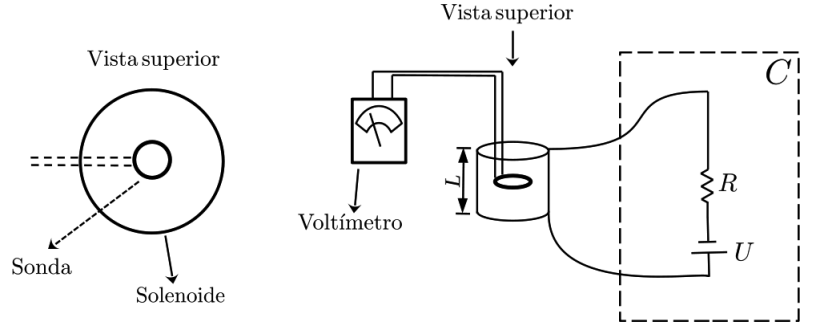
A magnitude da tensão medida pelo voltímetro e:
A sonda é conectada a um voltímetro e orientada de modo que o eixo axial de suas espiras seja paralelo ao campo magnético. Considere que R e muito maior do que a resistência/impedância proporcionada pelo solenoide e que a permeabilidade magnética do interior do solenoide é µ0 .
A magnitude da tensão medida pelo voltímetro e:
Q2280139
Física
Um próton com posição inicial x = R e velocidade inicial  na direção y (v0 ≪ c) adentra uma região (x > 0 e y > 0) onde atua um campo magnético perpendicular ao plano xy, conforme mostra a figura. Considere que
logo após acessar esta região a trajetória do próton apresenta um raio de curvatura R (L/2 < R < L) e que um detetor
suficientemente estreito e posicionado para sua contagem ´
em y = L/2.
na direção y (v0 ≪ c) adentra uma região (x > 0 e y > 0) onde atua um campo magnético perpendicular ao plano xy, conforme mostra a figura. Considere que
logo após acessar esta região a trajetória do próton apresenta um raio de curvatura R (L/2 < R < L) e que um detetor
suficientemente estreito e posicionado para sua contagem ´
em y = L/2.
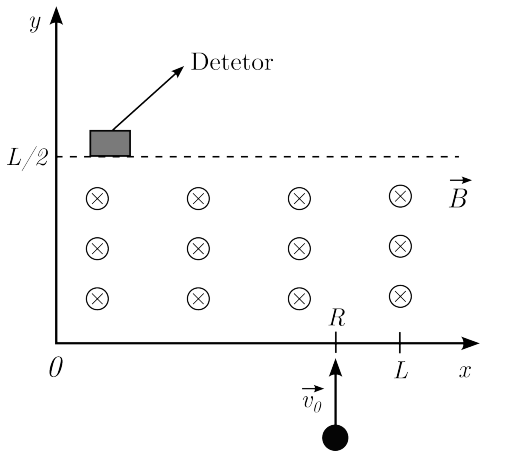
Determine a posição em x que o detetor deve estar para a contagem deste próton.
na direção y (v0 ≪ c) adentra uma região (x > 0 e y > 0) onde atua um campo magnético perpendicular ao plano xy, conforme mostra a figura. Considere que
logo após acessar esta região a trajetória do próton apresenta um raio de curvatura R (L/2 < R < L) e que um detetor
suficientemente estreito e posicionado para sua contagem ´
em y = L/2. Determine a posição em x que o detetor deve estar para a contagem deste próton.
 Conheça nossos planos