Selecionar segmento
Estude com questões de diferentes segmentos
Atenção: Isso limpará todos os campos já preenchidos no filtro!
Foram encontradas 135.752 questões
Resolva questões gratuitamente!
Junte-se a mais de 4 milhões de concurseiros!


Ano: 2025
Banca:
IDECAN
Órgão:
CBM-RJ
Prova:
IDECAN - 2025 - CBM-RJ - Soldado BM QBMP 1 - Busca e Salvamento |
Q3956147
Português
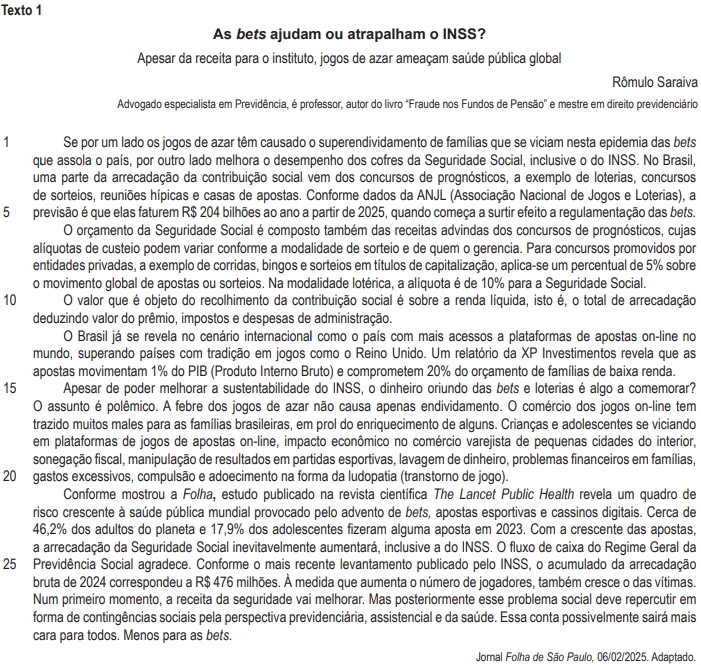
Assinale a única das alternativas que completa o trecho
abaixo fornecido de modo adequado aos padrões gerais de
colocação pronominal, aceitos pela gramática normativa do
português brasileiro.
A pessoa que vai criar as regras para o funcionamento das bets no Brasil deve ter muito cuidado, pois...
A pessoa que vai criar as regras para o funcionamento das bets no Brasil deve ter muito cuidado, pois...
Ano: 2025
Banca:
IDECAN
Órgão:
CBM-RJ
Prova:
IDECAN - 2025 - CBM-RJ - Soldado BM QBMP 1 - Busca e Salvamento |
Q3956146
Português
No trecho “Conforme mostrou a Folha, estudo publicado na
revista cientifica The Lancet Public Health revela um quadro de
risco crescente à saúde pública mundial provocado pelo advento
de bets, apostas esportivas e cassinos digitais” (l.21 - 22), o
verbo “revelar” classifica-se quanto a sua transitividade, como
Ano: 2025
Banca:
IDECAN
Órgão:
CBM-RJ
Prova:
IDECAN - 2025 - CBM-RJ - Soldado BM QBMP 1 - Busca e Salvamento |
Q3956145
Português
Marque a única alternativa que apresenta uma construção
sintática que está livre de falhas de concordância.
Ano: 2025
Banca:
IDECAN
Órgão:
CBM-RJ
Prova:
IDECAN - 2025 - CBM-RJ - Soldado BM QBMP 1 - Busca e Salvamento |
Q3956144
Português
Assinale a única alternativa cuja construção sintática está
livre de falhas de concordância.
Ano: 2025
Banca:
IDECAN
Órgão:
CBM-RJ
Prova:
IDECAN - 2025 - CBM-RJ - Soldado BM QBMP 1 - Busca e Salvamento |
Q3956143
Português
No período “Apesar de poder melhorar a sustentabilidade
do INSS, o dinheiro oriundo das bets e loterias é algo a
comemorar?” (l.15), podemos observar duas orações que se
relacionam. A relação entre estas orações é de
Ano: 2025
Banca:
IDECAN
Órgão:
CBM-RJ
Prova:
IDECAN - 2025 - CBM-RJ - Soldado BM QBMP 1 - Busca e Salvamento |
Q3956142
Português
Assinale abaixo o único dos enunciados em que o emprego
ou não do sinal indicativo de crase está correto.
Ano: 2025
Banca:
IDECAN
Órgão:
CBM-RJ
Prova:
IDECAN - 2025 - CBM-RJ - Soldado BM QBMP 1 - Busca e Salvamento |
Q3956141
Português
Analisando a formulação sintática do trecho “Um relatório
da XP Investimentos revela que as apostas movimentam 1% do
PIB (Produto Interno Bruto) e comprometem 20% do orçamento
de famílias de baixa renda” (l.13-14), podemos afirmar que ele
possui
Ano: 2025
Banca:
IDECAN
Órgão:
CBM-RJ
Prova:
IDECAN - 2025 - CBM-RJ - Soldado BM QBMP 1 - Busca e Salvamento |
Q3956140
Português
No trecho “O Brasil já se revela no cenário internacional
como o país com mais acessos a plataformas de apostas
on-line no mundo” (l.12-13), a palavra em destaque é um
Ano: 2025
Banca:
IDECAN
Órgão:
CBM-RJ
Prova:
IDECAN - 2025 - CBM-RJ - Soldado BM QBMP 1 - Busca e Salvamento |
Q3956139
Português
A palavra “superendividamento” (l.1) no texto 1 passou,
em seu processo de formação, por ao menos duas
transformações. A partir da palavra “dívida” formou-se
“endividamento” e a partir de endividamento formou-se
“superendividamento”. Estes processos referidos acima
são nomeados na gramática da língua portuguesa,
respectivamente, como
Ano: 2025
Banca:
IDECAN
Órgão:
CBM-RJ
Prova:
IDECAN - 2025 - CBM-RJ - Soldado BM QBMP 1 - Busca e Salvamento |
Q3956138
Português
No período “O orçamento da Seguridade Social é composto
também das receitas advindas dos concursos de prognósticos,
cujas alíquotas de custeio podem variar conforme a modalidade
de sorteio e de quem o gerencia” (l.6-7), o termo em destaque
está empregado como
Ano: 2025
Banca:
IDECAN
Órgão:
CBM-RJ
Prova:
IDECAN - 2025 - CBM-RJ - Soldado BM QBMP 1 - Busca e Salvamento |
Q3956137
Português
No trecho “Conforme dados da ANJL (Associação Nacional
de Jogos e Loterias), a previsão é que elas faturem R$ 204
bilhões ao ano a partir de 2025” (l.4-5), o verbo em destaque
está empregado no tempo
Ano: 2025
Banca:
IDECAN
Órgão:
CBM-RJ
Prova:
IDECAN - 2025 - CBM-RJ - Soldado BM QBMP 1 - Busca e Salvamento |
Q3956136
Português
Entre os pares de palavras abaixo, listados conforme o
sentido que é dado a cada um destes termos no texto 1, assinale
a alternativa em que ambas as palavras pertencem ao mesmo
campo semântico.
Ano: 2025
Banca:
IDECAN
Órgão:
CBM-RJ
Prova:
IDECAN - 2025 - CBM-RJ - Soldado BM QBMP 1 - Busca e Salvamento |
Q3956135
Português
A partir da leitura do texto 1, podemos afirmar que o
vocábulo “prognósticos” (l.3) está empregado no texto com o
sentido de
Ano: 2025
Banca:
IDECAN
Órgão:
CBM-RJ
Prova:
IDECAN - 2025 - CBM-RJ - Soldado BM QBMP 1 - Busca e Salvamento |
Q3956134
Português
O trecho reproduzido a seguir encontra-se abaixo do título
e do subtítulo do texto 1, e organiza-se linguisticamente como
um texto:
“Advogado especialista em Previdência, é professor, autor do livro ‘Fraude nos Fundos de Pensão’ e mestre em direito previdenciário”
“Advogado especialista em Previdência, é professor, autor do livro ‘Fraude nos Fundos de Pensão’ e mestre em direito previdenciário”
Ano: 2025
Banca:
IDECAN
Órgão:
CBM-RJ
Prova:
IDECAN - 2025 - CBM-RJ - Soldado BM QBMP 1 - Busca e Salvamento |
Q3956133
Português
A partir da leitura do 1º parágrafo do texto 1, podemos
afirmar que este trecho do texto se organiza linguisticamente
como um parágrafo
Ano: 2025
Banca:
Exército
Órgão:
EsPCEx
Prova:
Exército - 2025 - EsPCEx - Cadete do Exército - 2º Dia |
Q3909828
Inglês
Texto associado
Leia o texto a seguir e responda à questão.
Stateless People
Stateless people are not recognized as citizens by any country. UNHCR (United Nations High
Commissioner for Refugees) advocates for their rights and works to prevent and end statelessness globally.
Millions of people around the world are denied the right to a nationality, which leaves them stateless. As a
result, they may be unable to access other basic rights and services. They are also often at a higher risk of
exploitation and abuse. At the end of June 2024, UNHCR’s statistical reporting counted 4.4 million stateless
people. Given that most countries do not report statelessness data, the actual figure is believed to be
substantially higher. Stateless people can be found in almost every country and in all regions of the world,
and most live in the same country in which they were born.
Stateless people face a lifetime of missed opportunities and disappointment. When they are born, their
parents may not be able to register their birth, obtain a birth certificate or other legal identity documents.
Without this, they often cannot be enrolled in school. If they do manage to enter school and receive education,
they may be barred from sitting formal exams to progress or enter university, unless they can prove their legal
identity. As an adult, they may not be allowed to work legally, which leaves them at an increased risk of
exploitation and abuse as they take low-paying and informal jobs. They often cannot access public services
like health care. They also frequently cannot open a bank account, vote, get a passport to travel, buy a home
or even get married. Stateless people cannot confer a nationality on their children. If the child is unable to
obtain a nationality through either of their parents or from the country of birth, they will also end up stateless,
perpetuating statelessness across generations.
What is the difference between a stateless person and a refugee? A stateless person is not considered
a national of any country. A refugee is someone who has fled their country to escape conflict or persecution
and has crossed an international border. While most refugees have a nationality, a person can be both
stateless and a refugee. However, the majority of stateless people live within the country in which they were
born and have never crossed an international border.
Adapted from https://www.unhcr.org/about-unhcr/who-we-protect/stateless-people
According to the text, read the statements and choose the correct alternative.
I - UNHCR supports stateless people to move to a new country.
II - There are probably more than 4.4 million stateless people in the world.
III - Stateless people prefer informal jobs because they don’t have bank accounts.
IV - Stateless people may find themselves in a vicious circle.
V - Stateless people don’t have a nationality, neither do refugees.
I - UNHCR supports stateless people to move to a new country.
II - There are probably more than 4.4 million stateless people in the world.
III - Stateless people prefer informal jobs because they don’t have bank accounts.
IV - Stateless people may find themselves in a vicious circle.
V - Stateless people don’t have a nationality, neither do refugees.
Ano: 2025
Banca:
Exército
Órgão:
EsPCEx
Prova:
Exército - 2025 - EsPCEx - Cadete do Exército - 2º Dia |
Q3909827
Inglês
Texto associado
Leia o texto a seguir e responda à questão.
Stateless People
Stateless people are not recognized as citizens by any country. UNHCR (United Nations High
Commissioner for Refugees) advocates for their rights and works to prevent and end statelessness globally.
Millions of people around the world are denied the right to a nationality, which leaves them stateless. As a
result, they may be unable to access other basic rights and services. They are also often at a higher risk of
exploitation and abuse. At the end of June 2024, UNHCR’s statistical reporting counted 4.4 million stateless
people. Given that most countries do not report statelessness data, the actual figure is believed to be
substantially higher. Stateless people can be found in almost every country and in all regions of the world,
and most live in the same country in which they were born.
Stateless people face a lifetime of missed opportunities and disappointment. When they are born, their
parents may not be able to register their birth, obtain a birth certificate or other legal identity documents.
Without this, they often cannot be enrolled in school. If they do manage to enter school and receive education,
they may be barred from sitting formal exams to progress or enter university, unless they can prove their legal
identity. As an adult, they may not be allowed to work legally, which leaves them at an increased risk of
exploitation and abuse as they take low-paying and informal jobs. They often cannot access public services
like health care. They also frequently cannot open a bank account, vote, get a passport to travel, buy a home
or even get married. Stateless people cannot confer a nationality on their children. If the child is unable to
obtain a nationality through either of their parents or from the country of birth, they will also end up stateless,
perpetuating statelessness across generations.
What is the difference between a stateless person and a refugee? A stateless person is not considered
a national of any country. A refugee is someone who has fled their country to escape conflict or persecution
and has crossed an international border. While most refugees have a nationality, a person can be both
stateless and a refugee. However, the majority of stateless people live within the country in which they were
born and have never crossed an international border.
Adapted from https://www.unhcr.org/about-unhcr/who-we-protect/stateless-people
Choose the alternative that has the same meaning as the word sitting in the sentence “…they
may be barred from sitting formal exams to progress…” (paragraph 2).
Ano: 2025
Banca:
Exército
Órgão:
EsPCEx
Prova:
Exército - 2025 - EsPCEx - Cadete do Exército - 2º Dia |
Q3909826
Inglês
Texto associado
Leia o texto a seguir e responda à questão.
Stateless People
Stateless people are not recognized as citizens by any country. UNHCR (United Nations High
Commissioner for Refugees) advocates for their rights and works to prevent and end statelessness globally.
Millions of people around the world are denied the right to a nationality, which leaves them stateless. As a
result, they may be unable to access other basic rights and services. They are also often at a higher risk of
exploitation and abuse. At the end of June 2024, UNHCR’s statistical reporting counted 4.4 million stateless
people. Given that most countries do not report statelessness data, the actual figure is believed to be
substantially higher. Stateless people can be found in almost every country and in all regions of the world,
and most live in the same country in which they were born.
Stateless people face a lifetime of missed opportunities and disappointment. When they are born, their
parents may not be able to register their birth, obtain a birth certificate or other legal identity documents.
Without this, they often cannot be enrolled in school. If they do manage to enter school and receive education,
they may be barred from sitting formal exams to progress or enter university, unless they can prove their legal
identity. As an adult, they may not be allowed to work legally, which leaves them at an increased risk of
exploitation and abuse as they take low-paying and informal jobs. They often cannot access public services
like health care. They also frequently cannot open a bank account, vote, get a passport to travel, buy a home
or even get married. Stateless people cannot confer a nationality on their children. If the child is unable to
obtain a nationality through either of their parents or from the country of birth, they will also end up stateless,
perpetuating statelessness across generations.
What is the difference between a stateless person and a refugee? A stateless person is not considered
a national of any country. A refugee is someone who has fled their country to escape conflict or persecution
and has crossed an international border. While most refugees have a nationality, a person can be both
stateless and a refugee. However, the majority of stateless people live within the country in which they were
born and have never crossed an international border.
Adapted from https://www.unhcr.org/about-unhcr/who-we-protect/stateless-people
The word statelessness (paragraph 1) is
Ano: 2025
Banca:
Exército
Órgão:
EsPCEx
Prova:
Exército - 2025 - EsPCEx - Cadete do Exército - 2º Dia |
Q3909825
Inglês
Texto associado
Leia o texto a seguir e responda à questão.
A New Trend in Cryptocurrency: Selling Your Iris
Characters of countless sci-fi films have relied on iris scans to unlock hidden rooms, power up
advanced gadgets, or authenticate their identities in a tech-centric world. What once was only a Hollywood
fantasy is now becoming a reality, with similar applications just around the corner. These days, it’s not unusual
to hear about shopping malls in cities like Barcelona featuring tiny booths where visitors scan their eyes.
The concept is puzzling, especially when they explain that the goal is to “scan your iris to give you
cryptocurrencies.”
Worldcoin, one of Sam Altman’s (director of OpenAI, creators of ChatGPT) ventures, has recently
gained increased attention due to their new initiative: offering money in exchange for iris scans. Worldcoin
scans the biometric data of the eye and then compensates individuals with cryptocurrency. However, many
ask the same questions: What (1)____ Worldcoin gain from our iris? What (2)____ they really planning to do
with it? Why (3)____ the iris so important? How (4)____ it affect your privacy?
Unlike data such as phone numbers, credit cards, or passwords, biometric data is unchangeable.
Biometric data includes traits that can be used to identify you, such as your voice, fingerprint, or iris. They are
inherently yours and non-transferable. Sharing biometric data could expose individuals to risks of tracking
and surveillance, potentially enabling identification without consent through various technologies. Often
without realizing it, people have given permission for their data to be sold.
After carefully studying the legality of this practice, Spain has banned these operations and is removing
the stands and iris scanners used by Worldcoin. In countries like France or Brazil, Worldcoin has also faced
bans on conducting their activities, while claiming they’re leaving voluntarily rather than because it’s illegal.
Adapted from https://theswitch.es/en/selling-your-iris-worldcoin/
According to the text, choose the correct statement.
Ano: 2025
Banca:
Exército
Órgão:
EsPCEx
Prova:
Exército - 2025 - EsPCEx - Cadete do Exército - 2º Dia |
Q3909824
Inglês
Texto associado
Leia o texto a seguir e responda à questão.
A New Trend in Cryptocurrency: Selling Your Iris
Characters of countless sci-fi films have relied on iris scans to unlock hidden rooms, power up
advanced gadgets, or authenticate their identities in a tech-centric world. What once was only a Hollywood
fantasy is now becoming a reality, with similar applications just around the corner. These days, it’s not unusual
to hear about shopping malls in cities like Barcelona featuring tiny booths where visitors scan their eyes.
The concept is puzzling, especially when they explain that the goal is to “scan your iris to give you
cryptocurrencies.”
Worldcoin, one of Sam Altman’s (director of OpenAI, creators of ChatGPT) ventures, has recently
gained increased attention due to their new initiative: offering money in exchange for iris scans. Worldcoin
scans the biometric data of the eye and then compensates individuals with cryptocurrency. However, many
ask the same questions: What (1)____ Worldcoin gain from our iris? What (2)____ they really planning to do
with it? Why (3)____ the iris so important? How (4)____ it affect your privacy?
Unlike data such as phone numbers, credit cards, or passwords, biometric data is unchangeable.
Biometric data includes traits that can be used to identify you, such as your voice, fingerprint, or iris. They are
inherently yours and non-transferable. Sharing biometric data could expose individuals to risks of tracking
and surveillance, potentially enabling identification without consent through various technologies. Often
without realizing it, people have given permission for their data to be sold.
After carefully studying the legality of this practice, Spain has banned these operations and is removing
the stands and iris scanners used by Worldcoin. In countries like France or Brazil, Worldcoin has also faced
bans on conducting their activities, while claiming they’re leaving voluntarily rather than because it’s illegal.
Adapted from https://theswitch.es/en/selling-your-iris-worldcoin/
Choose the alternative with words that correctly and respectively complete gaps (1), (2), (3) and
(4) (paragraph 2).
 Conheça nossos planos