Selecionar segmento
Estude com questões de diferentes segmentos
Atenção: Isso limpará todos os campos já preenchidos no filtro!
Foram encontradas 16.230 questões
Resolva questões gratuitamente!
Junte-se a mais de 4 milhões de concurseiros!


Ano: 2020
Banca:
VUNESP
Órgão:
EsFCEx
Provas:
VUNESP - 2020 - EsFCEx - Oficial - Magistério de Inglês
|
Exército - 2020 - EsFCEx - Magistério de Inglês |
Q1778082
Inglês
Texto associado
Leia os dois parágrafos a seguir para responder à questão.
An international student who majors in engineering
drops by the engineering department office and asks the
secretary, “Can you tell me where the English department is?”
The secretary smiles and responds, “I don’t know, actually.
It’s probably somewhere in the Humanities Building. Do you
have a campus map?” The student turns around and leaves.
The secretary is taken aback and feels slightly uncomfortable.
She wonders why the student left so abruptly.
(...)
People who interact with ESL students have commented
that some seem to express gratitude excessively for small
considerations, even to the point of embarrassing the person
they are speaking. Others seem downright rude because they
do not say thank you when they are expected to.
(Celce-Murcia, M. 2001.)
A relação entre os dois parágrafos permite perceber que
o mal entendido no episódio narrado no primeiro parágrafo provavelmente foi causado por
Ano: 2020
Banca:
VUNESP
Órgão:
EsFCEx
Provas:
VUNESP - 2020 - EsFCEx - Oficial - Magistério de Inglês
|
Exército - 2020 - EsFCEx - Magistério de Inglês |
Q1778074
Inglês
Texto associado
Read the text below and answer the question.
Thought-in-Action Links
It is important to recognize that methods link thoughts
and actions, because teaching is not entirely about one
or the other. As a teacher of language, you have thoughts
about your subject matter – what language is, what culture
is – and about your students – who they are as learners and
how it is they learn. You also have thoughts about yourself
as a teacher and what you can do to help your students to
learn. Many of your thoughts have been formed by your own
experience as a language learner. With this awareness, you
are able to examine why you do what you do and perhaps
choose to think about or do things differently.
As an example, let us relate an anecdote about a teacher
with whom Diane Larsen-Freeman was working some time
ago. From her study of methods in Stevick (1980), Heather
(not her real name) became interested in how to work with
teacher control and student initiative in her teaching. She
determined that during her student teaching internship, she
would exercise less control of the lesson in order to encourage
her students to take more initiative, and have them impose
the questions in the classroom, since so often it is the teacher
who asks all the questions, not the students.
However, she felt that the students were not taking the
initiative, but she could not see what was wrong. When Diane
Larsen Freeman, who was her supervisor, visited her class,
she observed the following:
HEATHER: Juan, ask Anna what she is wearing.
JÜAN: What are you wearing?
ANNA: I am wearing a dress.
HEATHER: Anna, ask Muriel what she is writing.
ANNA: What are you writing?
MÜRIEL: I am writing a letter.
This pattern continued for some time. It was clear to see
that Heather had successfully avoided the common problem
of the teacher asking all the questions in the class. The
teacher was not asking the questions – the students were.
However, Heather had not achieved her goal of encouraging
student initiative.
(Larsen-Freeman, D. 2000. Adaptado)
In the simple past and past participle, regular verbs may
be pronounced in three different ways: /t/, /d/ or /id/. The
verb taken from the second paragraph that is pronounced
with an extra syllable /id/ in one of those forms is:
Ano: 2020
Banca:
VUNESP
Órgão:
EsFCEx
Provas:
VUNESP - 2020 - EsFCEx - Oficial - Magistério de Inglês
|
Exército - 2020 - EsFCEx - Magistério de Inglês |
Q1778073
Inglês
Texto associado
Read the text below and answer the question.
Thought-in-Action Links
It is important to recognize that methods link thoughts
and actions, because teaching is not entirely about one
or the other. As a teacher of language, you have thoughts
about your subject matter – what language is, what culture
is – and about your students – who they are as learners and
how it is they learn. You also have thoughts about yourself
as a teacher and what you can do to help your students to
learn. Many of your thoughts have been formed by your own
experience as a language learner. With this awareness, you
are able to examine why you do what you do and perhaps
choose to think about or do things differently.
As an example, let us relate an anecdote about a teacher
with whom Diane Larsen-Freeman was working some time
ago. From her study of methods in Stevick (1980), Heather
(not her real name) became interested in how to work with
teacher control and student initiative in her teaching. She
determined that during her student teaching internship, she
would exercise less control of the lesson in order to encourage
her students to take more initiative, and have them impose
the questions in the classroom, since so often it is the teacher
who asks all the questions, not the students.
However, she felt that the students were not taking the
initiative, but she could not see what was wrong. When Diane
Larsen Freeman, who was her supervisor, visited her class,
she observed the following:
HEATHER: Juan, ask Anna what she is wearing.
JÜAN: What are you wearing?
ANNA: I am wearing a dress.
HEATHER: Anna, ask Muriel what she is writing.
ANNA: What are you writing?
MÜRIEL: I am writing a letter.
This pattern continued for some time. It was clear to see
that Heather had successfully avoided the common problem
of the teacher asking all the questions in the class. The
teacher was not asking the questions – the students were.
However, Heather had not achieved her goal of encouraging
student initiative.
(Larsen-Freeman, D. 2000. Adaptado)
The title of the text “Thought-in-Action Links” is an
example of a noun phrase in English. It is correct to state
about noun phrases that they
Ano: 2020
Banca:
VUNESP
Órgão:
EsFCEx
Provas:
VUNESP - 2020 - EsFCEx - Oficial - Magistério de Inglês
|
Exército - 2020 - EsFCEx - Magistério de Inglês |
Q1778060
Inglês
Texto associado
Leia o texto e responda à questão.
The discussion of the worldliness of English (…) suggests
that it is impossible to separate English from its many
contexts, and therefore, that the idea that it might be possible
to ‘just teach the language’ - is (…) indefensible. (…) To
teach is to be caught up in an array of questions concerning
curriculum, educational systems and classroom practices:
(1) whose knowledges and cultures are given credence?
(2) to what extent does an educational system reproduce
social and cultural inequalities? And (3) what understandings
of language, culture, education, authority, knowledge or
communication do we assume in our teaching?
(PENNYCOOK, A. The cultural politics of English as an
international language. Adaptado).
A discussão de Pennycook sobre “just teach the language”
vai ao encontro do debate sobre multiletramentos feito
por Rojo e Moura em seu livro, uma vez que os autores
entendem que, para ensinar na área, é preciso que o(a)
professor(a)
Ano: 2020
Banca:
VUNESP
Órgão:
EsFCEx
Provas:
VUNESP - 2020 - EsFCEx - Oficial - Magistério de Inglês
|
Exército - 2020 - EsFCEx - Magistério de Inglês |
Q1778058
Inglês
Texto associado
Read the following extract and answer question.
The disjunction between method as conceptualized
by theorists and method as conducted by teachers is the
direct consequence of the inherent limitations of the concept
of method itself. First and foremost, methods are based
on idealized concepts geared toward idealized contexts.
Since language learning and teaching needs, wants, and
situations are unpredictably numerous, no idealized method
can visualize all the variables in advance in order to provide
situation-specific suggestions that practicing teachers so
clearly need in order to tackle the challenges they confront
every day of their professional lives. As a predominantly topdown exercise, the conception and construction of methods
have been largely guided by a one-size-fits-all (…) approach
that assumes a common clientele with common goals.
(KUMARAVADIVELU, B. Beyond methods:
macrostrategies for language teaching. Adapted)
Kumaravadivelu states that there are over 15 methods
for Second and Foreign Language (L2) teaching, which
he divides into three categories, i.e. language-centered,
learner-centered and learning-centered methods, as
seen, respectively, in alternative:
Q1778011
Física
Uma vela acesa foi colocada parada, verticalmente, a
4 m de distância de uma parede também vertical. Na
região entre a vela e a parede existem duas posições
onde se pode fixar uma lente convergente gaussiana, de
distância focal 0,75 m, de modo que sejam projetadas
sobre a parede imagens nítidas da chama dessa vela.
Essas posições estão indicadas na figura e nomeadas
como Posição 1, a uma distância x1
da vela, e Posição 2,
distante x2
da vela.
É correto afirmar que a relação x1 / x2é igual a:
É correto afirmar que a relação x1 / x2é igual a:
Q1777995
Física
O professor de Física de certa turma de alunos do Ensino
Médio faz uma experiência para demonstrar a interferência de ondas sonoras. Dirige-se ao estacionamento da
escola onde há uma região bem ampla, silenciosa e o
som sofre reflexão praticamente desprezível. Dois alunos
trouxeram seus violões e foram colocados a uma certa
distância um do outro. Eles emitiram, simultaneamente, a
mesma nota musical com frequência de 400 Hz. A velocidade de propagação do som ali foi admitida com o valor
320 m/s. Uma aluna A ficou posicionada a 10,0 m de um
violão e a 8,0 m do outro. Outra aluna B ficou a 8,2 m de
um violão e a 9,8 m do outro, como ilustra a figura.
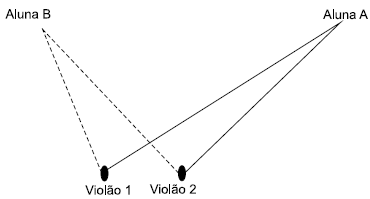
É correto afirmar que a aluna A
É correto afirmar que a aluna A
Ano: 2020
Banca:
VUNESP
Órgão:
EsFCEx
Provas:
VUNESP - 2020 - EsFCEx - Oficial - Magistério de Física
|
Exército - 2020 - EsFCEx - Magistério de Física |
Q1777989
Física
Texto associado
O enunciado a seguir refere-se à questão.
Um professor realiza uma experiência em um laboratório
de física com um feixe de íons, de massa m e dimensões
desprezíveis. A função horária das posições S ocupadas pelo feixe ao longo de uma trajetória circular de raio
R, em função do tempo t, no SI, é S = t³ + b.t² – f.t +g,
em que b, f e g são constantes positivas.
A intensidade da componente tangencial da força no instante t = 3,0 s será dada por:
Ano: 2020
Banca:
VUNESP
Órgão:
EsFCEx
Provas:
VUNESP - 2020 - EsFCEx - Oficial - Pedagogia
|
Exército - 2020 - EsFCEx - Pedagogia |
Q1777936
Pedagogia
Assinale a alternativa correta, conforme a perspectiva de
Heloísa Lück (autora de Gestão educacional: uma questão paradigmática) sobre a relação entre as noções de
gestão e administração no contexto educacional.
Q1777933
Pedagogia
De acordo com as metas e as estratégias traçadas no
Plano Nacional de Educação (PNE, Lei n°
13.005/2014)
em relação à educação de jovens e adultos, é correto
afirmar que
Q1777931
Pedagogia
Em 2020, o Estatuto da Criança e do Adolescente (ECA)
completou 30 anos. No período compreendido entre sua
promulgação e os dias de hoje, o contexto político e social
do país sofreu numerosas transformações, assim como se
modificaram muitas das pautas e das reivindicações estudantis. A despeito dessas mudanças, permanece assegurado aos alunos em suas escolas o direito, especificamente
expresso no artigo 53 do Estatuto,
Ano: 2020
Banca:
VUNESP
Órgão:
EsFCEx
Provas:
VUNESP - 2020 - EsFCEx - Oficial - Pedagogia
|
Exército - 2020 - EsFCEx - Pedagogia |
Q1777926
Pedagogia
Libâneo, Oliveira e Toschi (autores do livro Educação
escolar: políticas, estrutura e organização) discorrem sobre
diferentes tipos de manifestações do currículo. A uma
delas, os autores atribuem a seguinte definição: refere-se
às “influências que afetam a aprendizagem dos alunos e o
trabalho dos professores e são provenientes da experiência cultural, dos valores e significados trazidos de seu meio
social de origem e vivenciados no ambiente escolar”. Outra
das manifestações é definida por eles como aquele currículo que é “estabelecido pelos sistemas de ensino, expresso
em diretrizes curriculares, nos objetivos e conteúdos das
áreas ou disciplinas de estudo”. Identifique a alternativa
que corresponde a essas duas definições, respectivamente, de acordo com Libâneo, Oliveira e Toschi.
Ano: 2020
Banca:
VUNESP
Órgão:
EsFCEx
Provas:
VUNESP - 2020 - EsFCEx - Oficial - Pedagogia
|
Exército - 2020 - EsFCEx - Pedagogia |
Q1777924
Pedagogia
A partir da leitura de Pedagogia da autonomia, é possível
depreender que, de acordo com Paulo Freire,
Ano: 2020
Banca:
VUNESP
Órgão:
EsFCEx
Provas:
VUNESP - 2020 - EsFCEx - Oficial - Pedagogia
|
Exército - 2020 - EsFCEx - Pedagogia |
Q1777922
Pedagogia
De acordo com a Base Nacional Comum Curricular, a
“mobilização de conhecimentos (conceitos e procedimentos), habilidades (práticas, cognitivas e socioemocionais), atitudes e valores para resolver demandas complexas da vida cotidiana, do pleno exercício da cidadania e
do mundo do trabalho” denomina-se
Q1777918
Pedagogia
Ao discutir o conceito professor reflexivo a partir de uma
retomada histórica de diferentes perspectivas a esse respeito, Selma Garrido Pimenta (In: Pimenta, S. G.; Ghedin,
E. (orgs.). Professor reflexivo no Brasil: gênese e crítica
de um conceito) aponta problemas decorrentes de uma
apropriação generalizada da noção de reflexão no contexto da formação inicial e continuada de professores. Para
a autora, apesar das críticas, uma das contribuições da
perspectiva da reflexão no exercício da docência é a
Ano: 2020
Banca:
VUNESP
Órgão:
EsFCEx
Provas:
VUNESP - 2020 - EsFCEx - Oficial - Pedagogia
|
Exército - 2020 - EsFCEx - Pedagogia |
Q1777916
Pedagogia
Santos (2012) afirma que o Exame Nacional do Ensino
Médio (ENEM)
Ano: 2020
Banca:
VUNESP
Órgão:
EsFCEx
Provas:
VUNESP - 2020 - EsFCEx - Oficial - Pedagogia
|
Exército - 2020 - EsFCEx - Pedagogia |
Q1777907
Pedagogia
Para Saviani (2010), no âmbito do escolanovismo,
“aprender a aprender” significava a “capacidade de buscar conhecimento por si mesmo, de adaptar-se a uma
sociedade que era entendida como um organismo em que
cada indivíduo tinha um lugar e cumpria um papel determinado em benefício de todo corpo social”. De acordo com
o autor, esse lema foi ressignificado e retomado no final
do século XX no Brasil, e, na atualidade, “aprender a
aprender” relaciona-se à necessidade de
Q1777901
Pedagogia
Cabe à União estabelecer, em colaboração com os
Estados, o Distrito Federal e os Municípios, competências
e diretrizes que norteiam os currículos e seus conteúdos
mínimos para a Educação Infantil, o Ensino Fundamental e o Ensino Médio. De acordo com a Base Nacional
Comum Curricular (BNCC), “ao dizer que os conteúdos
curriculares estão a serviço do desenvolvimento de competências”, a LDB
Q1777898
Pedagogia
O artigo 53-A da Lei n°
8.069/1990, Estatuto da Criança e
do Adolescente (ECA), define que “é dever da instituição
de ensino, clubes e agremiações recreativas e de estabelecimentos congêneres assegurar
Q1777821
Espanhol
Las expresiones so pena de y so pretexto de van
encabezadas por la preposición so, la cual se emplea en:

 Conheça nossos planos