Foram encontradas 16.230 questões
Resolva questões gratuitamente!
Junte-se a mais de 4 milhões de concurseiros!


Um tecido é vendido em formato retangular com as medidas de comprimento e largura que o cliente quiser. Sabe-se que o tecido sofre encolhimento, apenas na primeira lavagem, de 1/5 do comprimento e 2/9 da largura. Pedro deseja comprar esse tecido, necessitando que ele tenha 35 m2 de área após o encolhimento da primeira lavagem.
Sejam x, y, A e P, respectivamente, as medidas do comprimento (em metros), da largura (em metros), da área
(em metros quadrados) e do perímetro (em metros) da
peça retangular de tecido que Pedro deve comprar para
atender sua necessidade. Nessas condições, x2
+ y2
necessariamente será igual a
Um tecido é vendido em formato retangular com as medidas de comprimento e largura que o cliente quiser. Sabe-se que o tecido sofre encolhimento, apenas na primeira lavagem, de 1/5 do comprimento e 2/9 da largura. Pedro deseja comprar esse tecido, necessitando que ele tenha 35 m2 de área após o encolhimento da primeira lavagem.
A peça retangular de tecido que Pedro irá comprar para
atender sua necessidade terá que ter área, em m2
, igual a
Na figura, ABCD é um quadrado de lado 36 cm.  e
e  são arcos de circunferência de centros D, C e A, respectivamente.'
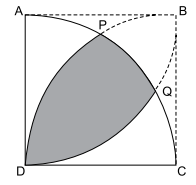
O perímetro da região demarcada em cinza na figura, em
cm, é igual a
Quanto às distinções entre tipos de texto e gêneros de texto/discurso, a mais famosa a esse respeito é a de Marcuschi (2002), que os define como
I. Usamos a expressão tipo textual para designar uma espécie de construção teórica definida pela natureza linguística de sua composição {aspectos lexicais, sintáticos, tempos verbais, relações lógicas}. Em geral, os tipos textuais abrangem cerca de meia dúzia de categorias conhecidas: descrição, narração, dissertação/ argumentação, exposição e injunção.
II. Usamos a expressão gênero textual como uma noção propositalmente vaga para referir os textos materializados que encontramos em nossa vida diária e que apresentam características sócio-comunicativas definidas por conteúdos, propriedades funcionais, estilo e composição característica. Se os tipos textuais são apenas meia dúzia, os gêneros são inúmeros.
Tipos de textos vem sendo ensinados na escola há pelo menos uma centena de anos, o que faz deles gêneros escolares. Na escola, escrevemos narrações, na vida, lemos notícias, relatamos nossa vida, recontamos um filme. Na escola, redigimos “uma composição à vista de gravura” (descrição) fora dela, contamos como decoramos nosso apartamento, instruímos uma pessoa como chegar a um lugar desconhecido. Os gêneros de texto, ao contrário, não são classes gramaticais para classificar textos: são entidades da vida.
(ROJO, R. H. R.; BARBOSA, J. P. Hipermodernidade,
multiletramentos e gêneros discursivos.
São Paulo: Parábola Editorial, 2015. Adaptado)
Quanto às distinções entre tipos de texto e gêneros de texto/discurso, a mais famosa a esse respeito é a de Marcuschi (2002), que os define como
I. Usamos a expressão tipo textual para designar uma espécie de construção teórica definida pela natureza linguística de sua composição {aspectos lexicais, sintáticos, tempos verbais, relações lógicas}. Em geral, os tipos textuais abrangem cerca de meia dúzia de categorias conhecidas: descrição, narração, dissertação/ argumentação, exposição e injunção.
II. Usamos a expressão gênero textual como uma noção propositalmente vaga para referir os textos materializados que encontramos em nossa vida diária e que apresentam características sócio-comunicativas definidas por conteúdos, propriedades funcionais, estilo e composição característica. Se os tipos textuais são apenas meia dúzia, os gêneros são inúmeros.
Tipos de textos vem sendo ensinados na escola há pelo menos uma centena de anos, o que faz deles gêneros escolares. Na escola, escrevemos narrações, na vida, lemos notícias, relatamos nossa vida, recontamos um filme. Na escola, redigimos “uma composição à vista de gravura” (descrição) fora dela, contamos como decoramos nosso apartamento, instruímos uma pessoa como chegar a um lugar desconhecido. Os gêneros de texto, ao contrário, não são classes gramaticais para classificar textos: são entidades da vida.
(ROJO, R. H. R.; BARBOSA, J. P. Hipermodernidade,
multiletramentos e gêneros discursivos.
São Paulo: Parábola Editorial, 2015. Adaptado)
Quanto às distinções entre tipos de texto e gêneros de texto/discurso, a mais famosa a esse respeito é a de Marcuschi (2002), que os define como
I. Usamos a expressão tipo textual para designar uma espécie de construção teórica definida pela natureza linguística de sua composição {aspectos lexicais, sintáticos, tempos verbais, relações lógicas}. Em geral, os tipos textuais abrangem cerca de meia dúzia de categorias conhecidas: descrição, narração, dissertação/ argumentação, exposição e injunção.
II. Usamos a expressão gênero textual como uma noção propositalmente vaga para referir os textos materializados que encontramos em nossa vida diária e que apresentam características sócio-comunicativas definidas por conteúdos, propriedades funcionais, estilo e composição característica. Se os tipos textuais são apenas meia dúzia, os gêneros são inúmeros.
Tipos de textos vem sendo ensinados na escola há pelo menos uma centena de anos, o que faz deles gêneros escolares. Na escola, escrevemos narrações, na vida, lemos notícias, relatamos nossa vida, recontamos um filme. Na escola, redigimos “uma composição à vista de gravura” (descrição) fora dela, contamos como decoramos nosso apartamento, instruímos uma pessoa como chegar a um lugar desconhecido. Os gêneros de texto, ao contrário, não são classes gramaticais para classificar textos: são entidades da vida.
(ROJO, R. H. R.; BARBOSA, J. P. Hipermodernidade,
multiletramentos e gêneros discursivos.
São Paulo: Parábola Editorial, 2015. Adaptado)
Language-centered methods are those that seek to provide opportunities for learners to practice preselected linguistic structures through form-focused exercises in class. The assumption is that language practice will ultimately lead to a mastery of the target language and that learners can draw from this formal repertoire whenever they wish to communicate in the target language outside the class. According to this belief, language development is largely intentional rather than incidental; and language learning seen as a linear, additive process.
Learner-centered methods are those that are principally concerned with language use and learner needs. These methods seek to provide opportunities for learners to practice preselected, presequenced grammatical structures as well as communicative functions (i.e., speech acts such as apologizing, requesting, etc.) through meaning-focused activities. Proponents of learner-centered methods believe in accumulated entities, represented by structures plus notions and functions.
Learning-centered methods are those that are principally concerned with learning processes. These methods seek to provide opportunities for learners to participate in open-ended meaningful interaction through communicative activities or problem-solving tasks in class. The assumption is that a preoccupation with meaning-making will most likely lead to grammatical as well as communicative mastery of the language and that learners can learn through the process of communication. In this approach, unlike the other two, language development is a nonlinear process and considered more incidental than intentional. Proponents of learningcentered methods believe that language is best learned when the learner’s attention is focused on understanding, saying and doing something with language, and not when their attention is focused explicitly on linguistic features.
(Kumaravadivelu, B. Beyond Methods: Macrostrategies for language learning. Haven and London: Yale University Press. 2003. Adaptado)
Language-centered methods are those that seek to provide opportunities for learners to practice preselected linguistic structures through form-focused exercises in class. The assumption is that language practice will ultimately lead to a mastery of the target language and that learners can draw from this formal repertoire whenever they wish to communicate in the target language outside the class. According to this belief, language development is largely intentional rather than incidental; and language learning seen as a linear, additive process.
Learner-centered methods are those that are principally concerned with language use and learner needs. These methods seek to provide opportunities for learners to practice preselected, presequenced grammatical structures as well as communicative functions (i.e., speech acts such as apologizing, requesting, etc.) through meaning-focused activities. Proponents of learner-centered methods believe in accumulated entities, represented by structures plus notions and functions.
Learning-centered methods are those that are principally concerned with learning processes. These methods seek to provide opportunities for learners to participate in open-ended meaningful interaction through communicative activities or problem-solving tasks in class. The assumption is that a preoccupation with meaning-making will most likely lead to grammatical as well as communicative mastery of the language and that learners can learn through the process of communication. In this approach, unlike the other two, language development is a nonlinear process and considered more incidental than intentional. Proponents of learningcentered methods believe that language is best learned when the learner’s attention is focused on understanding, saying and doing something with language, and not when their attention is focused explicitly on linguistic features.
(Kumaravadivelu, B. Beyond Methods: Macrostrategies for language learning. Haven and London: Yale University Press. 2003. Adaptado)
Language-centered methods are those that seek to provide opportunities for learners to practice preselected linguistic structures through form-focused exercises in class. The assumption is that language practice will ultimately lead to a mastery of the target language and that learners can draw from this formal repertoire whenever they wish to communicate in the target language outside the class. According to this belief, language development is largely intentional rather than incidental; and language learning seen as a linear, additive process.
Learner-centered methods are those that are principally concerned with language use and learner needs. These methods seek to provide opportunities for learners to practice preselected, presequenced grammatical structures as well as communicative functions (i.e., speech acts such as apologizing, requesting, etc.) through meaning-focused activities. Proponents of learner-centered methods believe in accumulated entities, represented by structures plus notions and functions.
Learning-centered methods are those that are principally concerned with learning processes. These methods seek to provide opportunities for learners to participate in open-ended meaningful interaction through communicative activities or problem-solving tasks in class. The assumption is that a preoccupation with meaning-making will most likely lead to grammatical as well as communicative mastery of the language and that learners can learn through the process of communication. In this approach, unlike the other two, language development is a nonlinear process and considered more incidental than intentional. Proponents of learningcentered methods believe that language is best learned when the learner’s attention is focused on understanding, saying and doing something with language, and not when their attention is focused explicitly on linguistic features.
(Kumaravadivelu, B. Beyond Methods: Macrostrategies for language learning. Haven and London: Yale University Press. 2003. Adaptado)
Language-centered methods are those that seek to provide opportunities for learners to practice preselected linguistic structures through form-focused exercises in class. The assumption is that language practice will ultimately lead to a mastery of the target language and that learners can draw from this formal repertoire whenever they wish to communicate in the target language outside the class. According to this belief, language development is largely intentional rather than incidental; and language learning seen as a linear, additive process.
Learner-centered methods are those that are principally concerned with language use and learner needs. These methods seek to provide opportunities for learners to practice preselected, presequenced grammatical structures as well as communicative functions (i.e., speech acts such as apologizing, requesting, etc.) through meaning-focused activities. Proponents of learner-centered methods believe in accumulated entities, represented by structures plus notions and functions.
Learning-centered methods are those that are principally concerned with learning processes. These methods seek to provide opportunities for learners to participate in open-ended meaningful interaction through communicative activities or problem-solving tasks in class. The assumption is that a preoccupation with meaning-making will most likely lead to grammatical as well as communicative mastery of the language and that learners can learn through the process of communication. In this approach, unlike the other two, language development is a nonlinear process and considered more incidental than intentional. Proponents of learningcentered methods believe that language is best learned when the learner’s attention is focused on understanding, saying and doing something with language, and not when their attention is focused explicitly on linguistic features.
(Kumaravadivelu, B. Beyond Methods: Macrostrategies for language learning. Haven and London: Yale University Press. 2003. Adaptado)
Implications of the humanistic approach
Hamachek (1977) provides some useful examples of the kind of educational implications that follow from taking a humanistic approach. First, every learning experience should be seen within the context of helping learners to develop a sense of personal identity. This is in keeping with the view that one important task for the teacher is differentiation, i.e. identifying and seeking to meet the individual learner’s needs within the context of the classroom group. Second, learners should be encouraged to make choices for themselves in what and how they learn. This again is in sharp contrast to the view that the curriculum content for every learner of a similar age should be set in ‘tablets of stone’. Third, it is important for teachers to empathise with their learners by seeking to understand the ways in which they make sense of the world, rather than always seeking to impose their own viewpoints. Fourth, it is important to provide optimum conditions for individualised and group learning of an authentic nature to take place.Thus, from a humanistic perspective, a learning experience of personal consequence occurs when the learner assumes the responsibility of evaluating the degree to which he or she is personally moving toward knowledge rather than looking to an external source for such evaluation.
(Williams, M.; Burden, R.L. Psychology for Language Teachers: A Social Constructivist Approach. Cambridge:CUP, 1999. Adaptado)
The expression ‘rather than’, in the concluding sentence of the text, means
Implications of the humanistic approach
Hamachek (1977) provides some useful examples of the kind of educational implications that follow from taking a humanistic approach. First, every learning experience should be seen within the context of helping learners to develop a sense of personal identity. This is in keeping with the view that one important task for the teacher is differentiation, i.e. identifying and seeking to meet the individual learner’s needs within the context of the classroom group. Second, learners should be encouraged to make choices for themselves in what and how they learn. This again is in sharp contrast to the view that the curriculum content for every learner of a similar age should be set in ‘tablets of stone’. Third, it is important for teachers to empathise with their learners by seeking to understand the ways in which they make sense of the world, rather than always seeking to impose their own viewpoints. Fourth, it is important to provide optimum conditions for individualised and group learning of an authentic nature to take place.Thus, from a humanistic perspective, a learning experience of personal consequence occurs when the learner assumes the responsibility of evaluating the degree to which he or she is personally moving toward knowledge rather than looking to an external source for such evaluation.
(Williams, M.; Burden, R.L. Psychology for Language Teachers: A Social Constructivist Approach. Cambridge:CUP, 1999. Adaptado)
Implications of the humanistic approach
Hamachek (1977) provides some useful examples of the kind of educational implications that follow from taking a humanistic approach. First, every learning experience should be seen within the context of helping learners to develop a sense of personal identity. This is in keeping with the view that one important task for the teacher is differentiation, i.e. identifying and seeking to meet the individual learner’s needs within the context of the classroom group. Second, learners should be encouraged to make choices for themselves in what and how they learn. This again is in sharp contrast to the view that the curriculum content for every learner of a similar age should be set in ‘tablets of stone’. Third, it is important for teachers to empathise with their learners by seeking to understand the ways in which they make sense of the world, rather than always seeking to impose their own viewpoints. Fourth, it is important to provide optimum conditions for individualised and group learning of an authentic nature to take place.Thus, from a humanistic perspective, a learning experience of personal consequence occurs when the learner assumes the responsibility of evaluating the degree to which he or she is personally moving toward knowledge rather than looking to an external source for such evaluation.
(Williams, M.; Burden, R.L. Psychology for Language Teachers: A Social Constructivist Approach. Cambridge:CUP, 1999. Adaptado)
Implications of the humanistic approach
Hamachek (1977) provides some useful examples of the kind of educational implications that follow from taking a humanistic approach. First, every learning experience should be seen within the context of helping learners to develop a sense of personal identity. This is in keeping with the view that one important task for the teacher is differentiation, i.e. identifying and seeking to meet the individual learner’s needs within the context of the classroom group. Second, learners should be encouraged to make choices for themselves in what and how they learn. This again is in sharp contrast to the view that the curriculum content for every learner of a similar age should be set in ‘tablets of stone’. Third, it is important for teachers to empathise with their learners by seeking to understand the ways in which they make sense of the world, rather than always seeking to impose their own viewpoints. Fourth, it is important to provide optimum conditions for individualised and group learning of an authentic nature to take place.Thus, from a humanistic perspective, a learning experience of personal consequence occurs when the learner assumes the responsibility of evaluating the degree to which he or she is personally moving toward knowledge rather than looking to an external source for such evaluation.
(Williams, M.; Burden, R.L. Psychology for Language Teachers: A Social Constructivist Approach. Cambridge:CUP, 1999. Adaptado)

 Conheça nossos planos