Questões Militares
Foram encontradas 14.721 questões
Resolva questões gratuitamente!
Junte-se a mais de 4 milhões de concurseiros!


By Nick Allen
9:04PM BST 16 Aug 2013
Climate scientists have concluded that temperatures could jump by up to 5°C and sea levels could rise by up to 82 cm by the end of the century, according to a leaked draft of a United Nations (UN) report.
The UN Intergovernmental Panel on Climate Change (IPCC) also said there was a 95 per cent likelihood that global warming is caused by human activities. That was the highest assessment so far from the IPCC, which put the figure at 90 per cent in a previous report in 2007, 66 per cent in 2001, and just over 50 per cent in 1995.
Reto Knutti, a professor at the Swiss Federal Institute of Technology in Zurich, said: “We have got quite a bit more certain that climate change is largely man-made. We’re less certain than many would hope about the local impacts.” The IPCC report, the first of three in 2013 and 2014, will face intense scrutiny particularly after errors in the 2007 study, which wrongly predicted that all Himalayan glaciers could melt by 2035.
Almost 200 governments have agreed to try to limit global warming to below 2°C above pre-industrial times, which is seen as a threshold for dangerous changes including more droughts, extinctions, floods and rising seas that could swamp coastal regions and island nations. Temperatures have already risen by 0.8°C since the Industrial Revolution.
The report will say there is a high risk global temperatures will rise by more than 2°C this century. They could rise anywhere from about 0.6°C to almost 5°C a wider range at both ends of the scale than predicted in the 2007 report. It will also say evidence of rising sea levels is “unequivocal”. The report projects seas will rise by between 30 cm and 82 cm by the late 21st century. In 2007 the estimated rise was between 18 cm and 58 cm, but that did not fully account for changes in Antarctica and Greenland.
Scientists say it is harder to predict local impacts. Drew Shindell, a Nasa scientist, said: “I talk to people in regional power planning. They ask, 'What’s the temperature going to be in this region in the next 20 to 30 years, because that’s where our power grid is?’ We can’t really tell.”
By Nick Allen
9:04PM BST 16 Aug 2013
Climate scientists have concluded that temperatures could jump by up to 5°C and sea levels could rise by up to 82 cm by the end of the century, according to a leaked draft of a United Nations (UN) report.
The UN Intergovernmental Panel on Climate Change (IPCC) also said there was a 95 per cent likelihood that global warming is caused by human activities. That was the highest assessment so far from the IPCC, which put the figure at 90 per cent in a previous report in 2007, 66 per cent in 2001, and just over 50 per cent in 1995.
Reto Knutti, a professor at the Swiss Federal Institute of Technology in Zurich, said: “We have got quite a bit more certain that climate change is largely man-made. We’re less certain than many would hope about the local impacts.” The IPCC report, the first of three in 2013 and 2014, will face intense scrutiny particularly after errors in the 2007 study, which wrongly predicted that all Himalayan glaciers could melt by 2035.
Almost 200 governments have agreed to try to limit global warming to below 2°C above pre-industrial times, which is seen as a threshold for dangerous changes including more droughts, extinctions, floods and rising seas that could swamp coastal regions and island nations. Temperatures have already risen by 0.8°C since the Industrial Revolution.
The report will say there is a high risk global temperatures will rise by more than 2°C this century. They could rise anywhere from about 0.6°C to almost 5°C a wider range at both ends of the scale than predicted in the 2007 report. It will also say evidence of rising sea levels is “unequivocal”. The report projects seas will rise by between 30 cm and 82 cm by the late 21st century. In 2007 the estimated rise was between 18 cm and 58 cm, but that did not fully account for changes in Antarctica and Greenland.
Scientists say it is harder to predict local impacts. Drew Shindell, a Nasa scientist, said: “I talk to people in regional power planning. They ask, 'What’s the temperature going to be in this region in the next 20 to 30 years, because that’s where our power grid is?’ We can’t really tell.”
( ) The IPCC made a wrong prediction about the Himalayas in the 2007 report.
( ) Himalayan glaciers will certainly disappear by 2035 because of global warming.
( ) The IPCC can now be sure of how climate change will impact different locations.
( ) IPCC's new report will be carefully examined after the errors committed in 2007.
( ) Global warming will have a huge impact in Swiss because of its large glaciers.
Mark the alternative which presents the correct sequence, from top to bottom.
By Nick Allen
9:04PM BST 16 Aug 2013
Climate scientists have concluded that temperatures could jump by up to 5°C and sea levels could rise by up to 82 cm by the end of the century, according to a leaked draft of a United Nations (UN) report.
The UN Intergovernmental Panel on Climate Change (IPCC) also said there was a 95 per cent likelihood that global warming is caused by human activities. That was the highest assessment so far from the IPCC, which put the figure at 90 per cent in a previous report in 2007, 66 per cent in 2001, and just over 50 per cent in 1995.
Reto Knutti, a professor at the Swiss Federal Institute of Technology in Zurich, said: “We have got quite a bit more certain that climate change is largely man-made. We’re less certain than many would hope about the local impacts.” The IPCC report, the first of three in 2013 and 2014, will face intense scrutiny particularly after errors in the 2007 study, which wrongly predicted that all Himalayan glaciers could melt by 2035.
Almost 200 governments have agreed to try to limit global warming to below 2°C above pre-industrial times, which is seen as a threshold for dangerous changes including more droughts, extinctions, floods and rising seas that could swamp coastal regions and island nations. Temperatures have already risen by 0.8°C since the Industrial Revolution.
The report will say there is a high risk global temperatures will rise by more than 2°C this century. They could rise anywhere from about 0.6°C to almost 5°C a wider range at both ends of the scale than predicted in the 2007 report. It will also say evidence of rising sea levels is “unequivocal”. The report projects seas will rise by between 30 cm and 82 cm by the late 21st century. In 2007 the estimated rise was between 18 cm and 58 cm, but that did not fully account for changes in Antarctica and Greenland.
Scientists say it is harder to predict local impacts. Drew Shindell, a Nasa scientist, said: “I talk to people in regional power planning. They ask, 'What’s the temperature going to be in this region in the next 20 to 30 years, because that’s where our power grid is?’ We can’t really tell.”
1. Scientists think it is 95% likely that human activity is causing global warming.
2. Temperatures could be 5°C warmer by the end of the current century.
3. Sea levels are not likely to be higher than today by the end of the century.
4. Scientists are surer now than in 2007 that humans are causing global warming.
5. 50% of the scientists believed humans were the cause of climate change in 1995.
Which of the statements above are TRUE, according to the text?
So, at the start of 2012, I set myself the challenge of trying to read a book from every country (well, all 195 United Nations (UN) recognised states plus former UN member Taiwan) in a year to find out what I was missing. With no idea how to go about this beyond a sneaking suspicion that I was unlikely to find publications from nearly 200 nations on the shelves of my local bookshop, I decided to ask the planet’s readers for help. I created a blog called A Year of Reading the World and put out an appeal for suggestions of titles that I could read in English.
But the effort was worth it. As I made my way through the planet’s literary landscapes, extraordinary things started to happen. In the hands of gifted writers, I discovered bookpacking offered something a physical traveller could hope to experience only rarely: it took me inside the thoughts of individuals living far away and showed me the world through their eyes. More powerful than a thousand news reports, these stories not only opened my mind to the nuts and bolts of life in other places, but opened my heart to the way people there might feel.
And that in turn changed my thinking. Through reading the stories shared with me by bookish strangers around the globe, I realised I was not an isolated person, but part of a network that stretched all over the planet. One by one, the country names on the list that had begun as an intellectual exercise at the start of the year transformed into vital, vibrant places filled with laughter, love, anger, hope and fear. Lands that had once seemed exotic and remote became close and familiar to me – places I could identify with. At its best, I learned, fiction makes the world real.
So, at the start of 2012, I set myself the challenge of trying to read a book from every country (well, all 195 United Nations (UN) recognised states plus former UN member Taiwan) in a year to find out what I was missing. With no idea how to go about this beyond a sneaking suspicion that I was unlikely to find publications from nearly 200 nations on the shelves of my local bookshop, I decided to ask the planet’s readers for help. I created a blog called A Year of Reading the World and put out an appeal for suggestions of titles that I could read in English.
But the effort was worth it. As I made my way through the planet’s literary landscapes, extraordinary things started to happen. In the hands of gifted writers, I discovered bookpacking offered something a physical traveller could hope to experience only rarely: it took me inside the thoughts of individuals living far away and showed me the world through their eyes. More powerful than a thousand news reports, these stories not only opened my mind to the nuts and bolts of life in other places, but opened my heart to the way people there might feel.
And that in turn changed my thinking. Through reading the stories shared with me by bookish strangers around the globe, I realised I was not an isolated person, but part of a network that stretched all over the planet. One by one, the country names on the list that had begun as an intellectual exercise at the start of the year transformed into vital, vibrant places filled with laughter, love, anger, hope and fear. Lands that had once seemed exotic and remote became close and familiar to me – places I could identify with. At its best, I learned, fiction makes the world real.
So, at the start of 2012, I set myself the challenge of trying to read a book from every country (well, all 195 United Nations (UN) recognised states plus former UN member Taiwan) in a year to find out what I was missing. With no idea how to go about this beyond a sneaking suspicion that I was unlikely to find publications from nearly 200 nations on the shelves of my local bookshop, I decided to ask the planet’s readers for help. I created a blog called A Year of Reading the World and put out an appeal for suggestions of titles that I could read in English.
But the effort was worth it. As I made my way through the planet’s literary landscapes, extraordinary things started to happen. In the hands of gifted writers, I discovered bookpacking offered something a physical traveller could hope to experience only rarely: it took me inside the thoughts of individuals living far away and showed me the world through their eyes. More powerful than a thousand news reports, these stories not only opened my mind to the nuts and bolts of life in other places, but opened my heart to the way people there might feel.
And that in turn changed my thinking. Through reading the stories shared with me by bookish strangers around the globe, I realised I was not an isolated person, but part of a network that stretched all over the planet. One by one, the country names on the list that had begun as an intellectual exercise at the start of the year transformed into vital, vibrant places filled with laughter, love, anger, hope and fear. Lands that had once seemed exotic and remote became close and familiar to me – places I could identify with. At its best, I learned, fiction makes the world real.
1. The blog was very successful in getting responses from people all over the world.
2. Some people posted books from their countries to Ann while others did hours of research.
3. Some writers sent her translations of their novels that had already been published in English.
4. Sixty-two per cent of the people that visited the blog and gave suggestions to Ann were British.
5. The blog made it quite easy for Ann Morgan to find books from all over the world.
Which of the statements above are TRUE, according to the text?
So, at the start of 2012, I set myself the challenge of trying to read a book from every country (well, all 195 United Nations (UN) recognised states plus former UN member Taiwan) in a year to find out what I was missing. With no idea how to go about this beyond a sneaking suspicion that I was unlikely to find publications from nearly 200 nations on the shelves of my local bookshop, I decided to ask the planet’s readers for help. I created a blog called A Year of Reading the World and put out an appeal for suggestions of titles that I could read in English.
But the effort was worth it. As I made my way through the planet’s literary landscapes, extraordinary things started to happen. In the hands of gifted writers, I discovered bookpacking offered something a physical traveller could hope to experience only rarely: it took me inside the thoughts of individuals living far away and showed me the world through their eyes. More powerful than a thousand news reports, these stories not only opened my mind to the nuts and bolts of life in other places, but opened my heart to the way people there might feel.
And that in turn changed my thinking. Through reading the stories shared with me by bookish strangers around the globe, I realised I was not an isolated person, but part of a network that stretched all over the planet. One by one, the country names on the list that had begun as an intellectual exercise at the start of the year transformed into vital, vibrant places filled with laughter, love, anger, hope and fear. Lands that had once seemed exotic and remote became close and familiar to me – places I could identify with. At its best, I learned, fiction makes the world real.
( ) She decided to read nearly 200 books in a year, which included all the UN-recognized countries.
( ) She was sure she could find all the books she wanted to read at the local bookstore.
( ) She felt that she was missing something by not having read foreign publications.
( ) She created a blog to ask for suggestions of books she could read in English.
( ) She decided not to read a book from Taiwan because it was a former UN member.
Mark the alternative which presents the correct sequence, from top to bottom.
So, at the start of 2012, I set myself the challenge of trying to read a book from every country (well, all 195 United Nations (UN) recognised states plus former UN member Taiwan) in a year to find out what I was missing. With no idea how to go about this beyond a sneaking suspicion that I was unlikely to find publications from nearly 200 nations on the shelves of my local bookshop, I decided to ask the planet’s readers for help. I created a blog called A Year of Reading the World and put out an appeal for suggestions of titles that I could read in English.
But the effort was worth it. As I made my way through the planet’s literary landscapes, extraordinary things started to happen. In the hands of gifted writers, I discovered bookpacking offered something a physical traveller could hope to experience only rarely: it took me inside the thoughts of individuals living far away and showed me the world through their eyes. More powerful than a thousand news reports, these stories not only opened my mind to the nuts and bolts of life in other places, but opened my heart to the way people there might feel.
And that in turn changed my thinking. Through reading the stories shared with me by bookish strangers around the globe, I realised I was not an isolated person, but part of a network that stretched all over the planet. One by one, the country names on the list that had begun as an intellectual exercise at the start of the year transformed into vital, vibrant places filled with laughter, love, anger, hope and fear. Lands that had once seemed exotic and remote became close and familiar to me – places I could identify with. At its best, I learned, fiction makes the world real.
Soneto
Carregado de mim ando no mundo,
E o grande peso embarga-me as passadas,
Que como ando por vias desusadas,
Faço o peso crescer, e vou-me ao fundo.
O remédio será seguir o imundo
Caminho, onde dos mais vejo as pisadas,
Que as bestas andam juntas mais ousadas,
Do que anda o engenho mais profundo.
Não é fácil viver entre os insanos,
Erra, quem presumir que sabe tudo,
Se o atalho não soube dos seus danos.
O prudente varão há de ser mudo,
Que é melhor neste mundo, mar de enganos,
Ser louco c’os demais, que só, sisudo.
A poesia satírica de Gregório de Matos emprega modelos e procedimentos variados. José Miguel Wisnik indica que ela pode ser entendida como “uma luta cômica entre duas sociedades, uma normal e outra absurda”. (WISNIK, J. M. “Prefácio”. Poemas escolhidos de Gregório de Matos. São Paulo: Companhia das Letras, 2012, p.23). Com base nisso, é correto dizer que este soneto:
1. O negociante de escravos, o especulador inglês, o combatente da revolta no sul do país, a viúva preocupada em casar bem a filha são exemplos de personagens que retratam tipos característicos da sociedade da época, construídos por Martins Pena com grande densidade e aprofundamento psicológico.
2. Os diálogos vivos e cômicos são resultado de um cuidadoso trabalho no uso de linguagem coloquial, de falas simultâneas e entrecortadas, do xingamento em língua estrangeira (goddam), da exploração do som do francês (cou) em português e da fala caricata do inglês, que não conjuga os verbos e não faz distinção de gênero.
3. Contemporâneo das primeiras publicações do romantismo brasileiro (O moço loiro, Joaquim Manuel de Macedo, 1845; Primeiros Cantos, Gonçalves Dias, 1846), Martins Pena imprime a marca do estilo da época na sua peça, visível na idealização do amor e da pureza nos namoros da personagem Cecília.
4. Embora a proibição do comércio negreiro seja um contexto fundamental, os escravos não têm fala na peça. A realidade dos negros, no entanto, transparece de forma clara quando um meia-cara é entregue em um cesto como presente e no momento em que as chicotadas na escrava são tratadas como um fato tão natural que não chega a interromper a conversa com as visitas. 5. A comédia de costumes de Martins Pena retoma alguns temas recorrentes na poesia satírica de Gregório de Mattos – funcionários corruptos, leis burladas como normalidade, dinheiro como móvel da sociedade – aproximando a sociedade pós-independência do século XIX da sociedade colonial do século XVII.
Assinale a alternativa correta.
1. Nos dois romances, os nomes dos protagonistas são significativos: Lúcia, pseudônimo adotado pela brilhante cortesã, ofusca a pureza perdida de Maria da Glória; já no caso de Amaro, o apelido Bom-Crioulo é irônico, salientando o viés negativo adotado na caraterização dessa personagem.
2. Em Lucíola, busca-se legitimar o comportamento sexual da protagonista por meio de uma motivação ajustada à moralidade burguesa do século XIX: Lúcia inicia-se na prostituição por conta de sua ingenuidade e desamparo, tentando salvar a própria família da miséria extrema.
3. Bom-Crioulo estabelece paralelos entre o cativeiro da escravidão e aquele representado pela atração de Amaro por Aleixo: seja na cena do castigo físico a que Amaro é submetido no primeiro capítulo, seja nas agruras da personagem título quando, transferido de embarcação, se vê afastado de Aleixo. 4. A despeito das diferenças entre Romantismo e Naturalismo, no que se refere ao tratamento das cenas de intimidade sexual, ambos os romances adotam um tom sóbrio, com vocabulário discreto que evita expressões grosseiras de modo a ajustar-se às expectativas do público de seu tempo.
Assinale a alternativa correta.
—Nem sei como me contenha... Estou cego de raiva... Que presente me mandou o Chico!... É uma peste, este diabo melado... Vê uma rapariguinha e enche logo as bochechas para lhe dizer meia dúzia de pachuchadas e graçolas... Não está má esta!... É um perdido. Nada... Isto não me cheira bem: vou ficar de olho nele...
—Faz muito bem, apoiou Cirino.
—Vejam só, continuou Pereira retendo o seu interlocutor para deixar Meyer distanciar-se, em boas me fui eu meter! ... Se não fosse a tal carta do mano, o cujo dançava ao som do cacete... Malcriadaço! Uma mulher que daqui a dois dias está para receber marido... Deus nos livre que o Manecão o ouvisse... Desancava-o logo, se não o cosesse a facadas... Vejam só, hem?... Sempre é gente de outras terras... Cruz! Também vi logo... um latagão bonito... todo faceiro... havera por força de ser rufião.
(Visconde de Taunay, Inocência. São Paulo: FTD, 1992, p. 87)
Assinale a alternativa correta.
1. O mestre José Amaro é um homem pobre que vive no Santa Fé, mas não é empregado lá, trabalha por conta própria, o que não faz dele um homem independente, já que o proprietário exige que ele saia da casa que ocupa no engenho.
2. O coronel Lula de Holanda faz parte de uma longa linhagem de senhores de engenho, donos há gerações do engenho Santa Fé que, ao final do romance, estará de fogo morto.
3. Apesar da distância social que as separa, tanto a filha de José Amaro quanto a do coronel Lula de Holanda vivem em isolamento e terminam por enlouquecer.
4. O capitão Vitorino Carneiro da Cunha grita o tempo todo que é um homem que não se submete ao poder de ninguém, mas na verdade cede ao comando do cangaceiro, o capitão Antônio Silvino.
Assinale a alternativa correta.
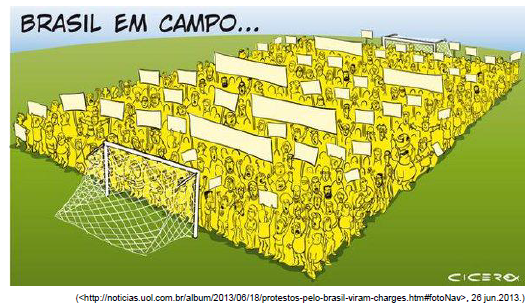
Tendo por base a charge, considere as seguintes afirmativas:
1. O autor aponta a falta de propósito das manifestações, representada na charge pelos cartazes em branco.
2. O autor problematiza a alienação dos brasileiros em época de Copa do Mundo.
3. A linguagem não-verbal enaltece a principal característica brasileira: a paixão pelo futebol.
4. A polissemia do título aproxima as manifestações ocorridas de um de seus principais alvos: o gasto com a Copa do Mundo.
Assinale a alternativa correta.
O estopim foram o aumento do ônibus e a reação truculenta da polícia. Na esteira do protesto inicial, vieram as demandas concretas: a péssima qualidade do transporte, a corrupção, os conchavos políticos, as incongruências entre o investimento em saúde e educação e as fortunas gastas com estádios e futebol, enfim, o abismo entre o Brasil que se vende para o mundo e a nação real, com sua violência, trânsito e serviços precários.
Muitos críticos cobraram falta de foco dos jovens e dificuldade de controle das massas que saíram às ruas. Isso deu, dizem os críticos, espaço para grupos mais radicais e bandidos, que causaram violência. Mas será que houve falta de foco?
Embora as queixas sejam muitas e variadas, alguns padrões em comum podem ser identificados. Trata-se, em primeiro lugar, de um movimento mais horizontal, sem liderança clara. Alguns grupos, como o Movimento Passe Livre (MPL), logo apareceram. Mesmo dentro deles, não parece haver voz única. Boa parte das manifestações se dá “por contágio”. Mesmo o jovem inicialmente acomodado se sente “tocado” pela onda de protestos e decide sair à rua, para participar do momento histórico. A insatisfação crônica com o status do país se transformou de forma rápida, talvez pela capilaridade das redes sociais, numa indignação ativa, potente geradora de força de mobilização. [...]
Os políticos correram para achar uma explicação e tentar dar respostas (algo que não andam acostumados a fazer). Algumas demandas foram rapidamente atendidas. É simplista, porém, justificar o que aconteceu com o fato de o jovem não se sentir representado. Além da crise de representatividade política, que não é queixa só do jovem, faltam a perspectiva de um país melhor – mais justiça, melhores condições de transporte, saúde e educação – e uma percepção menos ufanista e mais real do Brasil.
O desafio dos jovens é manter a força do movimento, num momento em que os governos atendem parcialmente a algumas demandas. Os políticos deveriam perceber que o desafio é usar essa força para mudar o país naquilo que ele tem de pior. Têm de limpar as feridas para facilitar a cicatrização. Não adianta dourar indefinidamente a pílula, na espera de um Brasil que nunca chega.
Observe que Jorge Bouer escreveu “de o jovem" e não “do jovem". Diferentemente do que acontece na fala, a escrita não aceita a contração da preposição com um artigo em certos casos. Em qual das sentenças abaixo a contração é VETADA na escrita culta?
O estopim foram o aumento do ônibus e a reação truculenta da polícia. Na esteira do protesto inicial, vieram as demandas concretas: a péssima qualidade do transporte, a corrupção, os conchavos políticos, as incongruências entre o investimento em saúde e educação e as fortunas gastas com estádios e futebol, enfim, o abismo entre o Brasil que se vende para o mundo e a nação real, com sua violência, trânsito e serviços precários.
Muitos críticos cobraram falta de foco dos jovens e dificuldade de controle das massas que saíram às ruas. Isso deu, dizem os críticos, espaço para grupos mais radicais e bandidos, que causaram violência. Mas será que houve falta de foco?
Embora as queixas sejam muitas e variadas, alguns padrões em comum podem ser identificados. Trata-se, em primeiro lugar, de um movimento mais horizontal, sem liderança clara. Alguns grupos, como o Movimento Passe Livre (MPL), logo apareceram. Mesmo dentro deles, não parece haver voz única. Boa parte das manifestações se dá “por contágio”. Mesmo o jovem inicialmente acomodado se sente “tocado” pela onda de protestos e decide sair à rua, para participar do momento histórico. A insatisfação crônica com o status do país se transformou de forma rápida, talvez pela capilaridade das redes sociais, numa indignação ativa, potente geradora de força de mobilização. [...]
Os políticos correram para achar uma explicação e tentar dar respostas (algo que não andam acostumados a fazer). Algumas demandas foram rapidamente atendidas. É simplista, porém, justificar o que aconteceu com o fato de o jovem não se sentir representado. Além da crise de representatividade política, que não é queixa só do jovem, faltam a perspectiva de um país melhor – mais justiça, melhores condições de transporte, saúde e educação – e uma percepção menos ufanista e mais real do Brasil.
O desafio dos jovens é manter a força do movimento, num momento em que os governos atendem parcialmente a algumas demandas. Os políticos deveriam perceber que o desafio é usar essa força para mudar o país naquilo que ele tem de pior. Têm de limpar as feridas para facilitar a cicatrização. Não adianta dourar indefinidamente a pílula, na espera de um Brasil que nunca chega.
1. As redes sociais propiciaram que os jovens se distanciassem das instituições públicas para poder melhor se mobilizar e criticá-las.
2. A falta de liderança clara confirma a tese de falta de foco do movimento.
3. O movimento das ruas fez com que um estado de insatisfação se transformasse em algo prático.
4. Não se sentir representado foi apenas uma das motivações para as manifestações dos jovens.
Assinale a alternativa correta.
O estopim foram o aumento do ônibus e a reação truculenta da polícia. Na esteira do protesto inicial, vieram as demandas concretas: a péssima qualidade do transporte, a corrupção, os conchavos políticos, as incongruências entre o investimento em saúde e educação e as fortunas gastas com estádios e futebol, enfim, o abismo entre o Brasil que se vende para o mundo e a nação real, com sua violência, trânsito e serviços precários.
Muitos críticos cobraram falta de foco dos jovens e dificuldade de controle das massas que saíram às ruas. Isso deu, dizem os críticos, espaço para grupos mais radicais e bandidos, que causaram violência. Mas será que houve falta de foco?
Embora as queixas sejam muitas e variadas, alguns padrões em comum podem ser identificados. Trata-se, em primeiro lugar, de um movimento mais horizontal, sem liderança clara. Alguns grupos, como o Movimento Passe Livre (MPL), logo apareceram. Mesmo dentro deles, não parece haver voz única. Boa parte das manifestações se dá “por contágio”. Mesmo o jovem inicialmente acomodado se sente “tocado” pela onda de protestos e decide sair à rua, para participar do momento histórico. A insatisfação crônica com o status do país se transformou de forma rápida, talvez pela capilaridade das redes sociais, numa indignação ativa, potente geradora de força de mobilização. [...]
Os políticos correram para achar uma explicação e tentar dar respostas (algo que não andam acostumados a fazer). Algumas demandas foram rapidamente atendidas. É simplista, porém, justificar o que aconteceu com o fato de o jovem não se sentir representado. Além da crise de representatividade política, que não é queixa só do jovem, faltam a perspectiva de um país melhor – mais justiça, melhores condições de transporte, saúde e educação – e uma percepção menos ufanista e mais real do Brasil.
O desafio dos jovens é manter a força do movimento, num momento em que os governos atendem parcialmente a algumas demandas. Os políticos deveriam perceber que o desafio é usar essa força para mudar o país naquilo que ele tem de pior. Têm de limpar as feridas para facilitar a cicatrização. Não adianta dourar indefinidamente a pílula, na espera de um Brasil que nunca chega.
Leia o texto para responder à questão.
What is organized crime?
Organized crime was characterised by the United Nations, in 1994, as: “group organization to commit crime; hierarchical links or personal relationships which permit leaders to control the group: violence, intimidation and corruption used to earn profits or control territories or markets; laundering of illicit proceeds both in furtherance of criminal activity and to infiltrate the legitimate economy; the potential for expansion into any new activities and beyond national borders; and cooperation with other organized transnational criminal groups.”
It is increasingly global. Although links between, for example, mafia groups in Italy and the USA have existed for decades, new and rapid means of communication have facilitated the development of international networks. Some build on shared linguistic or cultural ties, such as a network trafficking drugs and human organs, which links criminal gangs in Mozambique, Portugal, Brazil, Pakistan, Dubai and South Africa. Others bring together much less likely groups, such as those trafficking arms, drugs and people between South Africa, Nigeria, Pakistan and Russia, or those linking the Russian mafia with Colombian cocaine cartels or North American criminal gangs with the Japanese Yakuza. Trafficked commodities may pass from group to group along the supply chain; for instance heroin in Italy has traditionally been produced in Afghanistan, transported by Turks, distributed by Albanians, and sold by Italians.
Organized crime exploits profit opportunities wherever they arise. Globalization of financial markets, with free movement of goods and capital, has facilitated smuggling of counterfeit goods (in part a reflection of the creation of global brands), internet fraud, and money-laundering. On the other hand, organized crime also takes advantage of the barriers to free movement of people across national borders and the laws against non-medicinal use of narcotics: accordingly it earns vast profits in smuggling migrants and psychoactive drugs. Briquet and Favarel have identified deregulation and the “rolling back of the state” in some countries as creating lacunae that have been occupied by profiteers. The political changes in Europe in the late 1980s fuelled the growth in criminal networks, often involving former law enforcement officers. Failed states, such as the Democratic Republic of Congo or Sierra Leone, have provided further opportunities as criminal gangs smuggle arms in and commodities out, for example diamonds, gold, and rare earth metals, often generating violence against those involved in the trade and in the surrounding communities. Finally, there are a few states, such as the Democratic Republic of Korea and Burma and Guinea-Bissau (once described as a narco-state) where politicians have been alleged to have played an active role in international crime.
Organized criminal gangs have strong incentives. Compared with legitimate producers, they have lower costs of production due to the ability to disregard quality and safety standards, tax obligations, minimum wages or employee benefits. Once established, they may threaten or use violence to eliminate competitors, and can obtain favourable treatment by regulatory authorities either through bribes or threats.
(www.globalizationandhealth.com. Adaptado)
Leia o texto para responder à questão.
What is organized crime?
Organized crime was characterised by the United Nations, in 1994, as: “group organization to commit crime; hierarchical links or personal relationships which permit leaders to control the group: violence, intimidation and corruption used to earn profits or control territories or markets; laundering of illicit proceeds both in furtherance of criminal activity and to infiltrate the legitimate economy; the potential for expansion into any new activities and beyond national borders; and cooperation with other organized transnational criminal groups.”
It is increasingly global. Although links between, for example, mafia groups in Italy and the USA have existed for decades, new and rapid means of communication have facilitated the development of international networks. Some build on shared linguistic or cultural ties, such as a network trafficking drugs and human organs, which links criminal gangs in Mozambique, Portugal, Brazil, Pakistan, Dubai and South Africa. Others bring together much less likely groups, such as those trafficking arms, drugs and people between South Africa, Nigeria, Pakistan and Russia, or those linking the Russian mafia with Colombian cocaine cartels or North American criminal gangs with the Japanese Yakuza. Trafficked commodities may pass from group to group along the supply chain; for instance heroin in Italy has traditionally been produced in Afghanistan, transported by Turks, distributed by Albanians, and sold by Italians.
Organized crime exploits profit opportunities wherever they arise. Globalization of financial markets, with free movement of goods and capital, has facilitated smuggling of counterfeit goods (in part a reflection of the creation of global brands), internet fraud, and money-laundering. On the other hand, organized crime also takes advantage of the barriers to free movement of people across national borders and the laws against non-medicinal use of narcotics: accordingly it earns vast profits in smuggling migrants and psychoactive drugs. Briquet and Favarel have identified deregulation and the “rolling back of the state” in some countries as creating lacunae that have been occupied by profiteers. The political changes in Europe in the late 1980s fuelled the growth in criminal networks, often involving former law enforcement officers. Failed states, such as the Democratic Republic of Congo or Sierra Leone, have provided further opportunities as criminal gangs smuggle arms in and commodities out, for example diamonds, gold, and rare earth metals, often generating violence against those involved in the trade and in the surrounding communities. Finally, there are a few states, such as the Democratic Republic of Korea and Burma and Guinea-Bissau (once described as a narco-state) where politicians have been alleged to have played an active role in international crime.
Organized criminal gangs have strong incentives. Compared with legitimate producers, they have lower costs of production due to the ability to disregard quality and safety standards, tax obligations, minimum wages or employee benefits. Once established, they may threaten or use violence to eliminate competitors, and can obtain favourable treatment by regulatory authorities either through bribes or threats.
(www.globalizationandhealth.com. Adaptado)
No trecho do terceiro parágrafo – The political changes in Europe in the late 1980s fuelled the growth in criminal networks, often involving former law enforcement officers. – a palavra fuelled equivale, em português, a
 Conheça nossos planos