Questões Militares
Foram encontradas 14.726 questões
Resolva questões gratuitamente!
Junte-se a mais de 4 milhões de concurseiros!


The underlined word introduces the reason for something to happen.
Another linker used for the same purpose is the one underlined in:
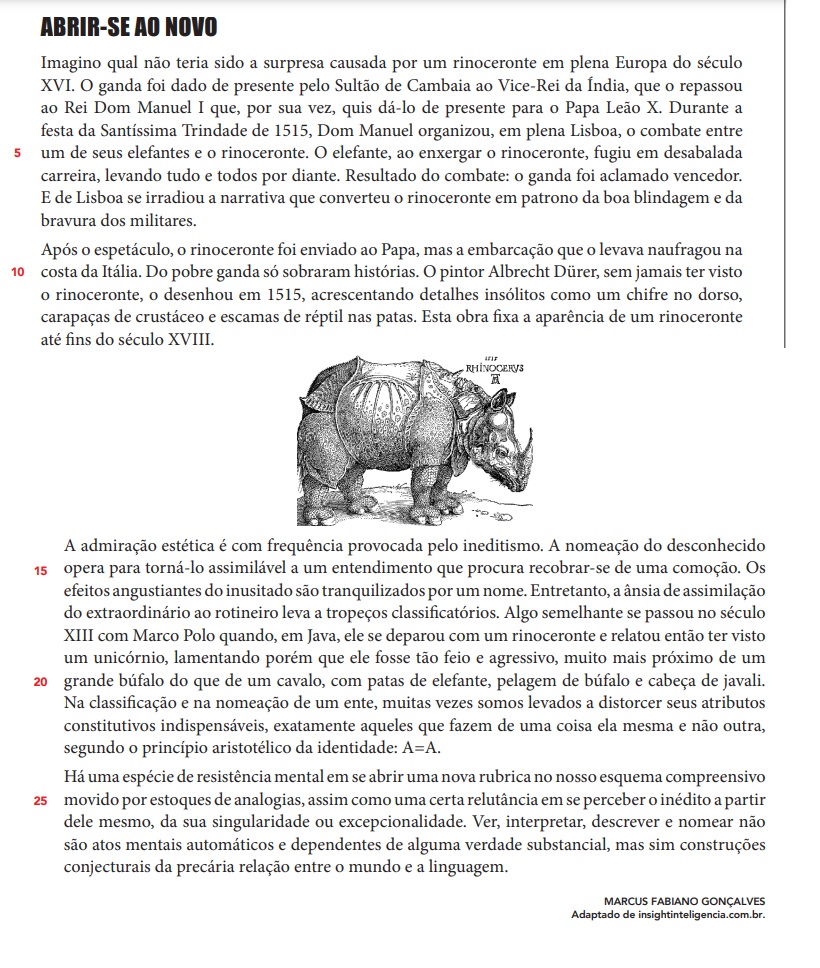
The text Masterpieces rejected by art critics discusses how people deal with novelty, as well as the text Abrir-se ao novo.
Regarding novelty, the two texts have the following aspect in common:

No texto, essa pergunta serve de justificativa para a afirmação que a antecede.
De acordo com essa justificativa, a pessoa mal-educada é ignorante porque:
Esse posicionamento pode ser descrito como:
Esse fenômeno é designado no texto como:
A expressão que melhor contempla a ideia central do texto, servindo de título, é:

Em construções conjecturais da precária relação entre o mundo e a linguagem, o autor destaca que a linguagem oferece uma representação do chamado mundo real, mas não se confunde com ele.
Um trecho do texto que exemplifica essa perspectiva é:
Considerando a articulação das ideias no trecho, o uso da estrutura “não ... mas sim” evidencia, por parte do autor, a adoção de um procedimento de:
A frase sublinhada estabelece com a anterior uma relação de:
TEXT II
The most decorated firefighter in FDNY history
By Xavier Jackson
From the 1970s through the 1990s, there were thousands of fires raging across New York City. And all those fires had one thing in common: they were likely to have faced the likes of Jack Pritchard, the most decorated firefighter in New York City history.
From the beginning, Pritchard had proven himself a worthy member of the team, although his commanding officer was reportedly getting worried about his “near suicidal” tendencies when battling fires. For example, he found himself at the fire of a three-story building with a mentally-challenged child trapped on the third floor. He quickly charged in without oxygen and found the child, before he realized he was trapped. Left with no other exit — and by this point actually on fire himself — Pritchard smothered the child, and leaped to the first floor where he was doused with water and shipped off to the burn ward with the boy.
Pritchard’s next large inferno would be several years later, when he found himself rescuing fellow firefighters from a fire at Waldbaum’s Supermarket in Brooklyn. It was a fire he didn’t even have to go to, since his shift had actually already ended. But that wasn’t going to stop him.
It didn’t take long for him to distinguish himself again. On March 27, 1992, Engine 255 arrived at a fire to find an injured firefighter being pulled from the building after unsuccessfully attempting to rescue a 70-year-old man. Impatient and realizing he didn’t have to wait for orders as he was already in charge, Pritchard charged into the inferno, safety equipment be damned. He found the man, on fire, in his bed. Not hesitating, Pritchard extinguished the flames himself and dragged him out of the building.
He spent the next two months recovering from his burns in the hospital.
Then in July of 1998, Engine 255 pulled up to a fire where Jack Pritchard would perform the most famous heroics of his career. After learning there was an infant trapped in a crib on the fourth floor, Pritchard entered his Supermanmode and fearlessly leaped into the building to locate the baby.
After taking flames directly to his unprotected face, Pritchard located the baby, still alive. Unfortunately, flames were leaping above the crib, preventing him from lifting the baby to safety. Using his un-gloved hands — because safety was a word that still didn’t exist in his vocabulary — Pritchard grabbed the melting crib and began dragging it out of the room. Breathing carbon monoxide and severely burning his hand the whole way, Pritchard dragged the crib to his fellow firefighters where they assisted in rescuing the infant. For this he was awarded his second Bennett medal — the first was for the Walbaum’s fire — the highest award possible in the FDNY.
He finally retired from the department in 1999 with the rank of Battalion Chief, ending his career by simply stating “It’s been a real honor to be a firefighter.”
Available at: <https://www.firerescue1.com/fdny/
articles/the-most-decorated-firefighter-in-fdny-history-
jed6X9Qw0PqRnEbF/>. Accessed on: August 13, 2020
(Adapted).
TEXT II
The most decorated firefighter in FDNY history
By Xavier Jackson
From the 1970s through the 1990s, there were thousands of fires raging across New York City. And all those fires had one thing in common: they were likely to have faced the likes of Jack Pritchard, the most decorated firefighter in New York City history.
From the beginning, Pritchard had proven himself a worthy member of the team, although his commanding officer was reportedly getting worried about his “near suicidal” tendencies when battling fires. For example, he found himself at the fire of a three-story building with a mentally-challenged child trapped on the third floor. He quickly charged in without oxygen and found the child, before he realized he was trapped. Left with no other exit — and by this point actually on fire himself — Pritchard smothered the child, and leaped to the first floor where he was doused with water and shipped off to the burn ward with the boy.
Pritchard’s next large inferno would be several years later, when he found himself rescuing fellow firefighters from a fire at Waldbaum’s Supermarket in Brooklyn. It was a fire he didn’t even have to go to, since his shift had actually already ended. But that wasn’t going to stop him.
It didn’t take long for him to distinguish himself again. On March 27, 1992, Engine 255 arrived at a fire to find an injured firefighter being pulled from the building after unsuccessfully attempting to rescue a 70-year-old man. Impatient and realizing he didn’t have to wait for orders as he was already in charge, Pritchard charged into the inferno, safety equipment be damned. He found the man, on fire, in his bed. Not hesitating, Pritchard extinguished the flames himself and dragged him out of the building.
He spent the next two months recovering from his burns in the hospital.
Then in July of 1998, Engine 255 pulled up to a fire where Jack Pritchard would perform the most famous heroics of his career. After learning there was an infant trapped in a crib on the fourth floor, Pritchard entered his Supermanmode and fearlessly leaped into the building to locate the baby.
After taking flames directly to his unprotected face, Pritchard located the baby, still alive. Unfortunately, flames were leaping above the crib, preventing him from lifting the baby to safety. Using his un-gloved hands — because safety was a word that still didn’t exist in his vocabulary — Pritchard grabbed the melting crib and began dragging it out of the room. Breathing carbon monoxide and severely burning his hand the whole way, Pritchard dragged the crib to his fellow firefighters where they assisted in rescuing the infant. For this he was awarded his second Bennett medal — the first was for the Walbaum’s fire — the highest award possible in the FDNY.
He finally retired from the department in 1999 with the rank of Battalion Chief, ending his career by simply stating “It’s been a real honor to be a firefighter.”
Available at: <https://www.firerescue1.com/fdny/
articles/the-most-decorated-firefighter-in-fdny-history-
jed6X9Qw0PqRnEbF/>. Accessed on: August 13, 2020
(Adapted).
TEXT I
Top stories of 2019 | No. 1: Hero firefighter mourned
BERWICK, Maine — Firefighters and residents in Berwick and surrounding communities felt a deep sense of loss after the death of Fire Capt. Joel Barnes, who died shielding a fellow firefighter from flames during threestory apartment building fire March 1.
Barnes, 32, was hailed as a hero at his funeral for giving up his life to save his comrade.
The fire also displaced eight tenants in six apartment units. No tenants were injured. The National Institute for Occupational Safety and Health, a federal agency responsible for conducting research and making recommendations for the prevention of work-related injury and illness, ruled the building needed to be demolished. The institute inspects buildings whenever a firefighter is killed in the line of duty, according to Berwick Town Manager Stephen Eldridge.
Barnes had no chance to escape from the third floor of the 10 Bell St. apartment building fire, leading to his death from “probable hyperthermia and/or hypoxia,” according to a report released April 5. Dr. Christine James of the New Hampshire chief medical examiner’s office determined the cause of death and ruled the manner of death was accidental. Hyperthermia is defined as the condition of having a body temperature greatly above normal, while hypoxia is a condition in which the body or a region of the body is deprived of adequate oxygen supply at the tissue level.
Available at: <https://www.fosters.com/news/20191230/top-
stories-of-2019--no-1-hero-firefighter-mourned>.
Accessed on: August 11, 2020 (Adapted).
TEXT I
Top stories of 2019 | No. 1: Hero firefighter mourned
BERWICK, Maine — Firefighters and residents in Berwick and surrounding communities felt a deep sense of loss after the death of Fire Capt. Joel Barnes, who died shielding a fellow firefighter from flames during threestory apartment building fire March 1.
Barnes, 32, was hailed as a hero at his funeral for giving up his life to save his comrade.
The fire also displaced eight tenants in six apartment units. No tenants were injured. The National Institute for Occupational Safety and Health, a federal agency responsible for conducting research and making recommendations for the prevention of work-related injury and illness, ruled the building needed to be demolished. The institute inspects buildings whenever a firefighter is killed in the line of duty, according to Berwick Town Manager Stephen Eldridge.
Barnes had no chance to escape from the third floor of the 10 Bell St. apartment building fire, leading to his death from “probable hyperthermia and/or hypoxia,” according to a report released April 5. Dr. Christine James of the New Hampshire chief medical examiner’s office determined the cause of death and ruled the manner of death was accidental. Hyperthermia is defined as the condition of having a body temperature greatly above normal, while hypoxia is a condition in which the body or a region of the body is deprived of adequate oxygen supply at the tissue level.
Available at: <https://www.fosters.com/news/20191230/top-
stories-of-2019--no-1-hero-firefighter-mourned>.
Accessed on: August 11, 2020 (Adapted).
TEXT I
Top stories of 2019 | No. 1: Hero firefighter mourned
BERWICK, Maine — Firefighters and residents in Berwick and surrounding communities felt a deep sense of loss after the death of Fire Capt. Joel Barnes, who died shielding a fellow firefighter from flames during threestory apartment building fire March 1.
Barnes, 32, was hailed as a hero at his funeral for giving up his life to save his comrade.
The fire also displaced eight tenants in six apartment units. No tenants were injured. The National Institute for Occupational Safety and Health, a federal agency responsible for conducting research and making recommendations for the prevention of work-related injury and illness, ruled the building needed to be demolished. The institute inspects buildings whenever a firefighter is killed in the line of duty, according to Berwick Town Manager Stephen Eldridge.
Barnes had no chance to escape from the third floor of the 10 Bell St. apartment building fire, leading to his death from “probable hyperthermia and/or hypoxia,” according to a report released April 5. Dr. Christine James of the New Hampshire chief medical examiner’s office determined the cause of death and ruled the manner of death was accidental. Hyperthermia is defined as the condition of having a body temperature greatly above normal, while hypoxia is a condition in which the body or a region of the body is deprived of adequate oxygen supply at the tissue level.
Available at: <https://www.fosters.com/news/20191230/top-
stories-of-2019--no-1-hero-firefighter-mourned>.
Accessed on: August 11, 2020 (Adapted).
O Bem e o Mal
Eu guardo em mim
dois corações
um que é do mar
um das paixões
um canto doce
um cheiro de temporal
eu guardo em mim
um deus, um louco, um santo
um bem e um mal
eu guardo em mim
tantas canções
de tanto mar
tantas manhãs
encanto doce
o cheiro de um vendaval
guardo em mim
o deus, o louco, o santo
o bem, o mal.
FALCÃO, Dudu; CAYMMI, Danilo. O bem e o mal. In: DANILO
CAYMMI. Danilo Caymmi. São Paulo: RGE, 1992. LP.
Lado A, faixa 1.
Leia este texto.
Três náufragos cegos: Homero, Joyce e Borges, à deriva num mar de palavras. Seu navio bateu numa metáfora – a ponta de um iceberg – e foi ao fundo. Seu bote salva-vidas é levado por uma corrente literária para longe das rotas mais navegadas, eles só serão encontrados se críticos e exegetas da guarda-costeira, que patrulham o mar, os descobrirem na vastidão azul das línguas e os resgatarem de helicóptero. E, mesmo assim, se debaterão contra o salvamento. São cegos difíceis.
VERÍSSIMO, Luís Fernando. A eterna privação do zagueiro
absoluto – as melhores crônicas de futebol, cinema e literatura.
Rio de Janeiro: Objetiva, 1999. p. 167.
Leia este texto.
A mim pouco importava. Tendo descoberto o mundo da palavra escrita, eu estava feliz, muito feliz. [...] Bastava-me o ato de escrever. Colocar no pergaminho letra após letra, palavra após palavra, era algo que me deliciava. Não era só um texto que eu estava produzindo; era beleza, a beleza que resulta da ordem, da harmonia. Eu descobria que uma letra atrai outra, que uma palavra atrai outra, essa afinidade organizando não apenas o texto, como a vida, o universo. O que eu via, no pergaminho, quando terminava o trabalho, era um mapa, como os mapas celestes que indicavam a posição das estrelas e planetas, posição essa que não resulta do acaso, mas da composição de misteriosas forças, as mesmas que, em escala menor, guiavam minha mão quando ela deixava seus sinais sobre o pergaminho. [...] A única pessoa a quem eu tinha vontade de contar o que acontecia era o pastorzinho. Diria a ele que minha vida tinha agora um sentido, um significado: feia, eu era, contudo, capaz de criar beleza. Não a falsa beleza que os espelhos enganosamente refletem, mas a verdadeira e duradoura beleza dos textos que eu escrevia, dia após dia, semana após semana – como se estivesse num estado de permanente e deliciosa embriaguez.
SCLIAR, Moacyr. In: PEREIRA JUNIOR, Luiz Costa. Obra
Aberta. Revista Língua Portuguesa. São Paulo: Segmento,
Ano 5. n.66, abr.2011, p.34-35. Disponível em: <https://poetriz.
wordpress.com/2011/04/16/bastava-escrever/>.
Leia este poema.
O encontro
Jonathan,
se resolvermos que o céu é este lugar onde
ninguém nos ouve,
quem poderá salvar-nos?
Quanto tempo resistiríamos sem falar a ninguém
deste acontecimento?
Acompanhei com os dedos o desenho miraculoso do teu lábio,
contornei-lhe as gengivas, bati-lhe no dente escuro como um cavalo,
um cavalo meu na campina.
Pedi-lhe: faz com tua unha um risco na minha cara,
o amor da morte instigando-nos com nunca vista coragem.
Vamos morrer juntos antes que o corpo alardeie sua mísera condição.
Agora, Jonathan neste lugar tão ermo, neste lugar
perfeito.
PRADO, Adélia. Poesia completa. 9 ed.
São Paulo: Siciliano, 1991. p. 6.
 Conheça nossos planos