Selecionar segmento
Estude com questões de diferentes segmentos
Atenção: Isso limpará todos os campos já preenchidos no filtro!
Foram encontradas 255 questões
Resolva questões gratuitamente!
Junte-se a mais de 4 milhões de concurseiros!


Ano: 2015
Banca:
Exército
Órgão:
IME
Prova:
Exército - 2015 - IME - Aluno - Matemática, Química e Física |
Q581571
Física
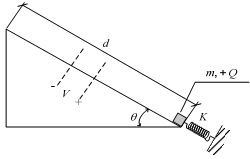
Um corpo de carga positiva, inicialmente em repouso sobre uma rampa plana isolante com atrito, está apoiado em uma mola, comprimindo-a. Após ser liberado, o corpo entra em movimento e atravessa uma região do espaço com diferença de potencial V, sendo acelerado. Para que o corpo chegue ao final da rampa com velocidade nula, a distância d indicada na figura é
Dados:
• deformação inicial da mola comprimida: x;
• massa do corpo: m;
• carga do corpo: + Q;
• aceleração da gravidade: g;
• coeficiente de atrito dinâmico entre o corpo e a rampa: µ;
• ângulo de inclinação da rampa: θ;
• constante elástica da mola: K.
Considerações:
• despreze os efeitos de borda;
• a carga do corpo permanece constante ao longo da trajetória.
Q504248
Inglês
Para a questão, marque a alternativa CORRETA.
Q504240
Inglês
Russian Sports Minister says he ___________ by the slow pace of designing the country’s stadiums for the 2018 World Cup and threatened heads will roll if the situation is not rectified.
Q504239
Inglês
The player was about to take corner when he _______________ at him.
Q504238
Inglês
___________ the Fifa president and vice president will be in Brazil for the World Soccer Cup.
Q504237
Inglês
There are many forms of prejudice and oppression, __________ based on race, but on gender, class, sexual orientation, etc.
Q504236
Inglês
On average, women continue to earn considerably less than men. In 2012, female full-time workers made only 77 cents for every dollar earned by men, a gender wage gap ____ 23 percent.
Q504235
Inglês
“I have a dream that one day, on the red hills of Georgia, the sons of former slaves and the sons of former slave owners _________________ sit down together at the table of brotherhood.” (Martin Luther King)
Q504234
Inglês
_______________ the legislation promising them a fair share of opportunity, Dalits (lower caste) Hindus continue to form among the poorest sections of indian society.
Q504233
Inglês
During the Second World War, approximately 6 million european jews __________ mass murdered in concentration camps and forced labour.
Q504231
Inglês
Texto associado
Text 2
What’s in a name?
Henry Louis Gates Jr. (1989)
The question of color takes up much space in these pages, but the question of color, especially in this country, operates to hide the graver questions of the self.
- James Baldwin, 1961
… blood, darky, Tar baby, Kaffir, shine… moor, blackamoor, Jim Crow, spook… quadroon, meriney, red bone, high yellow… Mammy, porch monkey, home, homeboy, George… spearchucker, Leroy, Smokey…mouli, buck, Ethiopian, brother, sistah…
- Trey Ellis, 1989
I had forgotten the incident completely, until I read Trey Elli’s essay, “Remember My Name,” in a recent issue of the Village Voice (June 13, 1989). But there, in the middle of an extended italicized list of the bynames of “the race” (“the race” or “our people” being the terms my parents used in polite or reverential discourse, “jigaboo” or “nigger” more commonly used in anger, jest, or pure disgust), it was: “George”. Now the events of that very brief exchange return to my mind so vividly that I wonder why I had forgotten it.
My father and I were walking home at dusk from his second job. He “moonlighted” as a janitor in the evenings for the telephone company. Every day, but Saturday, he would come home at 3:30 from his regular job at the paper Mill, wash up, eat supper, then at 4:30 head downtown to his second job. He used to make jokes frequently about a union official who moonlighted. I never got the joke, but he and his friends thought it was hilarious. All I knew was that my family always ate well, that my brother and I had new clothes to wear, and that all of the white people in Piedmont, West Virginia, treated my parents with an odd mixture of resentment and respect that even we understood at the time had something directly to do with a small but certain measure of financial security.
He had left a little early that evening because I was with him and I had to be in bed early. I could not have been more than five or six, and we had stopped off at the Cut-Rate Drug Store (where no black person in town but my father could sit down to eat, and eat off real plates with real silverware) so that I could buy some caramel ice cream, two scoops in a wafer cone, please, which I was busy licking when Mr. Wilson walked by.
Mr. Wilson was a very quiet man, whose stony, brooding, silent manner seemed designed to scare off any overtures of friendship, even from white people. He was Irish as was one-third of our village (another third being Italian), the more affluent among whom sent their children to “Catholic School” across the bridge in Maryland. He had white straight hair, like my Uncle Joe, whom he uncannily resembled, and he carried a black worn metal lunch pail, the kind that Riley carried on the television show. My father always spoke to him, and for reasons that we never did understand, he always spoke to my father.
“Hello, Mr. Wilson,” I heard my father say.
“Hello, George.” I stopped licking my ice cream cone, and asked my Dad in a loud voice why Mr. Wilson had called him “George.”
“Doesn’t he know your name, Daddy? Why don’t you tell him your name? Your name isn’t George.”
For a moment I tried to think of who Mr. Wilson was mixing Pop up with. But we didn’t have any Georges among the colored people in Piedmont; nor were there colored Georges living in the neighboring towns and working at the Mill.
“Tell him your name, Daddy.”
“He knows my name, boy,” my father said after a long pause. “He calls all colored people George.” A long silence ensued. It was “one of those things”, as my Mom would put it. Even then, that early, I knew when I was in the presence of “one of those things”, one of those things that provided a glimpse, through a rent curtain, at another world that we could not affect but that affected us. There would be a painful moment of silence, and you would wait for it to give way to a discussion of a black superstar such as Sugar Ray or Jackie Robinson.
“Nobody hits better in a clutch than Jackie Robinson.”
“That’s right. Nobody.”
I never again looked Mr. Wilson in the eye.
What’s in a name?
Henry Louis Gates Jr. (1989)
The question of color takes up much space in these pages, but the question of color, especially in this country, operates to hide the graver questions of the self.
- James Baldwin, 1961
… blood, darky, Tar baby, Kaffir, shine… moor, blackamoor, Jim Crow, spook… quadroon, meriney, red bone, high yellow… Mammy, porch monkey, home, homeboy, George… spearchucker, Leroy, Smokey…mouli, buck, Ethiopian, brother, sistah…
- Trey Ellis, 1989
I had forgotten the incident completely, until I read Trey Elli’s essay, “Remember My Name,” in a recent issue of the Village Voice (June 13, 1989). But there, in the middle of an extended italicized list of the bynames of “the race” (“the race” or “our people” being the terms my parents used in polite or reverential discourse, “jigaboo” or “nigger” more commonly used in anger, jest, or pure disgust), it was: “George”. Now the events of that very brief exchange return to my mind so vividly that I wonder why I had forgotten it.
My father and I were walking home at dusk from his second job. He “moonlighted” as a janitor in the evenings for the telephone company. Every day, but Saturday, he would come home at 3:30 from his regular job at the paper Mill, wash up, eat supper, then at 4:30 head downtown to his second job. He used to make jokes frequently about a union official who moonlighted. I never got the joke, but he and his friends thought it was hilarious. All I knew was that my family always ate well, that my brother and I had new clothes to wear, and that all of the white people in Piedmont, West Virginia, treated my parents with an odd mixture of resentment and respect that even we understood at the time had something directly to do with a small but certain measure of financial security.
He had left a little early that evening because I was with him and I had to be in bed early. I could not have been more than five or six, and we had stopped off at the Cut-Rate Drug Store (where no black person in town but my father could sit down to eat, and eat off real plates with real silverware) so that I could buy some caramel ice cream, two scoops in a wafer cone, please, which I was busy licking when Mr. Wilson walked by.
Mr. Wilson was a very quiet man, whose stony, brooding, silent manner seemed designed to scare off any overtures of friendship, even from white people. He was Irish as was one-third of our village (another third being Italian), the more affluent among whom sent their children to “Catholic School” across the bridge in Maryland. He had white straight hair, like my Uncle Joe, whom he uncannily resembled, and he carried a black worn metal lunch pail, the kind that Riley carried on the television show. My father always spoke to him, and for reasons that we never did understand, he always spoke to my father.
“Hello, Mr. Wilson,” I heard my father say.
“Hello, George.” I stopped licking my ice cream cone, and asked my Dad in a loud voice why Mr. Wilson had called him “George.”
“Doesn’t he know your name, Daddy? Why don’t you tell him your name? Your name isn’t George.”
For a moment I tried to think of who Mr. Wilson was mixing Pop up with. But we didn’t have any Georges among the colored people in Piedmont; nor were there colored Georges living in the neighboring towns and working at the Mill.
“Tell him your name, Daddy.”
“He knows my name, boy,” my father said after a long pause. “He calls all colored people George.” A long silence ensued. It was “one of those things”, as my Mom would put it. Even then, that early, I knew when I was in the presence of “one of those things”, one of those things that provided a glimpse, through a rent curtain, at another world that we could not affect but that affected us. There would be a painful moment of silence, and you would wait for it to give way to a discussion of a black superstar such as Sugar Ray or Jackie Robinson.
“Nobody hits better in a clutch than Jackie Robinson.”
“That’s right. Nobody.”
I never again looked Mr. Wilson in the eye.
According to Gates’ description in text 2, we can say that Mr Wilson was
Q504230
Inglês
Texto associado
Text 2
What’s in a name?
Henry Louis Gates Jr. (1989)
The question of color takes up much space in these pages, but the question of color, especially in this country, operates to hide the graver questions of the self.
- James Baldwin, 1961
… blood, darky, Tar baby, Kaffir, shine… moor, blackamoor, Jim Crow, spook… quadroon, meriney, red bone, high yellow… Mammy, porch monkey, home, homeboy, George… spearchucker, Leroy, Smokey…mouli, buck, Ethiopian, brother, sistah…
- Trey Ellis, 1989
I had forgotten the incident completely, until I read Trey Elli’s essay, “Remember My Name,” in a recent issue of the Village Voice (June 13, 1989). But there, in the middle of an extended italicized list of the bynames of “the race” (“the race” or “our people” being the terms my parents used in polite or reverential discourse, “jigaboo” or “nigger” more commonly used in anger, jest, or pure disgust), it was: “George”. Now the events of that very brief exchange return to my mind so vividly that I wonder why I had forgotten it.
My father and I were walking home at dusk from his second job. He “moonlighted” as a janitor in the evenings for the telephone company. Every day, but Saturday, he would come home at 3:30 from his regular job at the paper Mill, wash up, eat supper, then at 4:30 head downtown to his second job. He used to make jokes frequently about a union official who moonlighted. I never got the joke, but he and his friends thought it was hilarious. All I knew was that my family always ate well, that my brother and I had new clothes to wear, and that all of the white people in Piedmont, West Virginia, treated my parents with an odd mixture of resentment and respect that even we understood at the time had something directly to do with a small but certain measure of financial security.
He had left a little early that evening because I was with him and I had to be in bed early. I could not have been more than five or six, and we had stopped off at the Cut-Rate Drug Store (where no black person in town but my father could sit down to eat, and eat off real plates with real silverware) so that I could buy some caramel ice cream, two scoops in a wafer cone, please, which I was busy licking when Mr. Wilson walked by.
Mr. Wilson was a very quiet man, whose stony, brooding, silent manner seemed designed to scare off any overtures of friendship, even from white people. He was Irish as was one-third of our village (another third being Italian), the more affluent among whom sent their children to “Catholic School” across the bridge in Maryland. He had white straight hair, like my Uncle Joe, whom he uncannily resembled, and he carried a black worn metal lunch pail, the kind that Riley carried on the television show. My father always spoke to him, and for reasons that we never did understand, he always spoke to my father.
“Hello, Mr. Wilson,” I heard my father say.
“Hello, George.” I stopped licking my ice cream cone, and asked my Dad in a loud voice why Mr. Wilson had called him “George.”
“Doesn’t he know your name, Daddy? Why don’t you tell him your name? Your name isn’t George.”
For a moment I tried to think of who Mr. Wilson was mixing Pop up with. But we didn’t have any Georges among the colored people in Piedmont; nor were there colored Georges living in the neighboring towns and working at the Mill.
“Tell him your name, Daddy.”
“He knows my name, boy,” my father said after a long pause. “He calls all colored people George.” A long silence ensued. It was “one of those things”, as my Mom would put it. Even then, that early, I knew when I was in the presence of “one of those things”, one of those things that provided a glimpse, through a rent curtain, at another world that we could not affect but that affected us. There would be a painful moment of silence, and you would wait for it to give way to a discussion of a black superstar such as Sugar Ray or Jackie Robinson.
“Nobody hits better in a clutch than Jackie Robinson.”
“That’s right. Nobody.”
I never again looked Mr. Wilson in the eye.
What’s in a name?
Henry Louis Gates Jr. (1989)
The question of color takes up much space in these pages, but the question of color, especially in this country, operates to hide the graver questions of the self.
- James Baldwin, 1961
… blood, darky, Tar baby, Kaffir, shine… moor, blackamoor, Jim Crow, spook… quadroon, meriney, red bone, high yellow… Mammy, porch monkey, home, homeboy, George… spearchucker, Leroy, Smokey…mouli, buck, Ethiopian, brother, sistah…
- Trey Ellis, 1989
I had forgotten the incident completely, until I read Trey Elli’s essay, “Remember My Name,” in a recent issue of the Village Voice (June 13, 1989). But there, in the middle of an extended italicized list of the bynames of “the race” (“the race” or “our people” being the terms my parents used in polite or reverential discourse, “jigaboo” or “nigger” more commonly used in anger, jest, or pure disgust), it was: “George”. Now the events of that very brief exchange return to my mind so vividly that I wonder why I had forgotten it.
My father and I were walking home at dusk from his second job. He “moonlighted” as a janitor in the evenings for the telephone company. Every day, but Saturday, he would come home at 3:30 from his regular job at the paper Mill, wash up, eat supper, then at 4:30 head downtown to his second job. He used to make jokes frequently about a union official who moonlighted. I never got the joke, but he and his friends thought it was hilarious. All I knew was that my family always ate well, that my brother and I had new clothes to wear, and that all of the white people in Piedmont, West Virginia, treated my parents with an odd mixture of resentment and respect that even we understood at the time had something directly to do with a small but certain measure of financial security.
He had left a little early that evening because I was with him and I had to be in bed early. I could not have been more than five or six, and we had stopped off at the Cut-Rate Drug Store (where no black person in town but my father could sit down to eat, and eat off real plates with real silverware) so that I could buy some caramel ice cream, two scoops in a wafer cone, please, which I was busy licking when Mr. Wilson walked by.
Mr. Wilson was a very quiet man, whose stony, brooding, silent manner seemed designed to scare off any overtures of friendship, even from white people. He was Irish as was one-third of our village (another third being Italian), the more affluent among whom sent their children to “Catholic School” across the bridge in Maryland. He had white straight hair, like my Uncle Joe, whom he uncannily resembled, and he carried a black worn metal lunch pail, the kind that Riley carried on the television show. My father always spoke to him, and for reasons that we never did understand, he always spoke to my father.
“Hello, Mr. Wilson,” I heard my father say.
“Hello, George.” I stopped licking my ice cream cone, and asked my Dad in a loud voice why Mr. Wilson had called him “George.”
“Doesn’t he know your name, Daddy? Why don’t you tell him your name? Your name isn’t George.”
For a moment I tried to think of who Mr. Wilson was mixing Pop up with. But we didn’t have any Georges among the colored people in Piedmont; nor were there colored Georges living in the neighboring towns and working at the Mill.
“Tell him your name, Daddy.”
“He knows my name, boy,” my father said after a long pause. “He calls all colored people George.” A long silence ensued. It was “one of those things”, as my Mom would put it. Even then, that early, I knew when I was in the presence of “one of those things”, one of those things that provided a glimpse, through a rent curtain, at another world that we could not affect but that affected us. There would be a painful moment of silence, and you would wait for it to give way to a discussion of a black superstar such as Sugar Ray or Jackie Robinson.
“Nobody hits better in a clutch than Jackie Robinson.”
“That’s right. Nobody.”
I never again looked Mr. Wilson in the eye.
Which of the following conclusions can be drawn from text 2?
Ano: 2014
Banca:
Exército
Órgão:
IME
Prova:
Exército - 2014 - IME - Aluno - Matemática, Química e Física |
Q503359
Química
Considere a rota sintética descrita na sequência abaixo onde cada etapa ocorre em temperatura e pressão adequadas:
1a Etapa: o composto A (C7H6O) sofre oxidação em solução básica de permanganato de potássio. O produto gerado, após neutralizado, é o ácido benzoico;
2a Etapa: o ácido benzoico reage com etanol em solução ácida, produzindo o composto B e água;
3a Etapa: o composto B sofre forte redução com hidreto de lítio-alumínio em éter, gerando dois produtos que, depois de neutralizados, formam então o composto C e o etanol.
Considerando as etapas supracitadas, são feitas as seguintes afirmações:
I) o composto A e o composto C são isômeros.
II) o composto B é um éster.
III) o composto B é o acetato de benzila.
Com base na análise das afirmações acima, assinale a opção correta.
1a Etapa: o composto A (C7H6O) sofre oxidação em solução básica de permanganato de potássio. O produto gerado, após neutralizado, é o ácido benzoico;
2a Etapa: o ácido benzoico reage com etanol em solução ácida, produzindo o composto B e água;
3a Etapa: o composto B sofre forte redução com hidreto de lítio-alumínio em éter, gerando dois produtos que, depois de neutralizados, formam então o composto C e o etanol.
Considerando as etapas supracitadas, são feitas as seguintes afirmações:
I) o composto A e o composto C são isômeros.
II) o composto B é um éster.
III) o composto B é o acetato de benzila.
Com base na análise das afirmações acima, assinale a opção correta.
Ano: 2014
Banca:
Exército
Órgão:
IME
Prova:
Exército - 2014 - IME - Aluno - Matemática, Química e Física |
Q503357
Química
Assinale a alternativa correta.
Ano: 2014
Banca:
Exército
Órgão:
IME
Prova:
Exército - 2014 - IME - Aluno - Matemática, Química e Física |
Q503356
Química
Um isótopo radioativo X transforma-se em um elemento estável Y após reações de desintegração radioativa com emissão de radiação α, radiação β negativa e radiação ϒ. Assinale a alternativa correta.
Ano: 2014
Banca:
Exército
Órgão:
IME
Prova:
Exército - 2014 - IME - Aluno - Matemática, Química e Física |
Q503353
Química
Considere os compostos abaixo enumerados.
I. Acetona;
II. Neopentano;
III. Fluoreto de lítio;
IV. Etanamida;
V. Pentano.
Assinale a alternativa que apresenta a sequência correta, conforme a ordem crescente de ponto de ebulição.
I. Acetona;
II. Neopentano;
III. Fluoreto de lítio;
IV. Etanamida;
V. Pentano.
Assinale a alternativa que apresenta a sequência correta, conforme a ordem crescente de ponto de ebulição.
Ano: 2014
Banca:
Exército
Órgão:
IME
Prova:
Exército - 2014 - IME - Aluno - Matemática, Química e Física |
Q503350
Química
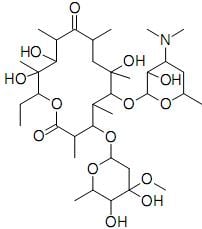
A eritromicina é uma substância antibacteriana do grupo dos macrolídeos muito utilizada no tratamento de diversas infecções. Dada a estrutura da eritromicina abaixo, assinale a alternativa que corresponde às funções orgânicas presentes.
Ano: 2013
Banca:
Exército
Órgão:
IME
Prova:
Exército - 2013 - IME - Aluno - Matemática, Química e Física |
Q670260
Química
Realiza-se a eletrólise de uma solução aquosa diluída de ácido sulfúrico com eletrodos inertes durante 10 minutos. Determine a corrente elétrica média aplicada, sabendo-se que foram produzidos no catodo 300 mL de hidrogênio, coletados a uma pressão total de 0,54 atm sobre a água, à temperatura de 300 K.
Considere:
• Pressão de vapor da água a 300 K = 0,060 atm;
• Constante de Faraday: 1 F = 96500 C.mol–1;
• Constante universal dos gases perfeitos: R = 0,08 atm.L.K–1.mol–1
.
Ano: 2013
Banca:
Exército
Órgão:
IME
Prova:
Exército - 2013 - IME - Aluno - Matemática, Química e Física |
Q670259
Química
Um hidreto gasoso tem fórmula empírica XH3 (massa molar de X = 13 g/mol) e massa específica de
6,0 g/L numa dada condição de temperatura e pressão. Sabendo-se que, nas mesmas temperatura e
pressão, 1,0 L de O2 gasoso tem massa de 3,0 g, pode-se afirmar que a fórmula molecular do hidreto é
Ano: 2013
Banca:
Exército
Órgão:
IME
Prova:
Exército - 2013 - IME - Aluno - Matemática, Química e Física |
Q670258
Química
Uma mistura “A”, cuja composição percentual volumétrica é de 95% de água e 5% de álcool etílico, está
contida no bécher 1. Uma mistura “B”, cuja composição percentual volumétrica é de 95% de água e 5%
de gasolina, está contida no bécher 2. Essas misturas são postas em repouso a 25 °C e 1 atm, tempo
suficiente para se estabelecer, em cada bécher, a situação de equilíbrio. Em seguida, aproximam-se
chamas sobre as superfícies de ambas as misturas. O que ocorrerá?

 Conheça nossos planos