Foram encontradas 458 questões
Resolva questões gratuitamente!
Junte-se a mais de 4 milhões de concurseiros!


1. Em cnidários, tanto pólipos como medusas apresentam o mesmo sistema respiratório. 2. Larvas e adultos de equinodermos normalmente têm o mesmo tipo de simetria. 3. Girinos e sapos diferem em seus sistemas respiratórios. 4. Em algumas espécies de borboletas, imaturos podem ter uma dieta completamente diferente da dieta de adultos. 5. Larvas de crustáceos comumente mudam de um estado séssil para a vida livre durante a sua metamorfose.
Assinale a alternativa correta
(<Fonte: http://revistapesquisa.fapesp.br/2016/05/19/vacina-contra-esquistossomose>. Acessado em 08/08/2016.)
Texto 2: Pesquisadores da Universidade Estadual Paulista (UNESP) de Botucatu conseguiram autorização do Ministério da Saúde e da Agência Nacional de Vigilância Sanitária (Anvisa) para iniciar testes em humanos do soro antiapílico (antiveneno de abelhas). O soro, composto por uma imunoglobulina heteróloga, será o primeiro do mundo.
(Fonte:<http://oglobo.globo.com/sociedade/ciencia/soro-antiveneno-de-abelha-comeca-ser-testado-em-humanos-este-mes-19046264> . Acesso: 24/04/16.)
A proteína Sm14 e a imunoglobulina heteróloga atuam no organismo, respectivamente, como:
( ) Os peixes GloFish são chamados transgênicos porque possuem em seu genoma um segmento de DNA de medusa.
( ) O gene que codifica a GFP foi inserido nas células somáticas, mas não nas gaméticas dos peixes GloFish.
( ) As células fluorescentes dos GloFish produzem RNA mensageiro, que, por meio da tradução, origina a proteína GFP.
( ) Os peixes GloFish foram produzidos pela introdução de um núcleo extraído de uma célula de medusa em uma célula de peixe cujo núcleo tinha sido anteriormente removido.
Assinale a alternativa que apresenta a sequência correta, de cima para baixo.
(Disponível em:<http://noticias.uol.com.br/ultimas-noticias/agencia-brasil/2016/08/30/ibge-brasil-ja-tem-206-milhoes-de-habitantes.htm> . Acessado em 31.08.2016.)
Com base nas informações do texto e nos conhecimentos em geografia da população, assinale a alternativa correta.
(Mendonça, F.; Danni-Oliveira, I. M. Climatologia: noções básicas e climas do Brasil. São Paulo: Oficina de Texto, 2007).
Sobre o El Niño e a dinâmica climática global, é correto afirmar:
Os processos industriais não imitam a natureza; a agroecologia, sim, o faz. Substitui os insumos externos, como o fertilizante, por saberes de como combinar plantas, árvores e animais, de tal forma que se reforce a produtividade da terra. […] a produtividade aumentou até 214% em 44 projetos em 20 países da África Subsaariana mediante técnicas de agroecologia em um período de 3-10 anos [...] muito mais do que qualquer cultivo geneticamente modificado alguma vez já tenha conseguido […]. Outras avaliações científicas recentes mostraram que os camponeses de 57 países que utilizam técnicas agroecológicas obtiveram aumento de até 80% na produtividade. O aumento médio dos africanos é de 116% […]. Hoje, a evidência científica demonstra que os métodos agroecológicos são muito melhores do que os fertilizantes químicos para aumentar a produção de alimentos em regiões onde vivem os famintos.
(Fontes: Stephen Leahy, Mudança climática e cultivos ecológicos, 20 dec. 2011. Disponível em<https://www.grain.org/article/entries/4439-mudanca-climatica-e-cultivos-ecologico> . Olivier de Schutter: “La agroecología y el derecho a la alimentación”, relatório apresentado no Conselho de Direitos Humanos, 8 de mar. 2011.)
Com base nas informações do texto e nos conhecimentos de geografia agrária, assinale a alternativa correta.
(Adaptado de Carleial, L. O desenvolvimento regional ainda em questão. In: Randolph, R.; Siqueira, H.; Oliveira, A. (orgs.). Planejamento, políticas e experiências de desenvolvimento regional: problemáticas e desafios. Rio de Janeiro: Letra Capital, 2014, p. 40).
Com base no texto e nos conhecimentos de geografia econômica e regional do Brasil, assinale a alternativa correta.
(Fonte:<http://www.gazetadopovo.com.br/vida-e-cidadania/apos-reuniao-ocupacao-do-predio-do-inss-no-centro-de-curitiba-continua-4fy22h23tbk3jhl7riwetqsop . Publicado em 15/04/2015. Acessado em 21/08/2016.)
Com base na problemática presente no texto e nos conhecimentos de geografia urbana, identifique como verdadeiras (V) ou falsas (F) as seguintes afirmativas:
( ) Uma das causas das situações expostas no texto é a valorização do solo urbano, sobretudo em espaços com boa infraestrutura, que impede o acesso à moradia por parte significativa dos habitantes das cidades brasileiras.
( ) A participação da sociedade na gestão urbana é uma diretriz prevista legalmente, que pode contribuir para a gestão democrática dos municípios e diminuir os conflitos pelo direito ao uso da cidade.
( ) Segundo o Estatuto das Cidades, a regularização fundiária e a urbanização são instrumentos de política urbana considerados entraves à prevenção e resolução de problemas ambientais.
( ) O Poder Público possui mecanismos para combater a especulação imobiliária e promover a função social da propriedade, mas, nesse tema, há um descompasso entre as questões legais e a ação governamental.
Assinale a alternativa que apresenta a sequência correta, de cima para baixo.
Considerando as informações do texto, o desenvolvimento da cartografia e o uso de mapas, identifique como verdadeiras (V) ou falsas (F) as seguintes afirmativas:
( ) A história da cartografia mostra que mapas são confeccionados para atender objetivos específicos que, quando cumpridos, tornam obsoletas as informações neles constantes.
( ) O texto ilustra o papel dos mapas como ferramenta de apoio e planejamento a inúmeras atividades que necessitam de informações espaciais.
( ) A leitura e interpretação de mapas exige a construção de legendas apropriadas ao tipo de informação que o mapa pretende transmitir.
( ) A observação Enrolem esse mapa; ele não será necessário pode ser considerada uma afirmação atual, uma vez que a tecnologia digital, empregada nos processos de produção e distribuição de mapas, tornou dispensável seu uso em papel.
Assinale a alternativa que apresenta a sequência correta, de cima para baixo.
1. Os satélites imageadores modernos possuem tecnologia capaz de adquirir imagens mesmo com a presença de densas nuvens, que não são mais um fator limitante, como ocorria com os antigos satélites do século XX.
2. O Brasil, devido aos altos custos e atraso tecnológico, desistiu da construção de satélites imageadores e passou a construir satélites de comunicação.
3. Imagens obtidas por sistemas sensores presentes em satélites são amplamente utilizadas em monitoramentos meteorológicos e de uso do solo, por exemplo.
Assinale a alternativa correta.
(Weissheimer, Marco. Disponível em:<http://www.sul21.com.br/jornal/mulheres-curdas-lutam-por-democracia-confederada-e-nova-economia/> . Acessado em: 16/08/2016).
Com base nas informações do texto e nos conhecimentos sobre geopolítica e conflitos territoriais mundiais, considere as seguintes afirmativas:
1. O texto retrata um dos principais conflitos e impasses étnico-territoriais na região do Oriente Médio, que envolve um grupo étnico considerado a maior nação sem pátria do mundo.
2. Grande parte do povo curdo habita uma região montanhosa localizada dentro dos territórios da Turquia, Síria, Iraque e Irã, mostrando que fronteiras étnicas e culturais entre Estados nem sempre são convergentes.
3. Apesar do conflito com o Estado Islâmico, o território curdo é reconhecido pelos Estados do Irã, Iraque e Turquia, onde a língua curda é tida como oficial.
Assinale a alternativa correta.
Como resultados dessas políticas de Estado, foi possível estimar ao menos 8.350 indígenas mortos no período de investigação da CNV, em decorrência da ação direta de agentes governamentais ou da sua omissão. Essa cifra inclui apenas aqueles casos aqui estudados em relação aos quais foi possível desenhar uma estimativa. O número real de indígenas mortos no período deve ser exponencialmente maior, uma vez que apenas uma parcela muito restrita dos povos indígenas afetados foi analisada e que há casos em que a quantidade de mortos é alta o bastante para desencorajar estimativas.
(RELATÓRIO, Comissão Nacional da Verdade. Violação dos Direitos Humanos dos Povos Indígenas, v. 2. Texto 5. 2014. p. 205.)
Sobre a questão indígena na Ditadura Militar, assinale a alternativa correta.
Observe a imagem e leia o fragmento a seguir:
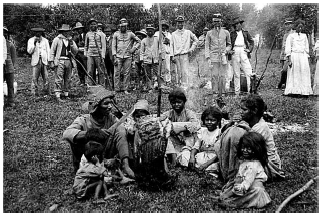
Desde 1853, a disputa territorial entre o Paraná e Santa Catarina vinha se arrastando e, já no início do século XX – após a Proclamação da República e o princípio de autonomia dos estados da Federação – constituiu motivo de discussões acirradas entre as instâncias de poder desses estados brasileiros, contando, em diversos momentos, com as opiniões de representantes políticos de outras regiões do país. Diversos foram os pareceres emitidos pelo poder federal, ora dando ganho de causa a um, ora a outro.
(DALFRÉ, Liz A. Outras narrativas da nacionalidade: o movimento do Contestado. Coleção Teses do Museu Paranaense. v. 8. Curitiba: SAMP. 2014. p. 38-39.)
Sobre o movimento do Contestado, considere as seguintes afirmativas:
1. O movimento do Contestado se deu no leste paranaense, no qual vários missionários buscavam resgatar terras adquiridas por Santa Catarina no final do século XIX.
2. Entre as figuras mais emblemáticas do movimento está a de José Maria, um monge leigo que teve vários seguidores, dando feição messiânica ao combate.
3. Em 1912, o governo federal deu por finalizado o conflito, após a batalha de Irani, em que morreram vários sertanejos, entre eles, José Maria.
4. O movimento do Contestado compreende o conflito que ocorreu entre sertanejos catarinenses e paranaenses e as forças do governo federal e local.
Assinale a alternativa correta.
Durante a Idade Média, a figura feminina revestiu-se dos piores atributos imagináveis. Para os teólogos, além de infantil e inconstante, a mulher era mãe de todo pecado: Thomas Murner chamava-a de “Diabo doméstico”, enquanto Tomás de Aquino reservava-lhe a pecha de “macho deficiente”. Essas características levaram-na a ser o elo fraco das sociedades cristãs, a janela pela qual Satã adentrava territórios sacramentados. Sendo fraca de vontade e caráter, a mulher ficava à mercê das tentações demoníacas, tornando-se facilmente discípula e amante do Diabo.
(SOUZA, Aníbal. Missionários e Feiticeiros. História: Questões e Debates, Curitiba, v. 13. jul./dez., 1996. p. 118.)
Em relação ao imaginário na Idade Média, é correto afirmar que vigorava uma forte influência:

 Conheça nossos planos