Foram encontradas 17 questões
Resolva questões gratuitamente!
Junte-se a mais de 4 milhões de concurseiros!


No último livro que publicou em vida, Teia (1996), a escritora Orides Fontela escreveu o poema ao lado.
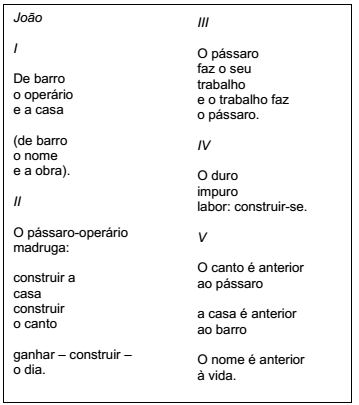
Podemos afirmar que:
I. nem a parte I nem a II indicam que o pássaro “joão-de-barro” pode ser visto como metáfora de um determinado tipo social.
II. apenas a parte III sugere que o trabalho feito pelo joão-de-barro aproxima-se daquele feito por um operário.
III. o poema, em seu todo, aproxima metaforicamente o “joão-de-barro” de um trabalhador brasileiro (um “João”, como o título indica).
IV. como no caso do pássaro, também para o operário vale a idéia de que o homem faz o trabalho e o trabalho faz o homem.
Estão corretas apenas as afirmações:
O poema ao lado faz parte da obra Livro sobre nada (1996), de Manoel de Barros:
A ciência pode classificar e nomear os órgãos de um sabiá
mas não pode medir seus encantos.
A ciência não pode calcular quantos cavalos de força
existem
nos encantos de um sabiá.
Quem acumula muita informação perde o condão de
adivinhar: divinare.
Os sabiás divinam.
É certo dizer que estamos diante de um poema
No romance A hora da estrela (1977), de Clarice Lispector, o narrador faz muitas observações acerca de Macabéa, tais como:
I. Há os que têm. E há os que não têm. É muito simples: a moça não tinha. Não tinha o quê? É apenas isso mesmo: não tinha.
II. Ela não pensava em Deus. Deus não pensava nela.
III. Vejo a nordestina se olhando no espelho e – um ruflar de tambor – no espelho aparece o meu rosto cansado e barbudo. Tanto nós nos intertrocamos.
IV. [...] ela era um acaso. [...] Pensando bem: quem não é um acaso na vida?
Tais frases nos permitem dizer que Macabéa provoca no narrador
Na obra Quaderna (1960), João Cabral de Melo Neto incluiu um conjunto de textos, intitulado “Poemas da cabra”, cujo tema é o papel desse animal no universo social e cultural nordestino. Um desses poemas é reproduzido ao lado:
Um núcleo de cabra é visível
por debaixo de muitas coisas.
Com a natureza da cabra
Outras aprendem sua crosta.
Um núcleo de cabra é visível
em certos atributos roucos
que têm as coisas obrigadas
a fazer de seu corpo couro.
A fazer de seu couro sola.
a armar-se em couraças, escamas:
como se dá com certas coisas
e muitas condições humanas.
Os jumentos são animais
que muito aprenderam da cabra.
O nordestino, convivendo-a,
fez-se de sua mesma casta.
Acerca desse poema, NÃO se pode afirmar que:
Qual o dito popular que se aplica à situação mostrada na tira abaixo?

O texto abaixo refere-se à questão. Ele é a resposta a uma pergunta dirigida à escritora estadunidense Lenore Skenazy, quando entrevistada.
As coisas mudaram muito em termos do que achamos necessário fazer para manter nossos filhos seguros. Um
exemplo: só 10% das crianças americanas vão para a escola sozinhas hoje em dia. Mesmo quando vão de ônibus,
são levadas pelos pais até a porta do veículo. Chegou a ponto de colocarem à venda vagas que dão o direito de o pai
parar o carro bem em frente à porta na hora de levar e buscar os filhos. Os pais se acham ótimos porque gastam
algumas centenas de dólares na segurança das crianças. Mas o que você realmente fez pelo seu filho? Se o seu filho
está numa cadeira de rodas, você vai querer estacionar em frente à porta. Essa é a vaga normalmente reservada aos
portadores de deficiência. Então, você assegurou ao seu filho saudável a chance de ser tratado como um inválido.
Isso é considerado um exemplo de paternidade hoje em dia. (IstoÉ, 22/07/2009)
O texto abaixo refere-se à questão. Ele é a resposta a uma pergunta dirigida à escritora estadunidense Lenore Skenazy, quando entrevistada.
As coisas mudaram muito em termos do que achamos necessário fazer para manter nossos filhos seguros. Um
exemplo: só 10% das crianças americanas vão para a escola sozinhas hoje em dia. Mesmo quando vão de ônibus,
são levadas pelos pais até a porta do veículo. Chegou a ponto de colocarem à venda vagas que dão o direito de o pai
parar o carro bem em frente à porta na hora de levar e buscar os filhos. Os pais se acham ótimos porque gastam
algumas centenas de dólares na segurança das crianças. Mas o que você realmente fez pelo seu filho? Se o seu filho
está numa cadeira de rodas, você vai querer estacionar em frente à porta. Essa é a vaga normalmente reservada aos
portadores de deficiência. Então, você assegurou ao seu filho saudável a chance de ser tratado como um inválido.
Isso é considerado um exemplo de paternidade hoje em dia. (IstoÉ, 22/07/2009)
Alguma onda conservadora, sempre tão pronta na imprensa e nas academias de ginástica, move-se contra a obrigatoriedade dos cursos de filosofia e sociologia no ensino médio do Brasil. Digo que são conservadores os responsáveis por essa onda porque aquilo que externam tais pessoas de formação culta vai embasado, admitamos, numa razão antiga, embora compreensível.
No Brasil, não se ensinam direito matemática, geografia, lógica ou português, então por que deveríamos nos preocupar com a transmissão dos modos de exercitar o pensamento no decorrer do tempo? Quem vai transmitir coisas tão complicadas em torno da história das interpretações de mundo se não há no mercado do ensino pré- universitário aqueles mestres capazes de ensinar as coisas simples já pensadas?
Da forma como vejo, matemática não é coisa simples. Nem português. Matemática é Pitágoras, Antônio Vieira, português. E Filosofia, Platão; Sociologia, Émile Durkheim. Na minha vida de leitora, talvez tenha percorrido mais vezes Platão e Durkheim do que aquele Pitágoras que, quando bem explicado por alguém, pareceu-me cristalino. Então, matemática não pode ser mais simples que filosofia (isto se não considerarmos a matemática uma pura implicação filosófica).
Matemática tem apenas mais professores especializados a ensiná-la. É preciso que se formem professores novos, não daqui a cem anos, quando parecermos prontos, mas já, estimulados por uma lei à primeira vista arrogante e inadequada. Ou isto acontece agora ou jamais começaremos a preparar quem estuda para a verdadeira vida acadêmica que, esperemos, terá depois.
Seria perda de tempo estender-me aqui sobre as razões pelas quais áreas como filosofia, condenada como
grande abstração, e sociologia, por sua concretude, tornaram-se vitais ao conhecimento de qualquer habitante de um
mundo civilizado. O Brasil está atrasado em relação ao Primeiro Mundo sonhado, a escola vai mal? A filosofia deve
entrar na cabeça dos alunos e a sociologia precisa explicar aspectos importantes do país, tão logo isto seja possível.
Aos 15 anos de idade, um mortal, mesmo que um brasileirinho, pode começar a aprendê-las... [...] (Rosane Pavam.
Carta Capital, 03/07/2008.)
Leia os trechos a seguir.
I. Alguma onda conservadora, sempre tão pronta na imprensa e nas academias de ginástica, move-se contra a obrigatoriedade dos cursos de filosofia e sociologia no ensino médio do Brasil.
II. Da forma como vejo, matemática não é coisa simples. Nem português.
III. A filosofia deve entrar na cabeça dos alunos e a sociologia precisa explicar aspectos importantes do país, tão logo isto seja possível.
Há depreciação apenas em
Alguma onda conservadora, sempre tão pronta na imprensa e nas academias de ginástica, move-se contra a obrigatoriedade dos cursos de filosofia e sociologia no ensino médio do Brasil. Digo que são conservadores os responsáveis por essa onda porque aquilo que externam tais pessoas de formação culta vai embasado, admitamos, numa razão antiga, embora compreensível.
No Brasil, não se ensinam direito matemática, geografia, lógica ou português, então por que deveríamos nos preocupar com a transmissão dos modos de exercitar o pensamento no decorrer do tempo? Quem vai transmitir coisas tão complicadas em torno da história das interpretações de mundo se não há no mercado do ensino pré- universitário aqueles mestres capazes de ensinar as coisas simples já pensadas?
Da forma como vejo, matemática não é coisa simples. Nem português. Matemática é Pitágoras, Antônio Vieira, português. E Filosofia, Platão; Sociologia, Émile Durkheim. Na minha vida de leitora, talvez tenha percorrido mais vezes Platão e Durkheim do que aquele Pitágoras que, quando bem explicado por alguém, pareceu-me cristalino. Então, matemática não pode ser mais simples que filosofia (isto se não considerarmos a matemática uma pura implicação filosófica).
Matemática tem apenas mais professores especializados a ensiná-la. É preciso que se formem professores novos, não daqui a cem anos, quando parecermos prontos, mas já, estimulados por uma lei à primeira vista arrogante e inadequada. Ou isto acontece agora ou jamais começaremos a preparar quem estuda para a verdadeira vida acadêmica que, esperemos, terá depois.
Seria perda de tempo estender-me aqui sobre as razões pelas quais áreas como filosofia, condenada como
grande abstração, e sociologia, por sua concretude, tornaram-se vitais ao conhecimento de qualquer habitante de um
mundo civilizado. O Brasil está atrasado em relação ao Primeiro Mundo sonhado, a escola vai mal? A filosofia deve
entrar na cabeça dos alunos e a sociologia precisa explicar aspectos importantes do país, tão logo isto seja possível.
Aos 15 anos de idade, um mortal, mesmo que um brasileirinho, pode começar a aprendê-las... [...] (Rosane Pavam.
Carta Capital, 03/07/2008.)
Alguma onda conservadora, sempre tão pronta na imprensa e nas academias de ginástica, move-se contra a obrigatoriedade dos cursos de filosofia e sociologia no ensino médio do Brasil. Digo que são conservadores os responsáveis por essa onda porque aquilo que externam tais pessoas de formação culta vai embasado, admitamos, numa razão antiga, embora compreensível.
No Brasil, não se ensinam direito matemática, geografia, lógica ou português, então por que deveríamos nos preocupar com a transmissão dos modos de exercitar o pensamento no decorrer do tempo? Quem vai transmitir coisas tão complicadas em torno da história das interpretações de mundo se não há no mercado do ensino pré- universitário aqueles mestres capazes de ensinar as coisas simples já pensadas?
Da forma como vejo, matemática não é coisa simples. Nem português. Matemática é Pitágoras, Antônio Vieira, português. E Filosofia, Platão; Sociologia, Émile Durkheim. Na minha vida de leitora, talvez tenha percorrido mais vezes Platão e Durkheim do que aquele Pitágoras que, quando bem explicado por alguém, pareceu-me cristalino. Então, matemática não pode ser mais simples que filosofia (isto se não considerarmos a matemática uma pura implicação filosófica).
Matemática tem apenas mais professores especializados a ensiná-la. É preciso que se formem professores novos, não daqui a cem anos, quando parecermos prontos, mas já, estimulados por uma lei à primeira vista arrogante e inadequada. Ou isto acontece agora ou jamais começaremos a preparar quem estuda para a verdadeira vida acadêmica que, esperemos, terá depois.
Seria perda de tempo estender-me aqui sobre as razões pelas quais áreas como filosofia, condenada como
grande abstração, e sociologia, por sua concretude, tornaram-se vitais ao conhecimento de qualquer habitante de um
mundo civilizado. O Brasil está atrasado em relação ao Primeiro Mundo sonhado, a escola vai mal? A filosofia deve
entrar na cabeça dos alunos e a sociologia precisa explicar aspectos importantes do país, tão logo isto seja possível.
Aos 15 anos de idade, um mortal, mesmo que um brasileirinho, pode começar a aprendê-las... [...] (Rosane Pavam.
Carta Capital, 03/07/2008.)
A razão antiga dos conservadores fundamenta-se no(s) seguinte(s) argumento(s):
I. No Brasil, não há professores qualificados para ensinar bem as disciplinas obrigatórias.
II. No Brasil, não há professores qualificados para ensinar as disciplinas de Filosofia e Sociologia.
III. No Brasil, a interpretação do mundo não deve ser tarefa para alunos do Ensino Médio.
Está(ão) correta(s) apenas
In August of 2000, a Japanese scientist named Toshiyuki Nakagaki announced that he had trained an amoebalike organism called slime mold to find the shortest route through a maze. Nakagaki had placed the mold in a small maze comprising four possible routes and planted pieces of food at two of the exits. Despite its being an incredibly primitive organism (a close relative of ordinary fungi) with no centralized brain whatsoever, the slime mold managed to plot the most efficient route to the food, stretching its body through the maze so that it connected directly to the two food sources. Without any apparent cognitive resources, the slime mold had “solved” the maze puzzle.
For such a simple organism, the slime mold has an impressive intellectual pedigree. Nakagaki’s announcement was only the latest in a long chain of investigations into the subtleties of slime mold behavior. For scientists trying to understand systems that use relatively simple components to build higher-level intelligence, the slime mold may someday be seen as the equivalent of the finches and tortoises that Darwin observed on the Galapagos Islands.
How did such a lowly organism come to play such an important scientific role? That story begins in the late sixties in New York City, with a scientist named Evelyn Fox Keller. A Harvard Ph.D. in physics, Keller had written her dissertation on molecular biology, and she had spent some time exploring the nascent field of “non-equilibrium thermodynamics”, which in later years would come to be associated with complexity theory. By 1968, she was working as an associate at Sloan-Kettering in Manhattan, thinking about the application of mathematics to biological problems. Mathematics had played such a tremendous role in expanding our understanding of physics, Keller thought – so perhaps it might also be useful for understanding living systems.
In the spring of 1968, Keller met a visiting scholar named Lee Segel, an applied mathematician who shared her interests. It was Segel who first introduced her to the bizarre conduct of the slime mold, and together they began a series of investigations that would help transform not just our understanding of biological development but also the disparate worlds of brain science, software design, and urban studies.
(…)
Johson, Steven. Emergence. Peguin Books Ltd. 2001, pp. 11-12.
In August of 2000, a Japanese scientist named Toshiyuki Nakagaki announced that he had trained an amoebalike organism called slime mold to find the shortest route through a maze. Nakagaki had placed the mold in a small maze comprising four possible routes and planted pieces of food at two of the exits. Despite its being an incredibly primitive organism (a close relative of ordinary fungi) with no centralized brain whatsoever, the slime mold managed to plot the most efficient route to the food, stretching its body through the maze so that it connected directly to the two food sources. Without any apparent cognitive resources, the slime mold had “solved” the maze puzzle.
For such a simple organism, the slime mold has an impressive intellectual pedigree. Nakagaki’s announcement was only the latest in a long chain of investigations into the subtleties of slime mold behavior. For scientists trying to understand systems that use relatively simple components to build higher-level intelligence, the slime mold may someday be seen as the equivalent of the finches and tortoises that Darwin observed on the Galapagos Islands.
How did such a lowly organism come to play such an important scientific role? That story begins in the late sixties in New York City, with a scientist named Evelyn Fox Keller. A Harvard Ph.D. in physics, Keller had written her dissertation on molecular biology, and she had spent some time exploring the nascent field of “non-equilibrium thermodynamics”, which in later years would come to be associated with complexity theory. By 1968, she was working as an associate at Sloan-Kettering in Manhattan, thinking about the application of mathematics to biological problems. Mathematics had played such a tremendous role in expanding our understanding of physics, Keller thought – so perhaps it might also be useful for understanding living systems.
In the spring of 1968, Keller met a visiting scholar named Lee Segel, an applied mathematician who shared her interests. It was Segel who first introduced her to the bizarre conduct of the slime mold, and together they began a series of investigations that would help transform not just our understanding of biological development but also the disparate worlds of brain science, software design, and urban studies.
(…)
Johson, Steven. Emergence. Peguin Books Ltd. 2001, pp. 11-12.
In August of 2000, a Japanese scientist named Toshiyuki Nakagaki announced that he had trained an amoebalike organism called slime mold to find the shortest route through a maze. Nakagaki had placed the mold in a small maze comprising four possible routes and planted pieces of food at two of the exits. Despite its being an incredibly primitive organism (a close relative of ordinary fungi) with no centralized brain whatsoever, the slime mold managed to plot the most efficient route to the food, stretching its body through the maze so that it connected directly to the two food sources. Without any apparent cognitive resources, the slime mold had “solved” the maze puzzle.
For such a simple organism, the slime mold has an impressive intellectual pedigree. Nakagaki’s announcement was only the latest in a long chain of investigations into the subtleties of slime mold behavior. For scientists trying to understand systems that use relatively simple components to build higher-level intelligence, the slime mold may someday be seen as the equivalent of the finches and tortoises that Darwin observed on the Galapagos Islands.
How did such a lowly organism come to play such an important scientific role? That story begins in the late sixties in New York City, with a scientist named Evelyn Fox Keller. A Harvard Ph.D. in physics, Keller had written her dissertation on molecular biology, and she had spent some time exploring the nascent field of “non-equilibrium thermodynamics”, which in later years would come to be associated with complexity theory. By 1968, she was working as an associate at Sloan-Kettering in Manhattan, thinking about the application of mathematics to biological problems. Mathematics had played such a tremendous role in expanding our understanding of physics, Keller thought – so perhaps it might also be useful for understanding living systems.
In the spring of 1968, Keller met a visiting scholar named Lee Segel, an applied mathematician who shared her interests. It was Segel who first introduced her to the bizarre conduct of the slime mold, and together they began a series of investigations that would help transform not just our understanding of biological development but also the disparate worlds of brain science, software design, and urban studies.
(…)
Johson, Steven. Emergence. Peguin Books Ltd. 2001, pp. 11-12.
De acordo com o texto, Evelyn Fox Keller
I. tornou-se PhD em Física pela Universidade de Harvard e foi a pioneira nos estudos sobre teoria de sistemas complexos.
II. acreditava na importância da Matemática não apenas para o estudo da Física, mas também da Biologia.
III. Influenciou as pesquisas do matemático Lee Segel, levando-o a se interessar pelo comportamento dos slime molds.
Está(ão) correta(s)
In August of 2000, a Japanese scientist named Toshiyuki Nakagaki announced that he had trained an amoebalike organism called slime mold to find the shortest route through a maze. Nakagaki had placed the mold in a small maze comprising four possible routes and planted pieces of food at two of the exits. Despite its being an incredibly primitive organism (a close relative of ordinary fungi) with no centralized brain whatsoever, the slime mold managed to plot the most efficient route to the food, stretching its body through the maze so that it connected directly to the two food sources. Without any apparent cognitive resources, the slime mold had “solved” the maze puzzle.
For such a simple organism, the slime mold has an impressive intellectual pedigree. Nakagaki’s announcement was only the latest in a long chain of investigations into the subtleties of slime mold behavior. For scientists trying to understand systems that use relatively simple components to build higher-level intelligence, the slime mold may someday be seen as the equivalent of the finches and tortoises that Darwin observed on the Galapagos Islands.
How did such a lowly organism come to play such an important scientific role? That story begins in the late sixties in New York City, with a scientist named Evelyn Fox Keller. A Harvard Ph.D. in physics, Keller had written her dissertation on molecular biology, and she had spent some time exploring the nascent field of “non-equilibrium thermodynamics”, which in later years would come to be associated with complexity theory. By 1968, she was working as an associate at Sloan-Kettering in Manhattan, thinking about the application of mathematics to biological problems. Mathematics had played such a tremendous role in expanding our understanding of physics, Keller thought – so perhaps it might also be useful for understanding living systems.
In the spring of 1968, Keller met a visiting scholar named Lee Segel, an applied mathematician who shared her interests. It was Segel who first introduced her to the bizarre conduct of the slime mold, and together they began a series of investigations that would help transform not just our understanding of biological development but also the disparate worlds of brain science, software design, and urban studies.
(…)
Johson, Steven. Emergence. Peguin Books Ltd. 2001, pp. 11-12.
Em sua pesquisa, Toshiyuki Nakagaki
I. colocou um slime mold num labirinto com quatro saídas.
II. treinou um slime mold a sair de um labirinto pelo caminho mais curto.
III. colocou alimentos em todas as saídas do labirinto para atrair o slime mold.
Está(ão) correta(s)
In August of 2000, a Japanese scientist named Toshiyuki Nakagaki announced that he had trained an amoebalike organism called slime mold to find the shortest route through a maze. Nakagaki had placed the mold in a small maze comprising four possible routes and planted pieces of food at two of the exits. Despite its being an incredibly primitive organism (a close relative of ordinary fungi) with no centralized brain whatsoever, the slime mold managed to plot the most efficient route to the food, stretching its body through the maze so that it connected directly to the two food sources. Without any apparent cognitive resources, the slime mold had “solved” the maze puzzle.
For such a simple organism, the slime mold has an impressive intellectual pedigree. Nakagaki’s announcement was only the latest in a long chain of investigations into the subtleties of slime mold behavior. For scientists trying to understand systems that use relatively simple components to build higher-level intelligence, the slime mold may someday be seen as the equivalent of the finches and tortoises that Darwin observed on the Galapagos Islands.
How did such a lowly organism come to play such an important scientific role? That story begins in the late sixties in New York City, with a scientist named Evelyn Fox Keller. A Harvard Ph.D. in physics, Keller had written her dissertation on molecular biology, and she had spent some time exploring the nascent field of “non-equilibrium thermodynamics”, which in later years would come to be associated with complexity theory. By 1968, she was working as an associate at Sloan-Kettering in Manhattan, thinking about the application of mathematics to biological problems. Mathematics had played such a tremendous role in expanding our understanding of physics, Keller thought – so perhaps it might also be useful for understanding living systems.
In the spring of 1968, Keller met a visiting scholar named Lee Segel, an applied mathematician who shared her interests. It was Segel who first introduced her to the bizarre conduct of the slime mold, and together they began a series of investigations that would help transform not just our understanding of biological development but also the disparate worlds of brain science, software design, and urban studies.
(…)
Johson, Steven. Emergence. Peguin Books Ltd. 2001, pp. 11-12.

 Conheça nossos planos