Questões Militares
Sobre inglês para aeronáutica
Foram encontradas 1.932 questões
Resolva questões gratuitamente!
Junte-se a mais de 4 milhões de concurseiros!


I. O uso do -ing mostra que os tipos de inteligência são momentâneos. II. O uso dos pronomes you, we, your, yourself possibilita identificação dos leitores com a figura. III. Os pronomes what e why têm função interrogativa.
Está(ão) correta(s)
Resumos relacionados
Advérbios e conjunções em inglês para concursos públicos
O estudo de advérbios e conjunções na língua inglesa é fundamental para quem deseja se destacar em provas de concursos públicos. Esses elementos desempenham papéis essenciais na construção de frases, influenciando diretamente o sentido e a coesão textual, habilidades bastante exigidas nas questões de interpretação e compreensão de textos em inglês.
Artigos (Articles) em inglês: uso em concursos públicos
Artigos (Articles) são palavras essenciais na gramática da língua inglesa, usadas para indicar se um substantivo está sendo mencionado de forma específica ou geral. Eles desempenham papel fundamental em provas de concursos, pois ajudam na compreensão e interpretação dos textos, além de serem frequentemente cobrados em questões envolvendo uso correto de estruturas gramaticais.
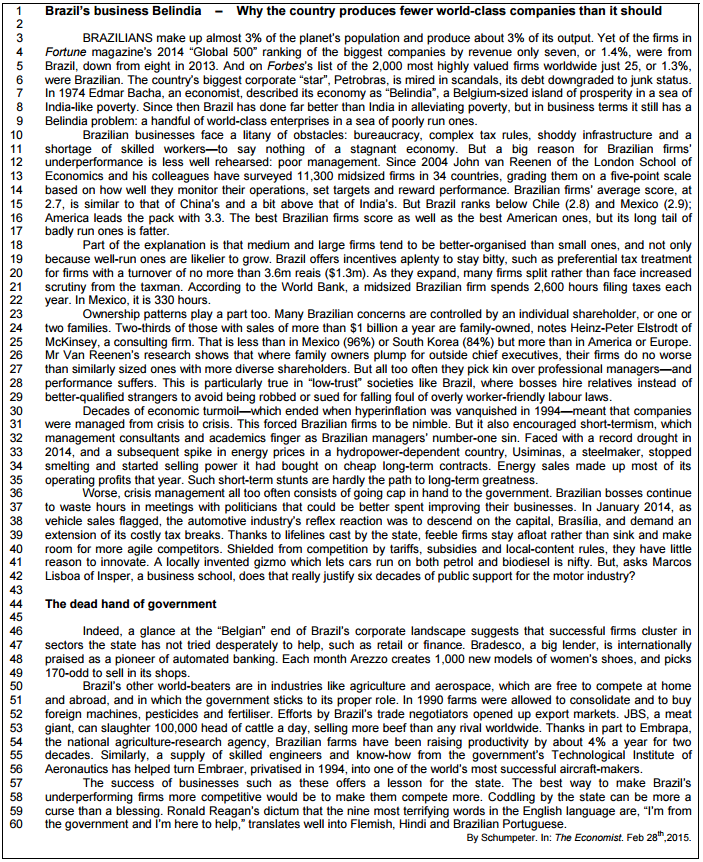
I. Em “This forced Brazilian firms to be nimble. But it also encouraged short-termism, which management consultants..." (linhas 31/32), os pronomes sublinhados possuem o mesmo referente. II. Em “The best Brazilian firms score as well as the best American ones..." (linha 16) e em “Brazil offers incentives aplenty to stay bitty, such as preferential tax treatment…" (linha 19) os termos sublinhados têm o mesmo sentido. III. Em “This is particularly true in “low-trust" societies like Brazil…" (linha 28) e em “Bradesco, a big lender, is internationally praised as a pioneer…" (linhas 47/48) os termos sublinhados têm o mesmo sentido. IV. Em “...which ended when hyperinflation was vanquished in 1994" (linha 30) e em “…the automotive industry's reflex reaction was to descend on the capital…" (linha 38), as formas verbais sublinhadas estão na voz passiva.
Está(ão) correta(s)
I. Ownership patterns play a part too (linha 23) → as well. II. Decades of economic turmoil... (linha 30) → growth. III. Brazilian bosses continue to waste hours in meetings with politicians…(linhas 36/37) → findings. IV. In January 2014, as vehicle sales flagged… (linha 37/38) → dropped.
Estão corretas

Write (T) for the true statements and (F) for the false statements, according to the text.
( ) Radiotelephone communications need to be efficient and brief.
( ) The sound in radiotelephone communications may not be good.
( ) In radiotelephone communications, there is no body language.
( ) Radiotelephone communications do not require a good level of language proficiency.
Choose the correct alternative, according to the order of the sentences.
Read the cartoon and write (T) for the true statements and (F) for the false statements.

( ) The toothbrush said that the toilet paper’s job is the best.
( ) The toothbrush said that it has the worst job in the world and the toilet paper agreed.
( ) The toilet paper’s thinking conveys the meaning that there is always someone who has a worse job.
( ) The toilet paper’s thinking was ironic, possibly interpreted as “so, you do not know what I actually do”.
Choose the alternative that corresponds to the correct order:
Choose the alternative that corresponds to the right form of the reported speech for what the boy said.
BOY: The teacher sent me an email with my grades, but I deleted it.
The boy said that his teacher
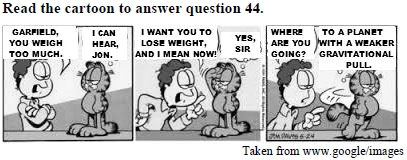
According to the cartoon, all the sentences are correct,
except:

Complete the statement taken from the text (lines 1-2) with the correct question tag:
“Flight 9525, an A irbus A320, took off at 10:01 a.m on March 24 fro m Barcelona, ______”?
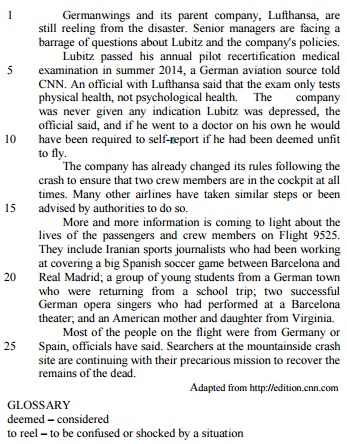
( ) There were artists on Flight 9525.
( ) There were only elderly people on board.
( ) All the passengers on Flight 9525 were Spanish.
( ) The journalists on board were returning from a vacation trip.
Choose the alternative which corresponds to the order.
 Conheça nossos planos