Foram encontradas 1.932 questões
Resolva questões gratuitamente!
Junte-se a mais de 4 milhões de concurseiros!


I‐ People were walking the streets because they had no place else to go.
II‐ The earthquake happened as the sun was setting in the Turkish horizon.
III‐ Some buildings collapsed to the ground, burying thousands of potential victims.
IV‐ The task of finding people alive was made easy because there were over 100,000 rescuers.
V‐ Even after the big earthquake had happened, rescuers could still feel smaller vibrations of the Earth’s surface.
According to the text,
I‐ As time went by, the probability of finding people alive was negatively affected.
II‐ Under strict local laws, the rescuers were only allowed to work up to eight hours a day.
III‐ Most of the homes have suffered major damage due to the earthquake’s intensity.
IV‐ There weren’t many victims, as the government had been warned of the quake by seismologists.
V‐ Many people chose to spend the night outdoors because they didn’t feel safe inside their homes.
According to the text,
Read the text and answer the question.
What is a friend?
Márcio Paulo Barbosa Pena Mascarenhas
Laurie: To me, a friend is someone who stands by you when you need them, someone who cares. Not like your parents, ________. Parents are either picking on you or telling you off, so sometimes it’s a pain. To a friend you can always open up.
Angela: I agree with Laurie but personally, I don’t think a friend has to be physically around all the time. I have friends that I haven’t seen in years, but I know if we get together, we’ll pick up right where we left off.
Fran: I think a friend is that old pal you’ve always gotten on with. I often look back on my schooldays and I think of the funny things my friends and I did together. As I see it, the friends you make in youth are friends to keep for a lifetime.
Gary: If you ask me, a friend is a person you have fun and relax with. My friends and I talk about movies, sports or politics. I don’t go round telling them my troubles and I don’t particularly want to hear theirs. I believe that if you don’t expect too much from people, you won’t be let down.
Grade 1, Student’s book, Belo Horizonte, 14th edition.
( ) In Angela’s opinion, a friend is someone who keeps physical contact with a fellow, at least once a year, in order to show the person that he/she cares about him/her.
( ) Gary thinks you should have fun and enjoy life with your friends, talking to them about your interests instead of talking about your problems and above all: without expectations.
( ) As far as Laurie is concerned, a friend is just like parents. Someone you can count on and talk about your feelings.
( ) In Frank’s view, friends are those who have good memories with you; those who are part of your teenager time and because of this should be kept for your whole life.
Read the text and answer the question.
What is a friend?
Márcio Paulo Barbosa Pena Mascarenhas
Laurie: To me, a friend is someone who stands by you when you need them, someone who cares. Not like your parents, ________. Parents are either picking on you or telling you off, so sometimes it’s a pain. To a friend you can always open up.
Angela: I agree with Laurie but personally, I don’t think a friend has to be physically around all the time. I have friends that I haven’t seen in years, but I know if we get together, we’ll pick up right where we left off.
Fran: I think a friend is that old pal you’ve always gotten on with. I often look back on my schooldays and I think of the funny things my friends and I did together. As I see it, the friends you make in youth are friends to keep for a lifetime.
Gary: If you ask me, a friend is a person you have fun and relax with. My friends and I talk about movies, sports or politics. I don’t go round telling them my troubles and I don’t particularly want to hear theirs. I believe that if you don’t expect too much from people, you won’t be let down.
Grade 1, Student’s book, Belo Horizonte, 14th edition.
Read the text and answer the question
One man in a boat
L.G. Alexander
Fishing is my favourite sport. I often fish for hours without catching anything. But this does not worry me. Some fishermen are unlucky. Instead of catching fish, they catch old boots and rubbish. I am even less lucky. I never catch anything ‐ not even old boots. After having spent whole mornings on the river, I always go home with an empty bag. “You must give up fishing!” my friends say. “It’s a waste of time.” But they don’t realize one important thing. I’m not really interested in fishing. I am only interested in sitting in a boat and doing nothing at all!
PRACTICE AND PROGRESS ‐ An Integrated Course for Pre‐Intermediate Students, L.G Alexander, Longman Group Limited, London.
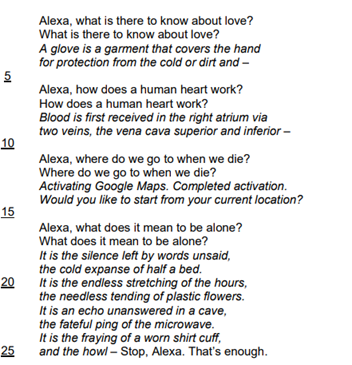
AI won’t take your job if you know about IA
Intelligence augmentation shows that human + AI is an ideal partnership – and the future of white-collar work
The less exciting but more likely reality is that the changes AI brings to the workplace will entail upskilling — when workers learn new skills — not reskilling or complete replacement. And upskilling is not about surrendering to AI but instead about mastering intelligence augmentation, or IA, which is what happens when humans and AI work together to accomplish more as a team than either could flying solo. That collaboration is based on the distinction between two concepts: reckoning and judgment. Reckoning vs. Judgment A critical difference between AI and humans is our primary mode of operation. AI operates through what is often referred to as “reckoning,” such as calculative prediction. By that, we mean AI’s true capabilities are grounded in facts and historical knowledge - data that can be calculated, memorized, and repeated. It makes predictions based on what it knows. By contrast, humans operate through judgment or practical wisdom. We understand things AI can’t possibly know. That’s because we humans have lived experiences that continually inform how we see the world. It’s the intangible factors, like ethical considerations and empathetic responses, that make humans better equipped than AI to make complex decisions about human affairs. This practical wisdom is one reason humans must keep creating new things for IA to advance. Imagine what would happen if humans stopped writing original content. The current model of AI could never pass a certain point because it would never encounter new, innovative ideas. Eventually, AI would run out of new ideas to share, and our collective knowledge would stagnate. AI is like moonlight; its ideas come from the reflected sunlight of human insights. Now, it’s essential to recognize that this contrast between AI and humans is nothing to fear. Instead, it shows us why “human + AI” is an ideal work partnership. AI can perform massive calculations in the blink of an eye at a pace far superior to even the most intelligent human on the planet. When paired with a human capable of making quick decisions based on lived experience, judgment, and practical wisdom, it’s an immensely more powerful tool than it is on its own. Adapted from MCCOOL, Chris Dede and David. AI Won’t Take Your Job if You Know About IA. Harvard Graduate School of Education. Available on: https://www.gse.harvard.edu/ideas/news/24/02/ai-wont-take-your-job-ifyou-know-about-ai. Accessed on March 10 th, 2025.
TEXT III
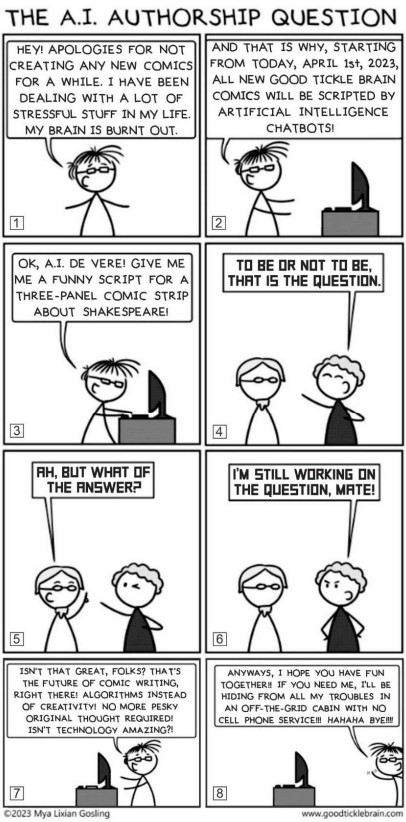
TEXT IV
Algorithmic Romance: The Bittersweet ‘Love Affair’ Between Humanity and AI
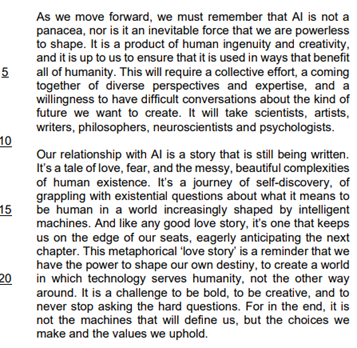
Adapted from HUTCHINS, Bob. Algorithmic Romance: The Bittersweet 'Love Affair' Between Humanity and AI. The human voice bridgin silicon and soul. Available on: https://bobhutchins.substack.com/p/algorithmicromance-the-bittersweet?utm_campaign=post&utm_medium=web. Accessed on March 10th, 202
Directions: Read texts I to IV and answer question.
Decide if the sentences are true (T) or false (F).
I. All four of them are sarcastic and critical. ( )
II. All of them acclaimed the use of AI at work. ( )
III. The texts explore AI´s role in replacing human relationships. ( )
IV. Texts III and IV depict consequences of Human-AI collaboration. ( )
V. Texts II and IV have overlapping ideas when it comes to responsible use of AI. ( )
Now, mark the right alternative.
 Conheça nossos planos