Foram encontradas 24.192 questões

Resolva questões gratuitamente!

Junte-se a mais de 4 milhões de concurseiros!

Q3516179 Português

Tomando por base a afirmação a seguir, de Afrânio Coutinho, a respeito da não existência de conflito entre a Literatura e a vida, assinale a alternativa que parece opor‐se ao pensamento do autor.


“Através das obras literárias tomamos contato com a vida, nas suas verdades eternas, comuns a todos os homens e lugares, porque são as verdades da mesma condição humana.”

Alternativas
Q3516177 Português
Marque a alternativa em que o uso da conjunção coordenativa assume valor particular de oposição.
Alternativas
Q3516174 Português
Assinale a alternativa em que o termo destacado não é regido pelo verbo caber.
Alternativas
Q3516172 Português
Analise os fragmentos de Machado de Assis e assinale a alternativa cuja circunstância está classificada corretamente.  
Alternativas
Q3516171 Português
Assinale a alternativa em que não há a presença de adjetivo no grau superlativo. 
Alternativas
Q3516169 Português

Leia as sentenças abaixo: 


I‐ Saudai os que vão morrer. 


II‐ Infelizmente  não puderam  apresentar efusivamente  a  todos  o projeto vencedor. 


III‐ Não arguímos mais da metade dos candidatos no dia de hoje.


Assinale  a  alternativa  que  traz  respectiva  e  correta  correspondência  dos  verbos  destacados  nas  sentenças,  ao  se  trocar as pessoas do plural para as mesmas pessoas do singular, mantendo‐se o mesmo tempo verbal. 

Alternativas
Q3516165 Português
Assinale  a  alternativa  em  que  o  acento  indicador  de  crase  foi utilizado incorretamente
Alternativas
Q3516164 Português
Assinale a alternativa em que ao menos um substantivo não pertence ao gênero masculino.  
Alternativas
Q3516162 Português
Assinale a alternativa em que o uso do pronome não atende  à norma padrão. 
Alternativas
Q3515702 Inglês
Read the text and answer question.

Global coral reef bleaching event underway as oceans get warmer

    The world’s oceans experience unprecedented rising temperatures: last month, the average global sea surface temperature reached a record 21° Celsius. Last week, the National Oceanic and Atmospheric Administration (NOAA) reported the 4th global bleaching event on record. A press release stated, “Within the last 14 months, significant coral bleaching has been documented in the Northern and Southern Hemispheres of each major ocean basin. Since 2023, the problem has become more frequent in the Atlantic, Pacific and Indian oceans.”

    According to NOAA, warmer ocean temperatures can result in expulsion of algae that live in the coral tissue, leaving the coral completely white - something known as ‘coral bleaching’. This does not necessarily mean corals will die, as they can recover if the strain on their ecosystems is reduced. At a local level, storms, disease, sediments and changes in salinity can cause corals to bleach. However, mass bleaching, which is when several varieties of coral reefs are bleached, is largely caused by increased sea temperatures. When these events are sufficiently severe or prolonged, they can cause coral mortality, which hurts the people who depend on the coral reefs for their livelihoods.

    In 2019, NOAA published a study that provided “resiliencebased management practices” and __________ the importance of coral restoration. “We are on the frontlines of coral reef research, management and restoration, and are actively and aggressively implementing the recommendations of the 2019 study.” A buoy in Florida reported an ocean temperature of 38° Celsius in July 2023, according to meteorologists at the time. In response, NOAA started a program to attempt to offset the effects of global climate change on the local coral reefs by moving coral nurseries to deeper, cooler waters and deploying sunshades to protect corals in other areas.


Adapted. Intemet: www.abcnews.go.com/International.
According to the text, warm sea temperatures 
Alternativas
Q3515700 Inglês
Read the text and answer question.

Global coral reef bleaching event underway as oceans get warmer

    The world’s oceans experience unprecedented rising temperatures: last month, the average global sea surface temperature reached a record 21° Celsius. Last week, the National Oceanic and Atmospheric Administration (NOAA) reported the 4th global bleaching event on record. A press release stated, “Within the last 14 months, significant coral bleaching has been documented in the Northern and Southern Hemispheres of each major ocean basin. Since 2023, the problem has become more frequent in the Atlantic, Pacific and Indian oceans.”

    According to NOAA, warmer ocean temperatures can result in expulsion of algae that live in the coral tissue, leaving the coral completely white - something known as ‘coral bleaching’. This does not necessarily mean corals will die, as they can recover if the strain on their ecosystems is reduced. At a local level, storms, disease, sediments and changes in salinity can cause corals to bleach. However, mass bleaching, which is when several varieties of coral reefs are bleached, is largely caused by increased sea temperatures. When these events are sufficiently severe or prolonged, they can cause coral mortality, which hurts the people who depend on the coral reefs for their livelihoods.

    In 2019, NOAA published a study that provided “resiliencebased management practices” and __________ the importance of coral restoration. “We are on the frontlines of coral reef research, management and restoration, and are actively and aggressively implementing the recommendations of the 2019 study.” A buoy in Florida reported an ocean temperature of 38° Celsius in July 2023, according to meteorologists at the time. In response, NOAA started a program to attempt to offset the effects of global climate change on the local coral reefs by moving coral nurseries to deeper, cooler waters and deploying sunshades to protect corals in other areas.


Adapted. Intemet: www.abcnews.go.com/International.
The word livelihoods, in bold in the text, refers to  
Alternativas
Q3515699 Inglês
Read the text and answer question.

Global coral reef bleaching event underway as oceans get warmer

    The world’s oceans experience unprecedented rising temperatures: last month, the average global sea surface temperature reached a record 21° Celsius. Last week, the National Oceanic and Atmospheric Administration (NOAA) reported the 4th global bleaching event on record. A press release stated, “Within the last 14 months, significant coral bleaching has been documented in the Northern and Southern Hemispheres of each major ocean basin. Since 2023, the problem has become more frequent in the Atlantic, Pacific and Indian oceans.”

    According to NOAA, warmer ocean temperatures can result in expulsion of algae that live in the coral tissue, leaving the coral completely white - something known as ‘coral bleaching’. This does not necessarily mean corals will die, as they can recover if the strain on their ecosystems is reduced. At a local level, storms, disease, sediments and changes in salinity can cause corals to bleach. However, mass bleaching, which is when several varieties of coral reefs are bleached, is largely caused by increased sea temperatures. When these events are sufficiently severe or prolonged, they can cause coral mortality, which hurts the people who depend on the coral reefs for their livelihoods.

    In 2019, NOAA published a study that provided “resiliencebased management practices” and __________ the importance of coral restoration. “We are on the frontlines of coral reef research, management and restoration, and are actively and aggressively implementing the recommendations of the 2019 study.” A buoy in Florida reported an ocean temperature of 38° Celsius in July 2023, according to meteorologists at the time. In response, NOAA started a program to attempt to offset the effects of global climate change on the local coral reefs by moving coral nurseries to deeper, cooler waters and deploying sunshades to protect corals in other areas.


Adapted. Intemet: www.abcnews.go.com/International.
According to the text, coral reefs may 
Alternativas
Q3515698 Inglês
Read the text and answer question.

Global coral reef bleaching event underway as oceans get warmer

    The world’s oceans experience unprecedented rising temperatures: last month, the average global sea surface temperature reached a record 21° Celsius. Last week, the National Oceanic and Atmospheric Administration (NOAA) reported the 4th global bleaching event on record. A press release stated, “Within the last 14 months, significant coral bleaching has been documented in the Northern and Southern Hemispheres of each major ocean basin. Since 2023, the problem has become more frequent in the Atlantic, Pacific and Indian oceans.”

    According to NOAA, warmer ocean temperatures can result in expulsion of algae that live in the coral tissue, leaving the coral completely white - something known as ‘coral bleaching’. This does not necessarily mean corals will die, as they can recover if the strain on their ecosystems is reduced. At a local level, storms, disease, sediments and changes in salinity can cause corals to bleach. However, mass bleaching, which is when several varieties of coral reefs are bleached, is largely caused by increased sea temperatures. When these events are sufficiently severe or prolonged, they can cause coral mortality, which hurts the people who depend on the coral reefs for their livelihoods.

    In 2019, NOAA published a study that provided “resiliencebased management practices” and __________ the importance of coral restoration. “We are on the frontlines of coral reef research, management and restoration, and are actively and aggressively implementing the recommendations of the 2019 study.” A buoy in Florida reported an ocean temperature of 38° Celsius in July 2023, according to meteorologists at the time. In response, NOAA started a program to attempt to offset the effects of global climate change on the local coral reefs by moving coral nurseries to deeper, cooler waters and deploying sunshades to protect corals in other areas.


Adapted. Intemet: www.abcnews.go.com/International.
The word underway, in the title of the text, means that something is  
Alternativas
Q3515679 Física
Em relação aos fenômenos elétricos, marque V para verdadeiro ou F para falso. Em seguida, assinale a alternativa com a sequência correta. 

( ) Na corrente contínua (CC), o fluxo de cargas elétricas ocorre em um único sentido. Esse tipo de corrente é produzido por pilhas e células fotovoltaicas. O sentido da corrente continua real é dado pelo sentido do fluxo dos portadores das cargas negativas. 
( ) A corrente alternada (CA) é um fluxo oscilante de cargas elétricas que ora se movimenta em um sentido, ora em outro. Esse tipo de corrente é produzido por baterias e hidroelétricas. O sentido da corrente alternada real é dado pelo sentido do fluxo dos portadores das cargas positivas.
( ) O fenômeno de emissdo de luz que ocorre quando uma corrente elétrica passa através de um gás rarefeito é conhecido como efeito térmico.
( ) Para medir a tensão aplicada aos terminais de um resistor, um voltímetro deve ser inserido a este de forma paralela. Além disso, para não influenciar no circuito medido, o voltímetro deve possuir a maior resistência interna possível, fazendo com que a corrente que o atravessa seja insignificante. 
Alternativas
Q3515671 Física
Uma família de 5 pessoas mora em uma residência que é alimentada por uma tensdo igual a 127 V. Todos os dias, cada membro da família toma 1 banho durante 20 minutos, e dois membros utilizam um secador de cabelo por 30 minutos cada. Sabendo que as potências do chuveiro e do secador de cabelo são, respectivamente, 5000 W e 1667 W, e que a empresa de eletricidade cobra R$ 0,30 por kWh, assinale a alternativa que indica, aproximadamente, a contribuição do consumo mensal de energia, em R$, do chuveiro e do secador de cabelo. Considere o mês com 30 dias. Adote 1 KWh = 3,6.106J. 
Alternativas
Q3515654 Matemática
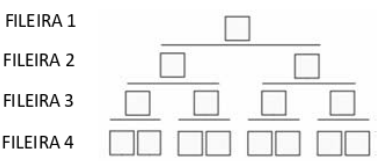
A figura representa uma pilha de caixas em uma prateleira de supermercado, contendo 4 fileiras. Se aumentarmos a quantidade de fileiras para 10, mantendo o mesmo padrão de montagem, ou seja, uma caixa sendo apoiada por duas, então a quantidade de caixas utilizadas para formar as 10 fileiras será _____. 
Captura_de tela 2025-08-09 181137.png (380×161)
Alternativas
Q3515634 Português
Assinale, entre as orações reduzidas de gerundio destacadas nas alternativas abaixo, aquela que pode ser classificada como coordenada aditiva.
Alternativas
Q3515625 Português
Assinale a alternativa que substitui, correta e respectivamente, as conjunções ou locuções conjuntivas grifadas nos periodos abaixo.  
I‐ Visto  que  pretende  mudar‐se,  preparamos  um  almoço  de  despedida. 
II‐ Terá sucesso na prova, contanto que estude. 
III‐ Casaram‐se  e  fizeram  uma  linda  viagem,  tudo  como  haviam  planejado.
IV‐ Foi  transferida  de  setor,  portanto  não  nos  veremos  com  muita frequência. 
Alternativas
Q3513824 Português

Leia  as  sentenças  abaixo  atentando  para  os  termos  destacados e, a seguir, assinale a alternativa correta. 


I‐ Honrado,  seu  nome  de  prestígio  pesa‐lhe  os  ombros  diante  da situação. 


II‐ Mostrou  ao  pai  alguns  amigos  especiais,  João,  que  corria  como  ninguém;  Pedro,  que  era  bom  de  bola;  Tonico,  que  conhecia muitas histórias; AbelJoaquimBeto... 


III‐ Diz Feliciano a verdade. O que não quero mesmo é desistir de  meu sonho. 


IV‐ Por  ambas  as  torcidas,  ainda  que  respirassem  rivalidade,  o  Hino Nacional era entoado com emoção. 


Os termos em destaque são, respectivamente, 

Alternativas
Q3513819 Português

Em  relação  à  acentuação  tônica  das  palavras  do  texto seguir, assinale a alternativa correta quanto ao que se afirma.


    A dona esperava paciente sob o guarda‐sol. O “basset” ruivo  afinal  despregou‐se  da  menina  e  saiu  sonâmbulo.  Ela  ficou  espantada,  com  o  acontecimento  nas  mãos,  numa  mudez  que  nem pai nem mãe compreenderiam. (Clarice Lispector)

Alternativas
Respostas
81: B
82: D
83: D
84: C
85: B
86: A
87: B
88: D
89: A
90: C
91: A
92: D
93: B
94: D
95: D
96: C
97: C
98: B
99: B
100: C