Foram encontradas 26.158 questões
Resolva questões gratuitamente!
Junte-se a mais de 4 milhões de concurseiros!


A tabela abaixo apresenta o resultado de um planejamento fatorial com os seguintes dois fatores: Fator A, com três níveis, e Fator B, com dois níveis. Com base nesses dados, o efeito principal do Fator B é:

Um pesquisador deseja estimar a porcentagem de pessoas com sangue do tipo O entre 1200 moradores de certo bairro. Ele quer garantir que o erro máximo de estimação seja igual a 5%, com aproximadamente 95% de confiança (Zα/2 -2) e supõe variabilidade populacional de 25%.
Assinale a alternativa que indica o tamanho da amostra que deve ser utilizado para um plano aleatório simples com reposição.
Analise as afirmativas sobre o efeito do desenho (DEFF), colocando entre parênteses a letra “V”, quando se tratar de afirmativa verdadeira, e a letra “F” quando se tratar de afirmativa falsa. A seguir, assinale a alternativa que apresenta a sequência correta.
( ) O DEFF é definido como a razão das variâncias do estimador obtido com um determinado desenho amostral e com uma amostra aleatória simples, de mesmo tamanho amostral.
( ) Um dos objetivos do DEFF é avaliar a eficiência de planos amostrais complexos.
( ) O DEFF é usado na estimação do tamanho amostral em planos amostrais complexos.
Sobre os pressupostos da ANOVA, analise as proposições abaixo e, em seguida, assinale a alternativa que apresenta a resposta correta.
I. As observações são independentes entre os grupos mas não necessariamente dentro dos grupos.
II. A distribuição dos resíduos é normal.
III. Os grupos comparados apresentam a mesma variabilidade residual.
IV. A variabilidade das observações dentro dos grupos é menor que a variabilidade entre os grupos.
Analise as afirmativas considerando as propriedades dos estimadores, colocando entre parênteses a letra “V”, quando se tratar de afirmativa verdadeira, e a letra “F” quando se tratar de afirmativa falsa. A seguir, assinale a alternativa que apresenta a sequência correta.
( ) Um estimador preciso tem um erro quadrático médio pequeno, portanto uma variância também pequena.
( ) O estimador T1 é dito ser mais eficiente que T2 se a variância de T1 for menor que a variância de T2, quaisquer que sejam as suas esperanças.
( ) Um estimador para ser consistente tem que ser assintoticamente não-viesado e sua variância tender para zero quando o tamanho da
amostra tender para o infinito.
Analise as afirmativas sobre a representação gráfica de variáveis, colocando entre parênteses a letra “V”, quando se tratar de afirmativa verdadeira, e a letra “F” quando se tratar de afirmativa falsa. A seguir, assinale a alternativa que apresenta a sequência correta.
( ) O gráfico boxplot exibe graficamente apenas os quartis; respectivamente o primeiro quartil, mediana e terceiro quartil.
( ) O histograma é um gráfico de barras contíguas utilizado para representar variáveis contínuas.
( ) O gráfico de barras, ou colunas, é utilizado para expressar variáveis qualitativas nominais ou ordinais. Uma alternativa ao seu uso é o gráfico de setores circulares.
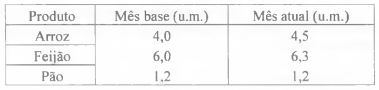
Seja o índice agregativo simples entre os períodos 0 e 1 definido por  sendo
sendo  os preços do produto i (i = 1 ,..., n) para os respectivos períodos. Através da Tabela abaixo, podemos afirmar que
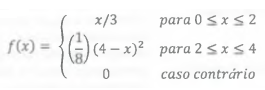
Qual o valor de c de modo que P(X >c) = 0,8?
Texto 4
FRANK WHITTLE AND THE INVENTION OF THE JET ENGINE:
SIX PLACES TO TRACE HIS GENIUS
It was, in many ways, a very British sort of achievement. When the turbine began to spin on the “WU” – the prototype jet engine developed by the Coventry-born engineer Frank Whittle – it was a moment which changed the world. Had you been passing through the byways of Rugby, in Warwickshire, more than 80 years ago, you might even have heard it. A thrum of mechanics in sync, building and building, growing in intensity to become a roar; a giddy howl which would permanently alter the way we journey around our planet.
And yet it might so easily not have happened. Whittle’s triumph – on April 12, 1937 – was garnered in the face of official indifference and scientific doubt, and was only pulled off by a merest financial hair’s breadth, with the Second World War crowding in on all sides.
( . . . )
Here was a visionary who began fomenting his design for a jet engine as early as 1927, and patented it in 1930, yet had to swim against the current after seeing his idea pooh-poohed by the UK's Air Ministry – which, upon seeing the blueprint in 1929, deemed it “impracticable.”
Undeterred, Whittle took his own path. In January 1936, he founded a private company, Power Jets Ltd, with aeronautical engineer Rolf Dudley Williams and retired RAF officer James Collingwood Tinling. With £2,000 of funding from O.T. Falk & Partners – an investment bank which was known for taking risks – the trio began converting what had been decried as fantasy into reality. That first blur of blades as the WU (Whittle Unit) screamed into life was followed by a series of leaps forward.
The Air Ministry placed its first order for Whittle’s brainwave in January 1940. The first jet-powered British plane took off from RAF Cranwell, Lincolnshire, on May 15, 1941. The rest is so much history.
None of this occurred in isolation. The story of the jet engine can never be told without mentions of Maxime Guillaume, who secured a French patent for a jet engine with a gas turbine in 1921 (no prototype was ever produced as it was beyond the scope of existing technology), and of Hans Von Ohain, who beat Whittle to the punch by building the first fully operational jet engine in 1939 as Germany chased advantages in the global conflict.
( . . . )
RAF = Royal Air Force
LEADBEATER, C. Adaptado de Frank Whittle and the invention of the jet engine: Six places to trace his genius. In: The Telegraph. Disponível em: <https://www.telegraph.co.uk/travel/destinations/europe/unitedkingdom/england/articles/frank-whittle-and-the-birth-of-the-jet-engine/>. Acesso em: 08/06/2018
Texto 4
FRANK WHITTLE AND THE INVENTION OF THE JET ENGINE:
SIX PLACES TO TRACE HIS GENIUS
It was, in many ways, a very British sort of achievement. When the turbine began to spin on the “WU” – the prototype jet engine developed by the Coventry-born engineer Frank Whittle – it was a moment which changed the world. Had you been passing through the byways of Rugby, in Warwickshire, more than 80 years ago, you might even have heard it. A thrum of mechanics in sync, building and building, growing in intensity to become a roar; a giddy howl which would permanently alter the way we journey around our planet.
And yet it might so easily not have happened. Whittle’s triumph – on April 12, 1937 – was garnered in the face of official indifference and scientific doubt, and was only pulled off by a merest financial hair’s breadth, with the Second World War crowding in on all sides.
( . . . )
Here was a visionary who began fomenting his design for a jet engine as early as 1927, and patented it in 1930, yet had to swim against the current after seeing his idea pooh-poohed by the UK's Air Ministry – which, upon seeing the blueprint in 1929, deemed it “impracticable.”
Undeterred, Whittle took his own path. In January 1936, he founded a private company, Power Jets Ltd, with aeronautical engineer Rolf Dudley Williams and retired RAF officer James Collingwood Tinling. With £2,000 of funding from O.T. Falk & Partners – an investment bank which was known for taking risks – the trio began converting what had been decried as fantasy into reality. That first blur of blades as the WU (Whittle Unit) screamed into life was followed by a series of leaps forward.
The Air Ministry placed its first order for Whittle’s brainwave in January 1940. The first jet-powered British plane took off from RAF Cranwell, Lincolnshire, on May 15, 1941. The rest is so much history.
None of this occurred in isolation. The story of the jet engine can never be told without mentions of Maxime Guillaume, who secured a French patent for a jet engine with a gas turbine in 1921 (no prototype was ever produced as it was beyond the scope of existing technology), and of Hans Von Ohain, who beat Whittle to the punch by building the first fully operational jet engine in 1939 as Germany chased advantages in the global conflict.
( . . . )
RAF = Royal Air Force
LEADBEATER, C. Adaptado de Frank Whittle and the invention of the jet engine: Six places to trace his genius. In: The Telegraph. Disponível em: <https://www.telegraph.co.uk/travel/destinations/europe/unitedkingdom/england/articles/frank-whittle-and-the-birth-of-the-jet-engine/>. Acesso em: 08/06/2018
Choose the correct option.
The sentence: “That first blur of blades as the WU (Whittle Unit) screamed into life was followed by a series of leaps forward” means that
Texto 4
FRANK WHITTLE AND THE INVENTION OF THE JET ENGINE:
SIX PLACES TO TRACE HIS GENIUS
It was, in many ways, a very British sort of achievement. When the turbine began to spin on the “WU” – the prototype jet engine developed by the Coventry-born engineer Frank Whittle – it was a moment which changed the world. Had you been passing through the byways of Rugby, in Warwickshire, more than 80 years ago, you might even have heard it. A thrum of mechanics in sync, building and building, growing in intensity to become a roar; a giddy howl which would permanently alter the way we journey around our planet.
And yet it might so easily not have happened. Whittle’s triumph – on April 12, 1937 – was garnered in the face of official indifference and scientific doubt, and was only pulled off by a merest financial hair’s breadth, with the Second World War crowding in on all sides.
( . . . )
Here was a visionary who began fomenting his design for a jet engine as early as 1927, and patented it in 1930, yet had to swim against the current after seeing his idea pooh-poohed by the UK's Air Ministry – which, upon seeing the blueprint in 1929, deemed it “impracticable.”
Undeterred, Whittle took his own path. In January 1936, he founded a private company, Power Jets Ltd, with aeronautical engineer Rolf Dudley Williams and retired RAF officer James Collingwood Tinling. With £2,000 of funding from O.T. Falk & Partners – an investment bank which was known for taking risks – the trio began converting what had been decried as fantasy into reality. That first blur of blades as the WU (Whittle Unit) screamed into life was followed by a series of leaps forward.
The Air Ministry placed its first order for Whittle’s brainwave in January 1940. The first jet-powered British plane took off from RAF Cranwell, Lincolnshire, on May 15, 1941. The rest is so much history.
None of this occurred in isolation. The story of the jet engine can never be told without mentions of Maxime Guillaume, who secured a French patent for a jet engine with a gas turbine in 1921 (no prototype was ever produced as it was beyond the scope of existing technology), and of Hans Von Ohain, who beat Whittle to the punch by building the first fully operational jet engine in 1939 as Germany chased advantages in the global conflict.
( . . . )
RAF = Royal Air Force
LEADBEATER, C. Adaptado de Frank Whittle and the invention of the jet engine: Six places to trace his genius. In: The Telegraph. Disponível em: <https://www.telegraph.co.uk/travel/destinations/europe/unitedkingdom/england/articles/frank-whittle-and-the-birth-of-the-jet-engine/>. Acesso em: 08/06/2018
Texto 4
FRANK WHITTLE AND THE INVENTION OF THE JET ENGINE:
SIX PLACES TO TRACE HIS GENIUS
It was, in many ways, a very British sort of achievement. When the turbine began to spin on the “WU” – the prototype jet engine developed by the Coventry-born engineer Frank Whittle – it was a moment which changed the world. Had you been passing through the byways of Rugby, in Warwickshire, more than 80 years ago, you might even have heard it. A thrum of mechanics in sync, building and building, growing in intensity to become a roar; a giddy howl which would permanently alter the way we journey around our planet.
And yet it might so easily not have happened. Whittle’s triumph – on April 12, 1937 – was garnered in the face of official indifference and scientific doubt, and was only pulled off by a merest financial hair’s breadth, with the Second World War crowding in on all sides.
( . . . )
Here was a visionary who began fomenting his design for a jet engine as early as 1927, and patented it in 1930, yet had to swim against the current after seeing his idea pooh-poohed by the UK's Air Ministry – which, upon seeing the blueprint in 1929, deemed it “impracticable.”
Undeterred, Whittle took his own path. In January 1936, he founded a private company, Power Jets Ltd, with aeronautical engineer Rolf Dudley Williams and retired RAF officer James Collingwood Tinling. With £2,000 of funding from O.T. Falk & Partners – an investment bank which was known for taking risks – the trio began converting what had been decried as fantasy into reality. That first blur of blades as the WU (Whittle Unit) screamed into life was followed by a series of leaps forward.
The Air Ministry placed its first order for Whittle’s brainwave in January 1940. The first jet-powered British plane took off from RAF Cranwell, Lincolnshire, on May 15, 1941. The rest is so much history.
None of this occurred in isolation. The story of the jet engine can never be told without mentions of Maxime Guillaume, who secured a French patent for a jet engine with a gas turbine in 1921 (no prototype was ever produced as it was beyond the scope of existing technology), and of Hans Von Ohain, who beat Whittle to the punch by building the first fully operational jet engine in 1939 as Germany chased advantages in the global conflict.
( . . . )
RAF = Royal Air Force
LEADBEATER, C. Adaptado de Frank Whittle and the invention of the jet engine: Six places to trace his genius. In: The Telegraph. Disponível em: <https://www.telegraph.co.uk/travel/destinations/europe/unitedkingdom/england/articles/frank-whittle-and-the-birth-of-the-jet-engine/>. Acesso em: 08/06/2018
Texto 4
FRANK WHITTLE AND THE INVENTION OF THE JET ENGINE:
SIX PLACES TO TRACE HIS GENIUS
It was, in many ways, a very British sort of achievement. When the turbine began to spin on the “WU” – the prototype jet engine developed by the Coventry-born engineer Frank Whittle – it was a moment which changed the world. Had you been passing through the byways of Rugby, in Warwickshire, more than 80 years ago, you might even have heard it. A thrum of mechanics in sync, building and building, growing in intensity to become a roar; a giddy howl which would permanently alter the way we journey around our planet.
And yet it might so easily not have happened. Whittle’s triumph – on April 12, 1937 – was garnered in the face of official indifference and scientific doubt, and was only pulled off by a merest financial hair’s breadth, with the Second World War crowding in on all sides.
( . . . )
Here was a visionary who began fomenting his design for a jet engine as early as 1927, and patented it in 1930, yet had to swim against the current after seeing his idea pooh-poohed by the UK's Air Ministry – which, upon seeing the blueprint in 1929, deemed it “impracticable.”
Undeterred, Whittle took his own path. In January 1936, he founded a private company, Power Jets Ltd, with aeronautical engineer Rolf Dudley Williams and retired RAF officer James Collingwood Tinling. With £2,000 of funding from O.T. Falk & Partners – an investment bank which was known for taking risks – the trio began converting what had been decried as fantasy into reality. That first blur of blades as the WU (Whittle Unit) screamed into life was followed by a series of leaps forward.
The Air Ministry placed its first order for Whittle’s brainwave in January 1940. The first jet-powered British plane took off from RAF Cranwell, Lincolnshire, on May 15, 1941. The rest is so much history.
None of this occurred in isolation. The story of the jet engine can never be told without mentions of Maxime Guillaume, who secured a French patent for a jet engine with a gas turbine in 1921 (no prototype was ever produced as it was beyond the scope of existing technology), and of Hans Von Ohain, who beat Whittle to the punch by building the first fully operational jet engine in 1939 as Germany chased advantages in the global conflict.
( . . . )
RAF = Royal Air Force
LEADBEATER, C. Adaptado de Frank Whittle and the invention of the jet engine: Six places to trace his genius. In: The Telegraph. Disponível em: <https://www.telegraph.co.uk/travel/destinations/europe/unitedkingdom/england/articles/frank-whittle-and-the-birth-of-the-jet-engine/>. Acesso em: 08/06/2018
 Conheça nossos planos