Questões de Concurso Militar IME 2025 para Oficial Engenheiro - Português/Inglês
Foram encontradas 32 questões


Ano: 2025
Banca:
Exército
Órgão:
IME
Prova:
Exército - 2025 - IME - Oficial Engenheiro - Português/Inglês |
Q3692545
Inglês
Texto associado
Text 1
ChatGPT May Be Eroding Critical Thinking Skills, According to a New MIT Study
By Andrew R. Chow
The study divided 54 subjects — 18 to 39 year-olds from the Boston area — into three groups, and asked them to
write several SAT essays using OpenAl's ChatGPT, Google’s search engine, and nothing at all, respectively. Researchers used an (electroencephalogram) EEG to record the writers’ brain activity across 32 regions, and found that of the
three groups, ChatGPT users had the lowest brain engagement and “consistently underperformed at neural, linguistic,
and behavioral levels.” Over the course of several months, ChatGPT users got lazier with each subsequent essay, often
resorting to copy-and-paste by the end of the study.
The paper suggests that the usage of (Large Language Model) LLMs could actually harm learning, especially for
younger users. The paper has not yet been peer reviewed, and its sample size is relatively small. But its paper’s main
author Nataliya Kosmyna felt it was important to release the findings to elevate concerns that as society increasingly
relies upon LLMs for immediate convenience, long-term brain development may be sacrificed in the process.
The group that wrote essays using ChatGPT all delivered extremely similar essays that lacked original thought,
relying on the same expressions and ideas. Two English teachers who assessed the essays called them largely
“soulless” The EEGs revealed low executive control and attentional engagement. And by their third essay, many of
the writers simply gave the prompt to ChatGPT and had it do almost all of the work. “It was more like, ‘just give me the
essay, refine this sentence, edit it, and 'm done,” Kosmyna says.
The brain-only group, conversely, showed the highest neural connectivity, especially in alpha, theta and delta bands,
which are associated with creativity ideation, memory load, and semantic processing. Researchers found this group
was more engaged and curious, and claimed ownership and expressed higher satisfaction with their essays.
The third group, which used Google Search, also expressed high satisfaction and active brain function. The
difference here is notable because many people now search for information within Al chatbots as opposed to Google
Search.
After writing the three essays, the subjects were then asked to re-write one of their previous efforts—but the
ChatGPT group had to do so without the tool, while the brain-only group could now use ChatGPT. The first group
remembered little of their own essays, and showed weaker alpha and theta brain waves, which likely reflected a
bypassing of deep memory processes.
The second group, in contrast, performed well, exhibiting a significant increase in brain connectivity across all EEG
frequency bands. This gives rise to the hope that Al, if used properly, could enhance learning as opposed to diminishing it.
Adapted from: TIME in [Accessed on 15th July 2025].
What distinguishes the Google Search group's results from those of the ChatGPT group?
Ano: 2025
Banca:
Exército
Órgão:
IME
Prova:
Exército - 2025 - IME - Oficial Engenheiro - Português/Inglês |
Q3692546
Inglês
Texto associado
Text 1
ChatGPT May Be Eroding Critical Thinking Skills, According to a New MIT Study
By Andrew R. Chow
The study divided 54 subjects — 18 to 39 year-olds from the Boston area — into three groups, and asked them to
write several SAT essays using OpenAl's ChatGPT, Google’s search engine, and nothing at all, respectively. Researchers used an (electroencephalogram) EEG to record the writers’ brain activity across 32 regions, and found that of the
three groups, ChatGPT users had the lowest brain engagement and “consistently underperformed at neural, linguistic,
and behavioral levels.” Over the course of several months, ChatGPT users got lazier with each subsequent essay, often
resorting to copy-and-paste by the end of the study.
The paper suggests that the usage of (Large Language Model) LLMs could actually harm learning, especially for
younger users. The paper has not yet been peer reviewed, and its sample size is relatively small. But its paper’s main
author Nataliya Kosmyna felt it was important to release the findings to elevate concerns that as society increasingly
relies upon LLMs for immediate convenience, long-term brain development may be sacrificed in the process.
The group that wrote essays using ChatGPT all delivered extremely similar essays that lacked original thought,
relying on the same expressions and ideas. Two English teachers who assessed the essays called them largely
“soulless” The EEGs revealed low executive control and attentional engagement. And by their third essay, many of
the writers simply gave the prompt to ChatGPT and had it do almost all of the work. “It was more like, ‘just give me the
essay, refine this sentence, edit it, and 'm done,” Kosmyna says.
The brain-only group, conversely, showed the highest neural connectivity, especially in alpha, theta and delta bands,
which are associated with creativity ideation, memory load, and semantic processing. Researchers found this group
was more engaged and curious, and claimed ownership and expressed higher satisfaction with their essays.
The third group, which used Google Search, also expressed high satisfaction and active brain function. The
difference here is notable because many people now search for information within Al chatbots as opposed to Google
Search.
After writing the three essays, the subjects were then asked to re-write one of their previous efforts—but the
ChatGPT group had to do so without the tool, while the brain-only group could now use ChatGPT. The first group
remembered little of their own essays, and showed weaker alpha and theta brain waves, which likely reflected a
bypassing of deep memory processes.
The second group, in contrast, performed well, exhibiting a significant increase in brain connectivity across all EEG
frequency bands. This gives rise to the hope that Al, if used properly, could enhance learning as opposed to diminishing it.
Adapted from: TIME in [Accessed on 15th July 2025].
What did the EEG data suggest about ChatGPT users' executive control during essay writing?
Ano: 2025
Banca:
Exército
Órgão:
IME
Prova:
Exército - 2025 - IME - Oficial Engenheiro - Português/Inglês |
Q3692547
Inglês
Texto associado
Text 1
ChatGPT May Be Eroding Critical Thinking Skills, According to a New MIT Study
By Andrew R. Chow
The study divided 54 subjects — 18 to 39 year-olds from the Boston area — into three groups, and asked them to
write several SAT essays using OpenAl's ChatGPT, Google’s search engine, and nothing at all, respectively. Researchers used an (electroencephalogram) EEG to record the writers’ brain activity across 32 regions, and found that of the
three groups, ChatGPT users had the lowest brain engagement and “consistently underperformed at neural, linguistic,
and behavioral levels.” Over the course of several months, ChatGPT users got lazier with each subsequent essay, often
resorting to copy-and-paste by the end of the study.
The paper suggests that the usage of (Large Language Model) LLMs could actually harm learning, especially for
younger users. The paper has not yet been peer reviewed, and its sample size is relatively small. But its paper’s main
author Nataliya Kosmyna felt it was important to release the findings to elevate concerns that as society increasingly
relies upon LLMs for immediate convenience, long-term brain development may be sacrificed in the process.
The group that wrote essays using ChatGPT all delivered extremely similar essays that lacked original thought,
relying on the same expressions and ideas. Two English teachers who assessed the essays called them largely
“soulless” The EEGs revealed low executive control and attentional engagement. And by their third essay, many of
the writers simply gave the prompt to ChatGPT and had it do almost all of the work. “It was more like, ‘just give me the
essay, refine this sentence, edit it, and 'm done,” Kosmyna says.
The brain-only group, conversely, showed the highest neural connectivity, especially in alpha, theta and delta bands,
which are associated with creativity ideation, memory load, and semantic processing. Researchers found this group
was more engaged and curious, and claimed ownership and expressed higher satisfaction with their essays.
The third group, which used Google Search, also expressed high satisfaction and active brain function. The
difference here is notable because many people now search for information within Al chatbots as opposed to Google
Search.
After writing the three essays, the subjects were then asked to re-write one of their previous efforts—but the
ChatGPT group had to do so without the tool, while the brain-only group could now use ChatGPT. The first group
remembered little of their own essays, and showed weaker alpha and theta brain waves, which likely reflected a
bypassing of deep memory processes.
The second group, in contrast, performed well, exhibiting a significant increase in brain connectivity across all EEG
frequency bands. This gives rise to the hope that Al, if used properly, could enhance learning as opposed to diminishing it.
Adapted from: TIME in [Accessed on 15th July 2025].
Based on the brain-only group’s later use of ChatGPT, researchers expressed the following hope:
Ano: 2025
Banca:
Exército
Órgão:
IME
Prova:
Exército - 2025 - IME - Oficial Engenheiro - Português/Inglês |
Q3692548
Inglês
Texto associado
Text 1
ChatGPT May Be Eroding Critical Thinking Skills, According to a New MIT Study
By Andrew R. Chow
The study divided 54 subjects — 18 to 39 year-olds from the Boston area — into three groups, and asked them to
write several SAT essays using OpenAl's ChatGPT, Google’s search engine, and nothing at all, respectively. Researchers used an (electroencephalogram) EEG to record the writers’ brain activity across 32 regions, and found that of the
three groups, ChatGPT users had the lowest brain engagement and “consistently underperformed at neural, linguistic,
and behavioral levels.” Over the course of several months, ChatGPT users got lazier with each subsequent essay, often
resorting to copy-and-paste by the end of the study.
The paper suggests that the usage of (Large Language Model) LLMs could actually harm learning, especially for
younger users. The paper has not yet been peer reviewed, and its sample size is relatively small. But its paper’s main
author Nataliya Kosmyna felt it was important to release the findings to elevate concerns that as society increasingly
relies upon LLMs for immediate convenience, long-term brain development may be sacrificed in the process.
The group that wrote essays using ChatGPT all delivered extremely similar essays that lacked original thought,
relying on the same expressions and ideas. Two English teachers who assessed the essays called them largely
“soulless” The EEGs revealed low executive control and attentional engagement. And by their third essay, many of
the writers simply gave the prompt to ChatGPT and had it do almost all of the work. “It was more like, ‘just give me the
essay, refine this sentence, edit it, and 'm done,” Kosmyna says.
The brain-only group, conversely, showed the highest neural connectivity, especially in alpha, theta and delta bands,
which are associated with creativity ideation, memory load, and semantic processing. Researchers found this group
was more engaged and curious, and claimed ownership and expressed higher satisfaction with their essays.
The third group, which used Google Search, also expressed high satisfaction and active brain function. The
difference here is notable because many people now search for information within Al chatbots as opposed to Google
Search.
After writing the three essays, the subjects were then asked to re-write one of their previous efforts—but the
ChatGPT group had to do so without the tool, while the brain-only group could now use ChatGPT. The first group
remembered little of their own essays, and showed weaker alpha and theta brain waves, which likely reflected a
bypassing of deep memory processes.
The second group, in contrast, performed well, exhibiting a significant increase in brain connectivity across all EEG
frequency bands. This gives rise to the hope that Al, if used properly, could enhance learning as opposed to diminishing it.
Adapted from: TIME in [Accessed on 15th July 2025].
Researchers highlighted the following main difference between using Google Search and Al chatbots for information
gathering:
Ano: 2025
Banca:
Exército
Órgão:
IME
Prova:
Exército - 2025 - IME - Oficial Engenheiro - Português/Inglês |
Q3692549
Inglês
Texto associado
Text 1
ChatGPT May Be Eroding Critical Thinking Skills, According to a New MIT Study
By Andrew R. Chow
The study divided 54 subjects — 18 to 39 year-olds from the Boston area — into three groups, and asked them to
write several SAT essays using OpenAl's ChatGPT, Google’s search engine, and nothing at all, respectively. Researchers used an (electroencephalogram) EEG to record the writers’ brain activity across 32 regions, and found that of the
three groups, ChatGPT users had the lowest brain engagement and “consistently underperformed at neural, linguistic,
and behavioral levels.” Over the course of several months, ChatGPT users got lazier with each subsequent essay, often
resorting to copy-and-paste by the end of the study.
The paper suggests that the usage of (Large Language Model) LLMs could actually harm learning, especially for
younger users. The paper has not yet been peer reviewed, and its sample size is relatively small. But its paper’s main
author Nataliya Kosmyna felt it was important to release the findings to elevate concerns that as society increasingly
relies upon LLMs for immediate convenience, long-term brain development may be sacrificed in the process.
The group that wrote essays using ChatGPT all delivered extremely similar essays that lacked original thought,
relying on the same expressions and ideas. Two English teachers who assessed the essays called them largely
“soulless” The EEGs revealed low executive control and attentional engagement. And by their third essay, many of
the writers simply gave the prompt to ChatGPT and had it do almost all of the work. “It was more like, ‘just give me the
essay, refine this sentence, edit it, and 'm done,” Kosmyna says.
The brain-only group, conversely, showed the highest neural connectivity, especially in alpha, theta and delta bands,
which are associated with creativity ideation, memory load, and semantic processing. Researchers found this group
was more engaged and curious, and claimed ownership and expressed higher satisfaction with their essays.
The third group, which used Google Search, also expressed high satisfaction and active brain function. The
difference here is notable because many people now search for information within Al chatbots as opposed to Google
Search.
After writing the three essays, the subjects were then asked to re-write one of their previous efforts—but the
ChatGPT group had to do so without the tool, while the brain-only group could now use ChatGPT. The first group
remembered little of their own essays, and showed weaker alpha and theta brain waves, which likely reflected a
bypassing of deep memory processes.
The second group, in contrast, performed well, exhibiting a significant increase in brain connectivity across all EEG
frequency bands. This gives rise to the hope that Al, if used properly, could enhance learning as opposed to diminishing it.
Adapted from: TIME in [Accessed on 15th July 2025].
Why did the researchers mention the small sample size?
Ano: 2025
Banca:
Exército
Órgão:
IME
Prova:
Exército - 2025 - IME - Oficial Engenheiro - Português/Inglês |
Q3692550
Inglês
Texto associado
Text 2
- The Impact of Electric Vehicles on the Automotive Industry Looking at the environmental, economical, and political impact of electric vehicles.
By Patrick Peterson of GoodCar
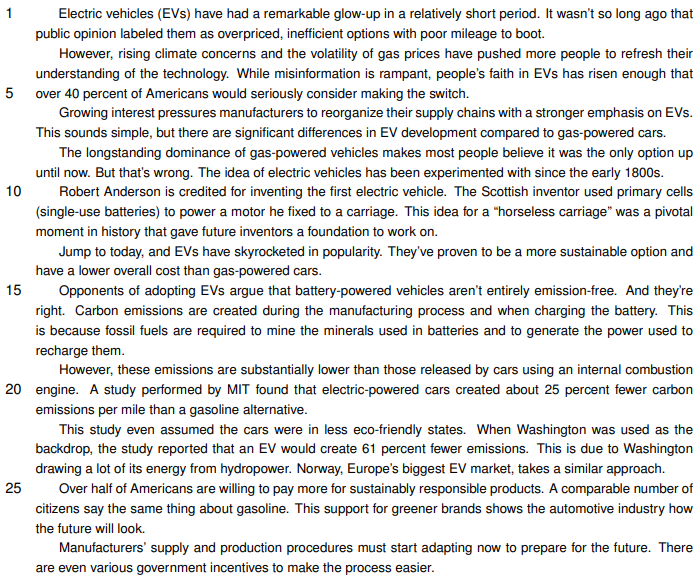
Adapted from: unsustainable in
Mark the option that best captures the author's tone throughout the article:
Ano: 2025
Banca:
Exército
Órgão:
IME
Prova:
Exército - 2025 - IME - Oficial Engenheiro - Português/Inglês |
Q3692551
Inglês
Texto associado
Text 2
- The Impact of Electric Vehicles on the Automotive Industry Looking at the environmental, economical, and political impact of electric vehicles.
By Patrick Peterson of GoodCar
Adapted from: unsustainable in
Mark the option that shows the most accurate meaning of the highlighted word in the sentence below: “Electric vehicles
(EVs) have had a remarkable glow-up in a relatively short period.” (line 1)
Ano: 2025
Banca:
Exército
Órgão:
IME
Prova:
Exército - 2025 - IME - Oficial Engenheiro - Português/Inglês |
Q3692552
Inglês
Texto associado
Text 2
- The Impact of Electric Vehicles on the Automotive Industry Looking at the environmental, economical, and political impact of electric vehicles.
By Patrick Peterson of GoodCar
Adapted from: unsustainable in
In the sentence “However, rising climate concerns and the volatility of gas prices have pushed more people to refresh
their understanding of the technology” (lines 3 and 4), the verb tense “have pushed” indicates:
Ano: 2025
Banca:
Exército
Órgão:
IME
Prova:
Exército - 2025 - IME - Oficial Engenheiro - Português/Inglês |
Q3692553
Inglês
Texto associado
Text 2
- The Impact of Electric Vehicles on the Automotive Industry Looking at the environmental, economical, and political impact of electric vehicles.
By Patrick Peterson of GoodCar
Adapted from: unsustainable in
According to the text, mark the option that most accurately reflects the relationship between public perception and
electric vehicle adoption:
Ano: 2025
Banca:
Exército
Órgão:
IME
Prova:
Exército - 2025 - IME - Oficial Engenheiro - Português/Inglês |
Q3692554
Inglês
Texto associado
Text 2
- The Impact of Electric Vehicles on the Automotive Industry Looking at the environmental, economical, and political impact of electric vehicles.
By Patrick Peterson of GoodCar
Adapted from: unsustainable in
According to the text, mark the correct option about the role of geography in the environmental impact of EVs:
Ano: 2025
Banca:
Exército
Órgão:
IME
Prova:
Exército - 2025 - IME - Oficial Engenheiro - Português/Inglês |
Q3692555
Inglês
Texto associado
Text 2
- The Impact of Electric Vehicles on the Automotive Industry Looking at the environmental, economical, and political impact of electric vehicles.
By Patrick Peterson of GoodCar
Adapted from: unsustainable in
What is the closest meaning of the word “volatile” as used in the phrase “the volatility of gas prices” (line 3)?
Ano: 2025
Banca:
Exército
Órgão:
IME
Prova:
Exército - 2025 - IME - Oficial Engenheiro - Português/Inglês |
Q3692556
Inglês
Texto associado
Text 2
- The Impact of Electric Vehicles on the Automotive Industry Looking at the environmental, economical, and political impact of electric vehicles.
By Patrick Peterson of GoodCar
Adapted from: unsustainable in
In the statement "This support for greener brands shows the automotive industry how the future will look" (lines 26 and
27), what does the term "greener" most precisely imply?

 Conheça nossos planos