Questões Militares
Sobre verbos | verbs em inglês
Foram encontradas 553 questões


How much should your boss know about you?
By José Luis Penarredonda, 26 March 2018
We’re all being graded every day. The expensive plane tickets I bought recently have already popped up in my credit score. The fact that I've stopped jogging every morning has been noted by my fitness app - and, if it were connected with an insurance company, this change might push up my premiums. [...]. And, yes, my desirability and efficiency as a worker is also up for evaluation and can be given a number.
HR departments are crunching increasing volumes of data to measure employees in a more granular way. From software that records every keystroke, or the ‘smart’ coffee machines that will only give you a hot drink if you tap it with your work ID badge there are more opportunities than ever for bosses to measure behaviour. Some analysts think this industry could be worth more than $1 billion by 2022.
One big aim of data collection is to make “predictions about how long an'employee will stay, and it may influence hiring, firing, or retention of people" [...].
One problem with this approach is that it’s blind to some of the non-quantifiable aspects of work. Some of the subtler things I do in order to be a better writer, for instance, are not quantifiable: having a drink with someone who tells me a great story, or imagining a piece on my commute. None of these things would show up in my ‘job score'. “A lot of the qualitative aspects of work are being written out,” says Moore, “because if you can’t measure them, they don't exist”.
The dilemma of data
There are several good business reasons to collect data on employees - from doing better risk management to examining if social behaviours in the workplace can lead to gender discrimination. “Companies fundamentally don't understand how people interact and collaborate at work,” says Ben Waber, president and CEO of Humanyze, an American company which gathers and analyses data about the workplace. He says that he can show them.
Humanyze gathers data from two sources. The first is the metadata from employees’ communications: their email, phone or corporate messaging service [...]. The second area is data gathered from gadgets like Bluetooth infrared sensors which detect how many people are working in one particular part of an office and how they move around. They also use 'supercharged' ID badges that, as Waber says, are beefed up with "microphones which don't record what you say, but do voice-processing in real time.” This allows measurement of the proportion of time you speak, or how often people interrupt you.
After six weeks of research, the employer gets a 'big picture’ of the problem it wants to solve, based on the analysed data. If the aim, for instance, is to boost sales, they can analyse what their best salespeople do that others don’t.
Waber sees it as “a lens of very large work issues, like diversity, inclusion, workload assessment, workspace planning, or regulatory risk”. His business case is that these tools will help companies save millions of dollars and even years of time [...].
(Abridged from http://www.bbc.com)
Which option completes the text below correctly?
There are cells in the retina of our eye that______ directly with the brain's biological clock regulators located in the hypothalamus and this pathway is most affected by light. These neurons______to be most affected by light waves from the blue spectrum or blue light. This is the kind of light most prominent in electronic lights from computers and smartphones. This______a modern challenge that can adversely affect our natural sleep-wake cycle.
Additional factors that can hamper sleep______ pain conditions, medications for other conditions, and the increased demands and connectedness of modern society.
(Adapted from http://theconversation.com)
How much should your boss know about you?
By José Luis Penarredonda, 26 March 2018
We’re all being graded every day. The expensive plane tickets I bought recently have already popped up in my credit score. The fact that I've stopped jogging every morning has been noted by my fitness app - and, if it were connected with an insurance company, this change might push up my premiums. [...]. And, yes, my desirability and efficiency as a worker is also up for evaluation and can be given a number.
HR departments are crunching increasing volumes of data to measure employees in a more granular way. From software that records every keystroke, or the ‘smart’ coffee machines that will only give you a hot drink if you tap it with your work ID badge there are more opportunities than ever for bosses to measure behaviour. Some analysts think this industry could be worth more than $1 billion by 2022.
One big aim of data collection is to make “predictions about how long an'employee will stay, and it may influence hiring, firing, or retention of people" [...].
One problem with this approach is that it’s blind to some of the non-quantifiable aspects of work. Some of the subtler things I do in order to be a better writer, for instance, are not quantifiable: having a drink with someone who tells me a great story, or imagining a piece on my commute. None of these things would show up in my ‘job score'. “A lot of the qualitative aspects of work are being written out,” says Moore, “because if you can’t measure them, they don't exist”.
The dilemma of data
There are several good business reasons to collect data on employees - from doing better risk management to examining if social behaviours in the workplace can lead to gender discrimination. “Companies fundamentally don't understand how people interact and collaborate at work,” says Ben Waber, president and CEO of Humanyze, an American company which gathers and analyses data about the workplace. He says that he can show them.
Humanyze gathers data from two sources. The first is the metadata from employees’ communications: their email, phone or corporate messaging service [...]. The second area is data gathered from gadgets like Bluetooth infrared sensors which detect how many people are working in one particular part of an office and how they move around. They also use 'supercharged' ID badges that, as Waber says, are beefed up with "microphones which don't record what you say, but do voice-processing in real time.” This allows measurement of the proportion of time you speak, or how often people interrupt you.
After six weeks of research, the employer gets a 'big picture’ of the problem it wants to solve, based on the analysed data. If the aim, for instance, is to boost sales, they can analyse what their best salespeople do that others don’t.
Waber sees it as “a lens of very large work issues, like diversity, inclusion, workload assessment, workspace planning, or regulatory risk”. His business case is that these tools will help companies save millions of dollars and even years of time [...].
(Abridged from http://www.bbc.com)
Which option completes the text below correctly?
A Beijing company has unveiled spectacularly futuristic designs for a pollution-busting, elevated bus
[...] Song Youzhou, the project’s chief engineer, claimed the busses could be produced for 20% of the price of an underground train and rolled out far more quickly since the______infrastructure was relatively simple.
The project has been greeted with ______ in China, where traffic jams have grown as the country ______the United States to become the largest car market on earth in 2009.
However,______over the______ was tempered by the fact that a virtually identical contraption was unveiled at the same expo in 2010 without catching on. Its ______? A Chinese engineer by the name of Song Youzhou.
(Adapted from https://www.ltheguardian.com)
How much should your boss know about you?
By José Luis Penarredonda, 26 March 2018
We’re all being graded every day. The expensive plane tickets I bought recently have already popped up in my credit score. The fact that I've stopped jogging every morning has been noted by my fitness app - and, if it were connected with an insurance company, this change might push up my premiums. [...]. And, yes, my desirability and efficiency as a worker is also up for evaluation and can be given a number.
HR departments are crunching increasing volumes of data to measure employees in a more granular way. From software that records every keystroke, or the ‘smart’ coffee machines that will only give you a hot drink if you tap it with your work ID badge there are more opportunities than ever for bosses to measure behaviour. Some analysts think this industry could be worth more than $1 billion by 2022.
One big aim of data collection is to make “predictions about how long an'employee will stay, and it may influence hiring, firing, or retention of people" [...].
One problem with this approach is that it’s blind to some of the non-quantifiable aspects of work. Some of the subtler things I do in order to be a better writer, for instance, are not quantifiable: having a drink with someone who tells me a great story, or imagining a piece on my commute. None of these things would show up in my ‘job score'. “A lot of the qualitative aspects of work are being written out,” says Moore, “because if you can’t measure them, they don't exist”.
The dilemma of data
There are several good business reasons to collect data on employees - from doing better risk management to examining if social behaviours in the workplace can lead to gender discrimination. “Companies fundamentally don't understand how people interact and collaborate at work,” says Ben Waber, president and CEO of Humanyze, an American company which gathers and analyses data about the workplace. He says that he can show them.
Humanyze gathers data from two sources. The first is the metadata from employees’ communications: their email, phone or corporate messaging service [...]. The second area is data gathered from gadgets like Bluetooth infrared sensors which detect how many people are working in one particular part of an office and how they move around. They also use 'supercharged' ID badges that, as Waber says, are beefed up with "microphones which don't record what you say, but do voice-processing in real time.” This allows measurement of the proportion of time you speak, or how often people interrupt you.
After six weeks of research, the employer gets a 'big picture’ of the problem it wants to solve, based on the analysed data. If the aim, for instance, is to boost sales, they can analyse what their best salespeople do that others don’t.
Waber sees it as “a lens of very large work issues, like diversity, inclusion, workload assessment, workspace planning, or regulatory risk”. His business case is that these tools will help companies save millions of dollars and even years of time [...].
(Abridged from http://www.bbc.com)
Which option completes the text below correctly?
The story of a sub's last desperate dive
[...] The lost submarine ______ during an expedition______by Find AE1 Limited in December 2017, more than 103 years after it______near the Duke of York Islands in PNG, ending one of Australia’s longest naval mysteries.
Defence Minister Marise Payne said the images collected during the expedition ______ that the boat’s guardrails ______ and hatches appeared to be shut. “These first assessments from the expedition indicate that the AE1 ______ to be in a state for underwater operations."
(Adapted from httpI I : www.defence.gov.au/news)
Texto 1

Observe o 6º parágrafo:
One such pervasive trend concerns demographics. The age structure of most African countries invokes the classic pyramidal distribution, in which younger generations are more numerous than older ones. The trend is extreme in subSaharan Africa, where 60 percent of the total population is under the age of 25. And you can find similar figures in other regions.
Após uma breve análise linguística desse parágrafo, é CORRETO afirmar que

Read the cartoon and answer question.


Choose the best alternative to complete the dialogue.
Jane: Hi Susan, how are you doing?
Susan: Everything is Okay!
Jane: Do you have any plans for this weekend?
Susan: Not sure… I ______ probably give a party this weekend.
Jane: Cool!
Read the text and complete the blanks with the appropriate verbs.
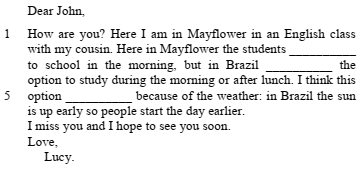
Text 5

Use the verbs in parentheses to complete the following statements.
I- I usually ___________ (listen) to music in the evenings, but at the moment I ___________(watch) my favorite program on TV.
II- Janeth ___________ (love) films. Sometimes, she ___________ (prefer) to go to the theater with her friends.
III- Mr. Steven ___________ (live) in Rio de Janeiro, Brazil. During the week, his parents ___________ (work) as lawyers for a big company downtown.
Now mark the option which completes them respectively.
Read the dialogue and mark the right option to fill in the gaps respectively.
A: Good morning, Pedro!
B: Hi, Anne! How are you?
A: I'm great. And you?
B: I'm OK.
A :__________you at Tom's party last night?
B: Yes, I _________.
A: Who_________ you go with?
B: I __________ with my friends from work. And you?
Were you there?
A: No, I __________. I __________home.

Marque a opção correta de acordo com o sentido com que os verbos modais sublinhados são empregados no texto.
I. Can living with less make you happier? (título) → para indicar uma possibilidade.
II. We never know what tomorrow might bring, (linha 13) → para indicar um estado contrário à realidade.
III. It may sound as if I’m exaggerating. (linha 35) → para indicar uma probabilidade.
IV. I think you should try saying goodbye to some of your things. (linha 39) → para dar um conselho.
Estão corretas



 Conheça nossos planos