Questões Militares
Comentadas sobre verbos | verbs em inglês
Foram encontradas 448 questões


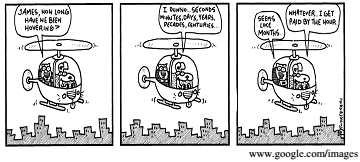
In the cartoon, “hovering” is
Read the sentences and write T for the correct matching between the phrasal verb and the meaning or F for the incorrect matching:
( ) May I close the door? It is too cold. (ask for permission)
( ) Nobody answers the phone. They must be busy. (obligation)
( ) She should talk to him to apologize. (suggestion)
( ) They might not come for dinner. (prohibition)
Choose the correct alternative:

Complete the sentence with the appropriate word.
“Even though it`s _______, I _______ go to the beach”
Choose the correct option to complete the text.
“My neighbors are very noisy. A young couple with a baby and a dog live upstairs. They aren`t happy together, so they _______ all the time. Their dog _______ when they aren`t at home, and their baby _______ when they are. An old couple lives downstairs. They can`t hear, so they always _______ the TV on very loud. They _______ loudly because the TV is loud, and they _______ a lot about which shows to watch.”
Choose the correct option to complete the dialogue.
A - Where __________ you from?
B - __________ from Australia, from Darwin.
A - Where`s Darwin? _________ it near Sydney?
B - No, it ________. It`s in the north.
A - _________ it nice?
B - Yes, it ________. It`s beautiful.
Regarding the right use of participle adjectives, choose the best alternative to fill the sentences:
Sarah __________ her best clothes for the prom.
Regarding the right use of participle adjectives, choose the best alternative to fill the sentences:
Why Peter and Chris are so _________? Are they going
to a party?
Regarding the right use of participle adjectives, choose the best alternative to fill the sentences:
I truly hope it rains in São Paulo soon. Sistema
Cantareira is almost _________.

Read the dialogue and complete it with the right form of the verb.
WAITER: Are you ready to order?
CLIENT: Would you mind _______ me the menu?
WAITER: Of course not. Here you are.
Water: Unclogging the finance
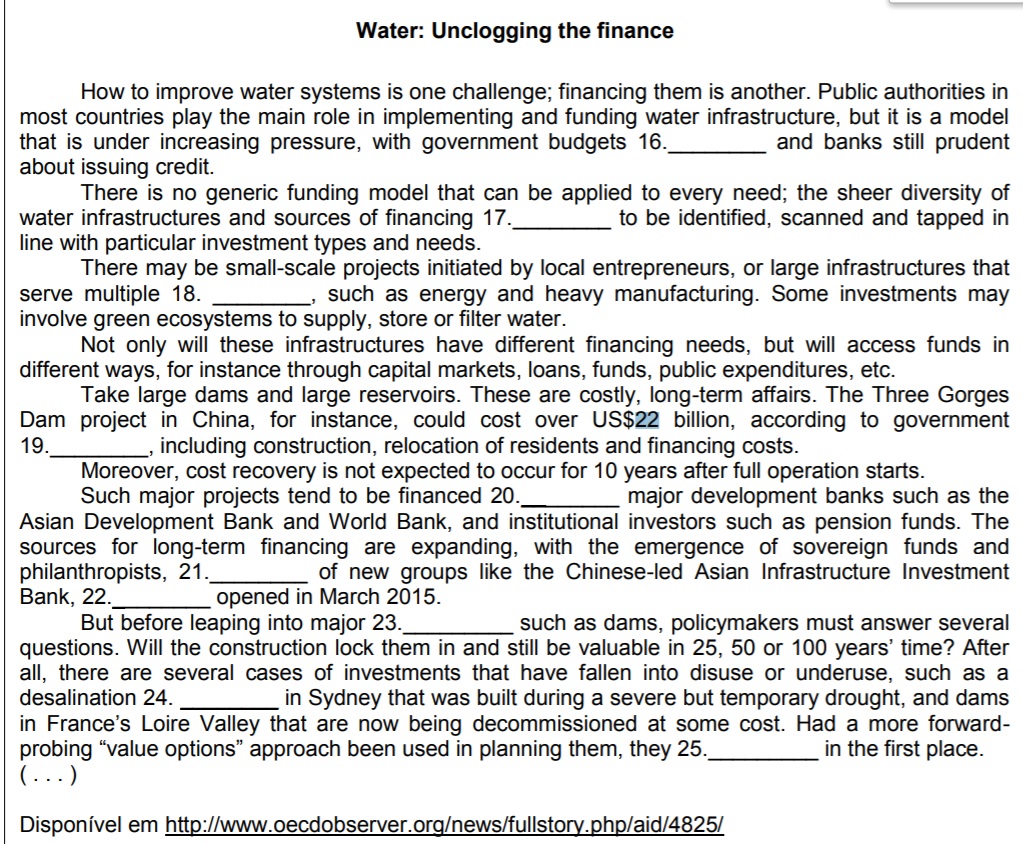
How to improve water systems is one challenge; financing them is another. Public authorities in most countries play the main role in implementing and funding water infrastructure, but it is a model that is under increasing pressure, with government budgets and banks still prudent about issuing credit.
There is no generic funding model that can be applied to every need; the sheer diversity of water infrastructures and sources of financing to be identified, scanned and tapped in line with particular investment types and needs.
There may be small-scale projects initiated by local entrepreneurs, or large infrastructures that serve multiple, such as energy and heavy manufacturing. Some investments may involve green ecosystems to supply, store or filter water.
Not only will these infrastructures have different financing needs, but will access funds in different ways, for instance through capital markets, loans, funds, public expenditures, etc.
Take large dams and large reservoirs. These are costly, long-term affairs. The Three Gorges Dam project in China, for instance, could cost over US$22 billion, according to government, including construction, relocation of residents and financing costs.
Moreover, cost recovery is not expected to occur for 10 years after full operation starts. Such major projects tend to be financed major development banks such as the Asian Development Bank and World Bank, and institutional investors such as pension funds. The sources for long-term financing are expanding, with the emergence of sovereign funds and philanthropists, of new groups like the Chinese-led Asian Infrastructure Investment Bank, opened in March 2015.
But before leaping into major such as dams, policymakers must answer several questions. Will the construction lock them in and still be valuable in 25, 50 or 100 years’ time? After all, there are several cases of investments that have fallen into disuse or underuse, such as a desalination in Sydney that was built during a severe but temporary drought, and dams in France’s Loire Valley that are now being decommissioned at some cost. Had a more forwardprobing “value options” approach been used in planning them, they _________ in the first place. ( . . . )
Disponível em http://www.oecdobserver.org/news/fullstory.php/aid/4825/ Water:_Unclogging_the_finance.html#sthash.kRhyDJ1.dpuf Acesso em 16 Abr 2015.
PARA A QUESTÃO, ESCOLHA A ALTERNATIVA QUE COMPLETA O TEXTO 1 CORRETAMENTE.
Water: Unclogging the finance
How to improve water systems is one challenge; financing them is another. Public authorities in most countries play the main role in implementing and funding water infrastructure, but it is a model that is under increasing pressure, with government budgets and banks still prudent about issuing credit.
There is no generic funding model that can be applied to every need; the sheer diversity of water infrastructures and sources of financing to be identified, scanned and tapped in line with particular investment types and needs.
There may be small-scale projects initiated by local entrepreneurs, or large infrastructures that serve multiple , such as energy and heavy manufacturing. Some investments may involve green ecosystems to supply, store or filter water.
Not only will these infrastructures have different financing needs, but will access funds in different ways, for instance through capital markets, loans, funds, public expenditures, etc.
Take large dams and large reservoirs. These are costly, long-term affairs. The Three Gorges Dam project in China, for instance, could cost over US$22 billion, according to government ________, including construction, relocation of residents and financing costs.
Moreover, cost recovery is not expected to occur for 10 years after full operation starts. Such major projects tend to be financed major development banks such as the Asian Development Bank and World Bank, and institutional investors such as pension funds. The sources for long-term financing are expanding, with the emergence of sovereign funds and philanthropists, of new groups like the Chinese-led Asian Infrastructure Investment Bank, opened in March 2015.
But before leaping into major such as dams, policymakers must answer several questions. Will the construction lock them in and still be valuable in 25, 50 or 100 years’ time? After all, there are several cases of investments that have fallen into disuse or underuse, such as a desalination in Sydney that was built during a severe but temporary drought, and dams in France’s Loire Valley that are now being decommissioned at some cost. Had a more forwardprobing “value options” approach been used in planning them, they in the first place. ( . . . )
Disponível em http://www.oecdobserver.org/news/fullstory.php/aid/4825/ Water:_Unclogging_the_finance.html#sthash.kRhyDJ1.dpuf Acesso em 16 Abr 2015.
PARA A QUESTÃO, ESCOLHA A ALTERNATIVA QUE COMPLETA O TEXTO 1 CORRETAMENTE.
Text 1
Child: Mom, uncle Tom looks so sleepy and tired.
Mom: He may have stayed up all night.
Select the alternative that best completes the extract below.
Doctors suggest not _________ much fat and sugar. Patients suffering from cardiopulmonary diseases also should not avoid ___________ to the doctor.
Read the text and answer questions 42 and 43.

Choose the alternative that fills in the blank in the sentence below.
Scientists say that when a person stops _____ very soon,
the chances of getting cancer and other diseases reduce.

 Conheça nossos planos