Questões Militares
Comentadas sobre sinônimos | synonyms em inglês
Foram encontradas 228 questões


Woman who rescued Nigerian 'witch-child' beats Obama and Pope Francis to top list of world's most inspiring people

A woman who rescued a two-year-old boy who had been cast out by his own community for being a "witch-child" has been recognised in an international list of the most inspiring people of the year. Anja Ringgren Lovén, a Danish care worker who rescued the young Nigerian boy back in February 2016, beat the likes of Pope Francis, Barack Obama and the Dalai Lama to top the list of 100 inspiring individuals compiled by German-language OOOM Magazine.
An image of Ms Lovén giving the two-year-old boy (now called Hope) some water was shared around the world, and served to highlight the work she was doing to help orphan children in Nigeria. Witch accusations is a growing problem in many African countries, especially in Nigeria, where Anja's charity African Children's Aid Education and Development Foundation cares for other children like Hope.
"When she saw the starving child, she acted like a human being and became an inspiration for millions," said Georg Kindel, OOOM's editor-in-chief, who led the jury that chose the list. Speaking today about the experience, she said: "He was the size of a little baby, my whole body froze. I was thinking of my own son when I saw the boy. For me it was clear at that moment that I would fight with all my strength for him to survive."
Adapted from http://www.independent.co.uk/news/people/
worlds-most-inspiring-person-2016-ooom-anja-ringgren-lovennigeria-witch-child-a7460976.html
Military operations in megacities
A linguistic perspective
The challenge of conducting future military operations within megacities (cities with populations over ten million) lies in understanding the dynamic and multidimensional complexities of these urban areas. Military operations in megacities, whether combat-oriented or otherwise, will be similar to those in other urban environments, but will be complicated by factors unique to the megacity environment.
First and foremost, megacities are largely multilingual. While this can be said of large cities in general, the scale of multilingualism in megacities magnifies its effects. For instance, in New York City (NYC) - a metropolitan megacity of over eighteen million people - nine foreign languages are spoken by communities of one hundred thousand or larger. Language also plays a role in determining one's identity and the language community in which one decides to live. For example, the majority of Russian speakers in NYC tend to live in south Brooklyn and Staten Island, while Chinese speakers tend to cluster in Manhattan and Sunset Park. In megacities, language, culture, and regional context go hand in hand and often reach beyond ethnic identities.
In order to fully understand the context of a megacity, we must understand the role of the languages used in its communities. How _____(1) language communities interact in megacities? What tensions _____ (2) caused by multiple language communities in urban space? What role______ (3) language play in the power structures (government or otherwise) of megacities?
Adapted from Military Review - Jan/Feb 2016
A handwritten note from September 11
In moments of crisis, our first thoughts are usually to get in contact with the people we love. September 11, 2001, was a day when many people wanted to know that their loved ones were safe. At 9:37 a.m., the Pentagon was attacked by terrorists who crashed an airplane into the western side of the building.
Many people tried using the mobile phones that existed then, but few were successful. Franklin and Daria Gaillard (Frank and Chip) were both members of the Air Force and worked at the Pentagon. They worked in different parts of the building and had a previous agreement that they would meet at their car in the parking lot if there were any emergency.
Daria was the first to arrive at the car and wrote a note to Franklin saying "Frank - Sweetie I am okay. I'm w/ my office over by the Lyndon B. Johnson Memorial Sign. I'll stay there till you come. Love lots & lots, Chip." Frank found the note and was able to locate his wife in the aftermath of the attack.
What makes this story so interesting is the handwritten note. Today, in our digital culture, we have a variety of ways to let people know that we are safe. Text messages, voicemail, and different forms of social media can be used to get the information out to loved ones. In 2001, when these attacks__________(1), the cellular network was still growing and was not as robust as it is today.
This letter is just one of the many objects that The National Museum of American History_________ (2) since 2001. To learn more, visit our online exhibition September 11th: Bearing Witness to History.
Adapted from http://americanhistory.si.edu/biog/handwritten-note-september-11-2001

How diversity makes us smarter
Decades of research by organizational scientists, psychologists, sociologists, economists and demographers show that socially diverse groups (that is, those with a diversity of race, ethnicity, gender and sexual orientation) are more innovative than homogeneous groups. It means being around people who are different from us makes us more creative, more diligent and more hardworking.
It seems obvious that a group of people with diverse individual expertise would be better than a homogeneous group at solving complex, non-routine problems. It is less obvious that social diversity should work in the same way - yet the science shows that it does. This is not only because people with different backgrounds bring new information. Simply interacting with individuals who are different forces group members to prepare better, to anticipate alternative viewpoints and to expect that reaching consensus will take effort.
Diversity of expertise confers benefits that are obvious - you would not think of building a new car without engineers, designers and quality-control experts - but what about social diversity? The same logic applies to social diversity. People who are different from one another in race, gender and other dimensions bring unique information and experiences to bear on the task at hand. A male and a female engineer might have perspectives as different from one another as an engineer and a physicist - and that is a good thing.
The fact is that if you want to build teams or organizations capable of innovating, you need diversity. Diversity enhances creativity. It encourages the search for novel information and perspectives, leading to better decision making and problem solving. Diversity can improve the bottom line of companies and lead to discoveries and breakthrough innovations. Even simply being exposed to diversity can change the way you think.
Adapted from http://www.scientificamerican.com/article/how-diversity-makes-us-smarter/
What is the meaning of the phrasal verb below:
“While some food “holidays” are indeed made-up, many have historical roots”.

In the extract from the first paragraph: “The damage
caused by a British-owned cruise ship that
accidentally ran aground on a pristine Indonesian
coral reef could total more than $18 million (...)”, the
word in bold means
Read the synopsis and answer question.

Read the cartoon and answer question.
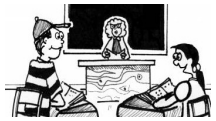
“I find the easiest way to expand my vocabulary is to make up
words.”
Read the text and answer question.
Some situation call for a lot of patience. We were going to call on some friends. But I had traveled to São Paulo and it was raining hard.
Because of the weather all flights to Rio were call off. So I couldn’t come. I called her up to explain, and then she called me down!
Choose the correct alternative to replace the phrasal verb,
underlined in the text.
Some situation call for a lot of patience. We were going to call on some friends. But I had traveled to São Paulo and it was raining hard.
Because of the weather all flights to Rio were call off. So I couldn’t come. I called her up to explain, and then she called me down!
“call for”, in bold type in the text, means


Six things I learned from riding in a Google self-driving car
1 - Human beings are terrible drivers.
We drink. We doze. We text. In the US, 30,000 people die from automobile accidents every year. Traffic crashes are the primary cause of death worldwide for people aged 15-24, and during a crash, 40% of drivers never even hit the brakes. We’re flawed organisms, barreling around at high speeds in vessels covered in glass, metal, distraction, and death. This is one of Google’s “moonshots” – to remove human error from a job which, for the past hundred years, has been entirely human.
2 - Google self-driving cars are timid.
The car we rode in did not strike me as dangerous. It drove slowly and deliberately, and I got the impression that it’s more likely to annoy other drivers than to harm them. In the early versions they tested on closed courses, the vehicles were programmed to be highly aggressive. Apparently during these tests, which involved obstacle courses full of traffic cones and inflatable crash-test objects, there were a lot of screeching brakes, roaring engines and terrified interns.
3 - They’re cute.
Google’s new fleet was intentionally designed to look adorable. Our brains are hardwired to treat inanimate (or animate) objects with greater care, caution, and reverence when they resemble a living thing. By turning self-driving cars into an adorable Skynet Marshmallow Bumper Bots, Google hopes to spiritually disarm other drivers. I also suspect the cuteness is used to quell some of the road rage that might emerge from being stuck behind one of these things. They’re intended as moderate-distance couriers, not openroad warriors, so their max speed is 25 miles per hour.
4 - It’s not done and it’s not perfect.
Some of the scenarios autonomous vehicles have the most trouble with are the same human beings have the most trouble with, such as traversing four-way stops or handling a yellow light. The cars use a mixture of 3D laser-mapping, GPS, and radar to analyze and interpret their surroundings, and the latest versions are fully electric with a range of about 100 miles. Despite the advantages over a human being in certain scenarios, however, these cars still aren’t ready for the real world. They can’t drive in the snow or heavy rain, and there’s a variety of complex situations they do not process well, such as passing through a construction zone. Google is hoping that, eventually, the cars will be able to handle all of this as well (or better) than a human could.
5 - I want this technology to succeed, like… yesterday.
I’m biased. Earlier this year my mom had a stroke. It damaged the visual cortex of her brain, and her vision was impaired to the point that she’ll probably never drive again. This reduced her from a fully-functional, independent human being with a career and a buzzing social life into someone who is homebound, disabled, and powerless. When discussing self-driving cars, people tend to ask many superficial questions. They ignore that 45% of disabled people in the US still work. They ignore that 95% of a car’s lifetime is spent parked. They ignore how this technology could transform the lives of the elderly, or eradicate the need for parking lots or garages or gas stations. They dismiss the entire concept because they don’t think a computer could ever be as good at merging on the freeway as they are. They ignore the great, big, beautiful picture: that this technology could make our lives so much better.
6 - It wasn’t an exhilarating ride, and that’s a good thing.
Riding in a self-driving car is not the cybernetic thrill ride one might expect. The car drives like a person, and after a few minutes you forget that you’re being driven autonomously. You forget that a robot is differentiating cars from pedestrians from mopeds from raccoons. You forget that millions of photons are being fired from a laser and interpreting, processing, and reacting to the hand signals of a cyclist. You forget that instead of an organic brain, which has had millions of years to evolve the cognitive ability to fumble its way through a four-way stop, you’re being piloted by an artificial one, which was birthed in less than a decade. The unfortunate part of something this transformative is the inevitable, ardent stupidity which is going to erupt from the general public. Even if in a few years self-driving cars are proven to be ten times safer than human-operated cars, all it’s going to take is one tragic accident and the public is going to lose their minds. There will be outrage. There will be politicizing. There will be hashtags. I say look at the bigger picture. All the self-driving cars currently on the road learn from one another, and possess 40 years of driving experience. And this technology is still in its infancy.
(Adapted from:: <http://theoatmeal.com/blog/google_self_driving_car>
Leia o texto para responder à questão.
Police in England and Wales consider making
misogyny a hate crime

September 10, 2016
Police forces across England and Wales are considering expanding their definition of hate crime to include misogyny (hatred, dislike, or mistrust of women, or prejudice against women) after an experiment in one city that saw more than 20 investigations launched in two months.
The initial success of Nottingham’s crackdown against sexist abuse has drawn national interest after the city’s police revealed that they investigated a case of misogyny every three days during July and August, the first months to see specially trained officers targeting behaviour ranging from street harassment to unwanted physical approaches.
Several other forces have confirmed they are sending representatives to Nottingham this month to discuss the introduction of misogyny as a hate crime. Police and campaigners said the initial figures were broadly in line with other categories of hate crime such as Islamophobia and antisemitism but were likely to rise significantly as awareness increased.
Dave Alton, the hate crime manager for Nottingham police, said: “The number of reports we are receiving is comparable with other, more established, categories of hate crime. We have received numerous reports and have been able to provide a service to women in Nottinghamshire who perhaps would not have approached us six months ago. The reality is that all of the reports so far have required some form of police action.”
(www.theguardian.com. Adaptado)
Read the text and answer the question.
Olympic Sports
The first modern Olympic Games took place in Athens, Greece, in the year 1896. Athletes from only 13 countries participated in the Games that year. They competed in 43 different events in just 9 sports (track and field, swimming, cycling, fencing, gymnastics, shooting, tennis, weight lifting, and wrestling). In 2004, the Olympic Games took place once again in Athens. This time athletes from 202 countries competed in 300 events in 28 sports. Only five sports have been in every Olympic Games.
Fonte: adapted from Thoughts and Notions.
Texto 5
HIGH-TECH EAVESDROPPING ON THE GANGES RIVER DOLPHIN
SONAR SIGNALS HOLD CLUES THAT COULD SAVE AN ENDANGERED SPECIES
The Ganges river dolphin is one of only two remaining freshwater dolphin species on Earth. But pollution, fishing, and dams threaten to wipe it out entirely.
So acoustical engineer Harumi Sugimatsu and her team have deployed an experimental sonar monitoring system just under the surface of the murky water. The hope is to track the dolphins by the high-frequency clicks they use to navigate and hunt. By eavesdropping on their underwater lives, Sugimatsu believes she can gather data about their behavior and geographical range—data that conservationists can use in their struggle to keep the species from going extinct.
IEEE Spectrum. High-tech eavesdropping on the ganges river dolphin. In: IEEE Spectrum,
2016. Disponível em:<http://spectrum.ieee.org/video/green-tech/conservation/hightech-eavesdropping-on-the-ganges-river-dolphin>
What's the meaning of the underlined word in the following sentence: “(…) her team have deployed an experimental sonar monitoring system just under the surface of the murky water”?

 Conheça nossos planos