Questões Militares Sobre inglês
Foram encontradas 4.472 questões


Ano: 2025
Banca:
VUNESP
Órgão:
EsFCEx
Prova:
VUNESP - 2025 - EsFCEx - Oficial - Especialidade: Magistério em Inglês |
Q3512692
Inglês
Texto associado
Read the text to answer question.
Making the Case: The Importance
of Listening in Language Learning
It has taken many years to bring the language teaching
profession around to realizing the importance of listening
in second and foreign language learning. As observed
by Rivers, long an advocate for listening comprehension,
“Speaking does not of itself constitute communication unless
what is said is comprehended by another person”. Teaching
the comprehension of spoken speech is therefore of primary
importance if the communication aim is to be reached” (1966,
pp. 196, 204). The reasons for the nearly total neglect of
listening are difficult to assess, but as Morley notes, “Perhaps
an assumption that listening is a reflex, a little like breathing
- listening seldom receives overt teaching attention in one’s
native language - has masked the importance and complexity
of listening with understanding in a non-native language”
(1972, p. vii).
In reality, listening is used far more than any other single
language skill in normal daily life. On average, we can expect
to listen twice as much as we speak, four times more than we
read, and five times more than we write.
(Joan Morley,. In: Marianne Celce-Murcia, (Ed.). Teaching English as a
second or foreign language. Boston: Heinle&Heinle-Thomson, 2001.
Adaptado)
Um professor apresenta a seus alunos uma atividade de
“listening” – um diálogo entre dois falantes de inglês a
respeito dos planetas Marte e Terra. Pretende que o diálogo seja o ponto de partida para uma atividade relacionada a situações de comunicação real. Com tal objetivo
em mente, orienta corretamente seus alunos para que
Ano: 2025
Banca:
VUNESP
Órgão:
EsFCEx
Prova:
VUNESP - 2025 - EsFCEx - Oficial - Especialidade: Magistério em Inglês |
Q3512691
Inglês
Texto associado
Read the text to answer question.
Making the Case: The Importance
of Listening in Language Learning
It has taken many years to bring the language teaching
profession around to realizing the importance of listening
in second and foreign language learning. As observed
by Rivers, long an advocate for listening comprehension,
“Speaking does not of itself constitute communication unless
what is said is comprehended by another person”. Teaching
the comprehension of spoken speech is therefore of primary
importance if the communication aim is to be reached” (1966,
pp. 196, 204). The reasons for the nearly total neglect of
listening are difficult to assess, but as Morley notes, “Perhaps
an assumption that listening is a reflex, a little like breathing
- listening seldom receives overt teaching attention in one’s
native language - has masked the importance and complexity
of listening with understanding in a non-native language”
(1972, p. vii).
In reality, listening is used far more than any other single
language skill in normal daily life. On average, we can expect
to listen twice as much as we speak, four times more than we
read, and five times more than we write.
(Joan Morley,. In: Marianne Celce-Murcia, (Ed.). Teaching English as a
second or foreign language. Boston: Heinle&Heinle-Thomson, 2001.
Adaptado)
In the fragment from the first paragraph “It has taken
many years to bring the language teaching profession
around to realizing the importance of listening in second
and foreign language learning”, the bolded words form a
collocation. In English, collocations with the verbs ‘do’ and
‘make’ are particularly frequent. One correct instance of
such collocation is found in the bolded words in alternative:
Ano: 2025
Banca:
VUNESP
Órgão:
EsFCEx
Prova:
VUNESP - 2025 - EsFCEx - Oficial - Especialidade: Magistério em Inglês |
Q3512690
Inglês
Texto associado
Read the text to answer question.
Making the Case: The Importance
of Listening in Language Learning
It has taken many years to bring the language teaching
profession around to realizing the importance of listening
in second and foreign language learning. As observed
by Rivers, long an advocate for listening comprehension,
“Speaking does not of itself constitute communication unless
what is said is comprehended by another person”. Teaching
the comprehension of spoken speech is therefore of primary
importance if the communication aim is to be reached” (1966,
pp. 196, 204). The reasons for the nearly total neglect of
listening are difficult to assess, but as Morley notes, “Perhaps
an assumption that listening is a reflex, a little like breathing
- listening seldom receives overt teaching attention in one’s
native language - has masked the importance and complexity
of listening with understanding in a non-native language”
(1972, p. vii).
In reality, listening is used far more than any other single
language skill in normal daily life. On average, we can expect
to listen twice as much as we speak, four times more than we
read, and five times more than we write.
(Joan Morley,. In: Marianne Celce-Murcia, (Ed.). Teaching English as a
second or foreign language. Boston: Heinle&Heinle-Thomson, 2001.
Adaptado)
Words ending in –ing may be verbs, nouns or adjectives,
depending on the context. The bolded -ing word functions
as an adjective in alternative:
Ano: 2025
Banca:
VUNESP
Órgão:
EsFCEx
Prova:
VUNESP - 2025 - EsFCEx - Oficial - Especialidade: Magistério em Inglês |
Q3512689
Inglês
Texto associado
Read the text to answer question.
Making the Case: The Importance
of Listening in Language Learning
It has taken many years to bring the language teaching
profession around to realizing the importance of listening
in second and foreign language learning. As observed
by Rivers, long an advocate for listening comprehension,
“Speaking does not of itself constitute communication unless
what is said is comprehended by another person”. Teaching
the comprehension of spoken speech is therefore of primary
importance if the communication aim is to be reached” (1966,
pp. 196, 204). The reasons for the nearly total neglect of
listening are difficult to assess, but as Morley notes, “Perhaps
an assumption that listening is a reflex, a little like breathing
- listening seldom receives overt teaching attention in one’s
native language - has masked the importance and complexity
of listening with understanding in a non-native language”
(1972, p. vii).
In reality, listening is used far more than any other single
language skill in normal daily life. On average, we can expect
to listen twice as much as we speak, four times more than we
read, and five times more than we write.
(Joan Morley,. In: Marianne Celce-Murcia, (Ed.). Teaching English as a
second or foreign language. Boston: Heinle&Heinle-Thomson, 2001.
Adaptado)
According to the author of this text, listening in second
language teaching and learning
Ano: 2025
Banca:
VUNESP
Órgão:
EsFCEx
Prova:
VUNESP - 2025 - EsFCEx - Oficial - Especialidade: Magistério em Inglês |
Q3512688
Inglês
Texto associado
Read the text to answer question.
Making the Case: The Importance
of Listening in Language Learning
It has taken many years to bring the language teaching
profession around to realizing the importance of listening
in second and foreign language learning. As observed
by Rivers, long an advocate for listening comprehension,
“Speaking does not of itself constitute communication unless
what is said is comprehended by another person”. Teaching
the comprehension of spoken speech is therefore of primary
importance if the communication aim is to be reached” (1966,
pp. 196, 204). The reasons for the nearly total neglect of
listening are difficult to assess, but as Morley notes, “Perhaps
an assumption that listening is a reflex, a little like breathing
- listening seldom receives overt teaching attention in one’s
native language - has masked the importance and complexity
of listening with understanding in a non-native language”
(1972, p. vii).
In reality, listening is used far more than any other single
language skill in normal daily life. On average, we can expect
to listen twice as much as we speak, four times more than we
read, and five times more than we write.
(Joan Morley,. In: Marianne Celce-Murcia, (Ed.). Teaching English as a
second or foreign language. Boston: Heinle&Heinle-Thomson, 2001.
Adaptado)
Considering the information available in the presentation
of the extract, it is correct to state that it is
Ano: 2025
Banca:
VUNESP
Órgão:
EsFCEx
Prova:
VUNESP - 2025 - EsFCEx - Oficial - Especialidade: Magistério em Inglês |
Q3512686
Inglês
Texto associado
Read the text to answer question.
Based on theoretical, experimental, and experiential
knowledge, teachers and teacher educators have expressed
their dissatisfaction with method in different ways. Studies
clearly demonstrate that, even as the methodological band
played on, practicing teachers have been marching to a
different drum.
In this sense, the post method condition is established
as a timely response. It signifies interrelated attributes. First
and foremost, it signifies a search for an alternative to method
rather than an alternative method. While alternative methods
are primarily products of top-down processes, alternatives
to method are mainly products of bottom-up processes.
In practical terms, this means that we need to refigure the
relationship between the theorizer and the practitioner of
language teaching. If the concept of method authorizes
theorizers to centralize pedagogic decision-making, the
postmethod condition enables practitioners to generate
location-specific, classroom-oriented innovative strategies.
Secondly, the postmethod condition signifies teacher
autonomy. The conventional concept of method “overlooks
the fund of experience and tacit knowledge about teaching
which the teachers already have by virtue of their lives as
students” (Freeman, 1991). The postmethod condition,
however, recognizes the teachers’ potential to know not
only how to teach but also how to act autonomously within
the academic and administrative constraints imposed by
institutions, curricula, and textbooks. It also promotes the
ability of teachers to know how to develop a critical approach
in order to self-observe, self-analyze, and self-evaluate
their own teaching practice with a view to effecting desired
changes.
(B. Kumaravadivelu, Beyond Methods: Macrostrategies for language
teaching. Haven and London: Yale University Press. 2003. Adaptado)
In the extract from the third paragraph “the fund of
experience and tacit knowledge about teaching which
the teachers already have by virtue of their lives as
students”, the bolded fragment functions as
Ano: 2025
Banca:
VUNESP
Órgão:
EsFCEx
Prova:
VUNESP - 2025 - EsFCEx - Oficial - Especialidade: Magistério em Inglês |
Q3512685
Inglês
Texto associado
Read the text to answer question.
Based on theoretical, experimental, and experiential
knowledge, teachers and teacher educators have expressed
their dissatisfaction with method in different ways. Studies
clearly demonstrate that, even as the methodological band
played on, practicing teachers have been marching to a
different drum.
In this sense, the post method condition is established
as a timely response. It signifies interrelated attributes. First
and foremost, it signifies a search for an alternative to method
rather than an alternative method. While alternative methods
are primarily products of top-down processes, alternatives
to method are mainly products of bottom-up processes.
In practical terms, this means that we need to refigure the
relationship between the theorizer and the practitioner of
language teaching. If the concept of method authorizes
theorizers to centralize pedagogic decision-making, the
postmethod condition enables practitioners to generate
location-specific, classroom-oriented innovative strategies.
Secondly, the postmethod condition signifies teacher
autonomy. The conventional concept of method “overlooks
the fund of experience and tacit knowledge about teaching
which the teachers already have by virtue of their lives as
students” (Freeman, 1991). The postmethod condition,
however, recognizes the teachers’ potential to know not
only how to teach but also how to act autonomously within
the academic and administrative constraints imposed by
institutions, curricula, and textbooks. It also promotes the
ability of teachers to know how to develop a critical approach
in order to self-observe, self-analyze, and self-evaluate
their own teaching practice with a view to effecting desired
changes.
(B. Kumaravadivelu, Beyond Methods: Macrostrategies for language
teaching. Haven and London: Yale University Press. 2003. Adaptado)
The meaning of the word “overlook” as used in the second
paragraph of the text is
Ano: 2025
Banca:
VUNESP
Órgão:
EsFCEx
Prova:
VUNESP - 2025 - EsFCEx - Oficial - Especialidade: Magistério em Inglês |
Q3512684
Inglês
Texto associado
Read the text to answer question.
Based on theoretical, experimental, and experiential
knowledge, teachers and teacher educators have expressed
their dissatisfaction with method in different ways. Studies
clearly demonstrate that, even as the methodological band
played on, practicing teachers have been marching to a
different drum.
In this sense, the post method condition is established
as a timely response. It signifies interrelated attributes. First
and foremost, it signifies a search for an alternative to method
rather than an alternative method. While alternative methods
are primarily products of top-down processes, alternatives
to method are mainly products of bottom-up processes.
In practical terms, this means that we need to refigure the
relationship between the theorizer and the practitioner of
language teaching. If the concept of method authorizes
theorizers to centralize pedagogic decision-making, the
postmethod condition enables practitioners to generate
location-specific, classroom-oriented innovative strategies.
Secondly, the postmethod condition signifies teacher
autonomy. The conventional concept of method “overlooks
the fund of experience and tacit knowledge about teaching
which the teachers already have by virtue of their lives as
students” (Freeman, 1991). The postmethod condition,
however, recognizes the teachers’ potential to know not
only how to teach but also how to act autonomously within
the academic and administrative constraints imposed by
institutions, curricula, and textbooks. It also promotes the
ability of teachers to know how to develop a critical approach
in order to self-observe, self-analyze, and self-evaluate
their own teaching practice with a view to effecting desired
changes.
(B. Kumaravadivelu, Beyond Methods: Macrostrategies for language
teaching. Haven and London: Yale University Press. 2003. Adaptado)
Suponha que o texto de Kamaravadivelu seja usado em
um curso de formação em serviço para professores de
inglês. Com o texto em mãos, um dos professores-alunos
imediatamente pergunta sobre o significado de overlook
no trecho do terceiro parágrafo “The conventional
concept of method overlooks the fund of experience”, e o
professor-formador o incentiva a usar o contexto do texto
para compreender a palavra. Ao oferecer tal orientação,
o professor-formador estará incentivando a prática da
seguinte estratégia de leitura:
Ano: 2025
Banca:
VUNESP
Órgão:
EsFCEx
Prova:
VUNESP - 2025 - EsFCEx - Oficial - Especialidade: Magistério em Inglês |
Q3512683
Inglês
Texto associado
Read the text to answer question.
Based on theoretical, experimental, and experiential
knowledge, teachers and teacher educators have expressed
their dissatisfaction with method in different ways. Studies
clearly demonstrate that, even as the methodological band
played on, practicing teachers have been marching to a
different drum.
In this sense, the post method condition is established
as a timely response. It signifies interrelated attributes. First
and foremost, it signifies a search for an alternative to method
rather than an alternative method. While alternative methods
are primarily products of top-down processes, alternatives
to method are mainly products of bottom-up processes.
In practical terms, this means that we need to refigure the
relationship between the theorizer and the practitioner of
language teaching. If the concept of method authorizes
theorizers to centralize pedagogic decision-making, the
postmethod condition enables practitioners to generate
location-specific, classroom-oriented innovative strategies.
Secondly, the postmethod condition signifies teacher
autonomy. The conventional concept of method “overlooks
the fund of experience and tacit knowledge about teaching
which the teachers already have by virtue of their lives as
students” (Freeman, 1991). The postmethod condition,
however, recognizes the teachers’ potential to know not
only how to teach but also how to act autonomously within
the academic and administrative constraints imposed by
institutions, curricula, and textbooks. It also promotes the
ability of teachers to know how to develop a critical approach
in order to self-observe, self-analyze, and self-evaluate
their own teaching practice with a view to effecting desired
changes.
(B. Kumaravadivelu, Beyond Methods: Macrostrategies for language
teaching. Haven and London: Yale University Press. 2003. Adaptado)
In the sentence from the second paragraph “If the
concept of method authorizes theorizers to centralize
pedagogic decision-making, the postmethod condition
enables practitioners to generate location-specific,
classroom-oriented innovative strategies”, the conditional
clause can be correctly rewritten as:
Ano: 2025
Banca:
VUNESP
Órgão:
EsFCEx
Prova:
VUNESP - 2025 - EsFCEx - Oficial - Especialidade: Magistério em Inglês |
Q3512682
Inglês
Texto associado
Read the text to answer question.
Based on theoretical, experimental, and experiential
knowledge, teachers and teacher educators have expressed
their dissatisfaction with method in different ways. Studies
clearly demonstrate that, even as the methodological band
played on, practicing teachers have been marching to a
different drum.
In this sense, the post method condition is established
as a timely response. It signifies interrelated attributes. First
and foremost, it signifies a search for an alternative to method
rather than an alternative method. While alternative methods
are primarily products of top-down processes, alternatives
to method are mainly products of bottom-up processes.
In practical terms, this means that we need to refigure the
relationship between the theorizer and the practitioner of
language teaching. If the concept of method authorizes
theorizers to centralize pedagogic decision-making, the
postmethod condition enables practitioners to generate
location-specific, classroom-oriented innovative strategies.
Secondly, the postmethod condition signifies teacher
autonomy. The conventional concept of method “overlooks
the fund of experience and tacit knowledge about teaching
which the teachers already have by virtue of their lives as
students” (Freeman, 1991). The postmethod condition,
however, recognizes the teachers’ potential to know not
only how to teach but also how to act autonomously within
the academic and administrative constraints imposed by
institutions, curricula, and textbooks. It also promotes the
ability of teachers to know how to develop a critical approach
in order to self-observe, self-analyze, and self-evaluate
their own teaching practice with a view to effecting desired
changes.
(B. Kumaravadivelu, Beyond Methods: Macrostrategies for language
teaching. Haven and London: Yale University Press. 2003. Adaptado)
In the excerpt from the second paragraph “we need to
refigure the relationship between the theorizer and
the practitioner”, the bolded word has been formed by
the addition of the prefix re- to a base word. Mark the
alternative in which the re- is a prefix in both words, and
not part of the base word itself.
Ano: 2025
Banca:
VUNESP
Órgão:
EsFCEx
Prova:
VUNESP - 2025 - EsFCEx - Oficial - Especialidade: Magistério em Inglês |
Q3512681
Inglês
Texto associado
Read the text to answer question.
Based on theoretical, experimental, and experiential
knowledge, teachers and teacher educators have expressed
their dissatisfaction with method in different ways. Studies
clearly demonstrate that, even as the methodological band
played on, practicing teachers have been marching to a
different drum.
In this sense, the post method condition is established
as a timely response. It signifies interrelated attributes. First
and foremost, it signifies a search for an alternative to method
rather than an alternative method. While alternative methods
are primarily products of top-down processes, alternatives
to method are mainly products of bottom-up processes.
In practical terms, this means that we need to refigure the
relationship between the theorizer and the practitioner of
language teaching. If the concept of method authorizes
theorizers to centralize pedagogic decision-making, the
postmethod condition enables practitioners to generate
location-specific, classroom-oriented innovative strategies.
Secondly, the postmethod condition signifies teacher
autonomy. The conventional concept of method “overlooks
the fund of experience and tacit knowledge about teaching
which the teachers already have by virtue of their lives as
students” (Freeman, 1991). The postmethod condition,
however, recognizes the teachers’ potential to know not
only how to teach but also how to act autonomously within
the academic and administrative constraints imposed by
institutions, curricula, and textbooks. It also promotes the
ability of teachers to know how to develop a critical approach
in order to self-observe, self-analyze, and self-evaluate
their own teaching practice with a view to effecting desired
changes.
(B. Kumaravadivelu, Beyond Methods: Macrostrategies for language
teaching. Haven and London: Yale University Press. 2003. Adaptado)
The word “while” has multiple meanings and functions.
Mark the alternative in which it has the same meaning as
the word in bold in the extract from the first paragraph in
the text: “While alternative methods are primarily products
of top-down processes”.
Ano: 2025
Banca:
VUNESP
Órgão:
EsFCEx
Prova:
VUNESP - 2025 - EsFCEx - Oficial - Especialidade: Magistério em Inglês |
Q3512680
Inglês
Texto associado
Read the text to answer question.
Based on theoretical, experimental, and experiential
knowledge, teachers and teacher educators have expressed
their dissatisfaction with method in different ways. Studies
clearly demonstrate that, even as the methodological band
played on, practicing teachers have been marching to a
different drum.
In this sense, the post method condition is established
as a timely response. It signifies interrelated attributes. First
and foremost, it signifies a search for an alternative to method
rather than an alternative method. While alternative methods
are primarily products of top-down processes, alternatives
to method are mainly products of bottom-up processes.
In practical terms, this means that we need to refigure the
relationship between the theorizer and the practitioner of
language teaching. If the concept of method authorizes
theorizers to centralize pedagogic decision-making, the
postmethod condition enables practitioners to generate
location-specific, classroom-oriented innovative strategies.
Secondly, the postmethod condition signifies teacher
autonomy. The conventional concept of method “overlooks
the fund of experience and tacit knowledge about teaching
which the teachers already have by virtue of their lives as
students” (Freeman, 1991). The postmethod condition,
however, recognizes the teachers’ potential to know not
only how to teach but also how to act autonomously within
the academic and administrative constraints imposed by
institutions, curricula, and textbooks. It also promotes the
ability of teachers to know how to develop a critical approach
in order to self-observe, self-analyze, and self-evaluate
their own teaching practice with a view to effecting desired
changes.
(B. Kumaravadivelu, Beyond Methods: Macrostrategies for language
teaching. Haven and London: Yale University Press. 2003. Adaptado)
Pronouns are important elements for text cohesion.
In the extract from the second paragraph “It signifies
interrelated attributes”, the pronoun It has “the
postmethod condition” as its referent. A pronoun it that
does not have a referent and only performs a grammatical
function is a “nonreferential it”. In the following sentences,
a “nonreferencial it” is found in:
Ano: 2025
Banca:
VUNESP
Órgão:
EsFCEx
Prova:
VUNESP - 2025 - EsFCEx - Oficial - Especialidade: Magistério em Inglês |
Q3512679
Inglês
Texto associado
Read the text to answer question.
Based on theoretical, experimental, and experiential
knowledge, teachers and teacher educators have expressed
their dissatisfaction with method in different ways. Studies
clearly demonstrate that, even as the methodological band
played on, practicing teachers have been marching to a
different drum.
In this sense, the post method condition is established
as a timely response. It signifies interrelated attributes. First
and foremost, it signifies a search for an alternative to method
rather than an alternative method. While alternative methods
are primarily products of top-down processes, alternatives
to method are mainly products of bottom-up processes.
In practical terms, this means that we need to refigure the
relationship between the theorizer and the practitioner of
language teaching. If the concept of method authorizes
theorizers to centralize pedagogic decision-making, the
postmethod condition enables practitioners to generate
location-specific, classroom-oriented innovative strategies.
Secondly, the postmethod condition signifies teacher
autonomy. The conventional concept of method “overlooks
the fund of experience and tacit knowledge about teaching
which the teachers already have by virtue of their lives as
students” (Freeman, 1991). The postmethod condition,
however, recognizes the teachers’ potential to know not
only how to teach but also how to act autonomously within
the academic and administrative constraints imposed by
institutions, curricula, and textbooks. It also promotes the
ability of teachers to know how to develop a critical approach
in order to self-observe, self-analyze, and self-evaluate
their own teaching practice with a view to effecting desired
changes.
(B. Kumaravadivelu, Beyond Methods: Macrostrategies for language
teaching. Haven and London: Yale University Press. 2003. Adaptado)
The following are characteristics of an approach used for
second language teaching.
• No use of the mother tongue is permitted (i.e., the teacher does not need to know the students’ native language).
• Lessons begin with dialogues and anecdotes in modern conversational style.
• Actions and pictures are used to make meanings clear.
• Grammar is learned inductively.
• The target culture is also taught inductively.
• The teacher must be a native speaker or have nativelike proficiency in the target language.
The characteristics listed are consistent with the approach named
• No use of the mother tongue is permitted (i.e., the teacher does not need to know the students’ native language).
• Lessons begin with dialogues and anecdotes in modern conversational style.
• Actions and pictures are used to make meanings clear.
• Grammar is learned inductively.
• The target culture is also taught inductively.
• The teacher must be a native speaker or have nativelike proficiency in the target language.
The characteristics listed are consistent with the approach named
Ano: 2025
Banca:
VUNESP
Órgão:
EsFCEx
Prova:
VUNESP - 2025 - EsFCEx - Oficial - Especialidade: Magistério em Inglês |
Q3512676
Inglês
Texto associado
Read the text to answer question.
Based on theoretical, experimental, and experiential
knowledge, teachers and teacher educators have expressed
their dissatisfaction with method in different ways. Studies
clearly demonstrate that, even as the methodological band
played on, practicing teachers have been marching to a
different drum.
In this sense, the post method condition is established
as a timely response. It signifies interrelated attributes. First
and foremost, it signifies a search for an alternative to method
rather than an alternative method. While alternative methods
are primarily products of top-down processes, alternatives
to method are mainly products of bottom-up processes.
In practical terms, this means that we need to refigure the
relationship between the theorizer and the practitioner of
language teaching. If the concept of method authorizes
theorizers to centralize pedagogic decision-making, the
postmethod condition enables practitioners to generate
location-specific, classroom-oriented innovative strategies.
Secondly, the postmethod condition signifies teacher
autonomy. The conventional concept of method “overlooks
the fund of experience and tacit knowledge about teaching
which the teachers already have by virtue of their lives as
students” (Freeman, 1991). The postmethod condition,
however, recognizes the teachers’ potential to know not
only how to teach but also how to act autonomously within
the academic and administrative constraints imposed by
institutions, curricula, and textbooks. It also promotes the
ability of teachers to know how to develop a critical approach
in order to self-observe, self-analyze, and self-evaluate
their own teaching practice with a view to effecting desired
changes.
(B. Kumaravadivelu, Beyond Methods: Macrostrategies for language
teaching. Haven and London: Yale University Press. 2003. Adaptado)
The end of the first paragraph “even as the methodological
band played on, practicing teachers have been marching
to a different drum” transported to second language
teaching, means that, although methods have frequently
been in use, practicing teachers have
Q3503336
Inglês
The speech “Don’t try to sneak a water bottle past security this
time” implies that the character in the cartoon
Q3503335
Inglês
Text II
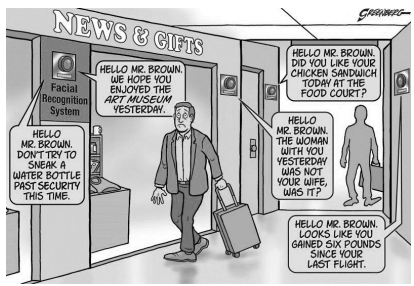
From: https://www.cartoonmovement.com/cartoon/facial-recognition-0
The cartoon criticizes the fact that face recognition can be
Q3503334
Inglês
Texto associado
Text I
Understanding bias in facial recognition technologies
Over the past couple of years, the growing debate around
automated facial recognition has reached a boiling point. As
developers have continued to swiftly expand the scope of these
kinds of technologies into an almost unbounded range of
applications, an increasingly strident chorus of critical voices has
sounded concerns about the injurious effects of the proliferation
of such systems on impacted individuals and communities. Critics
argue that the irresponsible design and use of facial detection and
recognition technologies (FDRTs) threaten to violate civil liberties,
infringe on basic human rights and further entrench structural
racism and systemic marginalisation. In addition, they argue that
the gradual creep of face surveillance infrastructures into every
domain of lived experience may eventually eradicate the modern
democratic forms of life that have long provided cherished means
to individual flourishing, social solidarity and human self-creation.
Defenders, by contrast, emphasise the gains in public safety,
security and efficiency that digitally streamlined capacities for
facial identification, identity verification and trait characterisation
may bring. These proponents point to potential real-world benefits
like the added security of facial recognition enhanced border
control, the increased efficacy of missing children or criminal
suspect searches that are driven by the application of brute force
facial analysis to largescale databases and the many added
conveniences of facial verification in the business of everyday life.
Whatever side of the debate on which one lands, it would
appear that FDRTs are here to stay.
Adapted from: understanding_bias_in_facial_recognition_technology.pdf
The word “like” in “like the added security of facial recognition”
(2nd paragraph) introduces a(n)
Q3503333
Inglês
Texto associado
Text I
Understanding bias in facial recognition technologies
Over the past couple of years, the growing debate around
automated facial recognition has reached a boiling point. As
developers have continued to swiftly expand the scope of these
kinds of technologies into an almost unbounded range of
applications, an increasingly strident chorus of critical voices has
sounded concerns about the injurious effects of the proliferation
of such systems on impacted individuals and communities. Critics
argue that the irresponsible design and use of facial detection and
recognition technologies (FDRTs) threaten to violate civil liberties,
infringe on basic human rights and further entrench structural
racism and systemic marginalisation. In addition, they argue that
the gradual creep of face surveillance infrastructures into every
domain of lived experience may eventually eradicate the modern
democratic forms of life that have long provided cherished means
to individual flourishing, social solidarity and human self-creation.
Defenders, by contrast, emphasise the gains in public safety,
security and efficiency that digitally streamlined capacities for
facial identification, identity verification and trait characterisation
may bring. These proponents point to potential real-world benefits
like the added security of facial recognition enhanced border
control, the increased efficacy of missing children or criminal
suspect searches that are driven by the application of brute force
facial analysis to largescale databases and the many added
conveniences of facial verification in the business of everyday life.
Whatever side of the debate on which one lands, it would
appear that FDRTs are here to stay.
Adapted from: understanding_bias_in_facial_recognition_technology.pdf
In the first sentence, when the author says that the debate
“has reached a boiling point”, he means that the debate is
Q3503332
Inglês
Texto associado
Text I
Understanding bias in facial recognition technologies
Over the past couple of years, the growing debate around
automated facial recognition has reached a boiling point. As
developers have continued to swiftly expand the scope of these
kinds of technologies into an almost unbounded range of
applications, an increasingly strident chorus of critical voices has
sounded concerns about the injurious effects of the proliferation
of such systems on impacted individuals and communities. Critics
argue that the irresponsible design and use of facial detection and
recognition technologies (FDRTs) threaten to violate civil liberties,
infringe on basic human rights and further entrench structural
racism and systemic marginalisation. In addition, they argue that
the gradual creep of face surveillance infrastructures into every
domain of lived experience may eventually eradicate the modern
democratic forms of life that have long provided cherished means
to individual flourishing, social solidarity and human self-creation.
Defenders, by contrast, emphasise the gains in public safety,
security and efficiency that digitally streamlined capacities for
facial identification, identity verification and trait characterisation
may bring. These proponents point to potential real-world benefits
like the added security of facial recognition enhanced border
control, the increased efficacy of missing children or criminal
suspect searches that are driven by the application of brute force
facial analysis to largescale databases and the many added
conveniences of facial verification in the business of everyday life.
Whatever side of the debate on which one lands, it would
appear that FDRTs are here to stay.
Adapted from: understanding_bias_in_facial_recognition_technology.pdf
In the last sentence, the author states that facial detection and
recognition technologies
Q3503331
Inglês
Texto associado
Text I
Understanding bias in facial recognition technologies
Over the past couple of years, the growing debate around
automated facial recognition has reached a boiling point. As
developers have continued to swiftly expand the scope of these
kinds of technologies into an almost unbounded range of
applications, an increasingly strident chorus of critical voices has
sounded concerns about the injurious effects of the proliferation
of such systems on impacted individuals and communities. Critics
argue that the irresponsible design and use of facial detection and
recognition technologies (FDRTs) threaten to violate civil liberties,
infringe on basic human rights and further entrench structural
racism and systemic marginalisation. In addition, they argue that
the gradual creep of face surveillance infrastructures into every
domain of lived experience may eventually eradicate the modern
democratic forms of life that have long provided cherished means
to individual flourishing, social solidarity and human self-creation.
Defenders, by contrast, emphasise the gains in public safety,
security and efficiency that digitally streamlined capacities for
facial identification, identity verification and trait characterisation
may bring. These proponents point to potential real-world benefits
like the added security of facial recognition enhanced border
control, the increased efficacy of missing children or criminal
suspect searches that are driven by the application of brute force
facial analysis to largescale databases and the many added
conveniences of facial verification in the business of everyday life.
Whatever side of the debate on which one lands, it would
appear that FDRTs are here to stay.
Adapted from: understanding_bias_in_facial_recognition_technology.pdf
Based on Text I, analyze the assertions below:
I. Critics are concerned about the pervasiveness of facial recognition technology.
II. Facial recognition systems may reduce the efficiency and security of border control.
III. Some argue that the new technology could undermine the stability of modern democracy.
Choose the correct answer:

 Conheça nossos planos