Questões Militares Sobre inglês
Foram encontradas 4.513 questões


Text 2
MATERIALS OF IMPORTANCE
Carbonated Beverages Containers
One common item that presents some interesting material property requirements is the container for carbonated beverages. The material used for this application must satisfy the following constraints: provide a barrier to the passage of carbon dioxide, which is under pressure in the container; be nontoxic, unreactive with the beverage, and, preferably be recyclable; be relatively strong, and capable of surviving a drop from a height of several feet when containing the beverage; be inexpensive and the cost to fabricate the final shape should be relatively low; if optically transparent, retain its optical clarity; and capable of being produced having different colors and/or able to be adorned with decorative labels.
All three of the basic material types—metal (aluminum), ceramic (glass), and polymer (polyester plastic)—are used for carbonated beverage containers. All of these materials are nontoxic and unreactive with beverages. In addition, each material has its pros and cons. For example, the aluminum alloy is relatively strong (but easily dented), is a very good barrier to the diffusion of carbon dioxide, is easily recycled, beverages are cooled rapidly, and labels may be painted onto its surface. On the other hand, the cans are optically opaque, and relatively expensive to produce. Glass is impervious to the passage of carbon dioxide, is a relatively inexpensive material, may be recycled, but it cracks and fractures easily, and glass bottles are relatively heavy. Whereas the plastic is relatively strong, may be made optically transparent, is inexpensive and lightweight, and is recyclable, it is not as impervious to the passage of carbon dioxide as the aluminum and glass. For example, you may have noticed that beverages in aluminum and glass containers retain their carbonization (i.e., “fizz”) for several years, whereas those in two-liter plastic bottles “go flat” within a few months.
Disponível em
https://onedrive.live.com/view.aspx?resid=FA116F188700E8B6!608&ithint=file%2cpdf&app =WordPdf&authkey=!AcrrQAFlJ83JGjU Acesso em 15 Abr 2015.
Text 1
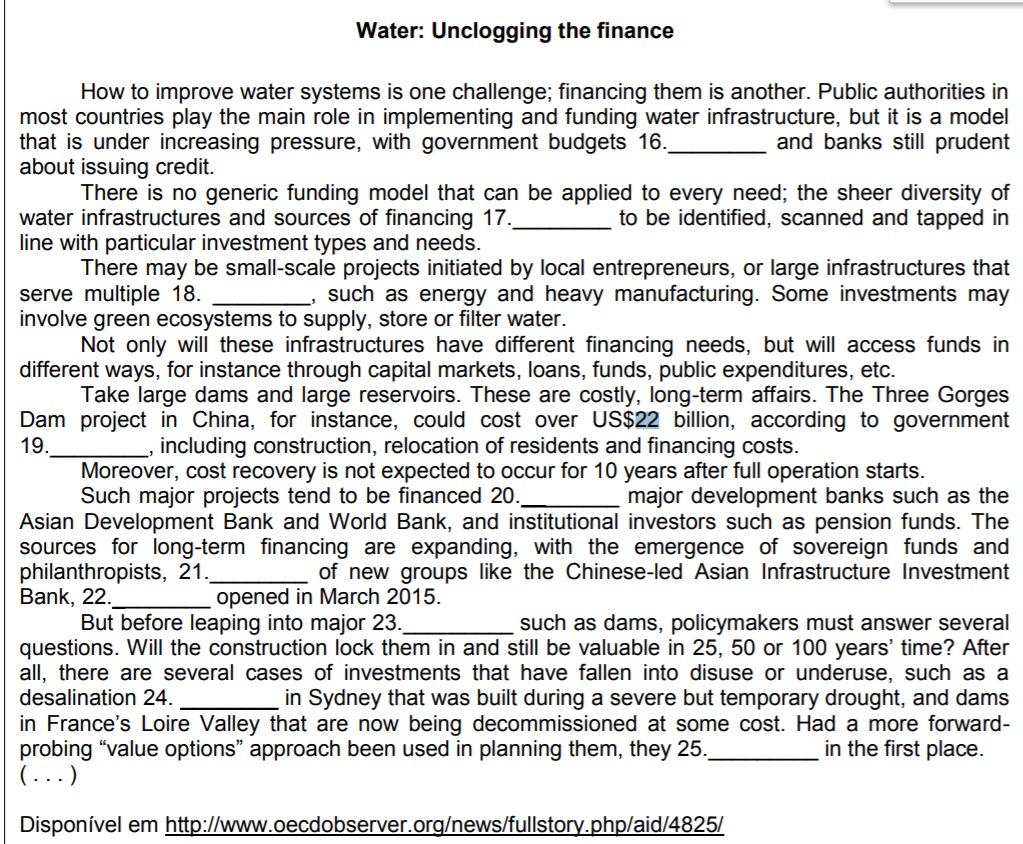
Text 1
Text 1
Text 1
Text 1

Teacher: Donald, what is the chemical formula for water?
Donald: HIJKLMNO.
Teacher: What are you talking about?
Donald: Yesterday you said it’s H to O.
Teacher: No! I said H20. You’ve heard me wrong.
We can infer that


Select the alternative that indicates the type of conditional in the sentence below.
According to scientists, if the amount of carbon dioxide in the atmosphere increases, there will be a global warming.

Select the alternative that best completes the dialogue:

Select the alternative that contains the passive voice of the sentence below:
Somebody has hurt Ronaldo during the soccer match.
Child: Mom, uncle Tom looks so sleepy and tired.
Mom: He may have stayed up all night.

 Conheça nossos planos