Questões Militares
Sobre preposições | prepositions em inglês
Foram encontradas 151 questões


Texto 1
FROM FILM STAR TO FREQUENCY-HOPPING INVENTOR
I’m guessing that some younger readers __(21)_ who Hedy Lamarr was. Old-timers remember her as a popular Hollywood star of the mid-20th century. Characterized by MGM studio mogul Louis B. Mayer as “the most beautiful girl in the world,” a title said to originally have been bestowed by stage director Max Reinhardt, she appeared in some 25 Hollywood films between 1938 and 1958.
__(22)__ her fans and many of her Hollywood colleagues was her creative side. They were unaware that __(23)__ the cameras were not rolling, Ms. Lamarr might be at home at her drawing board, diligently working at some concept that might lead to a commercial product or a patentable invention.
___(24)_ an admirer of Hedy Lamarr the movie star (I particularly remember her in “Ziegfeld Girl,” costarring James Stewart, Judy Garland, Lana Turner, and Tony Martin, and “H. M. Pulham, Esq.,” with Robert Young and Van Heflen), I too was unaware of her innovative proclivities until 1984, when historian of cryptology David Kahn authored an article in IEEE Spectrum. It revealed to the uninitiated the existence of a 1941 patent __(25)__ to Lamarr and her co-inventor, George Antheil, based on frequency-hopping and titled “Secret Communication System.” World War II __(26)__ in Europe, and Hedy, a native Austrian, left her munitions magnate husband Friedrich Mandl and relocated to the United States in 1937. As Hitler moved relentlessly in his attempt to conquer most of northern Europe, she was appalled by the German U-boat sinking of the SS City of Benarus. (…). She considered quitting the movie business and offering her services to the newly organized National Inventors Council (NIC), __(27)__ to evaluate technology that could be useful in wartime, and chaired by inventor Charles Kettering. She did __(28)__, however.
In Hollywood, Hedy had met George Antheil, not an engineer but a composer with “a fair grasp of electronics,” as historian Kahn expressed it. Antheil joined her in her attempt to devise a jamproof guidance system for Allied torpedoes. A year before Pearl Harbor, she told Antheil she knew “a good deal about new munitions and various secret weapons,” presumably knowledge acquired while she was privy to discussions between Mandl and his munitions agents.
While not on the movie set, Lamarr would work with Antheil in her apartment to move her idea from concept to a practical system. In her early working documents a reference is made to the 116RX, the 1939 Philco radio console that featured the first wireless remote control (termed the Mystery Control and offering the listener options to select up to eight stations, a volume control, and an off switch). This ___29__ just one among several inputs that inspired her to __30__ the idea she called “hopping of frequencies” (...)
CHRISTIANSEN, D. Adaptado de From Film Star to Frequency-Hopping Inventor. In: Institute of Electrical and Electronics Engineers. Disponível em:
Texto 1
FROM FILM STAR TO FREQUENCY-HOPPING INVENTOR
I’m guessing that some younger readers __(21)_ who Hedy Lamarr was. Old-timers remember her as a popular Hollywood star of the mid-20th century. Characterized by MGM studio mogul Louis B. Mayer as “the most beautiful girl in the world,” a title said to originally have been bestowed by stage director Max Reinhardt, she appeared in some 25 Hollywood films between 1938 and 1958.
__(22)__ her fans and many of her Hollywood colleagues was her creative side. They were unaware that __(23)__ the cameras were not rolling, Ms. Lamarr might be at home at her drawing board, diligently working at some concept that might lead to a commercial product or a patentable invention.
___(24)_ an admirer of Hedy Lamarr the movie star (I particularly remember her in “Ziegfeld Girl,” costarring James Stewart, Judy Garland, Lana Turner, and Tony Martin, and “H. M. Pulham, Esq.,” with Robert Young and Van Heflen), I too was unaware of her innovative proclivities until 1984, when historian of cryptology David Kahn authored an article in IEEE Spectrum. It revealed to the uninitiated the existence of a 1941 patent __(25)__ to Lamarr and her co-inventor, George Antheil, based on frequency-hopping and titled “Secret Communication System.” World War II __(26)__ in Europe, and Hedy, a native Austrian, left her munitions magnate husband Friedrich Mandl and relocated to the United States in 1937. As Hitler moved relentlessly in his attempt to conquer most of northern Europe, she was appalled by the German U-boat sinking of the SS City of Benarus. (…). She considered quitting the movie business and offering her services to the newly organized National Inventors Council (NIC), __(27)__ to evaluate technology that could be useful in wartime, and chaired by inventor Charles Kettering. She did __(28)__, however.
In Hollywood, Hedy had met George Antheil, not an engineer but a composer with “a fair grasp of electronics,” as historian Kahn expressed it. Antheil joined her in her attempt to devise a jamproof guidance system for Allied torpedoes. A year before Pearl Harbor, she told Antheil she knew “a good deal about new munitions and various secret weapons,” presumably knowledge acquired while she was privy to discussions between Mandl and his munitions agents.
While not on the movie set, Lamarr would work with Antheil in her apartment to move her idea from concept to a practical system. In her early working documents a reference is made to the 116RX, the 1939 Philco radio console that featured the first wireless remote control (termed the Mystery Control and offering the listener options to select up to eight stations, a volume control, and an off switch). This ___29__ just one among several inputs that inspired her to __30__ the idea she called “hopping of frequencies” (...)
CHRISTIANSEN, D. Adaptado de From Film Star to Frequency-Hopping Inventor. In: Institute of Electrical and Electronics Engineers. Disponível em:
Texto 1
FROM FILM STAR TO FREQUENCY-HOPPING INVENTOR
I’m guessing that some younger readers __(21)_ who Hedy Lamarr was. Old-timers remember her as a popular Hollywood star of the mid-20th century. Characterized by MGM studio mogul Louis B. Mayer as “the most beautiful girl in the world,” a title said to originally have been bestowed by stage director Max Reinhardt, she appeared in some 25 Hollywood films between 1938 and 1958.
__(22)__ her fans and many of her Hollywood colleagues was her creative side. They were unaware that __(23)__ the cameras were not rolling, Ms. Lamarr might be at home at her drawing board, diligently working at some concept that might lead to a commercial product or a patentable invention.
___(24)_ an admirer of Hedy Lamarr the movie star (I particularly remember her in “Ziegfeld Girl,” costarring James Stewart, Judy Garland, Lana Turner, and Tony Martin, and “H. M. Pulham, Esq.,” with Robert Young and Van Heflen), I too was unaware of her innovative proclivities until 1984, when historian of cryptology David Kahn authored an article in IEEE Spectrum. It revealed to the uninitiated the existence of a 1941 patent __(25)__ to Lamarr and her co-inventor, George Antheil, based on frequency-hopping and titled “Secret Communication System.” World War II __(26)__ in Europe, and Hedy, a native Austrian, left her munitions magnate husband Friedrich Mandl and relocated to the United States in 1937. As Hitler moved relentlessly in his attempt to conquer most of northern Europe, she was appalled by the German U-boat sinking of the SS City of Benarus. (…). She considered quitting the movie business and offering her services to the newly organized National Inventors Council (NIC), __(27)__ to evaluate technology that could be useful in wartime, and chaired by inventor Charles Kettering. She did __(28)__, however.
In Hollywood, Hedy had met George Antheil, not an engineer but a composer with “a fair grasp of electronics,” as historian Kahn expressed it. Antheil joined her in her attempt to devise a jamproof guidance system for Allied torpedoes. A year before Pearl Harbor, she told Antheil she knew “a good deal about new munitions and various secret weapons,” presumably knowledge acquired while she was privy to discussions between Mandl and his munitions agents.
While not on the movie set, Lamarr would work with Antheil in her apartment to move her idea from concept to a practical system. In her early working documents a reference is made to the 116RX, the 1939 Philco radio console that featured the first wireless remote control (termed the Mystery Control and offering the listener options to select up to eight stations, a volume control, and an off switch). This ___29__ just one among several inputs that inspired her to __30__ the idea she called “hopping of frequencies” (...)
CHRISTIANSEN, D. Adaptado de From Film Star to Frequency-Hopping Inventor. In: Institute of Electrical and Electronics Engineers. Disponível em:
Texto 1
FROM FILM STAR TO FREQUENCY-HOPPING INVENTOR
I’m guessing that some younger readers __(21)_ who Hedy Lamarr was. Old-timers remember her as a popular Hollywood star of the mid-20th century. Characterized by MGM studio mogul Louis B. Mayer as “the most beautiful girl in the world,” a title said to originally have been bestowed by stage director Max Reinhardt, she appeared in some 25 Hollywood films between 1938 and 1958.
__(22)__ her fans and many of her Hollywood colleagues was her creative side. They were unaware that __(23)__ the cameras were not rolling, Ms. Lamarr might be at home at her drawing board, diligently working at some concept that might lead to a commercial product or a patentable invention.
___(24)_ an admirer of Hedy Lamarr the movie star (I particularly remember her in “Ziegfeld Girl,” costarring James Stewart, Judy Garland, Lana Turner, and Tony Martin, and “H. M. Pulham, Esq.,” with Robert Young and Van Heflen), I too was unaware of her innovative proclivities until 1984, when historian of cryptology David Kahn authored an article in IEEE Spectrum. It revealed to the uninitiated the existence of a 1941 patent __(25)__ to Lamarr and her co-inventor, George Antheil, based on frequency-hopping and titled “Secret Communication System.” World War II __(26)__ in Europe, and Hedy, a native Austrian, left her munitions magnate husband Friedrich Mandl and relocated to the United States in 1937. As Hitler moved relentlessly in his attempt to conquer most of northern Europe, she was appalled by the German U-boat sinking of the SS City of Benarus. (…). She considered quitting the movie business and offering her services to the newly organized National Inventors Council (NIC), __(27)__ to evaluate technology that could be useful in wartime, and chaired by inventor Charles Kettering. She did __(28)__, however.
In Hollywood, Hedy had met George Antheil, not an engineer but a composer with “a fair grasp of electronics,” as historian Kahn expressed it. Antheil joined her in her attempt to devise a jamproof guidance system for Allied torpedoes. A year before Pearl Harbor, she told Antheil she knew “a good deal about new munitions and various secret weapons,” presumably knowledge acquired while she was privy to discussions between Mandl and his munitions agents.
While not on the movie set, Lamarr would work with Antheil in her apartment to move her idea from concept to a practical system. In her early working documents a reference is made to the 116RX, the 1939 Philco radio console that featured the first wireless remote control (termed the Mystery Control and offering the listener options to select up to eight stations, a volume control, and an off switch). This ___29__ just one among several inputs that inspired her to __30__ the idea she called “hopping of frequencies” (...)
CHRISTIANSEN, D. Adaptado de From Film Star to Frequency-Hopping Inventor. In: Institute of Electrical and Electronics Engineers. Disponível em:
Leia o texto a seguir e responda à questão.
Many graduates earn ‘paltry returns’ for their degree
Mr Halfon, a former skills minister, stated in his speech that the nation has “become obsessed ______(1) full academic degrees”.
“We are creating a higher education system that overwhelmingly favours academic degrees, while intermediate and higher technical offerings are comparatively tiny. The labour market does not need an ever-growing supply of academic degrees. Between a fifth and a third of our graduates take non-graduate jobs. The extra return for having a degree varies wildly according to subject and institution. For many, the returns are paltry.”
Mr Halfon said that there is a strong need for intermediate skills. “There are skills shortages in several sectors. And there are millions ______(2) people who want to get on in life – preferably without spending £50,000 on academic degrees,” he added. “There has been growing concern about the amount of debt students are accumulating and the interest being charged on that debt.”
A spokesman for UUK (a representative organisation for the UK’s universities) said: “Official figures are clear that, on average, university graduates continue to earn substantially more than non-graduates and are more likely to be in employment. A university degree remains an excellent investment.”
“We must, however, be careful to avoid using graduate salaries as the single measure of success in higher education. Many universities specialise in fields such ______(3) the arts, the creative industries, nursing and public sector professions that, despite making an essential contribution to society and the economy, pay less on average.”
Adapted from http://www.bbc.co.uk/news/education-42923529
Which is the correct option to complete the text below?
Chock-a-block
Today, this adjective means ‘crammed full with people or things' (the narrow roads are chock-a-block with vehicles).
Chock derives ,_____ , chock-full, a Middle English word______unknown origin meaning “very full’. It rhymes nicely______the block in question, more fully known as a pulley block, part______ a block and tackle. This is a device much used______, boats and elsewhere to make lifting heavy weights less demanding.
(https ://blog.oxforddictionaries.com)
Which option completes the paragraph below correctly?
In places with electricity, artificial lighting has prolonged our experience of daylight, allowing us ______ productive for longer. At the same time, it has cut nighttime short, and so to get enough sleep we now have______it all in one go. Now, "normar sleep requires forgoing the periods of wakefulness that used______up the night; we simply don't have time for a midnight chat with the neighbor any longer. "But people with particularly strong circadian rhythms continue,_____ , up in the night.
(https ://amp.livescience.com)
Switzerland’s invisible linguistic borders
There are four official Swiss languages: German, French, Italian and Romansh, an indigenous language with limited status that's similar to Latin and spoken today by only a handful of Swiss. A fifth language, English, is increasingly used to bridge the linguistic divide. In a recent survey by Pro Unguis, three quarters of those queried said they use English at least three times per week.
In polyglot Switzerland, even linguistic divisions are divided. People in the German-speaking cantons speak Swiss-German at home but learn standard German in school. The Italian spoken in the Ticino canton is peppered with words borrowed from German and French.
Language may not be destiny, but it does determine much more than the words we speak. Language drives culture, and culture drives life. In that sense, the Rõstigraben is as much a cultural border as a linguistic one. Life on either side of the divide unfolds at a different pace, Bianchi explained. “[In my opinion] French speakers are more laid-back. A glass of white wine for lunch on a workday is still rather usual. German speakers have little sense of humour, and follow rules beyond the rigidity of the Japanese."
The cultural divide between Italian-speaking Switzerland and the rest of the country - a divide marked by the so-called Polentagraben - is even sharper. Italianspeakers are a distinct minority, accounting for only 8% of the population and living mostly in the far southern canton of Ticino. “When I first moved here, people told me, Ticino is just like Italy except everything works’, and I think that's true,” said Paulo Gonçalves, a Brazilian academic who has been living in Ticino for the past decade.
Coming from a nation with one official spoken language, Gonçalves marvels at how the Swiss juggle four. “It is quite remarkable how they manage to get along,” he said, recalling going to a conference attended by people who spoke French, German, Italian and English. "You had presentations being given in four different languages in the same conference hall.’’
Living in such a multilingual environment "really reshapes how I see the world and imagine the possibilities,” Gonçalves said. “I am a significantly different person than I was 10 years ago.”
Switzerland’s languages are not evenly distributed. Of the country’s 26 cantons, most - 17 - are German speaking, while four are French and one Italian. (Three cantons are bilingual and one, Grisons, trilingual.) A majority of Swiss, 63%, speak German as their first language.
(Abridged from http ://www.bbc.com)
Which option completes the text below correctly?
School is exhausting! I’m so tired! I can’t keep up ______all the readings and assignments. It’s too much work! But l won’t drop_____. I need this degree. I don’t want to put_____my dreams any longer. I need to have the money to carry them ____ as soon as possible, but I’m really looking forward_____the spring break. I need to rest a little.
1. They insisted______making their child learn a foreign language. 2. He was never rude______any of his numerous subordinates. 3 .I depend_____my parents help in order to pay the rent. 4. As a teenager, she used to be interested______ jazz.
"Sue, would you kindly ______ John ? He has a hospital appointment at half past four tomorrow afternoon and he won’t be able to teach."
How much should your boss know about you?
By José Luis Penarredonda, 26 March 2018
We’re all being graded every day. The expensive plane tickets I bought recently have already popped up in my credit score. The fact that I've stopped jogging every morning has been noted by my fitness app - and, if it were connected with an insurance company, this change might push up my premiums. [...]. And, yes, my desirability and efficiency as a worker is also up for evaluation and can be given a number.
HR departments are crunching increasing volumes of data to measure employees in a more granular way. From software that records every keystroke, or the ‘smart’ coffee machines that will only give you a hot drink if you tap it with your work ID badge there are more opportunities than ever for bosses to measure behaviour. Some analysts think this industry could be worth more than $1 billion by 2022.
One big aim of data collection is to make “predictions about how long an'employee will stay, and it may influence hiring, firing, or retention of people" [...].
One problem with this approach is that it’s blind to some of the non-quantifiable aspects of work. Some of the subtler things I do in order to be a better writer, for instance, are not quantifiable: having a drink with someone who tells me a great story, or imagining a piece on my commute. None of these things would show up in my ‘job score'. “A lot of the qualitative aspects of work are being written out,” says Moore, “because if you can’t measure them, they don't exist”.
The dilemma of data
There are several good business reasons to collect data on employees - from doing better risk management to examining if social behaviours in the workplace can lead to gender discrimination. “Companies fundamentally don't understand how people interact and collaborate at work,” says Ben Waber, president and CEO of Humanyze, an American company which gathers and analyses data about the workplace. He says that he can show them.
Humanyze gathers data from two sources. The first is the metadata from employees’ communications: their email, phone or corporate messaging service [...]. The second area is data gathered from gadgets like Bluetooth infrared sensors which detect how many people are working in one particular part of an office and how they move around. They also use 'supercharged' ID badges that, as Waber says, are beefed up with "microphones which don't record what you say, but do voice-processing in real time.” This allows measurement of the proportion of time you speak, or how often people interrupt you.
After six weeks of research, the employer gets a 'big picture’ of the problem it wants to solve, based on the analysed data. If the aim, for instance, is to boost sales, they can analyse what their best salespeople do that others don’t.
Waber sees it as “a lens of very large work issues, like diversity, inclusion, workload assessment, workspace planning, or regulatory risk”. His business case is that these tools will help companies save millions of dollars and even years of time [...].
(Abridged from http://www.bbc.com)
Which option completes the text below correctly?
Marine Corps fitness test offers smart alternative to running
Marines of any age can now conduct the rowing portion of the PFT if they have a medical chit proving they are incapable______completing the running test. (CpI. Jeff Drew/ Marine Corps)
The Marine Corps is making changes______its Physical Fitness Test, allowing Marines to replace the three-mile running portion of the PFT ______ a 5,000- meter stint on a rowing machine.
Marines seeking to do that will require a medical chit to prove and explain why they can’t run. But it will allow fit and hard-working Marines to still earn a top score______ their fitness test without risking unnecessary injury.
It comes at a time when the entire military is wrestling______issues of standards and fitness.
(Adapted from https://www.navytimes.com)
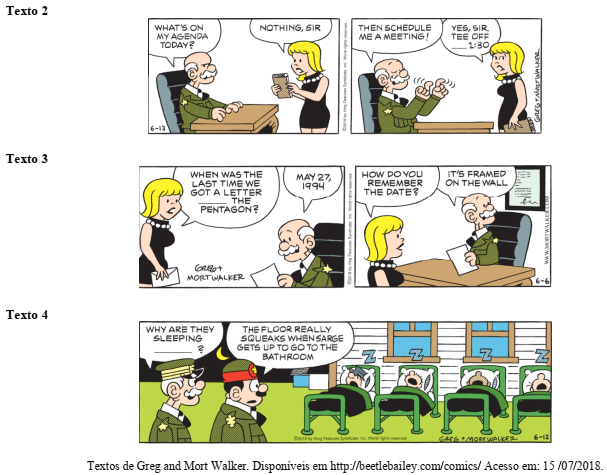
Considerando o contexto e a gramática da língua inglesa, assinale a alternativa cuja sequência de palavras
preenche, CORRETA e RESPECTIVAMENTE, as lacunas dos textos 2, 3 e 4.
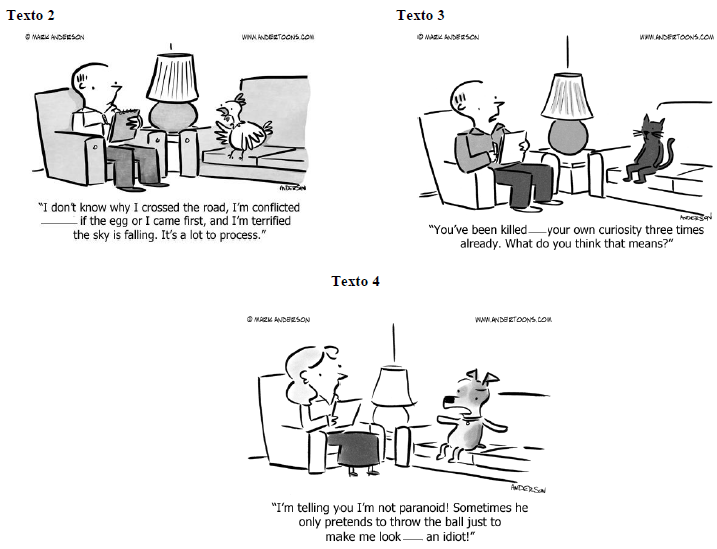
Considerando o contexto e gramática da língua inglesa, assinale a alternativa cuja palavras completam CORRETAMENTE as lacunas dos cartuns (textos 2, 3 e 4).


Choose the alternative that correctly completes the sentence below.
John w anted_____find a new apartment_______the city center but they were not____ _ him.

 Conheça nossos planos