Questões Militares
Sobre análise sintática | syntax parsing em inglês
Foram encontradas 62 questões


Lego wants to replace plastic blocks with sustainable materials
The Lego Group wants to replace the plastic in their products with a “sustainable material” by 2030, the company announced.
The world’s largest toy company will invest $1 billion in their new LEGO Sustainable Materials Centre in Denmark, which _______(1) devoted to finding and implementing new sustainable alternatives for their current building materials. Lego plans on hiring 100 specialists for the center. There is no official definition of a sustainable material.
Legos _______(2) made with a strong plastic known as acrylonitrile butadiene styrene since 1963. The company uses more than 6,000 tons of plastic annually to manufacture its products, according to NBC News. Changing the raw material could have a large effect on Lego’s carbon footprint, especially considering that only 10% of the carbon emissions from Lego products come from its factories. The other 90% is produced from the extraction and refinement of raw materials, as well as distribution from factories to toy stores.
The company _______(3) already taken steps to lower its carbon footprint, including a reduction of packaging size and an investment in an offshore wind farm.
Adapted from http://time.com/3931946/lego-sustainable-materials/
What is Interpol?

Founded in 1923, Interpol is an international police organisation made up of 194 member countries. It is not a police force in the traditional sense – its agents are not able to arrest criminals. Instead, it is more of an informationsharing network, providing a way for national police forces to co-operate effectively and tackle international crime ranging from human trafficking and terrorism to money laundering and illegal art dealing.
The organisation, based in France, operates centralised criminal databases that contain fingerprint records, DNA samples and stolen documents: a treasure trove so valuable that police consulted it 146 times every second in 2017. Interpol’s other main function is to issue notices: alerts to member states for missing or wanted persons. The bestknown of these is the “Red Notice”, a notification that a member state would like someone arrested. States are not obliged to follow these notices, but will often treat them as a warrant for someone’s arrest and extradition. “Diffusions”, which can be issued with less bureaucracy, are another popular way of seeking arrests through Interpol.
Notices and diffusions lie at the heart of the organisation’s recent turmoil. Though Interpol’s constitution explicitly forbids any activities of a political character, activists accuse it of failing to enforce this rule.
(www.economist.com/the-economist-explains/2018/11/22/ what-is-interpol. Adaptado)
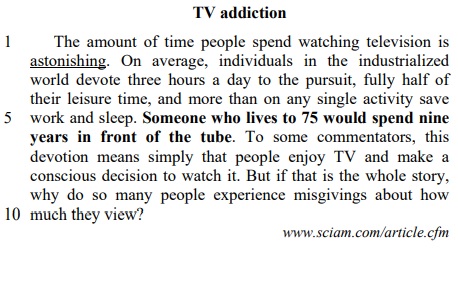
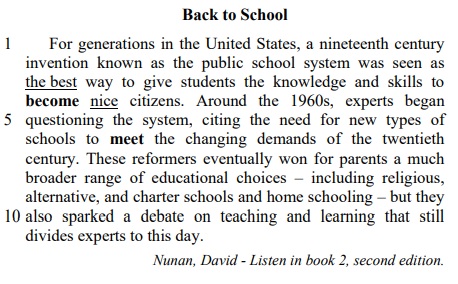
I - There are a lot fewer opportunities in this country. II- He is the nicest when he’s with children. III- He’s more lazy than stupid. IV- He explained it all carefully, but I was still none the wiser. V- Is this the first time for you to stay here ?
How much should your boss know about you?
By José Luis Penarredonda, 26 March 2018
We’re all being graded every day. The expensive plane tickets I bought recently have already popped up in my credit score. The fact that I've stopped jogging every morning has been noted by my fitness app - and, if it were connected with an insurance company, this change might push up my premiums. [...]. And, yes, my desirability and efficiency as a worker is also up for evaluation and can be given a number.
HR departments are crunching increasing volumes of data to measure employees in a more granular way. From software that records every keystroke, or the ‘smart’ coffee machines that will only give you a hot drink if you tap it with your work ID badge there are more opportunities than ever for bosses to measure behaviour. Some analysts think this industry could be worth more than $1 billion by 2022.
One big aim of data collection is to make “predictions about how long an'employee will stay, and it may influence hiring, firing, or retention of people" [...].
One problem with this approach is that it’s blind to some of the non-quantifiable aspects of work. Some of the subtler things I do in order to be a better writer, for instance, are not quantifiable: having a drink with someone who tells me a great story, or imagining a piece on my commute. None of these things would show up in my ‘job score'. “A lot of the qualitative aspects of work are being written out,” says Moore, “because if you can’t measure them, they don't exist”.
The dilemma of data
There are several good business reasons to collect data on employees - from doing better risk management to examining if social behaviours in the workplace can lead to gender discrimination. “Companies fundamentally don't understand how people interact and collaborate at work,” says Ben Waber, president and CEO of Humanyze, an American company which gathers and analyses data about the workplace. He says that he can show them.
Humanyze gathers data from two sources. The first is the metadata from employees’ communications: their email, phone or corporate messaging service [...]. The second area is data gathered from gadgets like Bluetooth infrared sensors which detect how many people are working in one particular part of an office and how they move around. They also use 'supercharged' ID badges that, as Waber says, are beefed up with "microphones which don't record what you say, but do voice-processing in real time.” This allows measurement of the proportion of time you speak, or how often people interrupt you.
After six weeks of research, the employer gets a 'big picture’ of the problem it wants to solve, based on the analysed data. If the aim, for instance, is to boost sales, they can analyse what their best salespeople do that others don’t.
Waber sees it as “a lens of very large work issues, like diversity, inclusion, workload assessment, workspace planning, or regulatory risk”. His business case is that these tools will help companies save millions of dollars and even years of time [...].
(Abridged from http://www.bbc.com)


 Conheça nossos planos