Selecionar segmento
Estude com questões de diferentes segmentos
Atenção: Isso limpará todos os campos já preenchidos no filtro!
Foram encontradas 71.618 questões
Resolva questões gratuitamente!
Junte-se a mais de 4 milhões de concurseiros!


Ano: 2019
Banca:
UEG
Órgão:
UEG
Prova:
UEG - 2019 - UEG - Vestibular - Caderno de Provas Inglês - á Distância |
Q1303247
Inglês
Texto associado
Leia o texto e responda à questão.
This is how the way the world measures success in education is changing
Since 2000 when the Organization for Economic Co-operation and Development (OECD) launched a global
academic benchmark for measuring student outcomes by testing 15-year-olds, many global education systems
have been impacted by what sometimes looks and feels like a race to rank high.
When the OECD launched the Programme for International Student Assessment — PISA — the idea was to enable countries to make cross-national comparisons of student achievement using a common/standard metric to increase human capital. In other words, higher academic achievement should corelate with earnings in the future and a country’s standard of living. As PISA states, it publishes the results of the test a year after the students are tested to help governments shape their education policies.
As PISA has developed, through seven global testing rounds every three years, with the first in 2000 and the most recent in 2018, for some it has gained a reputation as the “Olympics of education” given the widespread attention that country rankings receive following the release of results.
Now, partly in the face of criticisms, PISA is looking at expanding how and what it tests. As this process unfolds, policy-makers must remember that the social consequences of a test are just as important as the test’s content. Putting a new face on PISA will undoubtedly present various opportunities and challenges.
To date, PISA has been restricted to what is generally called the “cognitive” side of learning, focusing on reading, mathematics and scientific literacy. In addition to test questions, students and school principals fill out questionnaires to provide contextual information on student and school environment characteristics that can be associated with more or less favourable performance.
Countries that excel in PISA tests, such as Finland, a country with less than six million people, have become regarded by policy-makers as a “global reference society” — an ideal to aspire to — due to their high performance in PISA rankings.
Asian countries or jurisdictions like Singapore, Hong Kong (China) and Japan tend to consistently achieve exceptional PISA performances and hence get a lot of attention from other countries wishing to emulate their success via borrowing policy. For example, England flew teachers out to China to study mathematics teaching.
In the next administration in 2021, PISA will tackle creative thinking, trying to find ways to assess, and have students assess, flexibility in thinking and habits of creativity such as being inquisitive and persistent. The PISA team is also developing a way of testing students’ digital learning, which should be ready in time for the 2024 assessment.
However, it should be remembered that education policies from high achieving nations don’t migrate across international boundaries without consideration given to national and cultural contexts. Rather, innovations and changes in education require teachers to have the time and opportunity to re-educate themselves in relation to more recent insights in what it means to get the best out of children.
When the OECD launched the Programme for International Student Assessment — PISA — the idea was to enable countries to make cross-national comparisons of student achievement using a common/standard metric to increase human capital. In other words, higher academic achievement should corelate with earnings in the future and a country’s standard of living. As PISA states, it publishes the results of the test a year after the students are tested to help governments shape their education policies.
As PISA has developed, through seven global testing rounds every three years, with the first in 2000 and the most recent in 2018, for some it has gained a reputation as the “Olympics of education” given the widespread attention that country rankings receive following the release of results.
Now, partly in the face of criticisms, PISA is looking at expanding how and what it tests. As this process unfolds, policy-makers must remember that the social consequences of a test are just as important as the test’s content. Putting a new face on PISA will undoubtedly present various opportunities and challenges.
To date, PISA has been restricted to what is generally called the “cognitive” side of learning, focusing on reading, mathematics and scientific literacy. In addition to test questions, students and school principals fill out questionnaires to provide contextual information on student and school environment characteristics that can be associated with more or less favourable performance.
Countries that excel in PISA tests, such as Finland, a country with less than six million people, have become regarded by policy-makers as a “global reference society” — an ideal to aspire to — due to their high performance in PISA rankings.
Asian countries or jurisdictions like Singapore, Hong Kong (China) and Japan tend to consistently achieve exceptional PISA performances and hence get a lot of attention from other countries wishing to emulate their success via borrowing policy. For example, England flew teachers out to China to study mathematics teaching.
In the next administration in 2021, PISA will tackle creative thinking, trying to find ways to assess, and have students assess, flexibility in thinking and habits of creativity such as being inquisitive and persistent. The PISA team is also developing a way of testing students’ digital learning, which should be ready in time for the 2024 assessment.
However, it should be remembered that education policies from high achieving nations don’t migrate across international boundaries without consideration given to national and cultural contexts. Rather, innovations and changes in education require teachers to have the time and opportunity to re-educate themselves in relation to more recent insights in what it means to get the best out of children.
The OECD will need to respond to previous critiques and provide greater transparency around newer test
instruments and the choices made to arrive at rankings. The latter is no small challenge since the future focus of
PISA is based on topics which seem more difficult to evaluate than math, science or reading skills.
Disponível em: https://www.weforum.org/agenda/2019/04/new-global-testing-standards-will-force-countries-to-revisit-academic-rankings/. Acesso em: 25 jun.
2019. (Adaptado).
Considerando-se os aspectos semânticos presentes no texto, verifica-se que a construção
Ano: 2019
Banca:
UEG
Órgão:
UEG
Prova:
UEG - 2019 - UEG - Vestibular - Caderno de Provas Inglês - á Distância |
Q1303246
Inglês
Texto associado
Leia o texto e responda à questão.
This is how the way the world measures success in education is changing
Since 2000 when the Organization for Economic Co-operation and Development (OECD) launched a global
academic benchmark for measuring student outcomes by testing 15-year-olds, many global education systems
have been impacted by what sometimes looks and feels like a race to rank high.
When the OECD launched the Programme for International Student Assessment — PISA — the idea was to enable countries to make cross-national comparisons of student achievement using a common/standard metric to increase human capital. In other words, higher academic achievement should corelate with earnings in the future and a country’s standard of living. As PISA states, it publishes the results of the test a year after the students are tested to help governments shape their education policies.
As PISA has developed, through seven global testing rounds every three years, with the first in 2000 and the most recent in 2018, for some it has gained a reputation as the “Olympics of education” given the widespread attention that country rankings receive following the release of results.
Now, partly in the face of criticisms, PISA is looking at expanding how and what it tests. As this process unfolds, policy-makers must remember that the social consequences of a test are just as important as the test’s content. Putting a new face on PISA will undoubtedly present various opportunities and challenges.
To date, PISA has been restricted to what is generally called the “cognitive” side of learning, focusing on reading, mathematics and scientific literacy. In addition to test questions, students and school principals fill out questionnaires to provide contextual information on student and school environment characteristics that can be associated with more or less favourable performance.
Countries that excel in PISA tests, such as Finland, a country with less than six million people, have become regarded by policy-makers as a “global reference society” — an ideal to aspire to — due to their high performance in PISA rankings.
Asian countries or jurisdictions like Singapore, Hong Kong (China) and Japan tend to consistently achieve exceptional PISA performances and hence get a lot of attention from other countries wishing to emulate their success via borrowing policy. For example, England flew teachers out to China to study mathematics teaching.
In the next administration in 2021, PISA will tackle creative thinking, trying to find ways to assess, and have students assess, flexibility in thinking and habits of creativity such as being inquisitive and persistent. The PISA team is also developing a way of testing students’ digital learning, which should be ready in time for the 2024 assessment.
However, it should be remembered that education policies from high achieving nations don’t migrate across international boundaries without consideration given to national and cultural contexts. Rather, innovations and changes in education require teachers to have the time and opportunity to re-educate themselves in relation to more recent insights in what it means to get the best out of children.
When the OECD launched the Programme for International Student Assessment — PISA — the idea was to enable countries to make cross-national comparisons of student achievement using a common/standard metric to increase human capital. In other words, higher academic achievement should corelate with earnings in the future and a country’s standard of living. As PISA states, it publishes the results of the test a year after the students are tested to help governments shape their education policies.
As PISA has developed, through seven global testing rounds every three years, with the first in 2000 and the most recent in 2018, for some it has gained a reputation as the “Olympics of education” given the widespread attention that country rankings receive following the release of results.
Now, partly in the face of criticisms, PISA is looking at expanding how and what it tests. As this process unfolds, policy-makers must remember that the social consequences of a test are just as important as the test’s content. Putting a new face on PISA will undoubtedly present various opportunities and challenges.
To date, PISA has been restricted to what is generally called the “cognitive” side of learning, focusing on reading, mathematics and scientific literacy. In addition to test questions, students and school principals fill out questionnaires to provide contextual information on student and school environment characteristics that can be associated with more or less favourable performance.
Countries that excel in PISA tests, such as Finland, a country with less than six million people, have become regarded by policy-makers as a “global reference society” — an ideal to aspire to — due to their high performance in PISA rankings.
Asian countries or jurisdictions like Singapore, Hong Kong (China) and Japan tend to consistently achieve exceptional PISA performances and hence get a lot of attention from other countries wishing to emulate their success via borrowing policy. For example, England flew teachers out to China to study mathematics teaching.
In the next administration in 2021, PISA will tackle creative thinking, trying to find ways to assess, and have students assess, flexibility in thinking and habits of creativity such as being inquisitive and persistent. The PISA team is also developing a way of testing students’ digital learning, which should be ready in time for the 2024 assessment.
However, it should be remembered that education policies from high achieving nations don’t migrate across international boundaries without consideration given to national and cultural contexts. Rather, innovations and changes in education require teachers to have the time and opportunity to re-educate themselves in relation to more recent insights in what it means to get the best out of children.
The OECD will need to respond to previous critiques and provide greater transparency around newer test
instruments and the choices made to arrive at rankings. The latter is no small challenge since the future focus of
PISA is based on topics which seem more difficult to evaluate than math, science or reading skills.
Disponível em: https://www.weforum.org/agenda/2019/04/new-global-testing-standards-will-force-countries-to-revisit-academic-rankings/. Acesso em: 25 jun.
2019. (Adaptado).
According to the information in the text, the global education systems are assessed by PISA and it is
Q1300949
Química
O esquema a seguir representa a reação do álcool t-butanol com ácido clorídrico concentrado, o que geralmente
é a metodologia utilizada para a obtenção do cloreto de t-butila em escala de laboratório.

Considerando-se as características dos reagentes envolvidos na reação, constata-se que o processo de formação do cloreto de t-butila envolve
Considerando-se as características dos reagentes envolvidos na reação, constata-se que o processo de formação do cloreto de t-butila envolve
Q1300948
Química
O sulfato de bário é uma substância que, em suspensão aquosa, é indicada como meio de contraste radiológico
do tubo gastrointestinal. Já o cloreto de bário, outro sal de bário, é tóxico por ingestão, podendo causar a morte.
As solubilidades do sulfato de bário e do cloreto de bário em 100 g de água a 25 ºC são, respectivamente:
0,00031 g e 37,0 g. Se a uma solução aquosa de cloreto de bário for adicionado ácido sulfúrico em excesso,
formam-se os seguintes produtos:
Q1300947
Química
Polímeros são substâncias formadas por macromoléculas que apresentam unidades estruturais que se repetem
sucessivamente. Dentre eles, destacam-se os náilons, que quimicamente são poliamidas sintéticas.
A unidade de repetição do polímero que representa o náilon é a:
A unidade de repetição do polímero que representa o náilon é a:
Q1300946
Química
O conhecimento da estrutura química dos compostos orgânicos a seguir permite uma análise da natureza de
suas interações intermoleculares e, se os valores de suas massas moleculares forem próximos, podem-se
comparar suas propriedades físicas relativas.

Qual desses compostos orgânicos apresenta a menor temperatura de ebulição?
Qual desses compostos orgânicos apresenta a menor temperatura de ebulição?
Q1300945
Química
A partir do conhecimento da estrutura de Lewis adequada pode-se prever a geometria de moléculas ou íons e,
nesse contexto, considere as espécies químicas a seguir:
PCl3 BF3 SO2 SO4 2- NH4 + 1 2 3 4 5
Qual molécula ou íon apresenta geometria molecular angular?
PCl3 BF3 SO2 SO4 2- NH4 + 1 2 3 4 5
Qual molécula ou íon apresenta geometria molecular angular?
Q1300944
Química
Considere que na reação química hipotética representada a seguir um mol de um composto A seja misturado
com um mol de um composto B e, transcorrido certo tempo, estabeleça-se o equilíbrio químico, momento em que
se verifica que existem 2/5 de mol de A.
A + B ⇌ C + D
O valor numérico da constante de equilíbrio, Kc, será igual a:
A + B ⇌ C + D
O valor numérico da constante de equilíbrio, Kc, será igual a:
Q1300943
Química
O trióxido de enxofre (SO3) é um poluente atmosférico e pode ser obtido em laboratório pela reação do enxofre
com o oxigênio em excesso, na presença de um catalisador adequado.
Sobre essa molécula, verifica-se que
Q1300942
Química
Uma solução aquosa de ácido clorídrico, contendo 0,09125 g de HCl, foi diluída com água para 250 mL, em um
balão volumétrico.
Dado: MM(HCl) = 36,5 g/mol.
O pH dessa solução será igual a:
Q1300941
Biologia
Em 1937, os cientistas George W. Beadle (1903-1989) e Boris Ephrussi (1901-1979) investigaram a rota metabólica
determinante das cores de olhos selvagem, vermillion e cinnabar em moscas de fruta (D. melanogaster). Eles
transplantaram discos imaginais de olhos de uma larva para o abdome de outra larva hospedeira, que desenvolvia
um olho colorido no abdome ao chegar à fase adulta, como descrito na tabela a seguir.
# Discos imaginais Larva transplantada Discos imaginais na larva adulta 1 Selvagem Vermillion Selvagem 2 Vermillion Selvagem Selvagem 3 Selvagem Cinnabar Selvagem 4 Cinnabar Selvagem Selvagem 5 Vermillion Cinnabar Selvagem 6 Cinnabar Vermillion Cinnabar
Os resultados observados nas larvas adultas permitiram concluir que a cor do olho era determinada por uma via metabólica para produção do pigmento omocromo a partir do triptofano, sendo intermediárias as substâncias quinureína e 3-hidroxi-quinureína. A cor de olho selvagem decorre da associação entre os pigmentos omocromo e pterina. Olhos vermillion decorrem do bloqueio da enzima que converte o aminoácido triptofano em quinureína, ao passo que os olhos cinnabar decorrem do bloqueio da enzima que hidroxila a quinureína.
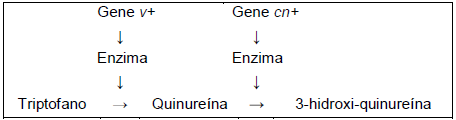
Ao analisar o contexto das cores de olhos frente à rota metabólica no quadro apresentado, se estabelece sobre a mosca #6 que:
# Discos imaginais Larva transplantada Discos imaginais na larva adulta 1 Selvagem Vermillion Selvagem 2 Vermillion Selvagem Selvagem 3 Selvagem Cinnabar Selvagem 4 Cinnabar Selvagem Selvagem 5 Vermillion Cinnabar Selvagem 6 Cinnabar Vermillion Cinnabar
Os resultados observados nas larvas adultas permitiram concluir que a cor do olho era determinada por uma via metabólica para produção do pigmento omocromo a partir do triptofano, sendo intermediárias as substâncias quinureína e 3-hidroxi-quinureína. A cor de olho selvagem decorre da associação entre os pigmentos omocromo e pterina. Olhos vermillion decorrem do bloqueio da enzima que converte o aminoácido triptofano em quinureína, ao passo que os olhos cinnabar decorrem do bloqueio da enzima que hidroxila a quinureína.
Ao analisar o contexto das cores de olhos frente à rota metabólica no quadro apresentado, se estabelece sobre a mosca #6 que:
Q1300940
Biologia
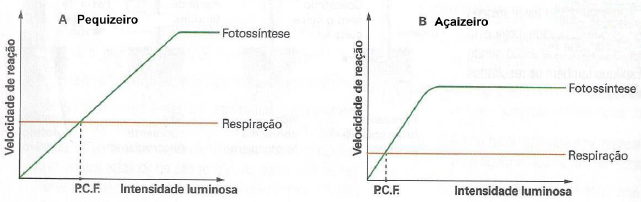
Em experimento para avaliar a relação do local de plantio e a intensidade luminosa, duas plantas (A e B) de
espécies diferentes foram submetidas à avaliação considerando a velocidade de reação da fotossíntese versus
respiração, conforme apresentado nas figuras a seguir:
LOPES, S.; ROSSO, S. Bio volume 2. São Paulo: Saraiva, 2010. 1p. 233. (Adaptado).
Acerca da comparação entre A e B, verifica-se que para o
LOPES, S.; ROSSO, S. Bio volume 2. São Paulo: Saraiva, 2010. 1p. 233. (Adaptado).
Acerca da comparação entre A e B, verifica-se que para o
Q1300939
Biologia
O uso de microcircuito eletrônico intradérmico para monitoramento da saúde individual é a tecnologia mais
moderna atualmente. A empresa Goiás-Health dispõe de um relógio de pulso com telas alternadas para
monitoramento bioquímico, cardiorrespiratório, imunológico, do sono e da temperatura. Cada tela informa as
medidas do biossensor do chip a cada 2 horas, conforme ilustradas no gráfico, como colunas dispostas em
ordem cronológica crescente, da esquerda para a direita, ou quando acionada pelo usuário. A imagem a seguir
corresponde às dosagens de imunogamaglobulinas (IgG), em unidades relativizadas de 0 a 100, com indicações
de ALERTA e RISCO, conforme a redução percentual na disponibilidade de anticorpos em contato com o
biossensor.
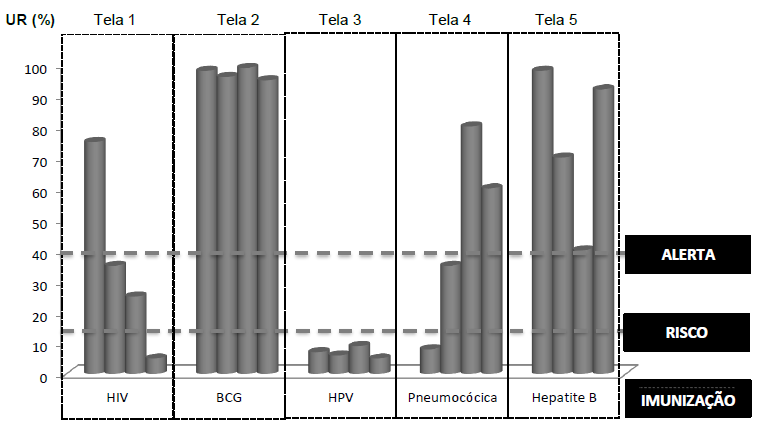
Para o funcionamento do dispositivo, faz-se necessário ter em evidência o quadro de vacinação, a seguir:
Vacina anti Quanto tomar Doses HIV N/A N/A
BCG Ao nascer 1
HPV 9 e 13 anos 2
Pneumocócica 2, 4 e 12 meses 3
Hepatite B Ao nascer, 10 a 19 anos, Múltiplas 20 a 59 anos, >60 anos e gestantes
Sobre a correlação entre os dados apresentados nas telas de 1 a 5 do dispositivo com o esquema de vacinação, verifica-se que:
Para o funcionamento do dispositivo, faz-se necessário ter em evidência o quadro de vacinação, a seguir:
Vacina anti Quanto tomar Doses HIV N/A N/A
BCG Ao nascer 1
HPV 9 e 13 anos 2
Pneumocócica 2, 4 e 12 meses 3
Hepatite B Ao nascer, 10 a 19 anos, Múltiplas 20 a 59 anos, >60 anos e gestantes
Sobre a correlação entre os dados apresentados nas telas de 1 a 5 do dispositivo com o esquema de vacinação, verifica-se que:
Q1300938
Biologia
A Estratégia Global para a Conservação das Plantas (GSPC) foi estabelecida pela Conferência das Partes em 2002
e estabeleceu uma série de tarefas aos diferentes países. Para cumprimento desta estratégia, o Brasil se
comprometeu em preparar a Lista de Espécies da Flora do Brasil (2008-2015) e a Flora do Brasil 2020 no
desenvolvimento do programa Reflora, visto que nosso país possui mais de 46 mil espécies de plantas, algas e
fungos, representando um dos países com maior biodiversidade no planeta, sendo um participante chave na GSPC.
Dentre as diferentes importâncias da publicação da Flora do Brasil em 2020 destaca-se:
Q1300937
Geografia
Em escala global, a presença de aquíferos é de suma importância na manutenção da biodiversidade planetária.
Os aquíferos são formados por rochas permeáveis que atuam como reservatórios subterrâneos e transmissores
de água. Esses reservatórios são preenchidos com águas de chuva que permeiam os espaços entre as rochas.
Durante os períodos de estiagem, por exemplo, esses reservatórios contribuem para a manutenção de rios
perenes, para o consumo humano e para a agropecuária. O Brasil abriga o aquífero mais importante do mundo,
que está situado na região:
Q1300936
Biologia
Na atualidade, é bastante comum que as redes de comercialização de produtos no ramo alimentício ofertem
produtos diferenciados à população humana com restrição de lactose na dieta alimentar. Em seres humanos, a
doença galactosemia causa retardo mental em idade adulta jovem, pois a lactose (composta por uma molécula
de galactose + uma molécula de glicose) do leite não pode ser degradada, falha esta que afeta o funcionamento
cerebral. Uma cura secundária para esta doença pode ser resultante da remoção de toda a galactose e lactose
da dieta alimentar. Considerando-se o padrão de herança da galactosemia, espera-se que este fenótipo seja:
Q1300935
Biologia
Em seres humanos, diagnósticos com maior nível de precisão devem utilizar exames de padrão de resolução
parcimonioso, como no eletroencefalograma. Assim, o impulso nervoso que ocorre quando há a propagação de
trocas de cargas elétricas pelo neurônio e a atividade somada do potencial pós-sináptico excitatório e do
potencial pós-sináptico inibitório causam um fluxo de corrente, cujas ondas são captadas no couro cabeludo pelo
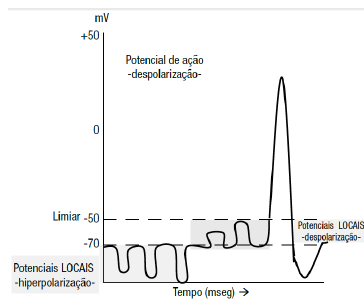
eletroencefalograma. A figura a seguir ilustra os potenciais de membrana do neurônio.
GOMES, Marleide da Mota. Rev. Bras. Neurol. 51(1):12-7, 2015.
A interpretação correta dos dados apresentados nesse gráfico é que a membrana:
GOMES, Marleide da Mota. Rev. Bras. Neurol. 51(1):12-7, 2015.
A interpretação correta dos dados apresentados nesse gráfico é que a membrana:
Q1300934
Biologia
Para regulação da pressão arterial em seres humanos, mecanismos de retroalimentação do sistema nervoso
autônomo pela ação de terminações nervosas livres e densamente ramificadas na camada adventícia são
evidenciadas. Essas terminações são ativadas quando a parede das artérias se deforma por ação mecânica e,
dentro de segundos, regulam a frequência cardíaca, débito cardíaco, contratilidade do miocárdio, resistência
vascular periférica e fluxo sanguíneo local. A denominação dessas terminações nervosas é:
Q1300933
Sociologia
A educação é a forma pela qual a cultura de uma sociedade é passada de uma geração para outra. As pesquisas
desenvolvidas pelo sociólogo Pierre Bourdieu concebem a educação enquanto reprodução. Desta forma, as
hierarquias sociais são convertidas em hierarquias escolares. Assim, segundo esta concepção, a educação
Q1300932
Sociologia
Segundo algumas concepções da sociologia do trabalho, a sociedade moderna é fundamentada por relações de
produção capitalistas. Em cada período histórico as relações de trabalho no interior da sociedade apresentam
diferentes características, fruto de modificações formais nas relações de produção capitalistas. Desta
perspectiva, na contemporaneidade as relações de trabalho são pautadas por:
 Conheça nossos planos