Foram encontradas 75.429 questões

Resolva questões gratuitamente!

Junte-se a mais de 4 milhões de concurseiros!

Q1795254 Matemática
Um retângulo é o primeiro polígono de uma sequência. A partir desse termo, cada novo termo da sequência é formado pela adição de um retângulo semelhante ao retângulo adicionado no termo anterior, com lados indicando o dobro do tamanho, conforme a figura.
Imagem associada para resolução da questão

O número de lados do polígono formado no 100º termo dessa sequência é igual a
Alternativas
Q1795253 Matemática
Um congresso terá a participação de dois representantes da Colômbia, três do Chile, quatro da Argentina e cinco do Brasil. Cada um dos 14 representantes preparou seu próprio discurso, porém apenas 6 serão sorteados para discursar. Se a regra do sorteio prevê que cada um dos quatro países deve ter pelo menos um representante discursando, o número de maneiras diferentes de compor o conjunto dos seis discursos que serão ouvidos no congresso, sem importar a ordem, é igual a
Alternativas
Q1795252 Matemática
Dadas as funções f(x) = x2 + 1 e g(x) = |x| + 1, ambas definidas para todos os números reais, o gráfico da função composta f(g(x)), em linha cheia, será
Alternativas
Q1795251 Matemática
A razão entre homens e mulheres, nessa ordem, em uma turma com 143 pessoas da FGV equivale à dízima periódica Imagem associada para resolução da questão. O número de mulheres dessa turma supera o de homens em 
Alternativas
Q1795250 Matemática
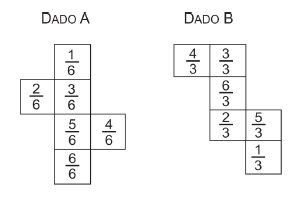
A figura indica a planificação de dois dados cúbicos e honestos utilizados em um jogo.
Imagem associada para resolução da questão

Na sua jogada, um jogador lança aleatoriamente o dado A e, em seguida, o dado B. Após os lançamentos, ele precisa escolher um resultado entre duas opções:
I. somar os números das faces que ficaram voltadas para cima dos dois dados; II. subtrair os números das faces que ficaram voltadas para baixo dos dois dados e pegar o módulo do resultado.
Se em uma jogada o dado A ficou com a face do número 1/6 voltada para cima, a probabilidade de que, após lançar o dado B, o jogador dessa jogada possa fazer uma escolha de resultado que corresponda a um número entre 1 e 2 é igual a
Alternativas
Q1795249 Matemática
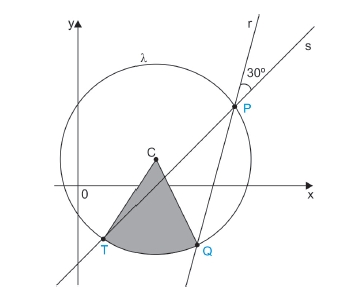
As retas r e s são secantes à circunferência λ, de equação (x – 3)2 + (y – 1)2 = 13, nos pontos P, Q e T, sendo que em P elas se intersectam formando um ângulo de 30°, como mostra a figura.
Imagem associada para resolução da questão

Sendo C o centro de λ, a área do setor circular destacado em cinza na figura, em unidades de área do sistema cartesiano de eixos ortogonais, é igual a
Alternativas
Q1795248 Matemática
No plano cartesiano, os gráficos das funções reais definidas por f(x) = log(2x + 12) e g(x) = log100 (x + 6) intersectam-se em
Alternativas
Q1795247 Matemática
O maior valor que pode ser assumido pela função real definida por f(x) = 4√ (16 - x)(20 + x) é
Alternativas
Q1795246 Matemática
Os lados do paralelogramo FGVE medem 5 e 8 centímetros. As mediatrizes de Imagem associada para resolução da questãoe Imagem associada para resolução da questão, indicadas por m e n, intersectam-se no ponto C, que é centro da circunferência λ, de raio CE = CF, como mostra a figura.
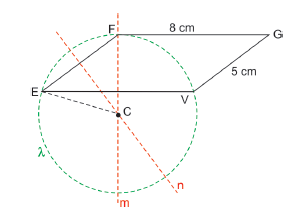
Imagem associada para resolução da questão

Sabendo que a mediatriz m passa pelo vértice F, a área do triângulo FEC é igual a
Alternativas
Q1795245 Matemática
Em 8 horas diárias de trabalho, 20 caminhões carregam 160 m³ de terra em 15 dias. Se o empreiteiro da obra deseja aumentar a frota em 4 caminhões para realizar o mesmo serviço em 6 dias, o número diário de horas que os caminhões terão que trabalhar para cumprir o novo prazo é de
Alternativas
Q1795244 Matemática
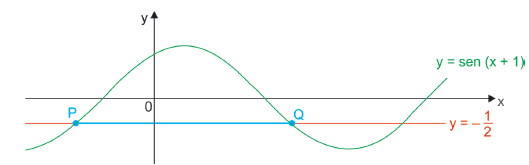
Observe a figura com a representação gráfica de uma função constante e de uma função trigonométrica, ambas definidas para todos os números reais.
Imagem associada para resolução da questão


Sendo P e Q os pontos de intersecção dos gráficos das funções indicadas na figura, a medida de Imagem associada para resolução da questão, em unidades de comprimento do plano cartesiano, é igual a
Alternativas
Q1795243 Matemática
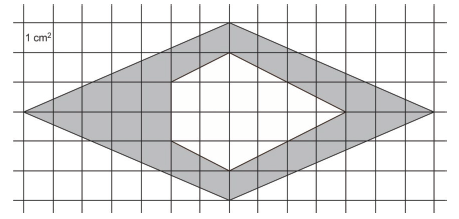
Observe a figura construída em uma malha quadriculada com unidade de área igual a 1 cm².
Imagem associada para resolução da questão

A área da região destacada em cinza na figura é igual a

Alternativas
Q1795242 Matemática
Um conjunto é composto por sete números naturais, repetidos ou não, cuja ordenação é dada por a1 ≤ a2 ≤ a3 ≤ a4 ≤ a5 ≤ a6 ≤ a7. O maior dos números é igual a 18 e o menor é igual a 3. A única moda desse conjunto coincide com o valor da mediana, que é igual a 5. Se a média aritmética dos sete números é igual a 9, o total de possibilidades distintas para a quádrupla ordenada (a2, a3, a5, a6) é igual a
Alternativas
Q1795241 Matemática
Considere a função polinomial f(x) = (1 – 2k)x + 3k + 1, em que k é um número real. Sorteando-se aleatoriamente o valor de k do conjunto Imagem associada para resolução da questão, a probabilidade de que a função f(x) seja estritamente crescente e seu gráfico intersecte o eixo y em um valor maior ou igual a 2 é de
Alternativas
Q1795240 Matemática
Fátima usou suas economias para comprar dólares, gastando R$ 46.400,00. Se Fátima tivesse feito a compra um ano atrás, com o mesmo montante, em reais, ela teria comprado US$ 1.280,00 a mais, já que o preço de compra do dólar era R$ 0,80 menor. Desconsiderando-se taxas e impostos, a cotação de compra de um dólar, em reais, quando Fátima fez o investimento era um número pertencente ao intervalo de números reais dado por
Alternativas
Q1795239 Matemática
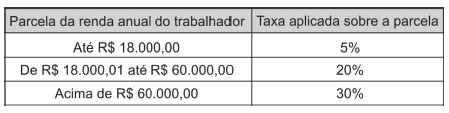
Um imposto progressivo sobre a renda anual do trabalhador será aplicado de acordo com a tabela:
Imagem associada para resolução da questão

Sérgio possui carteira assinada e recebe mensalmente R$ 7.000,00, sendo esta sua única renda. Considerando que a renda anual de Sérgio inclui a parcela do 13º salário que recebe, o valor total do imposto progressivo que terá que pagar sobre sua renda anual será de
Alternativas
Q1795238 Matemática
Em relação à expressão algébrica Imagem associada para resolução da questão, sua condição de existência no universo dos números reais e sua simplificação máxima são, respectivamente,
Alternativas
Q1795237 Matemática

A tabela indica as vendas de veículos, por categoria, de uma concessionária nos três primeiros meses de um ano, com a omissão de apenas dois valores, indicados por x e y.
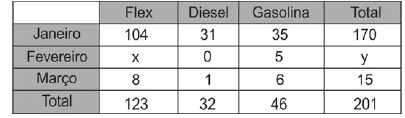

Imagem associada para resolução da questão


Considerando as três categorias de veículos, a porcentagem de veículos Flex vendidos em fevereiro foi de

Alternativas
Ano: 2020 Banca: CEPERJ Órgão: CEDERJ Prova: CEPERJ - 2020 - CEDERJ - Vestibular - Inglês |
Q1712827 Inglês

What about the artists?

The Guardian - Wed 14 Oct 2020


The government is deaf to the plight of freelance musicians and othercreatives


      On Monday, a number of British arts organisations finally heard whether they had received grants from the £1.57bn bailout fund announced in July by the chancellor, Rishi Sunak. Not a moment too soon, institutions such as Wigmore Hall in London, Bristol Old Vic and the City of Birmingham Symphony Orchestra have been given a cash bufferthatshould keep them alive until March.

     The welcome announcement has been marred, though, by the failure of the government to address the question of freelancers and self-employed people in the arts. In an interview with ITV last week, Mr. Sunak was asked what he thought professional musicians ought to do, given that they can’t earn enough to live. He answered that up to 3 million people in the country qualified for help under the self-employed support scheme. Pressed on whether musicians oughttofind differentwork, he mentioned retraining schemes that are "providing new and fresh opportunity”. People must adapt, he said. He added that it was untrue that there was no work for musicians. Music lessons, in his own household at least, were still going on.

     The interviewer’s question was specifically about musicians - a third of whom have been ineligible for the selfemployed support scheme. So even if, as he later asserted, Mr Sunak was talking about the workforce as a whole rather than cultural workers in particular when he spoke of the need to retrain, he certainly gave a strong impression of indifference to and ignorance of musicians’ plight. This was reinforced on Monday when a government-backed advertisement went viral, launching hundreds of derisive parodies. Aiming to recruit workers into cybersecurity roles, it showed a dancer doing up her ballet shoes. It read: "Fatima’s next job could be in cyber (she just doesn’t know it yet)”. 
     The culture secretary, Oliver Dowden, was forced to condemn the advertisement as "crass” as his day of good news descended into farce and contumely. The government seems unable to grasp that putting money into the arts infrastructure is only part of the solution; creatives themselves need to be helped to survive economically too. Though some institutions are putting work on stage - and will be helped to do so in the months to come by the rescue package - these events will necessarily be small-scale, representing a drop in the ocean compared with the industry working at full tilt.
     New digital business models are being explored, but they are in their infancy and are not going to pay next month’s rent. Moreover, performance dates in the diary - that is, employment opportunities for freelancers - amount to perilous bets against the future course of the virus. As infections soar, organisations are bound, quite rightly, to be cautious, particularly in the face of the catastrophic failure of the government’s test-and-trace scheme.
     Meanwhile, musicians and others are certainly "adapting” - often to unskilled, low-paid work, though there is not much of that to go around. The government’s continued implication that musicians and other creative workers - many of whom have trained since childhood for some of the most demanding, competitive and highly skilled work in the economy - are somehow not "viable” is both insulting and ignorant. Underlying Mr Sunak’s remarks was the tired old Tory notion that creative jobs are not "real jobs”, and are undertaken by some fantastical species who are not, in fact, real people. Perhaps the chancellor should ask his family’s music teacher what it’s really like for artists right now - and actually listen to the answer.

Source: The Guardian, available at https://www.theguardian. com/commentisfree/2020/oct/14/the-guardian-view-on-saving-thearts-what-about-the-artists, accessed on October21st, 2020.

Considering the expression of happenings in the past, verbs vary following time precision or imprecision. The example extracted from the editorial that reflects unspecified time is:
Alternativas
Ano: 2020 Banca: CEPERJ Órgão: CEDERJ Prova: CEPERJ - 2020 - CEDERJ - Vestibular - Inglês |
Q1712826 Inglês

What about the artists?

The Guardian - Wed 14 Oct 2020


The government is deaf to the plight of freelance musicians and othercreatives


      On Monday, a number of British arts organisations finally heard whether they had received grants from the £1.57bn bailout fund announced in July by the chancellor, Rishi Sunak. Not a moment too soon, institutions such as Wigmore Hall in London, Bristol Old Vic and the City of Birmingham Symphony Orchestra have been given a cash bufferthatshould keep them alive until March.

     The welcome announcement has been marred, though, by the failure of the government to address the question of freelancers and self-employed people in the arts. In an interview with ITV last week, Mr. Sunak was asked what he thought professional musicians ought to do, given that they can’t earn enough to live. He answered that up to 3 million people in the country qualified for help under the self-employed support scheme. Pressed on whether musicians oughttofind differentwork, he mentioned retraining schemes that are "providing new and fresh opportunity”. People must adapt, he said. He added that it was untrue that there was no work for musicians. Music lessons, in his own household at least, were still going on.

     The interviewer’s question was specifically about musicians - a third of whom have been ineligible for the selfemployed support scheme. So even if, as he later asserted, Mr Sunak was talking about the workforce as a whole rather than cultural workers in particular when he spoke of the need to retrain, he certainly gave a strong impression of indifference to and ignorance of musicians’ plight. This was reinforced on Monday when a government-backed advertisement went viral, launching hundreds of derisive parodies. Aiming to recruit workers into cybersecurity roles, it showed a dancer doing up her ballet shoes. It read: "Fatima’s next job could be in cyber (she just doesn’t know it yet)”. 
     The culture secretary, Oliver Dowden, was forced to condemn the advertisement as "crass” as his day of good news descended into farce and contumely. The government seems unable to grasp that putting money into the arts infrastructure is only part of the solution; creatives themselves need to be helped to survive economically too. Though some institutions are putting work on stage - and will be helped to do so in the months to come by the rescue package - these events will necessarily be small-scale, representing a drop in the ocean compared with the industry working at full tilt.
     New digital business models are being explored, but they are in their infancy and are not going to pay next month’s rent. Moreover, performance dates in the diary - that is, employment opportunities for freelancers - amount to perilous bets against the future course of the virus. As infections soar, organisations are bound, quite rightly, to be cautious, particularly in the face of the catastrophic failure of the government’s test-and-trace scheme.
     Meanwhile, musicians and others are certainly "adapting” - often to unskilled, low-paid work, though there is not much of that to go around. The government’s continued implication that musicians and other creative workers - many of whom have trained since childhood for some of the most demanding, competitive and highly skilled work in the economy - are somehow not "viable” is both insulting and ignorant. Underlying Mr Sunak’s remarks was the tired old Tory notion that creative jobs are not "real jobs”, and are undertaken by some fantastical species who are not, in fact, real people. Perhaps the chancellor should ask his family’s music teacher what it’s really like for artists right now - and actually listen to the answer.

Source: The Guardian, available at https://www.theguardian. com/commentisfree/2020/oct/14/the-guardian-view-on-saving-thearts-what-about-the-artists, accessed on October21st, 2020.

The second and first paragraphs are linked by a notion of contrast, which is explicitly conveyed by the linking word "though” (2nd paragraph). The contrast refers to the difference in treatment between::
Alternativas
Respostas
12861: B
12862: D
12863: A
12864: E
12865: B
12866: D
12867: A
12868: B
12869: E
12870: A
12871: E
12872: E
12873: C
12874: D
12875: C
12876: B
12877: D
12878: A
12879: C
12880: D