Selecionar segmento
Estude com questões de diferentes segmentos
Atenção: Isso limpará todos os campos já preenchidos no filtro!
Foram encontradas 75.429 questões
Resolva questões gratuitamente!
Junte-se a mais de 4 milhões de concurseiros!


Ano: 2020
Banca:
UECE-CEV
Órgão:
UECE
Prova:
UECE-CEV - 2020 - UECE - Vestibular - Conhecimentos Específicos - Primeiro Dia - Prova 1 - Inglês |
Q2030406
Inglês
Texto associado
Americans May Add Five Times More Plastic to
the Oceans Than Thought
The United States is using more
plastic than ever, and waste exported for
recycling is often mishandled, according
to a new study.
The United States contribution
to coastal plastic pollution worldwide is
significantly larger than previously
thought, possibly by as much as five
times, according to a study published
Friday. The research, published in Science
Advances, is the sequel to a 2015 paper
by the same authors. Two factors
contributed to the sharp increase:
Americans are using more plastic than
ever and the current study included
pollution generated by United States
exports of plastic waste, while the earlier
one did not.
The United States, which does
not have sufficient infrastructure to
handle its recycling demands at home,
exports about half of its recyclable waste.
Of the total exported, about 88 percent
ends up in countries considered to have
inadequate waste management.
“When you consider how much
of our plastic waste isn’t actually
recyclable because it is low-value,
contaminated or difficult to process, it’s
not surprising that a lot of it ends up
polluting the environment,” said the
study’s lead author, Kara Lavender Law,
research professor of oceanography at
Sea Education Association, in a
statement.
The study estimates that in
2016, the United States contributed
between 1.1 and 2.2 million metric tons of
plastic waste to the oceans through a
combination of littering, dumping and
mismanaged exports. At a minimum,
that’s almost double the total estimated
waste in the team’s previous study. At the
high end, it would be a fivefold increase
over the earlier estimate.
Nicholas Mallos, a senior
director at the Ocean Conservancy and an
author of the study, said the upper
estimate would be equal to a pile of
plastic covering the area of the White
House Lawn and reaching as high as the
Empire State Building.
The ranges are wide partly
because “there’s no real standard for
being able to provide good quality data on
collection and disposal of waste in
general,” said Ted Siegler, a resource
economist at DSM Environmental
Solutions, a consulting firm, and an
author of the study. Mr. Siegler said the
researchers had evaluated waste-disposal
practices in countries around the world
and used their “best professional
judgment” to determine the lowest and
highest amounts of plastic waste likely to
escape into the environment. They settled
on a range of 25 percent to 75 percent.
Tony Walker, an associate
professor at the Dalhousie University
School for Resource and Environmental
Studies in Halifax, Nova Scotia, said that
analyzing waste data can amount to a
“data minefield” because there are no
data standards across municipalities.
Moreover, once plastic waste is shipped
overseas, he said, data is often not
recorded at all.
Nonetheless, Dr. Walker, who
was not involved in the study, said it
could offer a more accurate accounting of
plastic pollution than the previous study,
which likely underestimated the United
States’ contribution. “They’ve put their
best estimate, as accurate as they can be
with this data,” he said, and used ranges,
which underscores that the figures are
estimates.
Of the plastics that go into the
United States recycling system, about 9
percent of the country’s total plastic
waste, there is no guarantee that they’ll
be remade into new consumer goods. New
plastic is so inexpensive to manufacture
that only certain expensive, high-grade
plastics are profitable to recycle within the
United States, which is why roughly half
of the country’s plastic waste was shipped
abroad in 2016, the most recent year for
which data is available.
Since 2016, however, the
recycling landscape has changed. China
and many countries in Southeast Asia
have stopped accepting plastic waste
imports. And lower oil prices have further
reduced the market for recycled plastic.
“What the new study really underscores is
we have to get a handle on source
reduction at home,” Mr. Mallos said. “That
starts with eliminating unnecessary and
problematic single-use plastics.”
From: https://www.nytimes.com/2020/10/30/
One of the factors that contributes to the huge
amount of plastic waste is the fact that
Ano: 2020
Banca:
UECE-CEV
Órgão:
UECE
Prova:
UECE-CEV - 2020 - UECE - Vestibular - Conhecimentos Específicos - Primeiro Dia - Prova 1 - Inglês |
Q2030405
Inglês
Texto associado
Americans May Add Five Times More Plastic to
the Oceans Than Thought
The United States is using more
plastic than ever, and waste exported for
recycling is often mishandled, according
to a new study.
The United States contribution
to coastal plastic pollution worldwide is
significantly larger than previously
thought, possibly by as much as five
times, according to a study published
Friday. The research, published in Science
Advances, is the sequel to a 2015 paper
by the same authors. Two factors
contributed to the sharp increase:
Americans are using more plastic than
ever and the current study included
pollution generated by United States
exports of plastic waste, while the earlier
one did not.
The United States, which does
not have sufficient infrastructure to
handle its recycling demands at home,
exports about half of its recyclable waste.
Of the total exported, about 88 percent
ends up in countries considered to have
inadequate waste management.
“When you consider how much
of our plastic waste isn’t actually
recyclable because it is low-value,
contaminated or difficult to process, it’s
not surprising that a lot of it ends up
polluting the environment,” said the
study’s lead author, Kara Lavender Law,
research professor of oceanography at
Sea Education Association, in a
statement.
The study estimates that in
2016, the United States contributed
between 1.1 and 2.2 million metric tons of
plastic waste to the oceans through a
combination of littering, dumping and
mismanaged exports. At a minimum,
that’s almost double the total estimated
waste in the team’s previous study. At the
high end, it would be a fivefold increase
over the earlier estimate.
Nicholas Mallos, a senior
director at the Ocean Conservancy and an
author of the study, said the upper
estimate would be equal to a pile of
plastic covering the area of the White
House Lawn and reaching as high as the
Empire State Building.
The ranges are wide partly
because “there’s no real standard for
being able to provide good quality data on
collection and disposal of waste in
general,” said Ted Siegler, a resource
economist at DSM Environmental
Solutions, a consulting firm, and an
author of the study. Mr. Siegler said the
researchers had evaluated waste-disposal
practices in countries around the world
and used their “best professional
judgment” to determine the lowest and
highest amounts of plastic waste likely to
escape into the environment. They settled
on a range of 25 percent to 75 percent.
Tony Walker, an associate
professor at the Dalhousie University
School for Resource and Environmental
Studies in Halifax, Nova Scotia, said that
analyzing waste data can amount to a
“data minefield” because there are no
data standards across municipalities.
Moreover, once plastic waste is shipped
overseas, he said, data is often not
recorded at all.
Nonetheless, Dr. Walker, who
was not involved in the study, said it
could offer a more accurate accounting of
plastic pollution than the previous study,
which likely underestimated the United
States’ contribution. “They’ve put their
best estimate, as accurate as they can be
with this data,” he said, and used ranges,
which underscores that the figures are
estimates.
Of the plastics that go into the
United States recycling system, about 9
percent of the country’s total plastic
waste, there is no guarantee that they’ll
be remade into new consumer goods. New
plastic is so inexpensive to manufacture
that only certain expensive, high-grade
plastics are profitable to recycle within the
United States, which is why roughly half
of the country’s plastic waste was shipped
abroad in 2016, the most recent year for
which data is available.
Since 2016, however, the
recycling landscape has changed. China
and many countries in Southeast Asia
have stopped accepting plastic waste
imports. And lower oil prices have further
reduced the market for recycled plastic.
“What the new study really underscores is
we have to get a handle on source
reduction at home,” Mr. Mallos said. “That
starts with eliminating unnecessary and
problematic single-use plastics.”
From: https://www.nytimes.com/2020/10/30/
According to the text, the United States
Ano: 2020
Banca:
UECE-CEV
Órgão:
UECE
Prova:
UECE-CEV - 2020 - UECE - Vestibular - Conhecimentos Específicos - Primeiro Dia - Prova 1 - Inglês |
Q2030404
Inglês
Texto associado
Americans May Add Five Times More Plastic to
the Oceans Than Thought
The United States is using more
plastic than ever, and waste exported for
recycling is often mishandled, according
to a new study.
The United States contribution
to coastal plastic pollution worldwide is
significantly larger than previously
thought, possibly by as much as five
times, according to a study published
Friday. The research, published in Science
Advances, is the sequel to a 2015 paper
by the same authors. Two factors
contributed to the sharp increase:
Americans are using more plastic than
ever and the current study included
pollution generated by United States
exports of plastic waste, while the earlier
one did not.
The United States, which does
not have sufficient infrastructure to
handle its recycling demands at home,
exports about half of its recyclable waste.
Of the total exported, about 88 percent
ends up in countries considered to have
inadequate waste management.
“When you consider how much
of our plastic waste isn’t actually
recyclable because it is low-value,
contaminated or difficult to process, it’s
not surprising that a lot of it ends up
polluting the environment,” said the
study’s lead author, Kara Lavender Law,
research professor of oceanography at
Sea Education Association, in a
statement.
The study estimates that in
2016, the United States contributed
between 1.1 and 2.2 million metric tons of
plastic waste to the oceans through a
combination of littering, dumping and
mismanaged exports. At a minimum,
that’s almost double the total estimated
waste in the team’s previous study. At the
high end, it would be a fivefold increase
over the earlier estimate.
Nicholas Mallos, a senior
director at the Ocean Conservancy and an
author of the study, said the upper
estimate would be equal to a pile of
plastic covering the area of the White
House Lawn and reaching as high as the
Empire State Building.
The ranges are wide partly
because “there’s no real standard for
being able to provide good quality data on
collection and disposal of waste in
general,” said Ted Siegler, a resource
economist at DSM Environmental
Solutions, a consulting firm, and an
author of the study. Mr. Siegler said the
researchers had evaluated waste-disposal
practices in countries around the world
and used their “best professional
judgment” to determine the lowest and
highest amounts of plastic waste likely to
escape into the environment. They settled
on a range of 25 percent to 75 percent.
Tony Walker, an associate
professor at the Dalhousie University
School for Resource and Environmental
Studies in Halifax, Nova Scotia, said that
analyzing waste data can amount to a
“data minefield” because there are no
data standards across municipalities.
Moreover, once plastic waste is shipped
overseas, he said, data is often not
recorded at all.
Nonetheless, Dr. Walker, who
was not involved in the study, said it
could offer a more accurate accounting of
plastic pollution than the previous study,
which likely underestimated the United
States’ contribution. “They’ve put their
best estimate, as accurate as they can be
with this data,” he said, and used ranges,
which underscores that the figures are
estimates.
Of the plastics that go into the
United States recycling system, about 9
percent of the country’s total plastic
waste, there is no guarantee that they’ll
be remade into new consumer goods. New
plastic is so inexpensive to manufacture
that only certain expensive, high-grade
plastics are profitable to recycle within the
United States, which is why roughly half
of the country’s plastic waste was shipped
abroad in 2016, the most recent year for
which data is available.
Since 2016, however, the
recycling landscape has changed. China
and many countries in Southeast Asia
have stopped accepting plastic waste
imports. And lower oil prices have further
reduced the market for recycled plastic.
“What the new study really underscores is
we have to get a handle on source
reduction at home,” Mr. Mallos said. “That
starts with eliminating unnecessary and
problematic single-use plastics.”
From: https://www.nytimes.com/2020/10/30/
As to the use of plastic by Americans, the text
mentions that it
Ano: 2020
Banca:
FGV
Órgão:
FGV
Prova:
FGV - 2020 - FGV - Graduação em Economia - Inglês e Física - 1° Dia |
Q1796848
Física
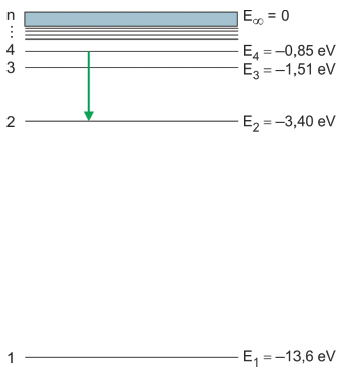
A figura mostra o diagrama de níveis de energia, em elétrons-volt, para o átomo de hidrogênio,
segundo o modelo proposto por Bohr. Nela está representada uma transição do elétron do nível n =
4 para o nível n = 2.
 (http://astro.if.ufrgs.br. Adaptado.)
A quantidade de energia associada ao fóton emitido pelo átomo de hidrogênio na transição mostrada na figura é
(http://astro.if.ufrgs.br. Adaptado.)A quantidade de energia associada ao fóton emitido pelo átomo de hidrogênio na transição mostrada na figura é
Ano: 2020
Banca:
FGV
Órgão:
FGV
Prova:
FGV - 2020 - FGV - Graduação em Economia - Inglês e Física - 1° Dia |
Q1796847
Física
Uma bateria de força eletromotriz ε e resistência interna r é ligada a um resistor ôhmico de
resistência R, que, nessa situação, é percorrido por uma corrente elétrica de intensidade I. Se essa
bateria for associada em paralelo com outra bateria idêntica e o conjunto, assim formado, for ligado
ao mesmo resistor R, a intensidade da corrente elétrica I’ que o percorrerá será tal que
Ano: 2020
Banca:
FGV
Órgão:
FGV
Prova:
FGV - 2020 - FGV - Graduação em Economia - Inglês e Física - 1° Dia |
Q1796846
Física
Uma esfera metálica oca, cujo raio da superfície externa é R, está eletrizada com carga positiva e
localizada no vácuo. Considere o ponto X, localizado no centro da esfera, e dois pontos, Y e Z,
localizados fora da esfera e distando, respectivamente, R e 3R da superfície externa da esfera.
Adotando-se o potencial elétrico como nulo a uma distância infinita da esfera e denominando-se
VX, VY e VZ os potenciais elétricos dos pontos X, Y e Z, respectivamente, tem-se:
Ano: 2020
Banca:
FGV
Órgão:
FGV
Prova:
FGV - 2020 - FGV - Graduação em Economia - Inglês e Física - 1° Dia |
Q1796845
Física
A figura mostra dois recipientes cilíndricos idênticos, R e S, de altura 35 cm, contendo água até
diferentes alturas, hR e hS.
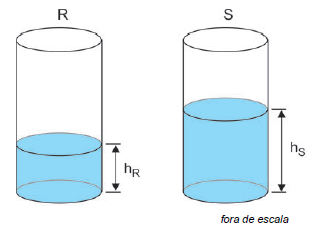
Colocando-se um alto-falante que emite um som de frequência 850 Hz sobre cada recipiente, separadamente, verifica-se que eles funcionam como tubos sonoros fechados em uma extremidade e abertos na outra, ocorrendo ressonância em ambos. Considerando-se a velocidade de propagação do som no ar igual a 340 m/s, a diferença entre as alturas da água nos dois recipientes, hS – hR, é igual a
Colocando-se um alto-falante que emite um som de frequência 850 Hz sobre cada recipiente, separadamente, verifica-se que eles funcionam como tubos sonoros fechados em uma extremidade e abertos na outra, ocorrendo ressonância em ambos. Considerando-se a velocidade de propagação do som no ar igual a 340 m/s, a diferença entre as alturas da água nos dois recipientes, hS – hR, é igual a
Ano: 2020
Banca:
FGV
Órgão:
FGV
Prova:
FGV - 2020 - FGV - Graduação em Economia - Inglês e Física - 1° Dia |
Q1796844
Física
Uma lente convergente de distância focal igual a 6,0 cm é colocada entre duas fontes de luz
puntiformes, de modo que fiquem localizadas sobre o eixo principal da lente. Sabendo-se que a
distância entre uma das fontes e a lente é 12 cm e que as imagens das duas fontes são
coincidentes, a distância entre as fontes de luz é
Ano: 2020
Banca:
FGV
Órgão:
FGV
Prova:
FGV - 2020 - FGV - Graduação em Economia - Inglês e Física - 1° Dia |
Q1796843
Física
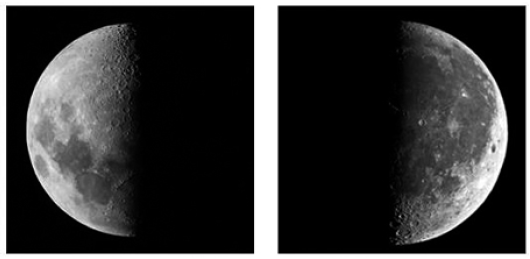
A imagem mostra duas fotografias da Lua, obtidas em uma mesma localidade.
(www.zenite.nu)
O intervalo de tempo mínimo entre os instantes em que as fotos foram obtidas é de, aproximadamente,
(www.zenite.nu)
O intervalo de tempo mínimo entre os instantes em que as fotos foram obtidas é de, aproximadamente,
Ano: 2020
Banca:
FGV
Órgão:
FGV
Prova:
FGV - 2020 - FGV - Graduação em Economia - Inglês e Física - 1° Dia |
Q1796842
Física
Certa massa de gás ideal sofreu três transformações. A primeira, AB, foi isotérmica, a segunda,
BC, foi isovolumétrica e a terceira, CA, foi isobárica, como mostra a figura.
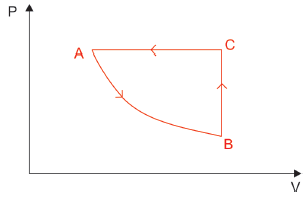
Considerando-se que o calor absorvido pelo gás seja positivo, que o calor cedido seja negativo, que o trabalho realizado pela força aplicada pelo gás no meio exterior seja positivo e que o trabalho realizado pela força aplicada pelo meio exterior sobre o gás seja negativo, montou-se o quadro a seguir.

Completam, respectivamente, as células X, Y e Z do quadro:
Considerando-se que o calor absorvido pelo gás seja positivo, que o calor cedido seja negativo, que o trabalho realizado pela força aplicada pelo gás no meio exterior seja positivo e que o trabalho realizado pela força aplicada pelo meio exterior sobre o gás seja negativo, montou-se o quadro a seguir.
Completam, respectivamente, as células X, Y e Z do quadro:
Ano: 2020
Banca:
FGV
Órgão:
FGV
Prova:
FGV - 2020 - FGV - Graduação em Economia - Inglês e Física - 1° Dia |
Q1796841
Física
Dois objetos de materiais, massas e temperaturas diferentes foram colocados no interior de um
calorímetro ideal de capacidade térmica desprezível e, após certo tempo, atingiram o equilíbrio
térmico. É indubitável que, ao fim desse processo,
Ano: 2020
Banca:
FGV
Órgão:
FGV
Prova:
FGV - 2020 - FGV - Graduação em Economia - Inglês e Física - 1° Dia |
Q1796840
Física
Um recipiente graduado de vidro, de volume interno igual a 800 cm3
, contém certa quantidade de
glicerina, ambos a 20 ºC, temperatura para a qual o recipiente foi calibrado. Aquecendo-se o
conjunto, nota-se que a indicação do volume de glicerina no interior do recipiente não se altera
enquanto a substância estiver no estado líquido. Sendo os coeficientes de dilatação volumétrica do
vidro e da glicerina, respectivamente, iguais a 3,0 × 10⁻⁵ ºC–1 e 5,0 × 10⁻⁴ ºC–1
, a quantidade de
glicerina no recipiente, a temperatura de 20 ºC, é igual a
Ano: 2020
Banca:
FGV
Órgão:
FGV
Prova:
FGV - 2020 - FGV - Graduação em Economia - Inglês e Física - 1° Dia |
Q1796839
Física
A figura mostra três recipientes, L, M e N, que contêm água, sendo que a altura da água no
recipiente L é h, no recipiente M é 2h e no recipiente N é 3h. A área da base do recipiente L é igual
ao dobro da área da base do recipiente M e ao triplo da área da base do recipiente N.
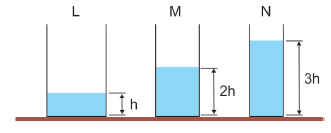
Comparando-se as pressões PL, PM e PN exercidas pela água nas bases dos recipientes L, M e N, respectivamente, tem-se
Comparando-se as pressões PL, PM e PN exercidas pela água nas bases dos recipientes L, M e N, respectivamente, tem-se
Ano: 2020
Banca:
FGV
Órgão:
FGV
Prova:
FGV - 2020 - FGV - Graduação em Economia - Inglês e Física - 1° Dia |
Q1796838
Física
Um asteroide com tamanho semelhante ao de um pequeno automóvel passou perto da Terra no
último domingo. Chamado de 2020QG, ele esteve a 2 950 quilômetros do planeta, uma distância
pequena em termos astronômicos.
(O Estado de S.Paulo, 20.08.2020. Adaptado.)
Considere que a constante de gravitação universal é igual a 6,7 × 10⁻¹¹ N·m2 /kg2 , que a massa da Terra é 6,0 × 1024 kg e que a menor distância entre o centro do asteroide e o centro da Terra foi, aproximadamente, 1,0 × 10⁷ m (resultado da soma do raio da Terra com a distância do asteroide ao planeta). Uma vez que o asteroide não foi capturado gravitacionalmente pela Terra, sua velocidade, ao passar pelo ponto mais próximo da Terra, era de, no mínimo,
(O Estado de S.Paulo, 20.08.2020. Adaptado.)
Considere que a constante de gravitação universal é igual a 6,7 × 10⁻¹¹ N·m2 /kg2 , que a massa da Terra é 6,0 × 1024 kg e que a menor distância entre o centro do asteroide e o centro da Terra foi, aproximadamente, 1,0 × 10⁷ m (resultado da soma do raio da Terra com a distância do asteroide ao planeta). Uma vez que o asteroide não foi capturado gravitacionalmente pela Terra, sua velocidade, ao passar pelo ponto mais próximo da Terra, era de, no mínimo,
Ano: 2020
Banca:
FGV
Órgão:
FGV
Prova:
FGV - 2020 - FGV - Graduação em Economia - Inglês e Física - 1° Dia |
Q1796837
Física
Uma bola de massa 60 g é solta, a partir do repouso, de uma altura igual a 80 cm. Após colidir com
o solo, a bola sobe verticalmente até a altura de 45 cm. Considerando-se a aceleração
gravitacional igual a 10 m/s² e desprezando-se a resistência do ar, a intensidade do impulso
recebido pela bola na colisão com o solo foi de
Ano: 2020
Banca:
FGV
Órgão:
FGV
Prova:
FGV - 2020 - FGV - Graduação em Economia - Inglês e Física - 1° Dia |
Q1796836
Física
Um bloco de massa 100 g, apoiado sobre uma superfície horizontal sem atrito, está preso à
extremidade de uma mola de constante elástica 1,6 N/m, que tem a outra extremidade presa a um
suporte vertical fixo. O bloco realiza movimento harmônico simples, e sua posição x é dada pela
equação x = 0,20 cos (4,0·t + 0,80). A máxima aceleração a que o bloco está sujeito nesse
movimento tem módulo igual a
Ano: 2020
Banca:
FGV
Órgão:
FGV
Prova:
FGV - 2020 - FGV - Graduação em Economia - Inglês e Física - 1° Dia |
Q1796835
Física
Um motorista, que conduz seu caminhão com velocidade constante de 25 m/s (90 km/h) por uma
estrada retilínea, plana e horizontal, aciona os freios quando percebe um ônibus a sua frente
deslocando-se lentamente no mesmo sentido, com velocidade constante de 5 m/s (18 km/h).
Supondo-se que a distância entre o caminhão e o ônibus no instante em que o motorista do
caminhão aciona os freios é de 80 m, que o ônibus não altera sua velocidade e que não há
mudança nas direções dos movimentos de ambos os veículos, o módulo da aceleração mínima,
admitida constante, que deve ser imprimida ao caminhão para evitar a colisão é
Ano: 2020
Banca:
FGV
Órgão:
FGV
Prova:
FGV - 2020 - FGV - Graduação em Economia - Inglês e Física - 1° Dia |
Q1796834
Física
O gráfico mostra a variação da quantidade de carga elétrica armazenada em um capacitor em
função do tempo, quando ligado a certo circuito elétrico.
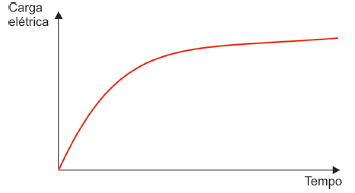
O coeficiente angular da reta tangente a um ponto correspondente a um instante qualquer da curva representa
O coeficiente angular da reta tangente a um ponto correspondente a um instante qualquer da curva representa
Ano: 2020
Banca:
FGV
Órgão:
FGV
Prova:
FGV - 2020 - FGV - Graduação em Economia - Inglês e Física - 1° Dia |
Q1796833
Inglês
Texto associado
Read the text to answer question.
The formula for calculating people’s environmental footprint is simple, but widely misunderstood:
Impact = Population x Affluence x Technology (I = PAT). The global rate of consumption growth, before
the pandemic, was 3% a year. Population growth is 1%. Some people assume this means that the rise in
population bears one-third of the responsibility for increased consumption. But population growth is
overwhelmingly concentrated among the world’s poorest people, who have scarcely any A or T to
multiply their P.
Yet it is widely used as a blanket explanation of environment breakdown. Panic about population
growth enables the people most responsible for the impacts of rising consumption (the affluent) to blame
those who are least responsible.
(George Monbiot. www.theguardian.com, 26.08.2020. Adapted.)
The formula for calculating people’s environmental footprint
Ano: 2020
Banca:
FGV
Órgão:
FGV
Prova:
FGV - 2020 - FGV - Graduação em Economia - Inglês e Física - 1° Dia |
Q1796832
Inglês
Texto associado
Read the text to answer question.
The formula for calculating people’s environmental footprint is simple, but widely misunderstood:
Impact = Population x Affluence x Technology (I = PAT). The global rate of consumption growth, before
the pandemic, was 3% a year. Population growth is 1%. Some people assume this means that the rise in
population bears one-third of the responsibility for increased consumption. But population growth is
overwhelmingly concentrated among the world’s poorest people, who have scarcely any A or T to
multiply their P.
Yet it is widely used as a blanket explanation of environment breakdown. Panic about population
growth enables the people most responsible for the impacts of rising consumption (the affluent) to blame
those who are least responsible.
(George Monbiot. www.theguardian.com, 26.08.2020. Adapted.)
The text states that

 Conheça nossos planos