Questões de Vestibular
Foram encontradas 75.429 questões
Resolva questões gratuitamente!
Junte-se a mais de 4 milhões de concurseiros!



Três triângulos equiláteros e dois quadrados formam uma
figura plana, como ilustrado. Seus centros são os vértices de um
pentágono irregular, que está destacado na figura. Se T é a área
de cada um dos triângulos e Q a área de cada um dos
quadrados, a área desse pentágono é

O quadrinho aborda o tema de números primos, sobre os quais
é correto afirmar:
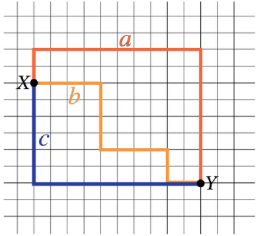
A figura ilustra graficamente uma região de um bairro, com ruas
ortogonais entre si. O ponto X indica um condomínio
residencial, e o ponto Y indica a entrada de um parque. Três
moradores realizam caminhos diferentes para chegar ao ponto Y,
partindo do ponto X, ilustrados com cores diferentes. Se a, b e
c representam as distâncias percorridas por esses moradores
nesses caminhos, é correto afirmar que
How things have changed.
Now disagreements feel deadly serious. Like when your colleague pronounces that wearing a face mask in public is a threat to his liberty. Or when you see that one of your friends has just tweeted that, actually, all lives matter. Before you know it, you’re feeling angry and forming harsh new judgments about your colleagues and friends. Let’s take a collective pause and breathe: there are some ways we can all try to have more civil disagreements in this febrile age of culture wars.
1. ‘Coupling’ and ‘decoupling’
The first is to consider how inclined people are to ‘couple’ or ‘decouple’ topics involving wider political and social factors. Swedish data analyst John Nerst has used the terms to describe the contrasting ways in which people approach contentious issues. Those of us more inclined to ‘couple’ see them as inextricably related to a broader matrix of factors, whereas those more predisposed to ‘decouple’ prefer to consider an issue in isolation. To take a crude example, a decoupler might consider in isolation the question of whether a vaccine provides a degree of immunity to a virus; a coupler, by contrast, would immediately see the issue as inextricably entangled in a mesh of factors, such as pharmaceutical industry power and parental choice.
2.____________________
A study at Arizona State University, U.S., analysed more than 100,000 comments on a forum where users post their views on an issue and invite others to persuade them to change their mind. The researchers found that regardless of the kind of topic, people were more likely to change their mind when confronted with more evidence-based arguments. “Our work may suggest that while attitude change is hard-won, providing facts, statistics and citations for one’s arguments can convince people to change their minds,” they concluded.
3. Just be nicer?
Finally, it’s easier said than done, but let’s all try to be more respectful of and attentive to each other’s positions. We should do this not just for virtuous reasons, but because the more we create that kind of a climate, the more open-minded and intellectually flexible we will all be inclined to be. And then hopefully, collectively, we can start having more constructive disagreements — even in our present very difficult times.
How things have changed.
Now disagreements feel deadly serious. Like when your colleague pronounces that wearing a face mask in public is a threat to his liberty. Or when you see that one of your friends has just tweeted that, actually, all lives matter. Before you know it, you’re feeling angry and forming harsh new judgments about your colleagues and friends. Let’s take a collective pause and breathe: there are some ways we can all try to have more civil disagreements in this febrile age of culture wars.
1. ‘Coupling’ and ‘decoupling’
The first is to consider how inclined people are to ‘couple’ or ‘decouple’ topics involving wider political and social factors. Swedish data analyst John Nerst has used the terms to describe the contrasting ways in which people approach contentious issues. Those of us more inclined to ‘couple’ see them as inextricably related to a broader matrix of factors, whereas those more predisposed to ‘decouple’ prefer to consider an issue in isolation. To take a crude example, a decoupler might consider in isolation the question of whether a vaccine provides a degree of immunity to a virus; a coupler, by contrast, would immediately see the issue as inextricably entangled in a mesh of factors, such as pharmaceutical industry power and parental choice.
2.____________________
A study at Arizona State University, U.S., analysed more than 100,000 comments on a forum where users post their views on an issue and invite others to persuade them to change their mind. The researchers found that regardless of the kind of topic, people were more likely to change their mind when confronted with more evidence-based arguments. “Our work may suggest that while attitude change is hard-won, providing facts, statistics and citations for one’s arguments can convince people to change their minds,” they concluded.
3. Just be nicer?
Finally, it’s easier said than done, but let’s all try to be more respectful of and attentive to each other’s positions. We should do this not just for virtuous reasons, but because the more we create that kind of a climate, the more open-minded and intellectually flexible we will all be inclined to be. And then hopefully, collectively, we can start having more constructive disagreements — even in our present very difficult times.
How things have changed.
Now disagreements feel deadly serious. Like when your colleague pronounces that wearing a face mask in public is a threat to his liberty. Or when you see that one of your friends has just tweeted that, actually, all lives matter. Before you know it, you’re feeling angry and forming harsh new judgments about your colleagues and friends. Let’s take a collective pause and breathe: there are some ways we can all try to have more civil disagreements in this febrile age of culture wars.
1. ‘Coupling’ and ‘decoupling’
The first is to consider how inclined people are to ‘couple’ or ‘decouple’ topics involving wider political and social factors. Swedish data analyst John Nerst has used the terms to describe the contrasting ways in which people approach contentious issues. Those of us more inclined to ‘couple’ see them as inextricably related to a broader matrix of factors, whereas those more predisposed to ‘decouple’ prefer to consider an issue in isolation. To take a crude example, a decoupler might consider in isolation the question of whether a vaccine provides a degree of immunity to a virus; a coupler, by contrast, would immediately see the issue as inextricably entangled in a mesh of factors, such as pharmaceutical industry power and parental choice.
2.____________________
A study at Arizona State University, U.S., analysed more than 100,000 comments on a forum where users post their views on an issue and invite others to persuade them to change their mind. The researchers found that regardless of the kind of topic, people were more likely to change their mind when confronted with more evidence-based arguments. “Our work may suggest that while attitude change is hard-won, providing facts, statistics and citations for one’s arguments can convince people to change their minds,” they concluded.
3. Just be nicer?
Finally, it’s easier said than done, but let’s all try to be more respectful of and attentive to each other’s positions. We should do this not just for virtuous reasons, but because the more we create that kind of a climate, the more open-minded and intellectually flexible we will all be inclined to be. And then hopefully, collectively, we can start having more constructive disagreements — even in our present very difficult times.
How things have changed.
Now disagreements feel deadly serious. Like when your colleague pronounces that wearing a face mask in public is a threat to his liberty. Or when you see that one of your friends has just tweeted that, actually, all lives matter. Before you know it, you’re feeling angry and forming harsh new judgments about your colleagues and friends. Let’s take a collective pause and breathe: there are some ways we can all try to have more civil disagreements in this febrile age of culture wars.
1. ‘Coupling’ and ‘decoupling’
The first is to consider how inclined people are to ‘couple’ or ‘decouple’ topics involving wider political and social factors. Swedish data analyst John Nerst has used the terms to describe the contrasting ways in which people approach contentious issues. Those of us more inclined to ‘couple’ see them as inextricably related to a broader matrix of factors, whereas those more predisposed to ‘decouple’ prefer to consider an issue in isolation. To take a crude example, a decoupler might consider in isolation the question of whether a vaccine provides a degree of immunity to a virus; a coupler, by contrast, would immediately see the issue as inextricably entangled in a mesh of factors, such as pharmaceutical industry power and parental choice.
2.____________________
A study at Arizona State University, U.S., analysed more than 100,000 comments on a forum where users post their views on an issue and invite others to persuade them to change their mind. The researchers found that regardless of the kind of topic, people were more likely to change their mind when confronted with more evidence-based arguments. “Our work may suggest that while attitude change is hard-won, providing facts, statistics and citations for one’s arguments can convince people to change their minds,” they concluded.
3. Just be nicer?
Finally, it’s easier said than done, but let’s all try to be more respectful of and attentive to each other’s positions. We should do this not just for virtuous reasons, but because the more we create that kind of a climate, the more open-minded and intellectually flexible we will all be inclined to be. And then hopefully, collectively, we can start having more constructive disagreements — even in our present very difficult times.
How things have changed.
Now disagreements feel deadly serious. Like when your colleague pronounces that wearing a face mask in public is a threat to his liberty. Or when you see that one of your friends has just tweeted that, actually, all lives matter. Before you know it, you’re feeling angry and forming harsh new judgments about your colleagues and friends. Let’s take a collective pause and breathe: there are some ways we can all try to have more civil disagreements in this febrile age of culture wars.
1. ‘Coupling’ and ‘decoupling’
The first is to consider how inclined people are to ‘couple’ or ‘decouple’ topics involving wider political and social factors. Swedish data analyst John Nerst has used the terms to describe the contrasting ways in which people approach contentious issues. Those of us more inclined to ‘couple’ see them as inextricably related to a broader matrix of factors, whereas those more predisposed to ‘decouple’ prefer to consider an issue in isolation. To take a crude example, a decoupler might consider in isolation the question of whether a vaccine provides a degree of immunity to a virus; a coupler, by contrast, would immediately see the issue as inextricably entangled in a mesh of factors, such as pharmaceutical industry power and parental choice.
2.____________________
A study at Arizona State University, U.S., analysed more than 100,000 comments on a forum where users post their views on an issue and invite others to persuade them to change their mind. The researchers found that regardless of the kind of topic, people were more likely to change their mind when confronted with more evidence-based arguments. “Our work may suggest that while attitude change is hard-won, providing facts, statistics and citations for one’s arguments can convince people to change their minds,” they concluded.
3. Just be nicer?
Finally, it’s easier said than done, but let’s all try to be more respectful of and attentive to each other’s positions. We should do this not just for virtuous reasons, but because the more we create that kind of a climate, the more open-minded and intellectually flexible we will all be inclined to be. And then hopefully, collectively, we can start having more constructive disagreements — even in our present very difficult times.
How things have changed.
Now disagreements feel deadly serious. Like when your colleague pronounces that wearing a face mask in public is a threat to his liberty. Or when you see that one of your friends has just tweeted that, actually, all lives matter. Before you know it, you’re feeling angry and forming harsh new judgments about your colleagues and friends. Let’s take a collective pause and breathe: there are some ways we can all try to have more civil disagreements in this febrile age of culture wars.
1. ‘Coupling’ and ‘decoupling’
The first is to consider how inclined people are to ‘couple’ or ‘decouple’ topics involving wider political and social factors. Swedish data analyst John Nerst has used the terms to describe the contrasting ways in which people approach contentious issues. Those of us more inclined to ‘couple’ see them as inextricably related to a broader matrix of factors, whereas those more predisposed to ‘decouple’ prefer to consider an issue in isolation. To take a crude example, a decoupler might consider in isolation the question of whether a vaccine provides a degree of immunity to a virus; a coupler, by contrast, would immediately see the issue as inextricably entangled in a mesh of factors, such as pharmaceutical industry power and parental choice.
2.____________________
A study at Arizona State University, U.S., analysed more than 100,000 comments on a forum where users post their views on an issue and invite others to persuade them to change their mind. The researchers found that regardless of the kind of topic, people were more likely to change their mind when confronted with more evidence-based arguments. “Our work may suggest that while attitude change is hard-won, providing facts, statistics and citations for one’s arguments can convince people to change their minds,” they concluded.
3. Just be nicer?
Finally, it’s easier said than done, but let’s all try to be more respectful of and attentive to each other’s positions. We should do this not just for virtuous reasons, but because the more we create that kind of a climate, the more open-minded and intellectually flexible we will all be inclined to be. And then hopefully, collectively, we can start having more constructive disagreements — even in our present very difficult times.
How things have changed.
Now disagreements feel deadly serious. Like when your colleague pronounces that wearing a face mask in public is a threat to his liberty. Or when you see that one of your friends has just tweeted that, actually, all lives matter. Before you know it, you’re feeling angry and forming harsh new judgments about your colleagues and friends. Let’s take a collective pause and breathe: there are some ways we can all try to have more civil disagreements in this febrile age of culture wars.
1. ‘Coupling’ and ‘decoupling’
The first is to consider how inclined people are to ‘couple’ or ‘decouple’ topics involving wider political and social factors. Swedish data analyst John Nerst has used the terms to describe the contrasting ways in which people approach contentious issues. Those of us more inclined to ‘couple’ see them as inextricably related to a broader matrix of factors, whereas those more predisposed to ‘decouple’ prefer to consider an issue in isolation. To take a crude example, a decoupler might consider in isolation the question of whether a vaccine provides a degree of immunity to a virus; a coupler, by contrast, would immediately see the issue as inextricably entangled in a mesh of factors, such as pharmaceutical industry power and parental choice.
2.____________________
A study at Arizona State University, U.S., analysed more than 100,000 comments on a forum where users post their views on an issue and invite others to persuade them to change their mind. The researchers found that regardless of the kind of topic, people were more likely to change their mind when confronted with more evidence-based arguments. “Our work may suggest that while attitude change is hard-won, providing facts, statistics and citations for one’s arguments can convince people to change their minds,” they concluded.
3. Just be nicer?
Finally, it’s easier said than done, but let’s all try to be more respectful of and attentive to each other’s positions. We should do this not just for virtuous reasons, but because the more we create that kind of a climate, the more open-minded and intellectually flexible we will all be inclined to be. And then hopefully, collectively, we can start having more constructive disagreements — even in our present very difficult times.
How things have changed.
Now disagreements feel deadly serious. Like when your colleague pronounces that wearing a face mask in public is a threat to his liberty. Or when you see that one of your friends has just tweeted that, actually, all lives matter. Before you know it, you’re feeling angry and forming harsh new judgments about your colleagues and friends. Let’s take a collective pause and breathe: there are some ways we can all try to have more civil disagreements in this febrile age of culture wars.
1. ‘Coupling’ and ‘decoupling’
The first is to consider how inclined people are to ‘couple’ or ‘decouple’ topics involving wider political and social factors. Swedish data analyst John Nerst has used the terms to describe the contrasting ways in which people approach contentious issues. Those of us more inclined to ‘couple’ see them as inextricably related to a broader matrix of factors, whereas those more predisposed to ‘decouple’ prefer to consider an issue in isolation. To take a crude example, a decoupler might consider in isolation the question of whether a vaccine provides a degree of immunity to a virus; a coupler, by contrast, would immediately see the issue as inextricably entangled in a mesh of factors, such as pharmaceutical industry power and parental choice.
2.____________________
A study at Arizona State University, U.S., analysed more than 100,000 comments on a forum where users post their views on an issue and invite others to persuade them to change their mind. The researchers found that regardless of the kind of topic, people were more likely to change their mind when confronted with more evidence-based arguments. “Our work may suggest that while attitude change is hard-won, providing facts, statistics and citations for one’s arguments can convince people to change their minds,” they concluded.
3. Just be nicer?
Finally, it’s easier said than done, but let’s all try to be more respectful of and attentive to each other’s positions. We should do this not just for virtuous reasons, but because the more we create that kind of a climate, the more open-minded and intellectually flexible we will all be inclined to be. And then hopefully, collectively, we can start having more constructive disagreements — even in our present very difficult times.
How things have changed.
Now disagreements feel deadly serious. Like when your colleague pronounces that wearing a face mask in public is a threat to his liberty. Or when you see that one of your friends has just tweeted that, actually, all lives matter. Before you know it, you’re feeling angry and forming harsh new judgments about your colleagues and friends. Let’s take a collective pause and breathe: there are some ways we can all try to have more civil disagreements in this febrile age of culture wars.
1. ‘Coupling’ and ‘decoupling’
The first is to consider how inclined people are to ‘couple’ or ‘decouple’ topics involving wider political and social factors. Swedish data analyst John Nerst has used the terms to describe the contrasting ways in which people approach contentious issues. Those of us more inclined to ‘couple’ see them as inextricably related to a broader matrix of factors, whereas those more predisposed to ‘decouple’ prefer to consider an issue in isolation. To take a crude example, a decoupler might consider in isolation the question of whether a vaccine provides a degree of immunity to a virus; a coupler, by contrast, would immediately see the issue as inextricably entangled in a mesh of factors, such as pharmaceutical industry power and parental choice.
2.____________________
A study at Arizona State University, U.S., analysed more than 100,000 comments on a forum where users post their views on an issue and invite others to persuade them to change their mind. The researchers found that regardless of the kind of topic, people were more likely to change their mind when confronted with more evidence-based arguments. “Our work may suggest that while attitude change is hard-won, providing facts, statistics and citations for one’s arguments can convince people to change their minds,” they concluded.
3. Just be nicer?
Finally, it’s easier said than done, but let’s all try to be more respectful of and attentive to each other’s positions. We should do this not just for virtuous reasons, but because the more we create that kind of a climate, the more open-minded and intellectually flexible we will all be inclined to be. And then hopefully, collectively, we can start having more constructive disagreements — even in our present very difficult times.
How things have changed.
Now disagreements feel deadly serious. Like when your colleague pronounces that wearing a face mask in public is a threat to his liberty. Or when you see that one of your friends has just tweeted that, actually, all lives matter. Before you know it, you’re feeling angry and forming harsh new judgments about your colleagues and friends. Let’s take a collective pause and breathe: there are some ways we can all try to have more civil disagreements in this febrile age of culture wars.
1. ‘Coupling’ and ‘decoupling’
The first is to consider how inclined people are to ‘couple’ or ‘decouple’ topics involving wider political and social factors. Swedish data analyst John Nerst has used the terms to describe the contrasting ways in which people approach contentious issues. Those of us more inclined to ‘couple’ see them as inextricably related to a broader matrix of factors, whereas those more predisposed to ‘decouple’ prefer to consider an issue in isolation. To take a crude example, a decoupler might consider in isolation the question of whether a vaccine provides a degree of immunity to a virus; a coupler, by contrast, would immediately see the issue as inextricably entangled in a mesh of factors, such as pharmaceutical industry power and parental choice.
2.____________________
A study at Arizona State University, U.S., analysed more than 100,000 comments on a forum where users post their views on an issue and invite others to persuade them to change their mind. The researchers found that regardless of the kind of topic, people were more likely to change their mind when confronted with more evidence-based arguments. “Our work may suggest that while attitude change is hard-won, providing facts, statistics and citations for one’s arguments can convince people to change their minds,” they concluded.
3. Just be nicer?
Finally, it’s easier said than done, but let’s all try to be more respectful of and attentive to each other’s positions. We should do this not just for virtuous reasons, but because the more we create that kind of a climate, the more open-minded and intellectually flexible we will all be inclined to be. And then hopefully, collectively, we can start having more constructive disagreements — even in our present very difficult times.
(Antonio Candido. Formação da literatura brasileira, 2013. Adaptado.)
O texto refere-se ao movimento
Quem morreu? O próprio Alves? Dou
Ao diabo o bem-’star que trazia.
Desde ontem a cidade mudou.
Quem era? Ora, era quem eu via.
Todos os dias o via. Estou
Agora sem essa monotonia.
Desde ontem a cidade mudou.
Ele era o dono da tabacaria.
Um ponto de referência de quem sou.
Eu passava ali de noite e de dia.
Desde ontem a cidade mudou.
Meu coração tem pouca alegria,
E isto diz que é morte aquilo onde estou.
Horror fechado da tabacaria!
Desde ontem a cidade mudou.
Mas ao menos a ele alguém o via,
Ele era fixo, eu, o que vou,
Se morrer, não falto, e ninguém diria:
Desde ontem a cidade mudou.
Quem morreu? O próprio Alves? Dou
Ao diabo o bem-’star que trazia.
Desde ontem a cidade mudou.
Quem era? Ora, era quem eu via.
Todos os dias o via. Estou
Agora sem essa monotonia.
Desde ontem a cidade mudou.
Ele era o dono da tabacaria.
Um ponto de referência de quem sou.
Eu passava ali de noite e de dia.
Desde ontem a cidade mudou.
Meu coração tem pouca alegria,
E isto diz que é morte aquilo onde estou.
Horror fechado da tabacaria!
Desde ontem a cidade mudou.
Mas ao menos a ele alguém o via,
Ele era fixo, eu, o que vou,
Se morrer, não falto, e ninguém diria:
Desde ontem a cidade mudou.
(Adriano da Gama Kury. Novas lições de análise sintática, 1997. Adaptado.)
O eu lírico lança mão desse recurso expressivo no verso
Quem morreu? O próprio Alves? Dou
Ao diabo o bem-’star que trazia.
Desde ontem a cidade mudou.
Quem era? Ora, era quem eu via.
Todos os dias o via. Estou
Agora sem essa monotonia.
Desde ontem a cidade mudou.
Ele era o dono da tabacaria.
Um ponto de referência de quem sou.
Eu passava ali de noite e de dia.
Desde ontem a cidade mudou.
Meu coração tem pouca alegria,
E isto diz que é morte aquilo onde estou.
Horror fechado da tabacaria!
Desde ontem a cidade mudou.
Mas ao menos a ele alguém o via,
Ele era fixo, eu, o que vou,
Se morrer, não falto, e ninguém diria:
Desde ontem a cidade mudou.
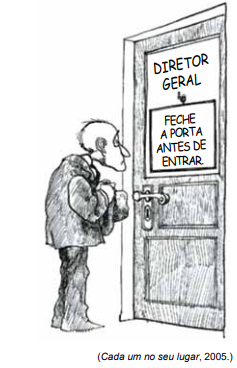
Contribui para o efeito de humor do cartum o recurso

 Conheça nossos planos