Foram encontradas 36.755 questões
Resolva questões gratuitamente!
Junte-se a mais de 4 milhões de concurseiros!


TEXTO 2
MINHA INFÂNCIA (trecho)
(Freudiana)
Cora Coralina
A rua... a rua!...
(Atração lúdica, anseio vivo da criança,
mundo sugestivo de maravilhosas descobertas)
- proibida às meninas do meu tempo.
Rígidos preconceitos familiares,
normas abusivas de educação
- emparedavam.
Na quietude sepulcral da casa,
era proibida, incomodava, a fala alta,
a risada franca, o grito espontâneo,
a turbulência ativa das crianças.
Contenção. motivação.Comportamento estreito,
limitando, estreitando exuberâncias,
pisando sensibilidades.
A gesta* dentro de mim...
Um mundo heroico, sublimado,
superposto, insuspeitado,
misturado à realidade.
*Gesta: composição poética que narra feitos memoráveis ou heroicos.
CORALINA, Cora.[coordenação, apresentação crítica e biografia Darcy França Denófrio].(Coleção melhores poemas). São Paulo: Global, 2004. (p. 95 a 100).
Cora Coralina (1889-1985), doutora honoris causa pela Universidade de Goiás, membro da Academia Goiana de Letras, recebeu, como poeta e ficcionista, o troféu Jabuti e o prêmio Juca Pato como intelectual do ano em 1984. Cora cursara somente o primário, mas poetara desde os 14 anos.
TELLES, Norma. Escritoras, escritas, escrituras. In: PRIORE, Mary
Del. (org.); PINSKY, Carla Bassanezi (coord. de textos). 10.ed. 6a.
reimpr. São Paulo: Contexto, 2018. p.408-409.
TEXTO 1
NOS ANOS 1940, MULHERES FORAM PRESAS POR JOGAR FUTEBOL NAS RUAS DE BELO HORIZONTE
Renan Damasceno /Estado de Minas

Página original do Diário da Tarde (Foto: Arquivo EM)
Em 1940, mulher jogando futebol em Belo Horizonte era caso de polícia. “Mulheres jogavam futebol à noite, no fim da linha de Lourdes”, chamava a atenção o Diário da Tarde de 20/4/1940. “O guarda prendeu as jogadoras e o seu treinador. Uma conseguiu escapar e trancar-se em casa”. O caso parece pitoresco, não fosse trágico, e revela um pouco sobre o preconceito dos primeiros registros de mulheres jogando futebol na capital mineira encontrados nos arquivos dos Diários Associados.
Disponível em: https://www.mg.superesportes.com.br/app/noticias/futebol/interior/ 2019/03/22/noticia_interior,574010/nos-anos-1940-mulheres-foram-presas-por-jogar-futebol-nas-ruas-de-bel.
shtml?fbclid=IwAR3S-N0oyIuAcC-U6vICoxuxSKonZYQ9p1 iMmDNHIqQvgPWDGB-Kb2_a__E?utm_
source=whatsapp&utm_medium=social
TEXTO 1
NOS ANOS 1940, MULHERES FORAM PRESAS POR JOGAR FUTEBOL NAS RUAS DE BELO HORIZONTE
Renan Damasceno /Estado de Minas
Página original do Diário da Tarde (Foto: Arquivo EM)
Em 1940, mulher jogando futebol em Belo Horizonte era caso de polícia. “Mulheres jogavam futebol à noite, no fim da linha de Lourdes”, chamava a atenção o Diário da Tarde de 20/4/1940. “O guarda prendeu as jogadoras e o seu treinador. Uma conseguiu escapar e trancar-se em casa”. O caso parece pitoresco, não fosse trágico, e revela um pouco sobre o preconceito dos primeiros registros de mulheres jogando futebol na capital mineira encontrados nos arquivos dos Diários Associados.
Disponível em: https://www.mg.superesportes.com.br/app/noticias/futebol/interior/ 2019/03/22/noticia_interior,574010/nos-anos-1940-mulheres-foram-presas-por-jogar-futebol-nas-ruas-de-bel.
shtml?fbclid=IwAR3S-N0oyIuAcC-U6vICoxuxSKonZYQ9p1 iMmDNHIqQvgPWDGB-Kb2_a__E?utm_
source=whatsapp&utm_medium=social
TEXTO 1
NOS ANOS 1940, MULHERES FORAM PRESAS POR JOGAR FUTEBOL NAS RUAS DE BELO HORIZONTE
Renan Damasceno /Estado de Minas
Página original do Diário da Tarde (Foto: Arquivo EM)
Em 1940, mulher jogando futebol em Belo Horizonte era caso de polícia. “Mulheres jogavam futebol à noite, no fim da linha de Lourdes”, chamava a atenção o Diário da Tarde de 20/4/1940. “O guarda prendeu as jogadoras e o seu treinador. Uma conseguiu escapar e trancar-se em casa”. O caso parece pitoresco, não fosse trágico, e revela um pouco sobre o preconceito dos primeiros registros de mulheres jogando futebol na capital mineira encontrados nos arquivos dos Diários Associados.
Disponível em: https://www.mg.superesportes.com.br/app/noticias/futebol/interior/ 2019/03/22/noticia_interior,574010/nos-anos-1940-mulheres-foram-presas-por-jogar-futebol-nas-ruas-de-bel.
shtml?fbclid=IwAR3S-N0oyIuAcC-U6vICoxuxSKonZYQ9p1 iMmDNHIqQvgPWDGB-Kb2_a__E?utm_
source=whatsapp&utm_medium=social
Fire Devastates Brazil's Oldest Science Museum
The overnight inferno likely claimed fossils, cultural artifacts, and more irreplaceable collections amassed over 200 years.
By Michael Greshko ______________________________________
PUBLISHED September 6, 2018
Major pieces of Brazil's scientific and cultural heritage went up in smoke on September 2, as a devastating fire ripped through much of Rio de Janeiro's Museu Nacional, or National Museum. Founded in 1818, the museum is Brazil's oldest scientific institution and one of the largest and most renowned museums in Latin America, amassing a collection of some 20 million scientifically and culturally invaluable artifacts.
The Museu Nacional's holdings include Luzia, an 11,500-year-old skull considered one of South America's oldest human fossils, as well as the bones of uniquely Brazilian creatures such as the long-necked dinosaur Maxakalisaurus. Because of the auction tastes of Brazil's 19th-century emperors, the Museu Nacional also ended up with Latin America's oldest collection of Egyptian mummies and artifacts.
Even the building holds historical importance: It housed the exiled Portuguese royal family from 1808 to 1821, after they fled to Rio de Janeiro in 1807 to escape Napoleon. The complex also served as the palace for Brazil's post-independence emperors until 1889, before the museum collections were transferred there in 1902. In an September 5 email, Museu Nacional curator Débora Pires wrote that the entomology and arachnology collections were completely destroyed, as was most of the mollusk collection. However, technicians had braved the fire to save 80 percent of the mollusk holotypes—the specimens that formally serve as the global references for a given species. The museum's vertebrate specimens, herbarium, and library were housed separately and survived the fire.
(…)
An Irreplaceable Loss
It's not yet clear how the fire started, but it did begin after the museum was closed to the public, and no injuries have yet been reported. Firefighters worked through the night to douse the burnt-out shell of the main building, but it seems the blaze has already seared a gaping hole in many scientists' careers.
“The importance of the collections that were lost couldn't be overstated,” says Luiz Rocha, a Brazilian ichthyologist now at the California Academy of Sciences who has visited the Museu Nacional several times to study its collections. “They were unique as it gets: Many of them were irreplaceable, there's no way to put a monetary value on it.”
“In terms of [my] life-long research agenda, I'm pretty much lost,” says Marcus Guidoti, a Brazilian entomologist finishing up his Ph.D. in a program co-run by Brazil's Federal University of Rio Grande do Sul.
Guidoti studies lace bugs, an insect family with more than 2,000 species worldwide. The Museu Nacional held one of the world's largest lace bug collections, but the fire likely destroyed it and the rest of the museum's five million arthropod specimens. “Those type specimens can't be replaced, and they are crucial to understand the species,” he says by text message. “If I was willing to keep working on this family in this region of the globe, this was definitely a big hit.”
Paleontologist Dimila Mothé, a postdoctoral researcher at the Federal University of the State of Rio de Janeiro, adds that the blows to science extend beyond the collections themselves. “It's not only the cultural history, the natural history, but all the theses and research developed there,” she says. “Most of the laboratories there were lost, too, and the research of several professors. I'm not sure you can say the impact of what was lost.”
Brazil’s indigenous knowledge also has suffered. The Museu Nacional housed world-renowned collections of indigenous objects, as well as many audio recordings of indigenous languages from all over Brazil. Some of these recordings, now lost, were of languages that are no longer spoken.
“I have no words to say how horrible this is,” says Brazilian anthropologist Mariana Françozo, an expert on South American indigenous objects at Leiden University. “The indigenous collections are a tremendous loss … we can no longer study them, we can no longer understand what our ancestors did. It’s heartbreaking.”
On Monday, The Brazilian publication G1 Rio reported that ashes of burned documents—some still flecked in notes or illustrations—have rained down from the sky more than a mile away from the Museu Nacional, thrown aloft by the inferno.
(…)
Editor's Note: This story was updated on September 6, 2018, with new details about which artifacts survived the fire.
Taken from:
https://www.nationalgeographic.com/science/2018/09/news-museu-nacional-fire-rio-de-janeiro-natural-history/. Access: 11 dez. 2018.
Fire Devastates Brazil's Oldest Science Museum
The overnight inferno likely claimed fossils, cultural artifacts, and more irreplaceable collections amassed over 200 years.
By Michael Greshko ______________________________________
PUBLISHED September 6, 2018
Major pieces of Brazil's scientific and cultural heritage went up in smoke on September 2, as a devastating fire ripped through much of Rio de Janeiro's Museu Nacional, or National Museum. Founded in 1818, the museum is Brazil's oldest scientific institution and one of the largest and most renowned museums in Latin America, amassing a collection of some 20 million scientifically and culturally invaluable artifacts.
The Museu Nacional's holdings include Luzia, an 11,500-year-old skull considered one of South America's oldest human fossils, as well as the bones of uniquely Brazilian creatures such as the long-necked dinosaur Maxakalisaurus. Because of the auction tastes of Brazil's 19th-century emperors, the Museu Nacional also ended up with Latin America's oldest collection of Egyptian mummies and artifacts.
Even the building holds historical importance: It housed the exiled Portuguese royal family from 1808 to 1821, after they fled to Rio de Janeiro in 1807 to escape Napoleon. The complex also served as the palace for Brazil's post-independence emperors until 1889, before the museum collections were transferred there in 1902. In an September 5 email, Museu Nacional curator Débora Pires wrote that the entomology and arachnology collections were completely destroyed, as was most of the mollusk collection. However, technicians had braved the fire to save 80 percent of the mollusk holotypes—the specimens that formally serve as the global references for a given species. The museum's vertebrate specimens, herbarium, and library were housed separately and survived the fire.
(…)
An Irreplaceable Loss
It's not yet clear how the fire started, but it did begin after the museum was closed to the public, and no injuries have yet been reported. Firefighters worked through the night to douse the burnt-out shell of the main building, but it seems the blaze has already seared a gaping hole in many scientists' careers.
“The importance of the collections that were lost couldn't be overstated,” says Luiz Rocha, a Brazilian ichthyologist now at the California Academy of Sciences who has visited the Museu Nacional several times to study its collections. “They were unique as it gets: Many of them were irreplaceable, there's no way to put a monetary value on it.”
“In terms of [my] life-long research agenda, I'm pretty much lost,” says Marcus Guidoti, a Brazilian entomologist finishing up his Ph.D. in a program co-run by Brazil's Federal University of Rio Grande do Sul.
Guidoti studies lace bugs, an insect family with more than 2,000 species worldwide. The Museu Nacional held one of the world's largest lace bug collections, but the fire likely destroyed it and the rest of the museum's five million arthropod specimens. “Those type specimens can't be replaced, and they are crucial to understand the species,” he says by text message. “If I was willing to keep working on this family in this region of the globe, this was definitely a big hit.”
Paleontologist Dimila Mothé, a postdoctoral researcher at the Federal University of the State of Rio de Janeiro, adds that the blows to science extend beyond the collections themselves. “It's not only the cultural history, the natural history, but all the theses and research developed there,” she says. “Most of the laboratories there were lost, too, and the research of several professors. I'm not sure you can say the impact of what was lost.”
Brazil’s indigenous knowledge also has suffered. The Museu Nacional housed world-renowned collections of indigenous objects, as well as many audio recordings of indigenous languages from all over Brazil. Some of these recordings, now lost, were of languages that are no longer spoken.
“I have no words to say how horrible this is,” says Brazilian anthropologist Mariana Françozo, an expert on South American indigenous objects at Leiden University. “The indigenous collections are a tremendous loss … we can no longer study them, we can no longer understand what our ancestors did. It’s heartbreaking.”
On Monday, The Brazilian publication G1 Rio reported that ashes of burned documents—some still flecked in notes or illustrations—have rained down from the sky more than a mile away from the Museu Nacional, thrown aloft by the inferno.
(…)
Editor's Note: This story was updated on September 6, 2018, with new details about which artifacts survived the fire.
Taken from:
https://www.nationalgeographic.com/science/2018/09/news-museu-nacional-fire-rio-de-janeiro-natural-history/. Access: 11 dez. 2018.
Fire Devastates Brazil's Oldest Science Museum
The overnight inferno likely claimed fossils, cultural artifacts, and more irreplaceable collections amassed over 200 years.
By Michael Greshko ______________________________________
PUBLISHED September 6, 2018
Major pieces of Brazil's scientific and cultural heritage went up in smoke on September 2, as a devastating fire ripped through much of Rio de Janeiro's Museu Nacional, or National Museum. Founded in 1818, the museum is Brazil's oldest scientific institution and one of the largest and most renowned museums in Latin America, amassing a collection of some 20 million scientifically and culturally invaluable artifacts.
The Museu Nacional's holdings include Luzia, an 11,500-year-old skull considered one of South America's oldest human fossils, as well as the bones of uniquely Brazilian creatures such as the long-necked dinosaur Maxakalisaurus. Because of the auction tastes of Brazil's 19th-century emperors, the Museu Nacional also ended up with Latin America's oldest collection of Egyptian mummies and artifacts.
Even the building holds historical importance: It housed the exiled Portuguese royal family from 1808 to 1821, after they fled to Rio de Janeiro in 1807 to escape Napoleon. The complex also served as the palace for Brazil's post-independence emperors until 1889, before the museum collections were transferred there in 1902. In an September 5 email, Museu Nacional curator Débora Pires wrote that the entomology and arachnology collections were completely destroyed, as was most of the mollusk collection. However, technicians had braved the fire to save 80 percent of the mollusk holotypes—the specimens that formally serve as the global references for a given species. The museum's vertebrate specimens, herbarium, and library were housed separately and survived the fire.
(…)
An Irreplaceable Loss
It's not yet clear how the fire started, but it did begin after the museum was closed to the public, and no injuries have yet been reported. Firefighters worked through the night to douse the burnt-out shell of the main building, but it seems the blaze has already seared a gaping hole in many scientists' careers.
“The importance of the collections that were lost couldn't be overstated,” says Luiz Rocha, a Brazilian ichthyologist now at the California Academy of Sciences who has visited the Museu Nacional several times to study its collections. “They were unique as it gets: Many of them were irreplaceable, there's no way to put a monetary value on it.”
“In terms of [my] life-long research agenda, I'm pretty much lost,” says Marcus Guidoti, a Brazilian entomologist finishing up his Ph.D. in a program co-run by Brazil's Federal University of Rio Grande do Sul.
Guidoti studies lace bugs, an insect family with more than 2,000 species worldwide. The Museu Nacional held one of the world's largest lace bug collections, but the fire likely destroyed it and the rest of the museum's five million arthropod specimens. “Those type specimens can't be replaced, and they are crucial to understand the species,” he says by text message. “If I was willing to keep working on this family in this region of the globe, this was definitely a big hit.”
Paleontologist Dimila Mothé, a postdoctoral researcher at the Federal University of the State of Rio de Janeiro, adds that the blows to science extend beyond the collections themselves. “It's not only the cultural history, the natural history, but all the theses and research developed there,” she says. “Most of the laboratories there were lost, too, and the research of several professors. I'm not sure you can say the impact of what was lost.”
Brazil’s indigenous knowledge also has suffered. The Museu Nacional housed world-renowned collections of indigenous objects, as well as many audio recordings of indigenous languages from all over Brazil. Some of these recordings, now lost, were of languages that are no longer spoken.
“I have no words to say how horrible this is,” says Brazilian anthropologist Mariana Françozo, an expert on South American indigenous objects at Leiden University. “The indigenous collections are a tremendous loss … we can no longer study them, we can no longer understand what our ancestors did. It’s heartbreaking.”
On Monday, The Brazilian publication G1 Rio reported that ashes of burned documents—some still flecked in notes or illustrations—have rained down from the sky more than a mile away from the Museu Nacional, thrown aloft by the inferno.
(…)
Editor's Note: This story was updated on September 6, 2018, with new details about which artifacts survived the fire.
Taken from:
https://www.nationalgeographic.com/science/2018/09/news-museu-nacional-fire-rio-de-janeiro-natural-history/. Access: 11 dez. 2018.
Fire Devastates Brazil's Oldest Science Museum
The overnight inferno likely claimed fossils, cultural artifacts, and more irreplaceable collections amassed over 200 years.
By Michael Greshko ______________________________________
PUBLISHED September 6, 2018
Major pieces of Brazil's scientific and cultural heritage went up in smoke on September 2, as a devastating fire ripped through much of Rio de Janeiro's Museu Nacional, or National Museum. Founded in 1818, the museum is Brazil's oldest scientific institution and one of the largest and most renowned museums in Latin America, amassing a collection of some 20 million scientifically and culturally invaluable artifacts.
The Museu Nacional's holdings include Luzia, an 11,500-year-old skull considered one of South America's oldest human fossils, as well as the bones of uniquely Brazilian creatures such as the long-necked dinosaur Maxakalisaurus. Because of the auction tastes of Brazil's 19th-century emperors, the Museu Nacional also ended up with Latin America's oldest collection of Egyptian mummies and artifacts.
Even the building holds historical importance: It housed the exiled Portuguese royal family from 1808 to 1821, after they fled to Rio de Janeiro in 1807 to escape Napoleon. The complex also served as the palace for Brazil's post-independence emperors until 1889, before the museum collections were transferred there in 1902. In an September 5 email, Museu Nacional curator Débora Pires wrote that the entomology and arachnology collections were completely destroyed, as was most of the mollusk collection. However, technicians had braved the fire to save 80 percent of the mollusk holotypes—the specimens that formally serve as the global references for a given species. The museum's vertebrate specimens, herbarium, and library were housed separately and survived the fire.
(…)
An Irreplaceable Loss
It's not yet clear how the fire started, but it did begin after the museum was closed to the public, and no injuries have yet been reported. Firefighters worked through the night to douse the burnt-out shell of the main building, but it seems the blaze has already seared a gaping hole in many scientists' careers.
“The importance of the collections that were lost couldn't be overstated,” says Luiz Rocha, a Brazilian ichthyologist now at the California Academy of Sciences who has visited the Museu Nacional several times to study its collections. “They were unique as it gets: Many of them were irreplaceable, there's no way to put a monetary value on it.”
“In terms of [my] life-long research agenda, I'm pretty much lost,” says Marcus Guidoti, a Brazilian entomologist finishing up his Ph.D. in a program co-run by Brazil's Federal University of Rio Grande do Sul.
Guidoti studies lace bugs, an insect family with more than 2,000 species worldwide. The Museu Nacional held one of the world's largest lace bug collections, but the fire likely destroyed it and the rest of the museum's five million arthropod specimens. “Those type specimens can't be replaced, and they are crucial to understand the species,” he says by text message. “If I was willing to keep working on this family in this region of the globe, this was definitely a big hit.”
Paleontologist Dimila Mothé, a postdoctoral researcher at the Federal University of the State of Rio de Janeiro, adds that the blows to science extend beyond the collections themselves. “It's not only the cultural history, the natural history, but all the theses and research developed there,” she says. “Most of the laboratories there were lost, too, and the research of several professors. I'm not sure you can say the impact of what was lost.”
Brazil’s indigenous knowledge also has suffered. The Museu Nacional housed world-renowned collections of indigenous objects, as well as many audio recordings of indigenous languages from all over Brazil. Some of these recordings, now lost, were of languages that are no longer spoken.
“I have no words to say how horrible this is,” says Brazilian anthropologist Mariana Françozo, an expert on South American indigenous objects at Leiden University. “The indigenous collections are a tremendous loss … we can no longer study them, we can no longer understand what our ancestors did. It’s heartbreaking.”
On Monday, The Brazilian publication G1 Rio reported that ashes of burned documents—some still flecked in notes or illustrations—have rained down from the sky more than a mile away from the Museu Nacional, thrown aloft by the inferno.
(…)
Editor's Note: This story was updated on September 6, 2018, with new details about which artifacts survived the fire.
Taken from:
https://www.nationalgeographic.com/science/2018/09/news-museu-nacional-fire-rio-de-janeiro-natural-history/. Access: 11 dez. 2018.
Fire Devastates Brazil's Oldest Science Museum
The overnight inferno likely claimed fossils, cultural artifacts, and more irreplaceable collections amassed over 200 years.
By Michael Greshko ______________________________________
PUBLISHED September 6, 2018
Major pieces of Brazil's scientific and cultural heritage went up in smoke on September 2, as a devastating fire ripped through much of Rio de Janeiro's Museu Nacional, or National Museum. Founded in 1818, the museum is Brazil's oldest scientific institution and one of the largest and most renowned museums in Latin America, amassing a collection of some 20 million scientifically and culturally invaluable artifacts.
The Museu Nacional's holdings include Luzia, an 11,500-year-old skull considered one of South America's oldest human fossils, as well as the bones of uniquely Brazilian creatures such as the long-necked dinosaur Maxakalisaurus. Because of the auction tastes of Brazil's 19th-century emperors, the Museu Nacional also ended up with Latin America's oldest collection of Egyptian mummies and artifacts.
Even the building holds historical importance: It housed the exiled Portuguese royal family from 1808 to 1821, after they fled to Rio de Janeiro in 1807 to escape Napoleon. The complex also served as the palace for Brazil's post-independence emperors until 1889, before the museum collections were transferred there in 1902. In an September 5 email, Museu Nacional curator Débora Pires wrote that the entomology and arachnology collections were completely destroyed, as was most of the mollusk collection. However, technicians had braved the fire to save 80 percent of the mollusk holotypes—the specimens that formally serve as the global references for a given species. The museum's vertebrate specimens, herbarium, and library were housed separately and survived the fire.
(…)
An Irreplaceable Loss
It's not yet clear how the fire started, but it did begin after the museum was closed to the public, and no injuries have yet been reported. Firefighters worked through the night to douse the burnt-out shell of the main building, but it seems the blaze has already seared a gaping hole in many scientists' careers.
“The importance of the collections that were lost couldn't be overstated,” says Luiz Rocha, a Brazilian ichthyologist now at the California Academy of Sciences who has visited the Museu Nacional several times to study its collections. “They were unique as it gets: Many of them were irreplaceable, there's no way to put a monetary value on it.”
“In terms of [my] life-long research agenda, I'm pretty much lost,” says Marcus Guidoti, a Brazilian entomologist finishing up his Ph.D. in a program co-run by Brazil's Federal University of Rio Grande do Sul.
Guidoti studies lace bugs, an insect family with more than 2,000 species worldwide. The Museu Nacional held one of the world's largest lace bug collections, but the fire likely destroyed it and the rest of the museum's five million arthropod specimens. “Those type specimens can't be replaced, and they are crucial to understand the species,” he says by text message. “If I was willing to keep working on this family in this region of the globe, this was definitely a big hit.”
Paleontologist Dimila Mothé, a postdoctoral researcher at the Federal University of the State of Rio de Janeiro, adds that the blows to science extend beyond the collections themselves. “It's not only the cultural history, the natural history, but all the theses and research developed there,” she says. “Most of the laboratories there were lost, too, and the research of several professors. I'm not sure you can say the impact of what was lost.”
Brazil’s indigenous knowledge also has suffered. The Museu Nacional housed world-renowned collections of indigenous objects, as well as many audio recordings of indigenous languages from all over Brazil. Some of these recordings, now lost, were of languages that are no longer spoken.
“I have no words to say how horrible this is,” says Brazilian anthropologist Mariana Françozo, an expert on South American indigenous objects at Leiden University. “The indigenous collections are a tremendous loss … we can no longer study them, we can no longer understand what our ancestors did. It’s heartbreaking.”
On Monday, The Brazilian publication G1 Rio reported that ashes of burned documents—some still flecked in notes or illustrations—have rained down from the sky more than a mile away from the Museu Nacional, thrown aloft by the inferno.
(…)
Editor's Note: This story was updated on September 6, 2018, with new details about which artifacts survived the fire.
Taken from:
https://www.nationalgeographic.com/science/2018/09/news-museu-nacional-fire-rio-de-janeiro-natural-history/. Access: 11 dez. 2018.
Leia o fragmento a seguir:
“A revolta já tinha mais de quatro meses de vida e as vantagens do governo eram problemáticas. No Sul, a insurreição chegava às portas de São Paulo, e só a Lapa resistia tenazmente, uma das poucas páginas dignas e limpas de todo aquele enxurro de paixões. A pequena cidade tinha dentro de suas trincheiras o Coronel Gomes Carneiro, uma energia, uma vontade, verdadeiramente isso, porque era sereno, confiante e soube tornar verdade a gasta frase grandiloquente: resistir até a morte.
A ilha do Governador tinha sido ocupada e Magé tomado; os revoltosos, porém, tinham a vasta baía e a barra apertada, por onde saíam e entravam, sem temer o estorvo das fortalezas.
As violências, os crimes que tinham assinalado esses dois marcos de atividade guerreira do governo, chegavam ao ouvido de Quaresma e ele sofria.
Da ilha do Governador fez-se uma verdadeira mudança de móveis, roupas e outros haveres. O que não podia ser transplantado era destruído pelo fogo e pelo machado.
A ocupação deixou lá a mais execranda memória e até hoje os seus habitantes ainda se recordam dolorosamente de um capitão, patriótico ou da guarda nacional, Ortiz, pela sua ferocidade e insofrido gosto pelo saque e outras vexações”.
Fonte: BARRETO, Lima. Triste fim de Policarpo Quaresma. Rio de Janeiro. Bestbolso. 2013. p. 211.
O trecho expressa elementos que fazem parte das diferentes formas de produção e organização do espaço brasileiro ao longo de sua construção histórica e humana. A partir de uma perspectiva da geografia humana, é CORRETO afirmar que o trecho ressalta a Revolta da
Leia o fragmento a seguir:
“[Esse grupo é formado por] países emergentes de grande expressão populacional e territorial, que, por apresentarem grande crescimento econômico e recursos produtivos, passaram a participar com maior intensidade da dinâmica global [especialmente, na primeira década do século XXI]. (...). Esse grupo já demonstrou que tem força econômica capaz de impor seus interesses no cenário global [pois] dispõem de consideráveis recursos econômicos, humanos e naturais e têm obtido maior protagonismo político diante de organismos internacionais, como o FMI e o Banco Mundial. [Visando ampliar a cooperação entre seus membros foi criado um banco de reservas emergenciais para socorro econômico entre os participantes, se necessário] ”.
Fonte: BALDRAIS, André. Ser protagonista – geografia. São Paulo. Edições SM. 2016. p. 115. Adaptado.
O trecho descreve o grupo, cuja sigla é:
Leia o fragmento a seguir:
“[Essa] é uma fonte de energia limpa, simples de ser obtida e que pode solucionar também parte do problema da quantidade de lixo que é descartado. Trata-se de uma mistura gasosa de metano e dióxido de carbono a partir da decomposição de restos orgânicos. Uma das formas de acelerar esse processo biológico é por meio de uso de biodigestores”.
Fonte: BALDRAIS, André. Ser protagonista – geografia. São Paulo. Edições SM. 2016. p. 66.
O trecho se refere a um tipo de energia alternativa denominada:
Sabemos que ao longo de bilhões de anos, a Terra passou por diferentes transformações que vão desde o resfriamento e solidificação das camadas até os resultados das transformações antrópicas.
Nesse contexto, assinale V para as afirmativas verdadeiras e F para as falsas.
( ) A Era Pré-Cambriana caracterizou-se pela inexistência da vida no planeta e pela constituição das primeiras rochas magmáticas.
( ) A Era Paleozoica caracterizou-se pela formação das grandes cadeias de montanha, tais como os Andes e os Alpes.
( ) A Era Mesozoica foi marcada pela fragmentação do continente Gondwana, que resultou na formação dos continentes africano e sul-americano e do oceano Atlântico.
( ) A Era Cenozoica foi marcada pelo grande soterramento de florestas em diversas partes do globo, que resultou na formação da jazidas de carvão mineral.
Assinale a alternativa que apresenta a sequência CORRETA:
Leia o fragmento a seguir:
“Consiste na continuidade da área continental emersa e pode atingir uma profundidade de cerca de 200m. Caracteriza-se por ser uma planície submersa que margeia todos os continentes, em uma extensão que varia de 70 a 1000km”.
Fonte: MARTINS, DADA et. al. Geografia no cotidiano: ensino médio. Curitiba. Base Editorial. 2016. p. 118.
O fragmento se refere à forma de relevo submarino, cujo nome é:
O Reino Animal, Animalia ou Metazoa é constituído por espécimes heterótrofos que necessitam ingerir ou absorver moléculas orgânicas pré-formadas de outros seres vivos para aquisição de energia e síntese das moléculas de que precisam. Os seres que pertencem ao Reino Animal são eucariontes e pluricelulares. Eles possuem capacidade de locomoção e de reprodução sexuada. Os animais vertebrados (que possuem vértebras) e os animais invertebrados (que não possuem vértebras) são classificados em diversos filos.
Sobre os animais invertebrados e os vertebrados, analise as afirmativas a seguir:
I- Nos artrópodes e na maioria dos moluscos, o sistema circulatório é aberto (lacunar), ou seja, o líquido bombeado pelo coração periodicamente abandona os vasos e cai em lacunas corporais.
II- Nos artrópodes e na maioria dos insetos, a respiração é traqueal; nos aracnídeos, além da traqueal, também é observada a filotraqueal; e os crustáceos em geral respiram por brânquias.
III- Nos anelídeos e nos vertebrados, o sistema circulatório é fechado, o sangue circula por uma grande rede de vasos pelos quais ocorrem as trocas de substâncias entre o sangue e os tecidos.
IV- Nos vertebrados, o sistema respiratório pode ser pulmonar ou branquial, ou seja, os processos de trocas gasosas ocorrem nos pulmões ou nas brânquias.
Estão CORRETAS as afirmativas:
Os vegetais multicelulares são formados por um grupamento de células diferenciadas que exercem uma mesma função. Esses conjuntos celulares são designados como tecidos e a divisão da Biologia que os estuda é denominada de Histologia.
Nesses tecidos, existem células que possuem celulose em sua parede celular, vacúolos e cloroplastos em seu interior.
Assinale a alternativa que apresenta o tecido vegetal formado por células mortas, alongadas e de parede celular lignificada.
Há mais de 100 anos, em 1904, aconteceu a primeira campanha de vacinação em massa feita no Brasil. Idealizada por Oswaldo Cruz, o fundador da saúde pública no país, a campanha tinha o objetivo de controlar a varíola, que então dizimava boa parte da população do Rio de Janeiro. Porém, as ações de imunização eram caracterizadas pela descontinuidade e pela baixa área de cobertura.
Atualmente, são oferecidas à população brasileira 19 vacinas recomendadas pela Organização Mundial da Saúde (OMS). São mais de 300 milhões de doses, por ano, todas adquiridas pelo Ministério da Saúde e distribuídas aos estados e municípios visando à imunização de crianças, adolescentes, adultos e idosos.
Disponível em: http://www.blog.saude.gov.br/index.php/promocao-da-saude/ Acesso: 11 dez. 2018 (Fragmento: Adaptado).
Os cientistas estão em constante pesquisa para desenvolverem vacinas para a imunização da população humana contra diversos agentes causadores que podem ser vírus, bactérias, protozoários, fungos e outros.
Relacione os agentes causadores enumerados na COLUNA I com as doenças apresentados na COLUNA II:
COLUNA I
1- Protozoários.
2- Fungos.
3- Bactérias.
4- Vírus.
COLUNA II
( ) Tracoma.
( ) Hidrófobia.
( ) Hanseníase.
( ) Histoplasmose.
( ) Toxoplasmose.
( ) Caxumba .
Assinale a alternativa que apresenta a sequência
CORRETA:
As populações possuem diversas características próprias, mensuráveis.
Cada membro de uma população pode nascer, crescer e morrer, mas somente uma população como um todo possui taxas de natalidade e de crescimento específicas, além de possuir um padrão de dispersão no tempo e no espaço.
O tamanho de uma população pode ser avaliado pela sua densidade.
A densidade populacional pode sofrer alterações. Mantendo-se fixa a área de distribuição, a população pode aumentar devido a nascimentos e imigrações. A diminuição da densidade pode ocorrer como consequência de mortes ou de emigrações.
Disponível em: https://www.sobiologia.com.br/conteudos/bio_ecologia/ecologia16. php Acesso: 11 de dez. 2018.
O gráfico a seguir representa a curva de crescimento de uma população a partir de um pequeno número de indivíduos:
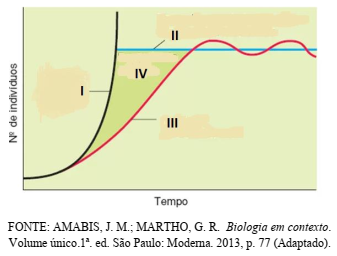
Sobre o gráfico, é INCORRETO afirmar que:
 Conheça nossos planos