A expressão “such as”, no trecho do segundo parágrafo “such ...
Próximas questões
Com base no mesmo assunto
Q4149990
Inglês
Texto associado
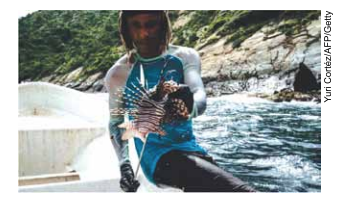
Aarav Chavda has been diving off the coast of Florida
for years. Each time he became increasingly depressed by
the ever-growing empty spaces, as colourful species of fish
and coral reefs continued to disappear. A significant reason
for that disappearance is the lionfish, an invasive species that
has boomed in Atlantic waters from Florida to the Caribbean
in recent decades, and in numerous other places from Brazil
and Mexico to the Mediterranean.
Lionfish have no natural predators outside their native
range — in the Indian and Pacific Oceans and the Red Sea —
and are all-consuming, devouring an estimated 79% of young
marine life within five weeks of entering a coral reef system.
“You can see the impacts on the reefs when you dive now
— it’s less vibrant, it’s less noisy,” Chavda said. “We know
there are solutions for some of the problems — such as coral-
-friendly sunscreens to help protect the reefs — but nobody’s
been able to do anything about the lionfish.”
So Chavda and a team of ecologically aware fellow
scuba enthusiasts decided to act by establishing a company
called Inversa, which turns lionfish into a new product: fish
leather. Chavda, 27, and his childhood friend from Texas,
Roland Salatino, set up the Florida-based company to make
the leather. They process the fish hides1
by tanning them
with drying agents and dye them before selling the leather to
partner companies to fashion into high-end products including
wallets, belts and handbags. Fish skin is thin but, because
the fibre structure runs crossways, it is stronger than many
other types of leather. Each hide, Chavda says, can save up
to 70,000 native reef fish.
The hides are also more sustainable than traditional
animal leathers, which generally require grazing on huge
amounts of pasture — degrading soils and producing high
carbon emissions. Inversa does not hunt the lionfish itself.
Instead, it relies on educating and encouraging largely poor
fishermen and women in often remote places to catch them.
“We’re really sort of empowering the consumer and fashion
by doing something for the planet — then we empower dive
communities in fishing cooperatives to do something for
themselves,” Chavda said.
(Richard Luscombe. www.theguardian.com, 12.06.2022. Adaptado.)
1
hide: an animal’s skin used to make leather
A expressão “such as”, no trecho do segundo parágrafo “such
as coral-friendly sunscreens”, foi utilizada para introduzir
 Conheça nossos planos