O texto informa que, de acordo com Paul Breslin, a interpre...
Próximas questões
Com base no mesmo assunto
Ano: 2025
Banca:
FUVEST
Órgão:
FUVEST
Prova:
FUVEST - 2025 - FUVEST - Vestibular - 1ª Fase - Conhecimentos Gerais |
Q3946321
Inglês
Texto associado
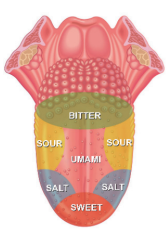
Think for a minute about the
little bumps on your tongue. You
probably saw a diagram of those
taste bud arrangements once in
a biology textbook — sweet
sensors at the tip, salty on either
side, sour behind them, bitter in
the back.
But the idea that specific
tastes are confined to certain
areas of the tongue is a myth that
“persists in the collective
consciousness, despite decades
of research debunking it”,
according to a review published this month in The New
England Journal of Medicine. Also wrong: the notion that taste
is limited to the mouth.
The old diagram, which has been used in many textbooks
over the years, originated in a study published by David Hanig,
a German scientist, in 1901. But the scientist was not
suggesting that various tastes are segregated on the tongue.
He was actually measuring the sensitivity of different areas,
said Paul Breslin, a researcher at Monell Chemical Senses
Center in Philadelphia. “What he found was that you could
detect things at a lower concentration in one part relative to
another,” Dr. Breslin said. The tip of the tongue, for example, is
dense with sweet sensors but contains the others as well.
The map’s mistakes are easy to confirm. If you place a
lemon wedge at the tip of your tongue, it will taste sour, and if
you put a bit of honey toward the side, it will be sweet.
The perception of taste is a remarkably complex process,
starting from that first encounter with the tongue. Taste cells
have a variety of sensors that signal the brain when they
encounter nutrients or toxins. For some tastes, tiny pores in cell
membranes let taste chemicals in.
Such taste receptors aren’t limited to the tongue; they are
also found in the gastrointestinal tract, liver, pancreas, fat cells,
brain, muscle cells, thyroid and lungs. We don’t generally think
of these organs as tasting anything, but they use the receptors
to pick up the presence of various molecules and metabolize
them, said Diego Bohórquez, a self-described gut-brain
neuroscientist at Duke University. For example, when the gut
notices sugar in food, it tells the brain to alert other organs to
get ready for digestion.
New York Times. May 29, 2024. Adaptado.
O texto informa que, de acordo com Paul Breslin, a
interpretação do estudo de Hanig foi equivocada, porque
 Conheça nossos planos