Questões de Vestibular UNIFIPA 2025 para Vestibular Medicina - Conhecimentos Gerais
Foram encontradas 86 questões


Ano: 2025
Banca:
VUNESP
Órgão:
UNIFIPA
Prova:
VUNESP - 2025 - UNIFIPA - Vestibular Medicina - Conhecimentos Gerais |
Q3966810
Inglês
Texto associado
Leia o texto para responder à questão.
Admixture’s impact on Brazilian population
evolution and health
Brazil is a vast continental country home to the largest
population in Latin America and boasts the world’s largest
recently admixed population1
. The colonization process
brought approximately 5 million Europeans to Brazil,
alongside the forced migration of at least 5 million Africans
and the decimation of Indigenous populations, which once
included more than 10 million people speaking more than
1000 languages. This distinctive historical interplay shaped
a complex mosaic of genetic diversity, underscoring the
importance of detailed genomic studies. Nevertheless,
similar to other populations in the Global South2
, the Brazilian
population remains notably underrepresented in genomic
research, where there is a lack of studies investigating the
effects of this population’s admixture on its evolution, diversity,
and health status.
To address these gaps, a research group generated
2723 high-coverage whole-genome sequences of the
Brazilian population, encompassing urban, rural, and riverine
communities from all five geographical regions of Brazil.
This dataset reflects a diverse group of ethnic backgrounds,
including Afro-Brazilians and descendants of Indigenous
people, and provides a comprehensive representation of
Brazilian genomic diversity.
(Kelly Nunes et al. www.science.org, 15.05.2025. Adaptado.)
1admixed population: group of individuals formed through interbreeding
of two or more previously isolated populations.
2Global South: a group of countries mainly located in the Southern
Hemisphere that are often characterized as developing, less developed
or underdeveloped.
No trecho do segundo parágrafo “To address these
gaps, a research group generated 2 723 high-coverage
whole-genome sequences”, a expressão sublinhada
refere-se, no contexto,
Ano: 2025
Banca:
VUNESP
Órgão:
UNIFIPA
Prova:
VUNESP - 2025 - UNIFIPA - Vestibular Medicina - Conhecimentos Gerais |
Q3966811
Inglês
Texto associado
Leia o texto para responder à questão.
Admixture’s impact on Brazilian population
evolution and health
Brazil is a vast continental country home to the largest
population in Latin America and boasts the world’s largest
recently admixed population1
. The colonization process
brought approximately 5 million Europeans to Brazil,
alongside the forced migration of at least 5 million Africans
and the decimation of Indigenous populations, which once
included more than 10 million people speaking more than
1000 languages. This distinctive historical interplay shaped
a complex mosaic of genetic diversity, underscoring the
importance of detailed genomic studies. Nevertheless,
similar to other populations in the Global South2
, the Brazilian
population remains notably underrepresented in genomic
research, where there is a lack of studies investigating the
effects of this population’s admixture on its evolution, diversity,
and health status.
To address these gaps, a research group generated
2723 high-coverage whole-genome sequences of the
Brazilian population, encompassing urban, rural, and riverine
communities from all five geographical regions of Brazil.
This dataset reflects a diverse group of ethnic backgrounds,
including Afro-Brazilians and descendants of Indigenous
people, and provides a comprehensive representation of
Brazilian genomic diversity.
(Kelly Nunes et al. www.science.org, 15.05.2025. Adaptado.)
1admixed population: group of individuals formed through interbreeding
of two or more previously isolated populations.
2Global South: a group of countries mainly located in the Southern
Hemisphere that are often characterized as developing, less developed
or underdeveloped.
According to the second paragraph, as a result of the study,
the researchers managed to supply
Ano: 2025
Banca:
VUNESP
Órgão:
UNIFIPA
Prova:
VUNESP - 2025 - UNIFIPA - Vestibular Medicina - Conhecimentos Gerais |
Q3966812
Inglês
Texto associado
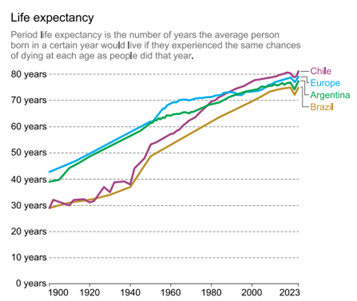
Leia o texto e analise o gráfico para responder à questão.
Life Expectancy (1900-2023)
People are living longer. In 1900, the average life
expectancy of a newborn was 32 years. By 2021 this had
more than doubled to 71 years.
The large reduction in child mortality has played
an important role in increasing life expectancy. But life
expectancy has increased at all ages. Infants, children,
adults, and the elderly are all less likely to die than in the
past, and death is being delayed. This remarkable shift
results from advances in medicine, public health, and living
standards. Along with it, many predictions of the “limit” of life
expectancy have been broken.
(Saloni Dattani et al. https://ourworldindata.org, 2023. Adaptado.)
O trecho do texto que pode ser confirmado no gráfico é:
Ano: 2025
Banca:
VUNESP
Órgão:
UNIFIPA
Prova:
VUNESP - 2025 - UNIFIPA - Vestibular Medicina - Conhecimentos Gerais |
Q3966813
Inglês
Texto associado
Leia o texto e analise o gráfico para responder à questão.
Life Expectancy (1900-2023)
People are living longer. In 1900, the average life
expectancy of a newborn was 32 years. By 2021 this had
more than doubled to 71 years.
The large reduction in child mortality has played
an important role in increasing life expectancy. But life
expectancy has increased at all ages. Infants, children,
adults, and the elderly are all less likely to die than in the
past, and death is being delayed. This remarkable shift
results from advances in medicine, public health, and living
standards. Along with it, many predictions of the “limit” of life
expectancy have been broken.
(Saloni Dattani et al. https://ourworldindata.org, 2023. Adaptado.)
According to the chart,
Ano: 2025
Banca:
VUNESP
Órgão:
UNIFIPA
Prova:
VUNESP - 2025 - UNIFIPA - Vestibular Medicina - Conhecimentos Gerais |
Q3966814
Inglês
Texto associado
Leia o texto e analise o gráfico para responder à questão.
Life Expectancy (1900-2023)
People are living longer. In 1900, the average life
expectancy of a newborn was 32 years. By 2021 this had
more than doubled to 71 years.
The large reduction in child mortality has played
an important role in increasing life expectancy. But life
expectancy has increased at all ages. Infants, children,
adults, and the elderly are all less likely to die than in the
past, and death is being delayed. This remarkable shift
results from advances in medicine, public health, and living
standards. Along with it, many predictions of the “limit” of life
expectancy have been broken.
(Saloni Dattani et al. https://ourworldindata.org, 2023. Adaptado.)
No trecho do segundo parágrafo “Infants, children, adults,
and the elderly are all less likely to die than in the past”, o
termo sublinhado equivale, em português, a:
Ano: 2025
Banca:
VUNESP
Órgão:
UNIFIPA
Prova:
VUNESP - 2025 - UNIFIPA - Vestibular Medicina - Conhecimentos Gerais |
Q3966815
Inglês
Texto associado
Leia o texto e analise o gráfico para responder à questão.
Life Expectancy (1900-2023)
People are living longer. In 1900, the average life
expectancy of a newborn was 32 years. By 2021 this had
more than doubled to 71 years.
The large reduction in child mortality has played
an important role in increasing life expectancy. But life
expectancy has increased at all ages. Infants, children,
adults, and the elderly are all less likely to die than in the
past, and death is being delayed. This remarkable shift
results from advances in medicine, public health, and living
standards. Along with it, many predictions of the “limit” of life
expectancy have been broken.
(Saloni Dattani et al. https://ourworldindata.org, 2023. Adaptado.)
In the excerpt from the second paragraph, “Along with it,
many predictions of the ‘limit’ of life expectancy have been
broken”, the underlined expression can be replaced, without
meaning change, by:

 Conheça nossos planos