Questões de Vestibular
Comentadas sobre vocabulário | vocabulary em inglês
Foram encontradas 225 questões


Why so few nurses are men

Ask health professionals in any country what the biggest problem in their health-care system is and one of the most common answers is the shortage of nurses. In ageing rich countries, demand for nursing care is becoming increasingly insatiable. Britain’s National Health Service, for example, has 40,000-odd nurse vacancies. Poor countries struggle with the emigration of nurses for greener pastures. One obvious solution seems neglected: recruit more men. Typically, just 5-10% of nurses registered in a given country are men. Why so few?
Views of nursing as a “woman’s job” have deep roots. Florence Nightingale, who established the principles of modern nursing in the 1860s, insisted that men’s “hard and horny” hands were “not fitted to touch, bathe and dress wounded limbs”. In Britain the Royal College of Nursing, the profession’s union, did not even admit men as members until 1960. Some nursing schools in America started admitting men only in 1982, after a Supreme Court ruling forced them to. Senior nurse titles such as “sister” (a ward manager) and “matron” (which in some countries is used for men as well) do not help matters. Unsurprisingly, some older people do not even know that men can be nurses too. Male nurses often encounter patients who assume they are doctors.
Another problem is that beliefs about what a nursing job entails are often outdated – in ways that may be particularly off-putting for men. In films, nurses are commonly portrayed as the helpers of heroic male doctors. In fact, nurses do most of their work independently and are the first responders to patients in crisis. To dispel myths, nurse-recruitment campaigns display nursing as a professional job with career progression, specialisms like anaesthetics, cardiology or emergency care, and use for skills related to technology, innovation and leadership. However, attracting men without playing to gender stereotypes can be tricky. “Are you man enough to be a nurse?”, the slogan of an American campaign, was involved in controversy.
Nursing is not a career many boys aspire to, or are encouraged to consider. Only two-fifths of British parents say they would be proud if their son became a nurse. Because of all this, men who go into nursing are usually already closely familiar with the job. Some are following in the career footsteps of their mothers. Others decide that the job would suit them after they see a male nurse care for a relative or they themselves get care from a male nurse when hospitalised. Although many gender stereotypes about jobs and caring have crumbled, nursing has, so far, remained unaffected.
(www.economist.com, 22.08.2018. Adaptado.)
Words that define the presente
At a time when the world is changing more quickly than ever before, we need a new vocabulary to help us grasp what’s happening.

Catfishing. This word would make more sense if it referred to fishing for cats, but in fact, it refers to people who construct false identities online. Whether out of boredom, loneliness or malice, they lure other people into continued messaging correspondence, thereby building false relationships with them (the apparent source of the term “catfish” is a 2010 documentary called Catfish, whose verity, ironically enough, has been questioned).
There are two ways of looking at this: 1) The internet/ cyberspace is wonderful, because it gives people the freedom to augment or totally change their identities, and this is a marvellous new dawn for human expression, a new step in human evolution. 2) Nah, it’s a false dawn, because the internet is essentially a libertarian arena, and, as such, an amoral one (lots of “freedoms” but with no attendant social obligations); it is a new jungle where we must watch our backs and struggle for survival, surely a backward step in evolution. I lean toward the latter.
(Cameron Laux. www.bbc.com, 08.08.2018. Adaptado.)
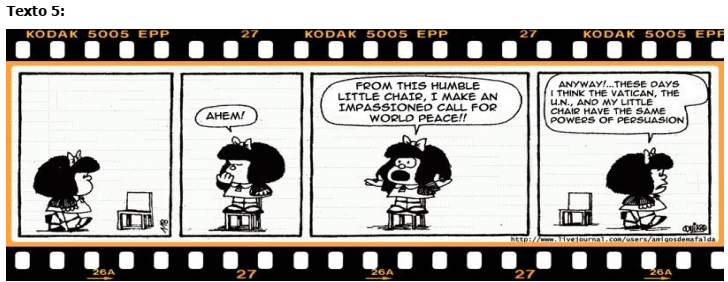
Mafalda, personagem famosa por seu pensamento crítico, discute um tema de grande importância para o mundo.
Aponte a alternativa que melhor explica o contido na tirinha lida.
Texto 1:
Accountant Job Application Cover Letter
To,
Bonn, Joseph
Regional Director
All Digital
102, Lake avenue
Torres, Paulo
Dated: 5th of May 2018 Subject: Application for the position of an accountant
Respected Mr. Bonn
This letter is in regards to the job advertisement posted by your organization in MMO magazine concerning to the requirement of a candidate in the position of an accountant for which I am interested and I would like to apply for. I have worked in similar position for five years and my last job was with Aspen Group where I used to prepare accounting statements for the organization, ensuring that balance sheet was tallied, compiling financial information and implementing accounting control procedures. I also had to ensure that accuracy is maintained in all statements and documents and solve any existing accounting discrepancy. I have excellent calculative skills and an eye for detail besides being good at preparing reports and statements. I can assure that my previous work experience is going to benefit your organization.
It would be great if we could meet for an interview round. My resume is enclosed.
Regards, Nataniel Lucas Disponível em https://www.dayjob.com/content/ accountant-cover-letter-example-350.htm. Acessado em 22/10/2018 (adaptado)
O gênero Carta é ainda um meio de comunicação muito usado, sobretudo no mundo do trabalho. Assim, leia a carta de
Nataniel Lucas e identifique o tipo de carta e sua finalidade:
Leia o texto para responder às questões
Prescriptions for fighting epidemics

Epidemics have plagued humanity since the dawn of
settled life. Yet, success in conquering them remains patchy.
Experts predict that a global one that could kill more than 300
million people would come round in the next 20 to 40 years.
What pathogen would cause it is anybody’s guess. Chances
are that it will be a virus that lurks in birds or mammals, or
one that that has not yet hatched. The scariest are both highly
lethal and spread easily among humans. Thankfully, bugs that
excel at the first tend to be weak at the other. But mutations
– ordinary business for germs – can change that in a blink.
Moreover, when humans get too close to beasts, either
wild or packed in farms, an animal disease can become a
human one.
A front-runner for global pandemics is the seasonal
influenza virus, which mutates so much that a vaccine must
be custom-made every year. The Spanish flu pandemic of
1918, which killed 50 million to 100 million people, was a
potent version of the “swine flu” that emerged in 2009. The
H5N1 “avian flu” strain, deadly in 60% of cases, came about
in the 1990s when a virus that sickened birds made the jump
to a human. Ebola, HIV and Zika took a similar route.
(www.economist.com, 08.02.2018. Adaptado.)
Leia o texto para responder às questões
Prescriptions for fighting epidemics
Epidemics have plagued humanity since the dawn of
settled life. Yet, success in conquering them remains patchy.
Experts predict that a global one that could kill more than 300
million people would come round in the next 20 to 40 years.
What pathogen would cause it is anybody’s guess. Chances
are that it will be a virus that lurks in birds or mammals, or
one that that has not yet hatched. The scariest are both highly
lethal and spread easily among humans. Thankfully, bugs that
excel at the first tend to be weak at the other. But mutations
– ordinary business for germs – can change that in a blink.
Moreover, when humans get too close to beasts, either
wild or packed in farms, an animal disease can become a
human one.
A front-runner for global pandemics is the seasonal
influenza virus, which mutates so much that a vaccine must
be custom-made every year. The Spanish flu pandemic of
1918, which killed 50 million to 100 million people, was a
potent version of the “swine flu” that emerged in 2009. The
H5N1 “avian flu” strain, deadly in 60% of cases, came about
in the 1990s when a virus that sickened birds made the jump
to a human. Ebola, HIV and Zika took a similar route.
(www.economist.com, 08.02.2018. Adaptado.)
Leia o texto para responder às questões
Prescriptions for fighting epidemics
Epidemics have plagued humanity since the dawn of
settled life. Yet, success in conquering them remains patchy.
Experts predict that a global one that could kill more than 300
million people would come round in the next 20 to 40 years.
What pathogen would cause it is anybody’s guess. Chances
are that it will be a virus that lurks in birds or mammals, or
one that that has not yet hatched. The scariest are both highly
lethal and spread easily among humans. Thankfully, bugs that
excel at the first tend to be weak at the other. But mutations
– ordinary business for germs – can change that in a blink.
Moreover, when humans get too close to beasts, either
wild or packed in farms, an animal disease can become a
human one.
A front-runner for global pandemics is the seasonal
influenza virus, which mutates so much that a vaccine must
be custom-made every year. The Spanish flu pandemic of
1918, which killed 50 million to 100 million people, was a
potent version of the “swine flu” that emerged in 2009. The
H5N1 “avian flu” strain, deadly in 60% of cases, came about
in the 1990s when a virus that sickened birds made the jump
to a human. Ebola, HIV and Zika took a similar route.
(www.economist.com, 08.02.2018. Adaptado.)
T E X T
Can you learn in your sleep?
Sleep is known to be crucial for learning and memory formation. What's more, scientists have even managed to pick out specific memories and consolidate them during sleep. However, the exact mechanisms behind this were unknown — until now.
Those among us who grew up with the popular cartoon "Dexter's Laboratory" might remember the famous episode wherein Dexter's trying to learn French overnight. He creates a device that helps him to learn in his sleep by playing French phrases to him. Of course, since the show is a comedy, Dexter's record gets stuck on the phrase "Omelette du fromage" and the next day he's incapable of saying anything else. This is, of course, a problem that puts him through a series of hilarious situations.
The idea that we can learn in our sleep has captivated the minds of artists and scientists alike; the possibility that one day we could all drastically improve our productivity by learning in our sleep is very appealing. But could such a scenario ever become a reality?
New research seems to suggest so, and scientists in general are moving closer to understanding precisely what goes on in the brain when we sleep and how the restful state affects learning and memory formation.
For instance, previous studies have shown that non-rapid eye movement (non-REM) sleep — or dreamless sleep — is crucial for consolidating memories. It has also been shown that sleep spindles, or sudden spikes in oscillatory brain activity that can be seen on an electroencephalogram (EEG) during the second stage of non-REM sleep, are key for this memory consolidation. Scientists were also able to specifically target certain memories and reactivate, or strengthen, them by using auditory cues.
However, the mechanism behind such achievements remained mysterious until now. Researchers were also unaware if such mechanisms would help with memorizing new information.
Therefore, a team of researchers set out to investigate. Scott Cairney, from the University of York in the United Kingdom, co-led the research with Bernhard Staresina, who works at the University of Birmingham, also in the U.K. Their findings were published in the journal Current Biology.
Cairney explains the motivation for the research, saying, "We are quite certain that memories are reactivated in the brain during sleep, but we don't know the neural processes that underpin this phenomenon." "Sleep spindles," he continues, "have been linked to the benefits of sleep for memory in previous research, so we wanted to investigate whether these brain waves mediate reactivation. If they support memory reactivation, we further reasoned that it could be possible to decipher memory signals at the time that these spindles took place."
To test their hypotheses, Cairney and his colleagues asked 46 participants "to learn associations between words and pictures of objects or scenes before a nap." Afterward, some of the participants took a 90-minute nap, whereas others stayed awake. To those who napped, "Half of the words were [...] replayed during the nap to trigger the reactivation of the newly learned picture memories," explains Cairney.
"When the participants woke after a good period of sleep," he says, "we presented them again with the words and asked them to recall the object and scene pictures. We found that their memory was better for the pictures that were connected to the words that were presented in sleep, compared to those words that weren't," Cairney reports.
Using an EEG machine, the researchers were also able to see that playing the associated words to reactivate memories triggered sleep spindles in the participants' brains. More specifically, the EEG sleep spindle patterns "told" the researchers whether the participants were processing memories related to objects or memories related to scenes.
"Our data suggest that spindles facilitate processing of relevant memory features during sleep and that this process boosts memory consolidation," says Staresina. "While it has been shown previously," he continues, "that targeted memory reactivation can boost memory consolidation during sleep, we now show that sleep spindles might represent the key underlying mechanism."
Cairney adds, "When you are awake you learn new things, but when you are asleep you refine them, making it easier to retrieve them and apply them correctly when you need them the most. This is important for how we learn but also for how we might help retain healthy brain functions."
Staresina suggests that this newly gained knowledge could lead to effective strategies for boosting memory while sleeping.
So, though learning things from scratch à la "Dexter's Lab" may take a while to become a reality, we can safely say that our brains continue to learn while we sleep, and that researchers just got a lot closer to understanding why this happens.
From:
https://www.medicalnewstoday.com/articles/Mar/2018
T E X T
Can you learn in your sleep?
Sleep is known to be crucial for learning and memory formation. What's more, scientists have even managed to pick out specific memories and consolidate them during sleep. However, the exact mechanisms behind this were unknown — until now.
Those among us who grew up with the popular cartoon "Dexter's Laboratory" might remember the famous episode wherein Dexter's trying to learn French overnight. He creates a device that helps him to learn in his sleep by playing French phrases to him. Of course, since the show is a comedy, Dexter's record gets stuck on the phrase "Omelette du fromage" and the next day he's incapable of saying anything else. This is, of course, a problem that puts him through a series of hilarious situations.
The idea that we can learn in our sleep has captivated the minds of artists and scientists alike; the possibility that one day we could all drastically improve our productivity by learning in our sleep is very appealing. But could such a scenario ever become a reality?
New research seems to suggest so, and scientists in general are moving closer to understanding precisely what goes on in the brain when we sleep and how the restful state affects learning and memory formation.
For instance, previous studies have shown that non-rapid eye movement (non-REM) sleep — or dreamless sleep — is crucial for consolidating memories. It has also been shown that sleep spindles, or sudden spikes in oscillatory brain activity that can be seen on an electroencephalogram (EEG) during the second stage of non-REM sleep, are key for this memory consolidation. Scientists were also able to specifically target certain memories and reactivate, or strengthen, them by using auditory cues.
However, the mechanism behind such achievements remained mysterious until now. Researchers were also unaware if such mechanisms would help with memorizing new information.
Therefore, a team of researchers set out to investigate. Scott Cairney, from the University of York in the United Kingdom, co-led the research with Bernhard Staresina, who works at the University of Birmingham, also in the U.K. Their findings were published in the journal Current Biology.
Cairney explains the motivation for the research, saying, "We are quite certain that memories are reactivated in the brain during sleep, but we don't know the neural processes that underpin this phenomenon." "Sleep spindles," he continues, "have been linked to the benefits of sleep for memory in previous research, so we wanted to investigate whether these brain waves mediate reactivation. If they support memory reactivation, we further reasoned that it could be possible to decipher memory signals at the time that these spindles took place."
To test their hypotheses, Cairney and his colleagues asked 46 participants "to learn associations between words and pictures of objects or scenes before a nap." Afterward, some of the participants took a 90-minute nap, whereas others stayed awake. To those who napped, "Half of the words were [...] replayed during the nap to trigger the reactivation of the newly learned picture memories," explains Cairney.
"When the participants woke after a good period of sleep," he says, "we presented them again with the words and asked them to recall the object and scene pictures. We found that their memory was better for the pictures that were connected to the words that were presented in sleep, compared to those words that weren't," Cairney reports.
Using an EEG machine, the researchers were also able to see that playing the associated words to reactivate memories triggered sleep spindles in the participants' brains. More specifically, the EEG sleep spindle patterns "told" the researchers whether the participants were processing memories related to objects or memories related to scenes.
"Our data suggest that spindles facilitate processing of relevant memory features during sleep and that this process boosts memory consolidation," says Staresina. "While it has been shown previously," he continues, "that targeted memory reactivation can boost memory consolidation during sleep, we now show that sleep spindles might represent the key underlying mechanism."
Cairney adds, "When you are awake you learn new things, but when you are asleep you refine them, making it easier to retrieve them and apply them correctly when you need them the most. This is important for how we learn but also for how we might help retain healthy brain functions."
Staresina suggests that this newly gained knowledge could lead to effective strategies for boosting memory while sleeping.
So, though learning things from scratch à la "Dexter's Lab" may take a while to become a reality, we can safely say that our brains continue to learn while we sleep, and that researchers just got a lot closer to understanding why this happens.
From:
https://www.medicalnewstoday.com/articles/Mar/2018


What time isit? Thatsimple question probably is asked more often today than ever. In our clock‐studded, cell‐phone society, the answer is never more than a glance away, and so we can blissfully partition our daysinto eversmaller incrementsfor ever more tightly scheduled tasks, confident that we will always know it is 7:03 P.M.
Modern scientific revelations about time, however, make the question endlessly frustrating. If we seek a precise knowledge of the time, the elusive infinitesimal of “now” dissolves into a scattering flock of nanoseconds. Bound by the speed of light and the velocity of nerve impulses, our perceptions of the present sketch the world as it was an instant ago—for all that our consciousness pretends otherwise, we can never catch up.
Even in principle, perfect synchronicity escapes us. Relativity dictates that, like a strange syrup, time flows slower on moving trains than in the stations and faster in the mountains than in the valleys. The time for our wristwatch or digital screen is not exactly the same as the time for our head.
Our intuitions are deeply paradoxical. Time heals all wounds, but it is also the great destroyer. Time is relative but also relentless. There is time for every purpose under heaven, but there is never enough.
Scientific American, October 24, 2014. Adaptado.
What time isit? Thatsimple question probably is asked more often today than ever. In our clock‐studded, cell‐phone society, the answer is never more than a glance away, and so we can blissfully partition our daysinto eversmaller incrementsfor ever more tightly scheduled tasks, confident that we will always know it is 7:03 P.M.
Modern scientific revelations about time, however, make the question endlessly frustrating. If we seek a precise knowledge of the time, the elusive infinitesimal of “now” dissolves into a scattering flock of nanoseconds. Bound by the speed of light and the velocity of nerve impulses, our perceptions of the present sketch the world as it was an instant ago—for all that our consciousness pretends otherwise, we can never catch up.
Even in principle, perfect synchronicity escapes us. Relativity dictates that, like a strange syrup, time flows slower on moving trains than in the stations and faster in the mountains than in the valleys. The time for our wristwatch or digital screen is not exactly the same as the time for our head.
Our intuitions are deeply paradoxical. Time heals all wounds, but it is also the great destroyer. Time is relative but also relentless. There is time for every purpose under heaven, but there is never enough.
Scientific American, October 24, 2014. Adaptado.
TEXTO 1:
YOUTUBE TO BAN VIDEOS PROMOTING GUN SALES
By NIRAJ CHOKSHI MARCH 22, 2018
YouTube said this week that it would tighten restrictions on some firearm videos, its latest policy announcement since coming under scrutiny after last month’s mass shooting at a high school in Parkland, Fla.
The video-streaming service, which is owned by Google, said it would ban videos that promote either the construction or sale of firearms and their accessories. The new policy, developed with expert advice over the last four months, will go into effect next month, it said.
“While we’ve long prohibited the sale of firearms, we recently notified creators of updates we will be making
around content promoting the sale or manufacture of firearms and their accessories, specifically, items like
ammunition, gatling triggers, and drop-in auto sears,” YouTube said in a statement.
YouTube, which described the move as part of “regular changes” to policy, notified users in a Monday forum post. The company had previously banned videos showing how to make firearms discharge faster, a technique used by the gunman who killed 58 people in Las Vegas last fall.
The announcement comes days before planned student-led protests against gun violence on Saturday. It was met with frustration from gun rights advocates.
“Much like Facebook, YouTube now acts as a virtual public square,” the National Shooting Sports Foundation, a private group representing gun makers, said in a statement. “The exercise of what amounts to censorship, then, can legitimately be viewed as the stifling of commercial free speech, which has constitutional protection. Such actions also impinge on the Second Amendment.”
The policy shift comes as YouTube and other technology platforms face increased scrutiny after the Parkland shooting, in which 17 people were killed at Marjory Stoneman Douglas High School.
Days after that massacre, a video promoting a baseless conspiracy about a shooting survivor became the top-trending video on YouTube, prompting a crackdown on such videos. YouTube’s chief executive also said that the platform planned to fight misinformation by working in partnership with Wikipedia, the nonprofit userrun online encyclopedia. But Wikipedia said it knew nothing about that plan.
Other businesses have also made changes amid growing pressure following the Parkland attack.
Dick’s Sporting Goods, Walmart and Kroger all raised the age limit for firearm purchases to 21. The retail chains REI and Mountain Equipment Co-op suspended orders of some popular products because the company that owns those brands, Vista Outdoor, also manufactures assault-style rifles.
In 2016, Facebook announced a ban on private gun sales on its flagship website as well as on Instagram, the photo-sharing social network it owns. Anti-gun activists have complained that sellers still found ways around Facebook’s ban.
Available at:<https://www.nytimes.com/2018/03/22/business/youtube-gun-ban.h...m_unit&version=latest&contentPlacement=5&pgtype=sectionfront>
TEXTO 01
CAN TECH DELIVER A SUSTAINABLE FUTURE FOR PLANET EARTH?
Sustainability means many things to many people, but it boils down to this: saving Planet Earth.
Mankind1 , as a species, has been too successful for its own good – the global population is estimate to top nine billion by 2050, according to the United Nations Department of Economic and Social Affairs.
As a result, there is already a strain2 on the planet’s essential natural resources, particularly food and water, which population growth can only aggravate.
Meanwhile, our demand for energy has directed to the plundering3 of the earth’s hydrocarbons oil, gas and coal, producing a catastrophic climate change. In a month-long series of features on the theme of sustainability, Technology of Business will be examining the main challenges facing businesses and asking whether technology – which got us into this mess in the first place – can help get us out.
Global megatrends are affecting the business environment
Most companies are already being affected by climate change today, directly or indirectly, says *CDP, a global not-for-profit organization specializing in measuring business environmental impact.
Extreme weather, drought and flooding can disrupt production capacity and affect supply chains for a whole range of businesses. For example, in a CDP survey of 70 European companies, 83% said they had operations in “water-stressed” regions, while 73% said water shortages posed risks to their own operations or those of their suppliers.
Considering an increasingly globalised economy, few businesses can isolate themselves from the impacts of climate change, population growth and resource reduction, says Emma Price-Thomas, head of sustainability strategy at charity Business in the Community.
“The world is changing very fast. Global megatrends are markedly affecting the business environment. If companies don’t address these and think longer-term, they may end up putting themselves out of business,” she argues.
A lot of technology and research is being directed towards reducing water usage an industrial processes and designing products that need less water to work, she says.
*CDP - Carbon Disclosure Project é uma organização que opera o sistema global de divulgação para que investidores, gerenciem seus impactos ambientais
Fonte: WALL, Matthew, BBC NEWS, 2 May 2014. Disponível em: http://www.bbc.com/news/business27208569. Adaptado. Acesso em: 6 abr. 2018.
1 ManKind: Humanidade
2 Strain:Tensão
3 Plundering: Pilhagem

For example, unusually heavy rains may predispose regions to ebola outbreaks (ℓ. 18-19)
The fragment that contains an expression with the same function as the one underlined above is:

In today’s political climate, it sometimes feels like we can’t even agree on basic facts. We bombard each other with statistics and figures, hoping that more data will make a difference. A progressive person might show you the same climate change graphs over and over while a conservative person might point to the trillions of dollars of growing national debt. We’re left wondering, “Why can’t they just see? It’s so obvious!”
Certain myths are so pervasive that no matter how many experts disprove them, they only seem to grow in popularity. There’s no shortage of serious studies showing no link between autism and vaccines, for example, but these are no match for an emotional appeal to parents worried for their young children.
Tali Sharot, a cognitive neuroscientist at University College London, studies how our minds work and how we process new information. In her upcoming book, The Influential Mind, she explores why we ignore facts and how we can get people to actually listen to the truth. Tali shows that we’re open to new information – but only if it confirms our existing beliefs. We find ways to ignore facts that challenge our ideals. And as neuroscientist Bahador Bahrami and colleagues have found, we weigh all opinions as equally valid, regardless of expertise.
So, having the data on your side is not always enough. For better or for worse, Sharot says, emotions may be the key to changing minds.
(Shankar Vedantam. www.npr.org. Adaptado.)
In today’s political climate, it sometimes feels like we can’t even agree on basic facts. We bombard each other with statistics and figures, hoping that more data will make a difference. A progressive person might show you the same climate change graphs over and over while a conservative person might point to the trillions of dollars of growing national debt. We’re left wondering, “Why can’t they just see? It’s so obvious!”
Certain myths are so pervasive that no matter how many experts disprove them, they only seem to grow in popularity. There’s no shortage of serious studies showing no link between autism and vaccines, for example, but these are no match for an emotional appeal to parents worried for their young children.
Tali Sharot, a cognitive neuroscientist at University College London, studies how our minds work and how we process new information. In her upcoming book, The Influential Mind, she explores why we ignore facts and how we can get people to actually listen to the truth. Tali shows that we’re open to new information – but only if it confirms our existing beliefs. We find ways to ignore facts that challenge our ideals. And as neuroscientist Bahador Bahrami and colleagues have found, we weigh all opinions as equally valid, regardless of expertise.
So, having the data on your side is not always enough. For better or for worse, Sharot says, emotions may be the key to changing minds.
(Shankar Vedantam. www.npr.org. Adaptado.)

 Conheça nossos planos