🎯 Saiba o que estudar

Avançado com Treinador a partir de R$ 0,76/dia

Questões de Vestibular Comentadas sobre vocabulário | vocabulary em inglês

Foram encontradas 225 questões

Ano: 2011 Banca: UFGD Órgão: UFGD Prova: UFGD - 2011 - UFGD - Vestibular - Prova 1 |
Q1265632 Inglês
Jobs‘s Unorthodox Treatment
By SHARON BEGLEY
Published: Oct 5, 2011

     Steve Jobs was right to be optimistic when, in 2004, he announced that he had cancer in his pancreas. Although cancer of the pancreas has a terrible prognosis—half of all patients with locally advanced pancreatic cancer die within 10 months of the diagnosis; half of those in whom it has metastasized die within six months—cancer in the pancreas is not necessarily a death sentence. 
     The difference is that pancreatic cancers arise from the pancreatic cells themselves; this is the kind that killed actor Patrick Swayze in 2009. But cancers in the pancreas, called neuroendocrine tumors, arise from islands of hormone-producing cells that happen to be in that organ. Jobs learned in 2003 that he had an extremely rare form of this cancer, an islet-cell neuroendocrine tumor. As the name implies, it arises from islet cells, the specialized factories within the pancreas that produce and secrete insulin, which cells need in order to take in glucose from the food we eat. Unlike pancreatic cancer, with neuroendocrine cancer ''if you catch it early, there is a real potential for cure,'' says cancer surgeon Joseph Kim of City of Hope, a comprehensive cancer center in Duarte, California.
     But although neither Apple nor those close to Jobs were willing to discuss the treatments he elected or the course of his disease, interviews with experts on neuroendocrine tumors suggest that some of the choices he made did not extend his life and may have shortened it. [...] Despite the expert consensus on the value of surgery, Jobs did not elect it right away. He reportedly spent nine months on ―alternative therapies,‖ including what Fortune called ―a special diet.‖ But when a scan showed that the original tumor had grown, he finally had it removed on July 31, 2004, at Stanford University Medical Clinic. In emails to Apple employees immediately after, Jobs said his form of cancer ―can be cured by surgical removal if diagnosed in time (mine was),'' and told his colleagues, ―I will be recuperating during the month of August, and expect to return to work in September.'' 

(Disponível em: <http://www.thedailybeast.com/articles/2011/10/05/steve-jobs-dies-his-unorthodox-treatment-for-neuroendocrine-cancer.html?obref=obinsite>. Acesso em: 5 out. 2011).
According to the subject of the text, which pair of words summarize it?
Alternativas
Ano: 2011 Banca: UFGD Órgão: UFGD Prova: UFGD - 2011 - UFGD - Vestibular - Prova 1 |
Q1265629 Inglês
Read the New York Times article and answer question.

Eating Disorders a New Front in Insurance Fight
By ANDREW POLLACK
Published: October 13, 2011

     People with eating disorders like anorexia have opened up a new battleground in the insurance wars, testing the boundaries of laws mandating equivalent coverage for mental illnesses. 
     Through claims and court cases, those with severe cases of anorexia or bulimia are fighting insurers to pay for stays in residential treatment centers, arguing that the centers offer around-the-clock monitoring so that patients do not forgo eating or purge their meals.
     But in the last few years, some insurance companies have re-emphasized that they do not cover residential treatment for eating disorders or other mental or emotional conditions. The insurers consider residential treatments not only costly — sometimes reaching more than $1,000 a day — but unproven and more akin to education than to medicine. Even some doctors who treat eating disorders concede there are few studies proving that residential care is effective, although they believe it has value. 

(Disponível em: <http://www.nytimes.com/2011/10/14/business/ruling-offers-hope-to-eating-disorder-sufferers.html?hp>. Acesso em: 5 out. 2011).
Which is the best option to replace the adjective „akin to‟ in the article?
Alternativas
Ano: 2011 Banca: PUC - GO Órgão: PUC-GO Prova: PUC - GO - 2011 - PUC-GO - Vestibular - Prova 1 |
Q1261807 Inglês
    A morte de Roberto Mitry teve ampla cobertura dos jornais. Editoriais condenaram com energia a escalada da violência e a falta de segurança dos cidadãos. Os outros cento e cinqüenta homicídios ocorridos naquele mês no Grande Rio, a maioria das vítimas, negros e mulatos pobres, havia recebido apenas a atenção parca e rotineira da imprensa, mas o assassinato de Mitry era uma novidade atraente – um homem rico da sociedade morto na cama com duas ninfetas. Os jornais publicaram glamourosas fotos das duas irmãs, Titi e Tatá, de topless em Ipanema; de Mitry a bordo de seu iate em Angra dos Reis; do edifício da Vieira Souto onde o milionário residia; do interior do apartamento destacando as valiosas obras de arte nele existentes. [...]
    Encontrei-me com Raul no necrotério do Médico Legal. A morte de Mitry deixara-nos perplexos. [...]
    “Mitry foi morto enquanto dormia. A expressão de horror no rosto das meninas indica que tiveram consciência de que estavam sendo mortas. Acreditamos que houve apenas um assassino, usando a mão direita. Não há dúvida, pela natureza e disposição dos ferimentos, de que ele é destro, e muito, muito hábil. Havia sangue no box do chuveiro, provavelmente das vítimas. [...]”
    Um homem de avental aproximou-se. “O doutor Sette Neto está esperando.” 
    “Sette Neto?” 
    “Ele.”
     “Pensei que tinha morrido.”
    Atravessamos um largo e comprido salão de paredes de ladrilho branco, passando por mesas de aço sobre as quais cadáveres nus aguardavam autópsia. 
    “Alguém disse que ele havia morrido.”
    “Esse tipo de gente não morre nunca.”
    “Lembra do nosso tempo?” 
    “Como eu poderia esquecer reminiscências tão agradáveis?”, respondi.
(FONSECA, Rubem. A grande arte. São Paulo: Companhia das Letras, 1990. p. 198-199)
Text 06 mentions the press and the newspapers. Mark the correct sequence of nouns related to this topic.
Alternativas
Ano: 2011 Banca: PUC - GO Órgão: PUC-GO Prova: PUC - GO - 2011 - PUC-GO - Vestibular - Prova 1 |
Q1261786 Inglês
Read the following piece of news that shows evidence that the heavy use of the Internet is considered to be an illness. Choose the correct sequence of words to complete the gaps. Excessive gaming, viewing online pornography, emailing and text messaging _______1 as causes of a compulsive-impulsive disorder by Dr. Jerald Block, a leading psychiatrist. A primary case study is South Korea, ______2 has the greatest use of broadband in the world. Their country now ‘considers internet addiction one of its ______3 serious public health issues’. There has been alarm at the rising number of addicts dropping ______4 school or quitting their jobs to spend more time ______5 computers. The extent of the disorder is more difficult to estimate in America ______6 people tend to surf at home instead of in internet cafes. Dr. Block ______7 The Observer that he did not believe specific websites were responsible. ‘The relationship is with the computer,’ he said.
(SMITH, David. Internet Addiction ‘is an illness’. The Observer. 28 March 2008. Adapted from: http://www. guardian.co.uk/technology/2008/mar/23/news.internet. Accessed on: 2 April 2011.)
Alternativas
Ano: 2011 Banca: VUNESP Órgão: UNESP Prova: VUNESP - 2011 - UNESP - Vestibular |
Q580944 Inglês

Sustainable flight

   TAM was the first airline in South America to carry out an experimental flight using biofuel on November 22, 2010. Produced from the oil of 100% domestic nettlespurge, known in Portuguese as pinhão-manso, it reduces carbon emissions by between 65% and 80% compared with petroleum-derived kerosene, according to research. Besides, the plant does not threatens the food chain, as it is not edible for humans nor animals. “Compared with other biofuels, the fuel from this plant is very promising for the Brazilian scenario,” says Paulus Figueiredo, TAM’s fuel manager. The next step in the project is to implement a farming unit, in reduced scale, at TAM’s Technological Center in São Carlos (SP), exclusively to conduct studies and make better cultivation techniques viable. “The objective is to carry out studies concerning technical and economic viability to build a biofuel Brazilian platform based on nettlespurge,” explains TAM’s CEO, Líbano Barroso. The experimental flight was a joint effort between TAM, Airbus, CFM International (joint venture between U.S.’s GE and the French Safran Group) and Air BP. The trip was authorized by Brazil’s National Civil Aviation Agency (ANAC) and by the European Aviation Safety Agency (EASA).

(TAM News, January 2011. Adaptado.)

As expressões carry out, edible, promising, step e joint effort no texto significam, respectivamente,
Alternativas
Ano: 2011 Banca: VUNESP Órgão: UNESP Prova: VUNESP - 2011 - UNESP - Vestibular |
Q580939 Inglês
                                    Why use biofuels for aviation?
The aviation industry has seen huge growth since its beginning. Today, more than two billion people enjoy the social and economical benefits of flight each year. The ability to fly conveniently and efficiently between nations has been a catalyst for the global economy and has shrunk cultural barriers like no other transport sector. But this progress comes at a cost.
In 2008, the commercial aviation industry produced 677 million tones of carbon dioxide (CO2 ). This is around 2% of the total man-made CO2 emissions of more than 34 billion tones. While this amount is smaller compared with other industry sectors, such as power generation and ground transport, these industries have viable alternative energy sources currently available. For example, the power generation industry can look to wind, hydro, nuclear and solar technologies to make electricity without producing much CO2 . Cars and buses can run on hybrid, flexible fuel engines or electricity.
-powered trains can replace
locomotives.
The aviation industry has identified the development of biofuels as one of the major ways it can reduce its greenhouse gas emissions. Biofuels provide aviation with the capability to partially, and perhaps one day fully, replace carbon-intensive petroleum fuels. They will, over time, enable the industry to reduce its carbon footprint significantly.

Quais palavras completam corretamente os dois espaços no segundo parágrafo do texto?
Alternativas
Ano: 2011 Banca: CECIERJ Órgão: CEDERJ Prova: CECIERJ - 2011 - CEDERJ - Vestibular - Prova 01 |
Q265272 Inglês
Read the text again and answer questions 38, 39,
40.


The word cons, in the sentence “In general, eBooks suffer from other cons as well […]” (line 43) can be substituted for
Alternativas
Ano: 2011 Banca: UDESC Órgão: UDESC Prova: UDESC - 2011 - UDESC - Vestibular - Prova 1 |
Q230514 Inglês
Read the Text 2 and answer the questions from 46 to 50.
TEXT 2  
                                                  Pros and Cons of Nuclear Power

Sergei Supinsky: This storage facility near the site of the Chernobyl Nuclear Power Plant currently houses nuclear waste. What's nuclear power's biggest advantage? It doesn't depend on fossil fuels and isn't affected by fluctuating oil and gas prices. Coal and natural gas power plants emit carbon dioxide into the atmosphere, which contributes to climate change. With nuclear power plants, CO2 emissions are minimal. According to the Nuclear Energy Institute, the power produced by the world's nuclear plants would normally produce 2 billion metric tons of CO2 per year if they depended on fossil fuels. In fact, a properly functioning nuclear power plant actually releases less radioactivity into the atmosphere than a coal-fired power plant. Plus, all this comes with a far lighter fuel requirement. Nuclear fission produces roughly a million times more energy per unit weight than fossil fuel alternatives. And then there are the negatives. Historically, mining and purifying uranium hasn't been a very clean process. Even transporting nuclear fuel to and from plants poses a contamination risk. And once the fuel is spent, you can't just throw it in the city dump. It's still radioactive and potentially deadly. On average, a nuclear power plant annually generates 20 metric tons of used nuclear fuel, classified as high-level radioactive waste. When you take into account every nuclear plant on Earth, the combined total climbs to roughly 2,000 metric tons a year. All of this waste emits radiation and heat, meaning that it will eventually corrode any container that holds it. It can also prove lethal to nearby life forms. As if this weren't bad enough, nuclear power plants produce a great deal of low-level radioactive waste in the form of radiated parts and equipment. Over time, spent nuclear fuel decays to safe radioactive levels, but this process takes tens of thousands of years. Even low-level radioactive waste requires centuries to reach acceptable levels. Currently, the nuclear industry lets waste cool for years before mixing it with glass and storing it in massive cooled, concrete structures. This waste has to be maintained, monitored and guarded to prevent the materials from falling into the wrong hands. All of these services and added materials cost money -- on top of the high costs required to build a plant. Disponível em: Acesso em: abr. 2011.  
The vocabularies “houses" (line 2), “fission" (line 11), “dump" (line 15) and “decays" (line 24) are used in the text as:
Alternativas
Ano: 2011 Banca: UDESC Órgão: UDESC Prova: UDESC - 2011 - UDESC - Vestibular - Prova 1 |
Q230513 Inglês
Read the Text 2 and answer the questions from 46 to 50.
TEXT 2  
                                                  Pros and Cons of Nuclear Power

Sergei Supinsky: This storage facility near the site of the Chernobyl Nuclear Power Plant currently houses nuclear waste. What's nuclear power's biggest advantage? It doesn't depend on fossil fuels and isn't affected by fluctuating oil and gas prices. Coal and natural gas power plants emit carbon dioxide into the atmosphere, which contributes to climate change. With nuclear power plants, CO2 emissions are minimal. According to the Nuclear Energy Institute, the power produced by the world's nuclear plants would normally produce 2 billion metric tons of CO2 per year if they depended on fossil fuels. In fact, a properly functioning nuclear power plant actually releases less radioactivity into the atmosphere than a coal-fired power plant. Plus, all this comes with a far lighter fuel requirement. Nuclear fission produces roughly a million times more energy per unit weight than fossil fuel alternatives. And then there are the negatives. Historically, mining and purifying uranium hasn't been a very clean process. Even transporting nuclear fuel to and from plants poses a contamination risk. And once the fuel is spent, you can't just throw it in the city dump. It's still radioactive and potentially deadly. On average, a nuclear power plant annually generates 20 metric tons of used nuclear fuel, classified as high-level radioactive waste. When you take into account every nuclear plant on Earth, the combined total climbs to roughly 2,000 metric tons a year. All of this waste emits radiation and heat, meaning that it will eventually corrode any container that holds it. It can also prove lethal to nearby life forms. As if this weren't bad enough, nuclear power plants produce a great deal of low-level radioactive waste in the form of radiated parts and equipment. Over time, spent nuclear fuel decays to safe radioactive levels, but this process takes tens of thousands of years. Even low-level radioactive waste requires centuries to reach acceptable levels. Currently, the nuclear industry lets waste cool for years before mixing it with glass and storing it in massive cooled, concrete structures. This waste has to be maintained, monitored and guarded to prevent the materials from falling into the wrong hands. All of these services and added materials cost money -- on top of the high costs required to build a plant. Disponível em: Acesso em: abr. 2011.  
The words “roughly" (line 11), “lighter" (line 10), “nearby" (line 21) and “Plus" (line 10) are used in the text as:
Alternativas
Ano: 2010 Banca: COPESE - IF-TM Órgão: IF-TM Prova: COPESE - IF-TM - 2010 - IF-TM - Vestibular - Prova 1 |
Q1271991 Inglês

GOOGLE TV: BOOM OR BUST

By: Tim Bajarin (10.18.2010)

The industry has been trying to bring IPTV to your TV since 1997. What makes Google and its partners think they'll be successful?

I have a question for you. Do you want to view the Internet on your TV? With all of the activity in IPTV these days, this is one of the key questions that is at the heart of whether IPTV eventually succeeds or fails. Since TVs were invented, we have been trained to sit in front of them and consume not interact with them. And only recently have we had to multitask with our TV. Even though we've had picture in picture for years, it took news scrolls at the bottom of our TV screens to train our brains. So, how will consumers integrate the new and even more complex IPTV features into their TV viewing experience?

One of the traits of consumers that has emboldened the IPTV crowd to push forward is the fact that many people sit on their couch and use their laptops or tablets while watching TV. They reason that if they multi-task in this fashion, they may be willing do it on the bigger screen. While I accept the fact that people may want Internet content, such as movies, TV shows, YouTube, etc. on their TV screens, it is quite a leap to assume that people also want to read their newspapers and magazines or view Web sites on a big-screen TV.

Source: http://www.pcmag.com/article2/0,2817,2370894,00.asp, accessed on November 4, 2010.

Push is a false cognate. In which of the sentences isn’t there another one?
Alternativas
Ano: 2010 Banca: PUC - GO Órgão: PUC-GO Prova: PUC - GO - 2010 - PUC-GO - Vestibular - Prova 01 |
Q1263777 Inglês
From the lists presented below, select the only one that has a sequence of different kinds of meat:
Alternativas
Ano: 2010 Banca: VUNESP Órgão: UNESP Prova: VUNESP - 2010 - UNESP - Vestibular - Primeiro Semestre |
Q577813 Inglês
Instrução: Leia o texto Status of same-sex marriage para responder a questão.

                                                 Status of same-sex marriage
South America

Argentina
The Autonomous City of Buenos Aires (a federal district and capital city of the republic) allows same-sex civil unions.
The province of Rio Negro allows same-sex civil unions, too.
Legislation to enact same-sex marriage across all of Argentina was approved on July 15, 2010.

Brazil
A law that would allow same-sex civil unions throughout the nation has been debated. Until the end of the first semester of 2010 the Supremo Tribunal Federal had not decided about it.

Colombia
The Colombian Constitutional Court ruled in February 2007 that same-sex couples are entitled to the same inheritance rights as heterosexuals in common-law marriages. This ruling made Colombia the first South American nation to legally recognize gay couples. Furthermore, in January 2009, the Court ruled that same-sex couples must be extended all of the rights offered to cohabitating heterosexual couples.

Ecuador
The Ecuadorian new constitution has made Ecuador stand out in the region. Ecuador has become the first country in South America where same sex civil union couples are legally recognized as a family and share the same rights of married
heterosexual couples.

Uruguay
Uruguay became the first country in South America to allow civil unions (for both opposite-sex and same-sexcouples) in a national platform on January 1, 2008. Children can be adopted by same-sex couples since 2009.

                                                                                                                                    (http://en.wikipedia.org/. Adaptado.)
Assinale a alternativa na qual todos os termos se caracterizam como vocabulário específico da área legislativa.
Alternativas
Ano: 2010 Banca: UFGD Órgão: UFGD Prova: UFGD - 2010 - UFGD - Vestibular - Prova 1 |
Q384161 Inglês
                         FOR CATS, A BIG GULP WITH A TOUCH OF THE TONGUE

             It has taken four highly qualified engineers and a bunch of integral equations to figure it out, but we now know how cats drink. The answer is: very elegantly, and not at all the way you might suppose. Cats lap water so fast that the human eye cannot follow what is happening, which is why the trick had apparently escaped attention until now. With the use of high-speed photography, the neatness of the feline solution has been captured. The act of drinking may seem like no big deal for anyone who can fully close his mouth to create suction, as people can. But the various species that cannot do so - and that includes most adult carnivores - must resort to some other mechanism. Dog owners are familiar with the unseemly lapping noises that ensue when their thirsty pet meets a bowl of water. The dog is thrusting its tongue into the water, forming a crude cup with it and hauling the liquid back into the muzzle.
             Cats, both big and little, are so much classier, according to new research by Pedro M. Reis and Roman Stocker of the Massachusetts Institute of Technology, joined by Sunghwan Jung of the Virginia Polytechnic Institute and Jeffrey M. Aristoff of Princeton. Writing in the Thursday issue of Science, the four engineers report that the cat’s lapping method depends on its instinctive ability to calculate the balance between opposing gravitational and inertial forces. What happens is that the cat darts its tongue, curving the upper side downward so that the tip lightly touches the surface of the water.
             The tongue is then pulled upward at high speed, drawing a column of water behind it. Just at the moment that gravity finally overcomes the rush of the water and starts to pull the column down - snap! The cat’s jaws have closed over the jet of water and swallowed it. The cat laps four times a second - too fast for the human eye to see anything but a blur - and its tongue moves at a speed of one meter per second. Being engineers, the cat-lapping team next tested its findings with a machine that mimicked a cat’s tongue, using a glass disk at the end of a piston to serve as the tip. After calculating things like the Froude number and the aspect ratio, they were able to figure out how fast a cat should lap to get the greatest amount of water into its mouth. The cats, it turns out, were way ahead of them - they lap at just that speed. To the scientific mind, the next obvious question is whether bigger cats should lap at different speeds.


WADE, Nicholas. For cats, a big gulp with a touch of the tongue. Disponível em: Acesso em: 20 nov. 2010.


Qual é o significado do substantivo sublinhado na seguinte oração?

"The neatness of the feline solution has been captured".
Alternativas
Ano: 2010 Banca: UFF Órgão: UFF Prova: UFF - 2010 - UFF - Vestibular-1º Etapa |
Q215697 Inglês
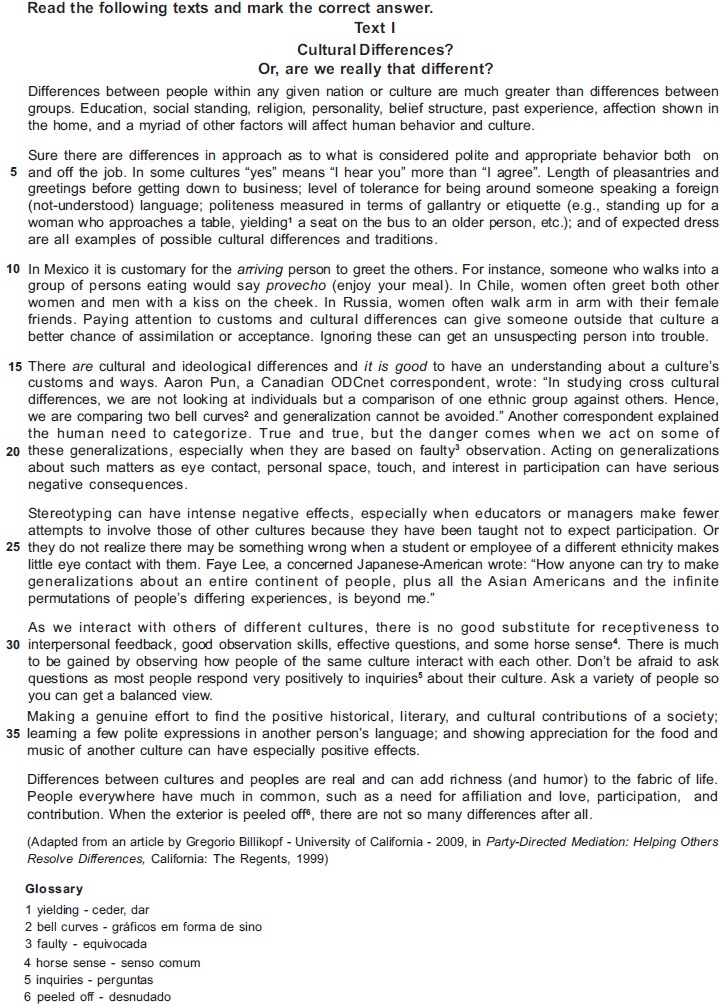
In “There is much to be gained by observing how people of the same culture interact with each other” (lines 30-31), the expression in bold could be replaced by
Alternativas
Ano: 2010 Banca: UFF Órgão: UFF Prova: UFF - 2010 - UFF - Vestibular-1º Etapa |
Q215694 Inglês
The meaning of unsuspecting (line 14) is
Alternativas
Q215447 Inglês
Instrução: Leia o texto para responder às questões de números 40 a 45.

      To Scientists, Laughter Is No Joke - It’s Serious
March 31, 2010.

     So a scientist walks into a shopping mall to watch people laugh. There’s no punchline. Laughter is a serious scientific subject, one that researchers are still trying to figure out. Laughing is primal, our first way of communicating. Apes laugh. So do dogs and rats. Babies laugh long before they speak. No one teaches you how to laugh. You just do. And often you laugh involuntarily, in a specific rhythm and in certain spots in conversation.
    You may laugh at a prank on April Fools’ Day. But surprisingly,  only 10 to 15 percent of laughter is the result of someone making a joke, said Baltimore neuroscientist Robert Provine, who has studied laughter for decades. Laughter is mostly about social responses rather than reaction to a joke. “Laughter above all else is a social thing,’’ Provine said. “The requirement for laughter is another person.’’  
    Over the years, Provine, a professor with the University of Maryland Baltimore County, has boiled laughter down to its basics. “All language groups laugh ‘ha-ha-ha’ basically the same way,’’ he said. “Whether you speak Mandarin, French or English, everyone will understand laughter. ... There’s a pattern generator in our brain that produces this sound.’’
    Each “ha’’ is about one-15th of a second, repeated every fifth of a second, he said. Laugh faster or slower than that and it sounds more like panting or something else. Deaf people laugh without hearing, and people on cell phones laugh without seeing, illustrating that laughter isn’t dependent on a single sense but on social interactions, said Provine, author of the book “Laughter: A Scientific Investigation.’’   
    “It’s joy, it’s positive engagement with life,’’ said Jaak Panksepp, a Bowling Green University psychology professor. “It’s deeply social.’’ And it’s not just a people thing either. Chimps tickle each other and even laugh when another chimp pretends to tickle them. By studying rats, Panksepp and other scientists can figure out what’s going on in the brain during laughter. And it holds promise for human ills.
    Northwestern biomedical engineering professor Jeffrey Burgdorf has found that laughter in rats produces an insulin-like growth factor chemical that acts as an antidepressant and anxietyreducer. He thinks the same thing probably happens in humans, too. This would give doctors a new chemical target in the brain in their effort to develop drugs that fight depression and anxiety in people. Even so, laughter itself hasn’t been proven to be the best medicine, experts said.

 (www.nytimes.com. Adaptado.)


No trecho do quarto parágrafo – Laugh faster or slower than that and it sounds more like panting or something else. – a palavra like indica
Alternativas
Q215446 Inglês
Instrução: Leia o texto para responder às questões de números 40 a 45.

      To Scientists, Laughter Is No Joke - It’s Serious
March 31, 2010.

     So a scientist walks into a shopping mall to watch people laugh. There’s no punchline. Laughter is a serious scientific subject, one that researchers are still trying to figure out. Laughing is primal, our first way of communicating. Apes laugh. So do dogs and rats. Babies laugh long before they speak. No one teaches you how to laugh. You just do. And often you laugh involuntarily, in a specific rhythm and in certain spots in conversation.
    You may laugh at a prank on April Fools’ Day. But surprisingly,  only 10 to 15 percent of laughter is the result of someone making a joke, said Baltimore neuroscientist Robert Provine, who has studied laughter for decades. Laughter is mostly about social responses rather than reaction to a joke. “Laughter above all else is a social thing,’’ Provine said. “The requirement for laughter is another person.’’  
    Over the years, Provine, a professor with the University of Maryland Baltimore County, has boiled laughter down to its basics. “All language groups laugh ‘ha-ha-ha’ basically the same way,’’ he said. “Whether you speak Mandarin, French or English, everyone will understand laughter. ... There’s a pattern generator in our brain that produces this sound.’’
    Each “ha’’ is about one-15th of a second, repeated every fifth of a second, he said. Laugh faster or slower than that and it sounds more like panting or something else. Deaf people laugh without hearing, and people on cell phones laugh without seeing, illustrating that laughter isn’t dependent on a single sense but on social interactions, said Provine, author of the book “Laughter: A Scientific Investigation.’’   
    “It’s joy, it’s positive engagement with life,’’ said Jaak Panksepp, a Bowling Green University psychology professor. “It’s deeply social.’’ And it’s not just a people thing either. Chimps tickle each other and even laugh when another chimp pretends to tickle them. By studying rats, Panksepp and other scientists can figure out what’s going on in the brain during laughter. And it holds promise for human ills.
    Northwestern biomedical engineering professor Jeffrey Burgdorf has found that laughter in rats produces an insulin-like growth factor chemical that acts as an antidepressant and anxietyreducer. He thinks the same thing probably happens in humans, too. This would give doctors a new chemical target in the brain in their effort to develop drugs that fight depression and anxiety in people. Even so, laughter itself hasn’t been proven to be the best medicine, experts said.

 (www.nytimes.com. Adaptado.)


No trecho do terceiro parágrafo – Whether you speak Mandarin, French or English, everyone will understand laughter. – a palavra whether pode ser substituída, sem alteração de sentido, por
Alternativas
Q215440 Inglês
 Instrução: Leia o texto para responder às questões de números 31 a 39.

               Brazil: the natural knowledge economy
Kirsten Bound – THE ATLAS OF IDEAS

    If you grew up in Europe or North America you will no doubt have been taught in school that the Wright Brothers from Ohio invented and flew the first aeroplane – the Kitty Hawk – in 1903. But if you grew up in Brazil you will have been taught that the real inventor was in fact a Brazilian from Minas Gerais called
Alberto Santos Dumont, whose 14-bis aeroplane took to the skies in 1906. This fierce historical debate, which turns on definitions of ‘practical airplanes’, the ability to launch unaided, length of time spent in the air and the credibility of witnesses, will not be resolved here. Yet it is a striking example of the lack of global recognition for Brazil’s achievements in innovation.
    Almost a century later, in 2005, Santos Dumont’s intellectual heirs, the company Empresa Brasileira de Aeronáutica (EMBRAER), made aviation history of a different kind when they unveiled the Ipanema, the world’s first commercially produced aircraft to run solely on biofuels. This time, the world
was watching. Scientific American credited it as one of the most important inventions of the year. The attention paid to the Ipanema reflects the growing interest in biofuels as a potential solution to climate change and rising energy demand. To their advocates, biofuels – most commonly bioethanol or biodiesel – offer a more secure, sustainable energy supply that can reduce carbon emissions by 50–60 per cent compared to fossil fuels.
      From learning to fly to learning to cope with the environmental costs of flight, biofuel innovations like the Ipanema reflect some of the tensions of modern science, in which expanding the frontiers of human ingenuity goes hand in hand with managing the consequences. The recent backlash against biofuels, which has seen them blamed for global food shortages as land is reportedly diverted from food crops, points to a growing interdependence between the science and innovation systems of different countries, and between innovation, economics and environmental sustainability.
    The debates now raging over biofuels reflect some of the wider dynamics in Brazil’s innovation system. They remind us that Brazil’s current strengths and achievements have deeper historical roots than is sometimes imagined. They reflect the fact that Brazil’s natural resources and assets are a key area of opportunity for science and innovation – a focus that leads us to characterise Brazil as a ‘natural knowledge economy’. Most importantly, they highlight the propitious timing of Brazil’s growing strength in these areas at a time when climate change, the environment, food scarcity and rising worldwide energy demand are at the forefront of global consciousness. What changed between the maiden flight of the 14-bis and the maiden flight of the Ipanema is not just Brazil’s capacity for technological and scientific innovation, but the rest of the world’s appreciation of the potential of that innovation to address some of the pressing challenges that confront us all.
 
(www.demos.co.uk. Adaptado.)

No trecho do terceiro parágrafo – which has seen them blamed for global food shortages as land is reportedly diverted from food crops – a palavra as introduz
Alternativas
Ano: 2009 Banca: CÁSPER LÍBERO Órgão: CÁSPER LÍBERO Prova: CÁSPER LÍBERO - 2009 - CÁSPER LÍBERO - Vestibular |
Q1381043 Inglês
Read the article below and answer question.


The El Mercurio File
By Peter Kornbluh


“For the better part of two years, a group of editors, journalism students, and human rights lawyers in Santiago, Chile, have been gathering evidence against their country’s leading media mogul, Agustín Edwards, to, at minimum, have him expelled from the press guild, the Academy of Chilean Journalists. The editor of the leftist magazine Puncto Final, Manuel Cabieses, has filed a formal petition accusing Edwards of violating the academy’s code of ethics by conspiring with the Nixon White House and the CIA between 1970 and 1973 to foment the military coup that overthrew the elected government of Salvador Allende and brought General Augusto Pinochet to power, thirty years ago this month. ‘Doonie’, as Edwards is known to his closest friends, is the patriarch of the press – a Chilean Rupert Murdoch. His media empire encompasses Chile’s renowned national newspaper, El Mercurio, a second national paper, Ultimas Noticias, and Santiago’s leading afternoon paper, La Segunda, along with a dozen smaller regional journals. In September 1970, when Chileans narrowly elected Allende, a Socialist, to the presidency, Edwards was widely considered to be the richest man in Chile – and the individual with the most to lose financially from Allende’s election.
The ethics charges against Edwards are likely to receive a boost from a careful analysis of formerly secret U.S. documents that shed considerable new light on CIA covert media operations in Chile. Since 1975, when a special congressional committee chaired by Idaho Senator Frank Church issued its report, Covert Action in Chile: 1963-1973, it has been no secret that the CIA provided significant funding to El Mercurio, put reporters and editors on its payroll, and used the paper, in the committee’s words, as ‘the most important channel for anti-Allende propaganda.’ But with the declassification of thousands of CIA and White House records at the end of Clinton administration, the history of the ‘El Mercurio Project’ emerges in far greater detail. Among the key revelations in the documents:
• Even before Allende was inaugurated as president of Chile, Edwards came to Washington and discussed with the CIA the ‘timing for possible military action’ to prevent Allende from taking office. • President Nixon directly authorized massive funding in the newspaper. The White House approve close to $2 million dollars – a significant sum when turned into Chilean currency on the black market.
• Secret CIA cables from mid-1973 identified El Mercurio as among the ‘most militant parts of the opposition’ pushing for military intervention to overthrow Allende.
• In the aftermath of the coup, the CIA continued to covertly finance media operations in order to influence Chilean public opinion in favor of the new military regime, despite General Pinochet’s brutal repression.”
From: KORNBLUH, Peter. “The El Mercurio File”. Columbia Journalism Review. New York, p.14-15, September/October 2007.
Choose the alternative that best translates the words: coup, boost, overthrew, issued, covert.
Alternativas
Ano: 2009 Banca: CÁSPER LÍBERO Órgão: CÁSPER LÍBERO Prova: CÁSPER LÍBERO - 2009 - CÁSPER LÍBERO - Vestibular |
Q1381042 Inglês
Read the article below and answer question.


The El Mercurio File
By Peter Kornbluh


“For the better part of two years, a group of editors, journalism students, and human rights lawyers in Santiago, Chile, have been gathering evidence against their country’s leading media mogul, Agustín Edwards, to, at minimum, have him expelled from the press guild, the Academy of Chilean Journalists. The editor of the leftist magazine Puncto Final, Manuel Cabieses, has filed a formal petition accusing Edwards of violating the academy’s code of ethics by conspiring with the Nixon White House and the CIA between 1970 and 1973 to foment the military coup that overthrew the elected government of Salvador Allende and brought General Augusto Pinochet to power, thirty years ago this month. ‘Doonie’, as Edwards is known to his closest friends, is the patriarch of the press – a Chilean Rupert Murdoch. His media empire encompasses Chile’s renowned national newspaper, El Mercurio, a second national paper, Ultimas Noticias, and Santiago’s leading afternoon paper, La Segunda, along with a dozen smaller regional journals. In September 1970, when Chileans narrowly elected Allende, a Socialist, to the presidency, Edwards was widely considered to be the richest man in Chile – and the individual with the most to lose financially from Allende’s election.
The ethics charges against Edwards are likely to receive a boost from a careful analysis of formerly secret U.S. documents that shed considerable new light on CIA covert media operations in Chile. Since 1975, when a special congressional committee chaired by Idaho Senator Frank Church issued its report, Covert Action in Chile: 1963-1973, it has been no secret that the CIA provided significant funding to El Mercurio, put reporters and editors on its payroll, and used the paper, in the committee’s words, as ‘the most important channel for anti-Allende propaganda.’ But with the declassification of thousands of CIA and White House records at the end of Clinton administration, the history of the ‘El Mercurio Project’ emerges in far greater detail. Among the key revelations in the documents:
• Even before Allende was inaugurated as president of Chile, Edwards came to Washington and discussed with the CIA the ‘timing for possible military action’ to prevent Allende from taking office. • President Nixon directly authorized massive funding in the newspaper. The White House approve close to $2 million dollars – a significant sum when turned into Chilean currency on the black market.
• Secret CIA cables from mid-1973 identified El Mercurio as among the ‘most militant parts of the opposition’ pushing for military intervention to overthrow Allende.
• In the aftermath of the coup, the CIA continued to covertly finance media operations in order to influence Chilean public opinion in favor of the new military regime, despite General Pinochet’s brutal repression.”
From: KORNBLUH, Peter. “The El Mercurio File”. Columbia Journalism Review. New York, p.14-15, September/October 2007.
Choose the alternative that best explains the meaning of the following words from the text above: chaired, charges, guild, mogul, currency.
Alternativas
Respostas
201: D
202: D
203: A
204: B
205: D
206: C
207: C
208: D
209: A
210: D
211: B
212: D
213: A
214: D
215: E
216: C
217: D
218: E
219: A
220: A