Questões de Vestibular
Comentadas sobre sinônimos | synonyms em inglês
Foram encontradas 116 questões


Ano: 2012
Banca:
UECE-CEV
Órgão:
UECE
Prova:
UECE-CEV - 2012 - UECE - Vestibular - Língua Inglesa - 1º Dia - 2ª fase |
Q1278809
Inglês
Texto associado
T E X T
SPEAKING two languages rather than just
one has obvious practical benefits in an
increasingly globalized world. But in recent years,
scientists have begun to show that the advantages
of bilingualism are even more fundamental than
being able to converse with a wider range of
people. Being bilingual, it turns out, makes you
smarter. It can have a profound effect on your
brain, improving cognitive skills not related to
language and even shielding against dementia in
old age.
This view of bilingualism is remarkably
different from the understanding of bilingualism
through much of the 20th century. Researchers,
educators and policy makers long considered a
second language to be an interference, cognitively
speaking, that hindered a child’s academic and
intellectual development.
They were not wrong about the
interference: there is ample evidence that in a
bilingual’s brain both language systems are active
even when he is using only one language, thus
creating situations in which one system obstructs
the other. But this interference, researchers are
finding out, isn’t so much a handicap as a
blessing in disguise. It forces the brain to resolve
internal conflict, giving the mind a workout that
strengthens its cognitive muscles.
Bilinguals, for instance, seem to be more
adept than monolinguals at solving certain kinds of
mental puzzles. In a 2004 study by the
psychologists Ellen Bialystok and Michelle MartinRhee, bilingual and monolingual preschoolers were
asked to sort blue circles and red squares
presented on a computer screen into two digital
bins — one marked with a blue square and the
other marked with a red circle.
In the first task, the children had to sort
the shapes by color, placing blue circles in the bin
marked with the blue square and red squares in
the bin marked with the red circle. Both groups did
this with comparable ease. Next, the children were
asked to sort by shape, which was more
challenging because it required placing the images
in a bin marked with a conflicting color. The
bilinguals were quicker at performing this task.
The collective evidence from a number of
such studies suggests that the bilingual experience
improves the brain’s so-called executive function
— a command system that directs the attention
processes that we use for planning, solving
problems and performing various other mentally
demanding tasks. These processes include ignoring
distractions to stay focused, switching attention
willfully from one thing to another and holding information in mind — like remembering a
sequence of directions while driving.
Why does the tussle between two
simultaneously active language systems improve
these aspects of cognition? Until recently,
researchers thought the bilingual advantage
stemmed primarily from an ability for inhibition
that was honed by the exercise of suppressing one
language system: this suppression, it was thought,
would help train the bilingual mind to ignore
distractions in other contexts. But that explanation
increasingly appears to be inadequate, since
studies have shown that bilinguals perform better
than monolinguals even at tasks that do not
require inhibition, like threading a line through an
ascending series of numbers scattered randomly
on a page.
The key difference between bilinguals and
monolinguals may be more basic: a heightened
ability to monitor the environment. “Bilinguals
have to switch languages quite often — you may
talk to your father in one language and to your
mother in another language,” says Albert Costa, a
researcher at the University of PompeuFabra in
Spain. “It requires keeping track of changes
around you in the same way that we monitor our
surroundings when driving.” In a study comparing
German-Italian bilinguals with Italian monolinguals
on monitoring tasks, Mr. Costa and his colleagues
found that the bilingual subjects not only
performed better, but they also did so with less
activity in parts of the brain involved in
monitoring, indicating that they were more
efficient at it.
The bilingual experience appears to
influence the brain from infancy to old age (and
there is reason to believe that it may also apply to
those who learn a second language later in life).
In a 2009 study led by Agnes Kovacs of
the International School for Advanced Studies in
Trieste, Italy, 7-month-old babies exposed to two
languages from birth were compared with peers
raised with one language. In an initial set of trials,
the infants were presented with an audio cue and
then shown a puppet on one side of a screen. Both
infant groups learned to look at that side of the
screen in anticipation of the puppet. But in a later
set of trials, when the puppet began appearing on
the opposite side of the screen, the babies exposed
to a bilingual environment quickly learned to
switch their anticipatory gaze in the new direction
while the other babies did not.
Bilingualism’s effects also extend into the
twilight years. In a recent study of 44 elderly
Spanish-English bilinguals, scientists led by the
neuropsychologist Tamar Gollan of the University
of California, San Diego, found that individuals
with a higher degree of bilingualism — measured
through a comparative evaluation of proficiency in
each language — were more resistant than others
to the onset of dementia and other symptoms of Alzheimer’s disease: the higher the degree of
bilingualism, the later the age of onset.
Nobody ever doubted the power of
language. But who would have imagined that the
words we hear and the sentences we speak might
be leaving such a deep imprint?
Source: www.nytimes.com
As to the meaning of the words “stemmed”,
“tussle”, “gaze”, and “onset” in the text, it is
expressed respectively in
Ano: 2012
Banca:
UECE-CEV
Órgão:
UECE
Prova:
UECE-CEV - 2012 - UECE - Vestibular - Língua Inglesa - 1º Dia - 2ª fase |
Q1278808
Inglês
Texto associado
T E X T
SPEAKING two languages rather than just
one has obvious practical benefits in an
increasingly globalized world. But in recent years,
scientists have begun to show that the advantages
of bilingualism are even more fundamental than
being able to converse with a wider range of
people. Being bilingual, it turns out, makes you
smarter. It can have a profound effect on your
brain, improving cognitive skills not related to
language and even shielding against dementia in
old age.
This view of bilingualism is remarkably
different from the understanding of bilingualism
through much of the 20th century. Researchers,
educators and policy makers long considered a
second language to be an interference, cognitively
speaking, that hindered a child’s academic and
intellectual development.
They were not wrong about the
interference: there is ample evidence that in a
bilingual’s brain both language systems are active
even when he is using only one language, thus
creating situations in which one system obstructs
the other. But this interference, researchers are
finding out, isn’t so much a handicap as a
blessing in disguise. It forces the brain to resolve
internal conflict, giving the mind a workout that
strengthens its cognitive muscles.
Bilinguals, for instance, seem to be more
adept than monolinguals at solving certain kinds of
mental puzzles. In a 2004 study by the
psychologists Ellen Bialystok and Michelle MartinRhee, bilingual and monolingual preschoolers were
asked to sort blue circles and red squares
presented on a computer screen into two digital
bins — one marked with a blue square and the
other marked with a red circle.
In the first task, the children had to sort
the shapes by color, placing blue circles in the bin
marked with the blue square and red squares in
the bin marked with the red circle. Both groups did
this with comparable ease. Next, the children were
asked to sort by shape, which was more
challenging because it required placing the images
in a bin marked with a conflicting color. The
bilinguals were quicker at performing this task.
The collective evidence from a number of
such studies suggests that the bilingual experience
improves the brain’s so-called executive function
— a command system that directs the attention
processes that we use for planning, solving
problems and performing various other mentally
demanding tasks. These processes include ignoring
distractions to stay focused, switching attention
willfully from one thing to another and holding information in mind — like remembering a
sequence of directions while driving.
Why does the tussle between two
simultaneously active language systems improve
these aspects of cognition? Until recently,
researchers thought the bilingual advantage
stemmed primarily from an ability for inhibition
that was honed by the exercise of suppressing one
language system: this suppression, it was thought,
would help train the bilingual mind to ignore
distractions in other contexts. But that explanation
increasingly appears to be inadequate, since
studies have shown that bilinguals perform better
than monolinguals even at tasks that do not
require inhibition, like threading a line through an
ascending series of numbers scattered randomly
on a page.
The key difference between bilinguals and
monolinguals may be more basic: a heightened
ability to monitor the environment. “Bilinguals
have to switch languages quite often — you may
talk to your father in one language and to your
mother in another language,” says Albert Costa, a
researcher at the University of PompeuFabra in
Spain. “It requires keeping track of changes
around you in the same way that we monitor our
surroundings when driving.” In a study comparing
German-Italian bilinguals with Italian monolinguals
on monitoring tasks, Mr. Costa and his colleagues
found that the bilingual subjects not only
performed better, but they also did so with less
activity in parts of the brain involved in
monitoring, indicating that they were more
efficient at it.
The bilingual experience appears to
influence the brain from infancy to old age (and
there is reason to believe that it may also apply to
those who learn a second language later in life).
In a 2009 study led by Agnes Kovacs of
the International School for Advanced Studies in
Trieste, Italy, 7-month-old babies exposed to two
languages from birth were compared with peers
raised with one language. In an initial set of trials,
the infants were presented with an audio cue and
then shown a puppet on one side of a screen. Both
infant groups learned to look at that side of the
screen in anticipation of the puppet. But in a later
set of trials, when the puppet began appearing on
the opposite side of the screen, the babies exposed
to a bilingual environment quickly learned to
switch their anticipatory gaze in the new direction
while the other babies did not.
Bilingualism’s effects also extend into the
twilight years. In a recent study of 44 elderly
Spanish-English bilinguals, scientists led by the
neuropsychologist Tamar Gollan of the University
of California, San Diego, found that individuals
with a higher degree of bilingualism — measured
through a comparative evaluation of proficiency in
each language — were more resistant than others
to the onset of dementia and other symptoms of Alzheimer’s disease: the higher the degree of
bilingualism, the later the age of onset.
Nobody ever doubted the power of
language. But who would have imagined that the
words we hear and the sentences we speak might
be leaving such a deep imprint?
Source: www.nytimes.com
An example of a pair of words/terms that
appear in the text with similar meaning is
Q382183
Inglês
Texto associado
In Higher Education, a Focus on Technology
By STEVE LOHR
The education gap facing the nation’s work force is evident in the numbers. Most new jobs will require more than a high school education, yet fewer than half of Americans under 30 have a (2) postsecondary degree of any kind. Recent state budget cuts, education experts agree, promise to make closing that gap even more difcult. The Bill and Melinda Gates Foundation, the William and Flora Hewlett Foundation, and four nonproft education organizations are beginning an ambitious initiative to address that challenge by accelerating the development and use of online learning tools. An initial $20 million round of money, from the Gates Foundation, will be for postsecondary online courses, particularly ones tailored for community colleges and low-income young people. Another round of grants, for high school programs, is scheduled for next year.
Just how efective technology can be in improving education - by making students more efective, more engaged learners - is a subject of debate. To date, education research shows that good teachers matter a lot, class size may be less important than once thought and nothing improves student performance as much as one-on-one human tutoring. If technology is well designed, experts say, it can help tailor the learning experience to individual students, facilitate student- teacher collaboration, and assist teachers in monitoring student performance each day and in quickly fne-tuning lessons. The potential benefts of technology are greater as students become older, more independent learners. Making that point, Mr. Gates said in an interview that for children from kindergarten to about ffth grade “the idea that you stick them in front of a computer is (3) ludicrous.”
(1)
higher education: educação superior.
(2)
postsecondary: termo que se refere aos cursos feitos após o high school ou, no modelo educacional brasileiro, o Ensino Médio.
(3)
ludicrous: ridícula, absurda.
By STEVE LOHR
The education gap facing the nation’s work force is evident in the numbers. Most new jobs will require more than a high school education, yet fewer than half of Americans under 30 have a (2) postsecondary degree of any kind. Recent state budget cuts, education experts agree, promise to make closing that gap even more difcult. The Bill and Melinda Gates Foundation, the William and Flora Hewlett Foundation, and four nonproft education organizations are beginning an ambitious initiative to address that challenge by accelerating the development and use of online learning tools. An initial $20 million round of money, from the Gates Foundation, will be for postsecondary online courses, particularly ones tailored for community colleges and low-income young people. Another round of grants, for high school programs, is scheduled for next year.
Just how efective technology can be in improving education - by making students more efective, more engaged learners - is a subject of debate. To date, education research shows that good teachers matter a lot, class size may be less important than once thought and nothing improves student performance as much as one-on-one human tutoring. If technology is well designed, experts say, it can help tailor the learning experience to individual students, facilitate student- teacher collaboration, and assist teachers in monitoring student performance each day and in quickly fne-tuning lessons. The potential benefts of technology are greater as students become older, more independent learners. Making that point, Mr. Gates said in an interview that for children from kindergarten to about ffth grade “the idea that you stick them in front of a computer is (3) ludicrous.”
(1)
higher education: educação superior.
(2)
postsecondary: termo que se refere aos cursos feitos após o high school ou, no modelo educacional brasileiro, o Ensino Médio.
(3)
ludicrous: ridícula, absurda.
No mesmo trecho do terceiro parágrafo – (...) particularly ones tailored for community colleges and low-income young people. – a palavra tailored pode ser substituída, sem alteração do sentido do texto, por
Q277175
Inglês

Based on the meanings of the words in the text, it can be said that
Q1400387
Inglês
Which of the following options best replaces the word “purchase” in the text?
Ano: 2011
Banca:
CÁSPER LÍBERO
Órgão:
CÁSPER LÍBERO
Prova:
CÁSPER LÍBERO - 2011 - CÁSPER LÍBERO - Vestibular |
Q1381600
Inglês
Texto associado
Read the following passage from “The Chicken”, by Clarice Lispector, and answer question.
“But when everyone was quiet in the house and seemed to have forgotten her, she puffed up
with modest courage, the last traces of her great escape. She circled the tiled floor, her body
advancing behind her head, as unhurried as if in an open field, although her small head betrayed
her, darting back and forth in rapid vibrant movements, with the age-old fear of her species now
ingrained. Once in a while, but ever more infrequently, she remembered how she had stood out
against the sky on the roof edge ready to cry out. At such moments, she filled her lungs with the
stuffy atmosphere of the kitchen and, had females been given the power to crow, she would not
have crowed but would have felt much happier. Not even at those moments, however, did the
expression on her empty head alter. In flight or in repose, when she gave birth or while pecking
grain, hers was a chicken head, identical to that drawn at the beginning of time.”
Without loss of meaning, the word “ingrained” could be replaced by:
Q1376778
Inglês
Texto associado
As we all know, electricity is a fundamental need. On a daily basis, we consume electricity even without us
knowing it. Just a simple task such as listening to your music player consumes electricity. Today, most of our electric
generators and power plants are fed with fossil fuels such as petroleum and coal. However, due to the exponential
increase of power demand, fossil fuel supplies are slowly being depleted. Not only that, but also burning fossil fuels
has given off greenhouse gases and other unwanted byproducts. Because of this, the search for alternative energy
sources is now a necessity. One of the most promising alternative energy sources today is Wind Powered Generators.
So, what is a wind-powered generator? Basically it is the use of wind as a mechanical force needed to power an electric
generator. Utilizing wind as an energy source is not exactly a new idea. The ancient Persians were the first to use wind
to pump water, cut wood, and grind food and others by building windmills. Even today you can find windmills still
being used on some farms. It was the use of wind as an electric source that came into existence much later. The first
practical wind powered generators were built in 1970, but yet we rarely see them in widespread use today, why? Let’s
look at the advantages and disadvantages of the wind powered generator.
The main advantage of wind powered generators is that they have, ideally, zero gas emissions – unlike fossil-fueled
power generators. Because of the alarming effects of greenhouse gases and global warming, we want our power
generators to be as clean and as environmentally friendly as possible. Since there is no burning process in a wind
powered generator that produces toxic gases, it is very safe to build one in residential areas. Also, with proper
engineering and enough wind, these generators can provide a high rate of wattage that can go as high as the Megawatt
range. Another advantage is that it can be implemented using several small turbines connected together. This is a good
thing when there is not enough space for huge structures.
The major disadvantage of wind powered generators is that wind power varies greatly from one place to another
and from day to day and season to season. Sometimes wind may be strong enough to supply energy, but that strength
cannot be maintained due to changes in weather patterns. Needing strong, constant wind to most effectively power
wind generators is one reason they are often built in coastal areas. Another disadvantage is that the structure of most
practical wind powered generators is huge and bulky. Commonly, its size is proportional to the wind power it can
collect.
Research in wind power has now intensified because of its innate advantages over other power generators. With
this increase in interest in wind energy and alternative energy sources as a whole, our future will become brighter and
more and more remote areas will eventually enjoy the benefits of clean electric energy. In an electricity-dependent
world, power supplies must provide the required electricity for communities and businesses. Wind powered generators
might just be the solution for power shortages.
Disponível em: http://mysolarcellhome.org/articles/pros-and-cons-of-wind-powered-generators.
The word “since” in the statement: “Since there is no burning process in a wind powered generator that produces
toxic gases, it is very safe to build one in residential areas” may be substituted, with the same meaning as the
original sentence, for:
Q1265629
Inglês
Texto associado
Read the New York Times article and answer
question.
Eating Disorders a New Front in Insurance Fight
By ANDREW POLLACK
Published: October 13, 2011
People with eating disorders like anorexia have
opened up a new battleground in the insurance wars,
testing the boundaries of laws mandating equivalent
coverage for mental illnesses.
Through claims and court cases, those with severe
cases of anorexia or bulimia are fighting insurers to pay
for stays in residential treatment centers, arguing that the
centers offer around-the-clock monitoring so that patients
do not forgo eating or purge their meals.
But in the last few years, some insurance
companies have re-emphasized that they do not cover
residential treatment for eating disorders or other mental
or emotional conditions. The insurers consider residential
treatments not only costly — sometimes reaching more
than $1,000 a day — but unproven and more akin to
education than to medicine. Even some doctors who treat
eating disorders concede there are few studies proving
that residential care is effective, although they believe it
has value.
(Disponível em: <http://www.nytimes.com/2011/10/14/business/ruling-offers-hope-to-eating-disorder-sufferers.html?hp>. Acesso em: 5 out.
2011).
Which is the best option to replace the
adjective „akin to‟ in the article?
Q1263920
Inglês
Texto associado
Considere o texto para responder a
questão.
HAITI'S INDENTURED CHIlDREN
THE DAYS AFTER HAITI'S EARTHQUAKE brought
joyous reunions for some families. Others faced the grim
reality that they'd been suddenly robbed of parents or offspring. But for Haiti's 225,000 restaveks, or indentured children, the quake brought only an uncertain future.
Slavery-which ended with independence in 1804-is illegal in Haiti. And technically, restaveks are not slaves.
The institution has its roots in the Caribbean tradition of
child lending between families (usually relatives) to pitch
in with extra work, care for the elderly or sick, or to provide
opportunity to a child from a poor family. Generally, rural
parents send their children to live with wealthier families
in the cities. In exchange for domestic labor, the children
are supposed to receive lodging, food, clothing, medicine, and-most importantly-education. In as many as half of
the cases, they do (though classifying treatment in private
homes is notoriously difficult). The unlucky ones, called
restaveks-from the French rester avec, or "to stay with"
-are loaned through normal channels but denied schooling
and subject to abuse and degradation. This phenomenon
has spiked in modern Haiti, as more and more children
end up with equally impoverished families in the slums.
Before the quake, up to 22 percent of Haitian homes contained restaveks, according to a study funded by USAID.
Keeping restaveks is illegal, but child loans are not and,
given the extent of Haiti's governmental dysfunction, it's
hard to tell which cases are which. Now that the quake
has thrown family networks into disarray, the flimsy social
ties supporting restaveks are likely to break down. "For
families struggling in the wake of a catastrophe, restavek
kids are the first to go; says Glenn Smucker, an anthropologist who specializes in development work in Haiti. "Their
parents are not there to watch out for them, so they're far
more vulnerable" to desertion and trafficking.
But even as the numbers of abandoned restaveks swell,
the demand for their services is likely to decrease. A mass
exodus of residents from Port-au-Prince is reversing decades of migratory trends. If the shift sticks, it means there
will be less need for restaveks in the city. But it's also possible that families suffering from the quake's economic aftershocks will feel extra pressure to lend out their children,
even as it becomes more likely they'll end up as restaveks.
Which, combined with a spike in new orphans, means Haiti will likely see a rise in the number of its street children in
the years to come.
(By Katie Paul - Newsweek)
A palavra flimsy, no 3º parágrafo do texto, pode ser
substituída por
Q1261379
Inglês
Texto associado
School Sports Injuries: 9 Prevention Tips
Reduce the risk of sports injuries with these essential guidelines.
Sports medicine doctors offer these tips to help reduce the number of youth sports injuries:
1. Warm-up and cool down properly. Warm-up exercises, such as stretching and light jogging, can help minimize the chance of muscle strain or other soft tissue injury and make the body’s tissues warmer and more flexible. Cooling down exercises loosen the body’s muscles that have tightened during exercise. Make warm-ups and cool downs part of your kids’ routine before and after sports participation.
2. Know and abide by the rules of the sport. Kids should also be instructed in how to use the sport’s athletic equipment properly.
3. Avoid playing when very tired or in pain. Children should take a break immediately if in pain.
4. Be in proper physical condition to play the sport. Before starting a sport, have your child work out to prepare.
5. Keep kids hydrated. Make sure there is adequate water or other liquids to maintain proper hydration. Kids need to drink 8 ounces of fluid every 20 minutes, plus more after playing.
6. Wear appropriate protective gear, such as shin guards for soccer, a hard-shell helmet when facing a baseball or softball pitcher, a helmet and body padding for ice hockey. Make sure your child uses the proper protective gear for a particular sport. This may lessen the chances of being injured.
7. Make sure the coach is certified. Enroll your child in organized sports through schools, community clubs, and recreation areas where there may be adults who are certified coaches. Ask about the coach’s background and training.
8. Get a preseason physical examination. Kids should have a thorough exam from a physician before participating in sports, including a cardiovascular workup to make sure there are no pre-existing conditions.
9. Insist on a team emergency plan. What happens if a child is injured? Where’s the first-aid kit? Who drives to the hospital? Make sure any injured child sees a doctor right away.
Extracted from The Reader’s Digest, 2010.
A frase “Make sure the coach is certified” poderia ser melhor substituída, neste contexto, por:
Q215697
Inglês
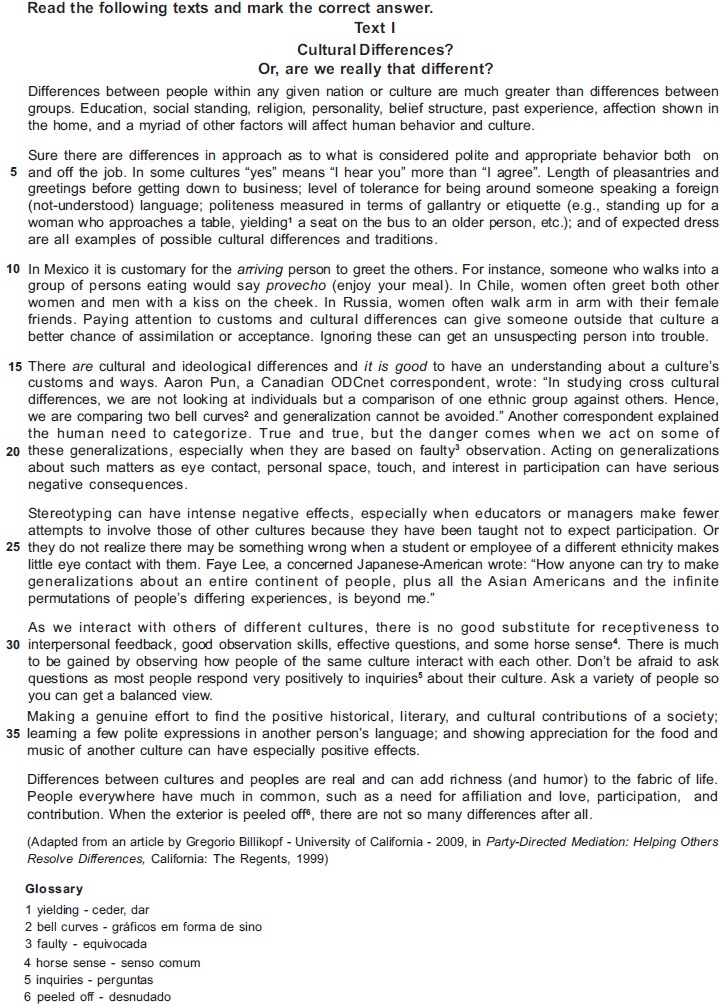
In “There is much to be gained by observing how people of the same culture interact with each other” (lines 30-31), the expression in bold could be replaced by
Q215694
Inglês
The meaning of unsuspecting (line 14) is
Ano: 2010
Banca:
VUNESP
Órgão:
UNIFESP
Prova:
VUNESP - 2010 - UNIFESP - Vestibular - Língua Portuguesa, Língua Estrangeira e Redação |
Q215446
Inglês
Texto associado
Instrução: Leia o texto para responder às questões de números 40 a 45.
To Scientists, Laughter Is No Joke - It’s Serious
March 31, 2010.
(www.nytimes.com. Adaptado.)
To Scientists, Laughter Is No Joke - It’s Serious
March 31, 2010.
So a scientist walks into a shopping mall to watch people laugh. There’s no punchline. Laughter is a serious scientific subject, one that researchers are still trying to figure out. Laughing is primal, our first way of communicating. Apes laugh. So do dogs and rats. Babies laugh long before they speak. No one teaches you how to laugh. You just do. And often you laugh involuntarily, in a specific rhythm and in certain spots in conversation.
You may laugh at a prank on April Fools’ Day. But surprisingly, only 10 to 15 percent of laughter is the result of someone making a joke, said Baltimore neuroscientist Robert Provine, who has studied laughter for decades. Laughter is mostly about social responses rather than reaction to a joke. “Laughter above all else is a social thing,’’ Provine said. “The requirement for laughter is another person.’’
Over the years, Provine, a professor with the University of Maryland Baltimore County, has boiled laughter down to its basics. “All language groups laugh ‘ha-ha-ha’ basically the same way,’’ he said. “Whether you speak Mandarin, French or English, everyone will understand laughter. ... There’s a pattern generator in our brain that produces this sound.’’
Each “ha’’ is about one-15th of a second, repeated every fifth of a second, he said. Laugh faster or slower than that and it sounds more like panting or something else. Deaf people laugh without hearing, and people on cell phones laugh without seeing, illustrating that laughter isn’t dependent on a single sense but on social interactions, said Provine, author of the book “Laughter: A Scientific Investigation.’’
“It’s joy, it’s positive engagement with life,’’ said Jaak Panksepp, a Bowling Green University psychology professor. “It’s deeply social.’’ And it’s not just a people thing either. Chimps tickle each other and even laugh when another chimp pretends to tickle them. By studying rats, Panksepp and other scientists can figure out what’s going on in the brain during laughter. And it holds promise for human ills.
Northwestern biomedical engineering professor Jeffrey Burgdorf has found that laughter in rats produces an insulin-like growth factor chemical that acts as an antidepressant and anxietyreducer. He thinks the same thing probably happens in humans, too. This would give doctors a new chemical target in the brain in their effort to develop drugs that fight depression and anxiety in people. Even so, laughter itself hasn’t been proven to be the best medicine, experts said.
You may laugh at a prank on April Fools’ Day. But surprisingly, only 10 to 15 percent of laughter is the result of someone making a joke, said Baltimore neuroscientist Robert Provine, who has studied laughter for decades. Laughter is mostly about social responses rather than reaction to a joke. “Laughter above all else is a social thing,’’ Provine said. “The requirement for laughter is another person.’’
Over the years, Provine, a professor with the University of Maryland Baltimore County, has boiled laughter down to its basics. “All language groups laugh ‘ha-ha-ha’ basically the same way,’’ he said. “Whether you speak Mandarin, French or English, everyone will understand laughter. ... There’s a pattern generator in our brain that produces this sound.’’
Each “ha’’ is about one-15th of a second, repeated every fifth of a second, he said. Laugh faster or slower than that and it sounds more like panting or something else. Deaf people laugh without hearing, and people on cell phones laugh without seeing, illustrating that laughter isn’t dependent on a single sense but on social interactions, said Provine, author of the book “Laughter: A Scientific Investigation.’’
“It’s joy, it’s positive engagement with life,’’ said Jaak Panksepp, a Bowling Green University psychology professor. “It’s deeply social.’’ And it’s not just a people thing either. Chimps tickle each other and even laugh when another chimp pretends to tickle them. By studying rats, Panksepp and other scientists can figure out what’s going on in the brain during laughter. And it holds promise for human ills.
Northwestern biomedical engineering professor Jeffrey Burgdorf has found that laughter in rats produces an insulin-like growth factor chemical that acts as an antidepressant and anxietyreducer. He thinks the same thing probably happens in humans, too. This would give doctors a new chemical target in the brain in their effort to develop drugs that fight depression and anxiety in people. Even so, laughter itself hasn’t been proven to be the best medicine, experts said.
(www.nytimes.com. Adaptado.)
No trecho do terceiro parágrafo – Whether you speak Mandarin, French or English, everyone will understand laughter. – a palavra whether pode ser substituída, sem alteração de sentido, por
Ano: 2009
Banca:
CÁSPER LÍBERO
Órgão:
CÁSPER LÍBERO
Prova:
CÁSPER LÍBERO - 2009 - CÁSPER LÍBERO - Vestibular |
Q1381042
Inglês
Texto associado
Read the article below and answer question.
The El Mercurio File
By Peter Kornbluh
“For the better part of two years, a group of editors, journalism students, and human rights lawyers
in Santiago, Chile, have been gathering evidence against their country’s leading media mogul, Agustín
Edwards, to, at minimum, have him expelled from the press guild, the Academy of Chilean Journalists.
The editor of the leftist magazine Puncto Final, Manuel Cabieses, has filed a formal petition accusing
Edwards of violating the academy’s code of ethics by conspiring with the Nixon White House and the
CIA between 1970 and 1973 to foment the military coup that overthrew the elected government of
Salvador Allende and brought General Augusto Pinochet to power, thirty years ago this month.
‘Doonie’, as Edwards is known to his closest friends, is the patriarch of the press – a Chilean Rupert
Murdoch. His media empire encompasses Chile’s renowned national newspaper, El Mercurio, a
second national paper, Ultimas Noticias, and Santiago’s leading afternoon paper, La Segunda, along
with a dozen smaller regional journals. In September 1970, when Chileans narrowly elected Allende,
a Socialist, to the presidency, Edwards was widely considered to be the richest man in Chile – and the
individual with the most to lose financially from Allende’s election.
The ethics charges against Edwards are likely to receive a boost from a careful analysis of formerly
secret U.S. documents that shed considerable new light on CIA covert media operations in Chile.
Since 1975, when a special congressional committee chaired by Idaho Senator Frank Church issued
its report, Covert Action in Chile: 1963-1973, it has been no secret that the CIA provided significant
funding to El Mercurio, put reporters and editors on its payroll, and used the paper, in the committee’s
words, as ‘the most important channel for anti-Allende propaganda.’ But with the declassification of
thousands of CIA and White House records at the end of Clinton administration, the history of the ‘El
Mercurio Project’ emerges in far greater detail. Among the key revelations in the documents:
• Even before Allende was inaugurated as president of Chile, Edwards came to Washington and
discussed with the CIA the ‘timing for possible military action’ to prevent Allende from taking
office.
• President Nixon directly authorized massive funding in the newspaper. The White House approve
close to $2 million dollars – a significant sum when turned into Chilean currency on the black
market.
• Secret CIA cables from mid-1973 identified El Mercurio as among the ‘most militant parts of the
opposition’ pushing for military intervention to overthrow Allende.
• In the aftermath of the coup, the CIA continued to covertly finance media operations in order to
influence Chilean public opinion in favor of the new military regime, despite General Pinochet’s
brutal repression.”
From: KORNBLUH, Peter. “The El Mercurio File”. Columbia Journalism Review. New York, p.14-15,
September/October 2007.
Choose the alternative that best explains the meaning of the following words from
the text above: chaired, charges, guild, mogul, currency.
Q240127
Inglês
Texto associado
Text 2
01 Take a dive with hundreds of tropical fish, colorful coral and the world's biggest fish, the
whale shark, at unspoilt Ningaloo Reef.
The reef on Western Australia's mid north coast, has gained an impressive reputation as
one of Earth's last ocean paradise.
05 It's one of the largest fringing reefs in the world and unlike many others; you can get to it
just by stepping off the beach.
The marine park stretches 260 kilometers from Bundegi Reef near the town of Exmouth to
Amherst Point near Coral Bay in the south.
It reaches nearly 20 kilometers seaward, encompassing a massive 5,000 square
10 kilometers of ocean with 500 species of tropical fish and 220 species of coral in all.
Nothing can compare to the thrill of swimming beside a whale shark. These docile
creatures visit the reef each year between April and June.
Rare turtle species hatch here in late January and February. Watch this amazing natural
phenomenon on special guided, eco-interactive trails.
15 Accommodation in the area is comfortable and ranges from camping and backpacker style
to chalets, motels, eco-retreats and self catering apartments.
It's not all about the water at Ningaloo - go four wheel driving to Cape Range National
Park to see amazing red rock canyons and gorges.
Getting there is easy - take a two hour flight north of Perth, or give yourself two days to
drive there from the capital.
(www.westernaustralia.com)
According to Text 2, answer the questions below:
01 Take a dive with hundreds of tropical fish, colorful coral and the world's biggest fish, the
whale shark, at unspoilt Ningaloo Reef.
The reef on Western Australia's mid north coast, has gained an impressive reputation as
one of Earth's last ocean paradise.
05 It's one of the largest fringing reefs in the world and unlike many others; you can get to it
just by stepping off the beach.
The marine park stretches 260 kilometers from Bundegi Reef near the town of Exmouth to
Amherst Point near Coral Bay in the south.
It reaches nearly 20 kilometers seaward, encompassing a massive 5,000 square
10 kilometers of ocean with 500 species of tropical fish and 220 species of coral in all.
Nothing can compare to the thrill of swimming beside a whale shark. These docile
creatures visit the reef each year between April and June.
Rare turtle species hatch here in late January and February. Watch this amazing natural
phenomenon on special guided, eco-interactive trails.
15 Accommodation in the area is comfortable and ranges from camping and backpacker style
to chalets, motels, eco-retreats and self catering apartments.
It's not all about the water at Ningaloo - go four wheel driving to Cape Range National
Park to see amazing red rock canyons and gorges.
Getting there is easy - take a two hour flight north of Perth, or give yourself two days to
drive there from the capital.
(www.westernaustralia.com)
According to Text 2, answer the questions below:
The word unlike in line 5, of the text, means:
Q240122
Inglês
Texto associado
Text 1
01 There, in the pasture greenery,
Sun mottling Nature's breast,
It was the summer wind's song
That filled me with its crest.
05 Emotion running rampant--
Rivers to the sea--
I could not even fathom the flood of you and me.
But take me in your arms again
And do not talk of time.
10 Let flesh rub flesh to parchment--
Pale flowers crushed--
And grind more mortar for my soul's room . . .
Paint mirrors for my mind.
(Michela Curtis: www.poetry.com)
According to Text 1, answer the questions below:
01 There, in the pasture greenery,
Sun mottling Nature's breast,
It was the summer wind's song
That filled me with its crest.
05 Emotion running rampant--
Rivers to the sea--
I could not even fathom the flood of you and me.
But take me in your arms again
And do not talk of time.
10 Let flesh rub flesh to parchment--
Pale flowers crushed--
And grind more mortar for my soul's room . . .
Paint mirrors for my mind.
(Michela Curtis: www.poetry.com)
According to Text 1, answer the questions below:
Analyze the best answer to complete the following sentence, giving it the same meaning as in the text.
"Emotion running __________
Rivers to the sea
I could not even ___________ the __________ of you and me."
Mark the right alternative.
"Emotion running __________
Rivers to the sea
I could not even ___________ the __________ of you and me."
Mark the right alternative.

 Conheça nossos planos