Questões de Vestibular Sobre inglês
Foram encontradas 6.365 questões


Advice for new students from those who know (old students)
The first day of college I was a ball of nerves. I remember walking into my first class and running to the first seat I found, thinking everyone would be staring at me. But nobody seemed to notice and then it hit me: The fact that nobody knew me meant nobody would judge, which, upon reflection, was what I was scared of the most. I told myself to let go. All along the year, I forced myself into situations that were uncomfortable for me – for example, auditioning for a dance piece. Believe it or not, that performance was a highlight of my freshman year. My advice: challenge yourself to try something new, something you couldn’t have done in high school. – Ria Jagasia, Vanderbilt University, ’18.
(Adaptado de http://www.nytimes.com/2015/08/02/ education/edlife/ advice-for-new-students-from-those-who-know-old-students.html?ref= edlife.)

O texto anuncia um
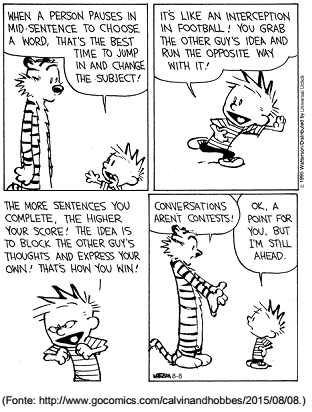
Na tirinha, Calvin dá dicas sobre como
"If you believe in freedom of speech, you believe in freedom of speech for views you don’t like. Goebbels was in favor of freedom of speech for views he liked. So was Stalin. If you’re in favor of freedom of speech, that means you’re in favor of freedom of speech precisely for views you despise."
(NoamChomsky)
(Fonte: http://noam-chomsky.tumblr.com/post/7223808896/if-youbelieve-in-freedom-of-speech-you-believe.)
O autor do texto
Oliver Burkeman
“Why is it so hard to take your own advice?” the psychology writer Melissa Dahl asked in a New York magazine essay some months ago, and the question’s been bugging me ever since. I have the arrogance to imagine that if you followed some of the suggestions made each week in this column, you might be a little happier or more productive, with a little less relationship drama, a little more inner calm. (From my email inbox, I know this happens at least occasionally.) But were you to infer from this that I follow such advice flawlessly myself, you’d be mistaken. When friends mention their difficulties with partners or bosses, Dahl wrote, she always tells them to talk to the person involved. Just say something! “And probably, this is good advice,” she mused. “I wouldn’t know, as it’s something I rarely do myself.” I can understand. I suspect most of us can. As the old wisecrack has it: “Take my advice – I’m not using it.”
The cynical take on this is that we ignore our own advice because it’s rubbish: we give it to seem wise, when in fact it’s nonsense. (All advice to “try harder” or “snap out of it” or “look on the bright side” fall into this category: if the recipient could do so, he or she already would have, without your so-called help.)
But a more interesting notion is that the advice is often good – yet something prevents us applying it to ourselves. One such obstacle is simply too much information: inside our own heads, we have access to all manner of details, making us believe that this relationship problem, this job dilemma, is special, so the advice doesn’t apply. Dahl cites work by the psychologist Dan Ariely, showing that when a friend gets a serious medical diagnosis, most people would urge them to get a second opinion. But were it to happen to themselves, they’d be more likely not to do so, for fear of offending their doctor. The fear of offence is something you’d think of only in your own case – and it’s totally unhelpful.
But there’s another big reason I don’t follow my own advice: the huge gulf between grasping something intellectually and really feeling it in your bones. For example, it was years ago that I first encountered the insight that anxiety and insecurity aren’t reduced by trying to exert more control over the world; in fact, that usually makes them worse. I know this. But apparently I have to keep learning it, over and over. Its correctness isn’t sufficient for it to get into my brain once and for all; that takes repeated experience. As a result, I continue to “suddenly realise” things I already wrote an entire book about.
If nothing else, this should be a caution against getting too frustrated with that one friend of yours who keeps getting into the same kind of pickle, time and again, deaf to the obviously good advice that everyone keeps offering. You know the type. We’ve all got a friend like that. The scary thought is that, for some of your friends, it’s probably you.
Adapted from http://www.theguardian.com/lifeandstyle/2015/sep/11/ taking-your-own-advice-oliver-burkeman. Accessed on: 22 out. 2015.
Glossary
Oliver Burkeman
“Why is it so hard to take your own advice?” the psychology writer Melissa Dahl asked in a New York magazine essay some months ago, and the question’s been bugging me ever since. I have the arrogance to imagine that if you followed some of the suggestions made each week in this column, you might be a little happier or more productive, with a little less relationship drama, a little more inner calm. (From my email inbox, I know this happens at least occasionally.) But were you to infer from this that I follow such advice flawlessly myself, you’d be mistaken. When friends mention their difficulties with partners or bosses, Dahl wrote, she always tells them to talk to the person involved. Just say something! “And probably, this is good advice,” she mused. “I wouldn’t know, as it’s something I rarely do myself.” I can understand. I suspect most of us can. As the old wisecrack has it: “Take my advice – I’m not using it.”
The cynical take on this is that we ignore our own advice because it’s rubbish: we give it to seem wise, when in fact it’s nonsense. (All advice to “try harder” or “snap out of it” or “look on the bright side” fall into this category: if the recipient could do so, he or she already would have, without your so-called help.)
But a more interesting notion is that the advice is often good – yet something prevents us applying it to ourselves. One such obstacle is simply too much information: inside our own heads, we have access to all manner of details, making us believe that this relationship problem, this job dilemma, is special, so the advice doesn’t apply. Dahl cites work by the psychologist Dan Ariely, showing that when a friend gets a serious medical diagnosis, most people would urge them to get a second opinion. But were it to happen to themselves, they’d be more likely not to do so, for fear of offending their doctor. The fear of offence is something you’d think of only in your own case – and it’s totally unhelpful.
But there’s another big reason I don’t follow my own advice: the huge gulf between grasping something intellectually and really feeling it in your bones. For example, it was years ago that I first encountered the insight that anxiety and insecurity aren’t reduced by trying to exert more control over the world; in fact, that usually makes them worse. I know this. But apparently I have to keep learning it, over and over. Its correctness isn’t sufficient for it to get into my brain once and for all; that takes repeated experience. As a result, I continue to “suddenly realise” things I already wrote an entire book about.
If nothing else, this should be a caution against getting too frustrated with that one friend of yours who keeps getting into the same kind of pickle, time and again, deaf to the obviously good advice that everyone keeps offering. You know the type. We’ve all got a friend like that. The scary thought is that, for some of your friends, it’s probably you.
Adapted from http://www.theguardian.com/lifeandstyle/2015/sep/11/ taking-your-own-advice-oliver-burkeman. Accessed on: 22 out. 2015.
Glossary
Oliver Burkeman
“Why is it so hard to take your own advice?” the psychology writer Melissa Dahl asked in a New York magazine essay some months ago, and the question’s been bugging me ever since. I have the arrogance to imagine that if you followed some of the suggestions made each week in this column, you might be a little happier or more productive, with a little less relationship drama, a little more inner calm. (From my email inbox, I know this happens at least occasionally.) But were you to infer from this that I follow such advice flawlessly myself, you’d be mistaken. When friends mention their difficulties with partners or bosses, Dahl wrote, she always tells them to talk to the person involved. Just say something! “And probably, this is good advice,” she mused. “I wouldn’t know, as it’s something I rarely do myself.” I can understand. I suspect most of us can. As the old wisecrack has it: “Take my advice – I’m not using it.”
The cynical take on this is that we ignore our own advice because it’s rubbish: we give it to seem wise, when in fact it’s nonsense. (All advice to “try harder” or “snap out of it” or “look on the bright side” fall into this category: if the recipient could do so, he or she already would have, without your so-called help.)
But a more interesting notion is that the advice is often good – yet something prevents us applying it to ourselves. One such obstacle is simply too much information: inside our own heads, we have access to all manner of details, making us believe that this relationship problem, this job dilemma, is special, so the advice doesn’t apply. Dahl cites work by the psychologist Dan Ariely, showing that when a friend gets a serious medical diagnosis, most people would urge them to get a second opinion. But were it to happen to themselves, they’d be more likely not to do so, for fear of offending their doctor. The fear of offence is something you’d think of only in your own case – and it’s totally unhelpful.
But there’s another big reason I don’t follow my own advice: the huge gulf between grasping something intellectually and really feeling it in your bones. For example, it was years ago that I first encountered the insight that anxiety and insecurity aren’t reduced by trying to exert more control over the world; in fact, that usually makes them worse. I know this. But apparently I have to keep learning it, over and over. Its correctness isn’t sufficient for it to get into my brain once and for all; that takes repeated experience. As a result, I continue to “suddenly realise” things I already wrote an entire book about.
If nothing else, this should be a caution against getting too frustrated with that one friend of yours who keeps getting into the same kind of pickle, time and again, deaf to the obviously good advice that everyone keeps offering. You know the type. We’ve all got a friend like that. The scary thought is that, for some of your friends, it’s probably you.
Adapted from http://www.theguardian.com/lifeandstyle/2015/sep/11/ taking-your-own-advice-oliver-burkeman. Accessed on: 22 out. 2015.
Glossary
Oliver Burkeman
“Why is it so hard to take your own advice?” the psychology writer Melissa Dahl asked in a New York magazine essay some months ago, and the question’s been bugging me ever since. I have the arrogance to imagine that if you followed some of the suggestions made each week in this column, you might be a little happier or more productive, with a little less relationship drama, a little more inner calm. (From my email inbox, I know this happens at least occasionally.) But were you to infer from this that I follow such advice flawlessly myself, you’d be mistaken. When friends mention their difficulties with partners or bosses, Dahl wrote, she always tells them to talk to the person involved. Just say something! “And probably, this is good advice,” she mused. “I wouldn’t know, as it’s something I rarely do myself.” I can understand. I suspect most of us can. As the old wisecrack has it: “Take my advice – I’m not using it.”
The cynical take on this is that we ignore our own advice because it’s rubbish: we give it to seem wise, when in fact it’s nonsense. (All advice to “try harder” or “snap out of it” or “look on the bright side” fall into this category: if the recipient could do so, he or she already would have, without your so-called help.)
But a more interesting notion is that the advice is often good – yet something prevents us applying it to ourselves. One such obstacle is simply too much information: inside our own heads, we have access to all manner of details, making us believe that this relationship problem, this job dilemma, is special, so the advice doesn’t apply. Dahl cites work by the psychologist Dan Ariely, showing that when a friend gets a serious medical diagnosis, most people would urge them to get a second opinion. But were it to happen to themselves, they’d be more likely not to do so, for fear of offending their doctor. The fear of offence is something you’d think of only in your own case – and it’s totally unhelpful.
But there’s another big reason I don’t follow my own advice: the huge gulf between grasping something intellectually and really feeling it in your bones. For example, it was years ago that I first encountered the insight that anxiety and insecurity aren’t reduced by trying to exert more control over the world; in fact, that usually makes them worse. I know this. But apparently I have to keep learning it, over and over. Its correctness isn’t sufficient for it to get into my brain once and for all; that takes repeated experience. As a result, I continue to “suddenly realise” things I already wrote an entire book about.
If nothing else, this should be a caution against getting too frustrated with that one friend of yours who keeps getting into the same kind of pickle, time and again, deaf to the obviously good advice that everyone keeps offering. You know the type. We’ve all got a friend like that. The scary thought is that, for some of your friends, it’s probably you.
Adapted from http://www.theguardian.com/lifeandstyle/2015/sep/11/ taking-your-own-advice-oliver-burkeman. Accessed on: 22 out. 2015.
Glossary
Oliver Burkeman
“Why is it so hard to take your own advice?” the psychology writer Melissa Dahl asked in a New York magazine essay some months ago, and the question’s been bugging me ever since. I have the arrogance to imagine that if you followed some of the suggestions made each week in this column, you might be a little happier or more productive, with a little less relationship drama, a little more inner calm. (From my email inbox, I know this happens at least occasionally.) But were you to infer from this that I follow such advice flawlessly myself, you’d be mistaken. When friends mention their difficulties with partners or bosses, Dahl wrote, she always tells them to talk to the person involved. Just say something! “And probably, this is good advice,” she mused. “I wouldn’t know, as it’s something I rarely do myself.” I can understand. I suspect most of us can. As the old wisecrack has it: “Take my advice – I’m not using it.”
The cynical take on this is that we ignore our own advice because it’s rubbish: we give it to seem wise, when in fact it’s nonsense. (All advice to “try harder” or “snap out of it” or “look on the bright side” fall into this category: if the recipient could do so, he or she already would have, without your so-called help.)
But a more interesting notion is that the advice is often good – yet something prevents us applying it to ourselves. One such obstacle is simply too much information: inside our own heads, we have access to all manner of details, making us believe that this relationship problem, this job dilemma, is special, so the advice doesn’t apply. Dahl cites work by the psychologist Dan Ariely, showing that when a friend gets a serious medical diagnosis, most people would urge them to get a second opinion. But were it to happen to themselves, they’d be more likely not to do so, for fear of offending their doctor. The fear of offence is something you’d think of only in your own case – and it’s totally unhelpful.
But there’s another big reason I don’t follow my own advice: the huge gulf between grasping something intellectually and really feeling it in your bones. For example, it was years ago that I first encountered the insight that anxiety and insecurity aren’t reduced by trying to exert more control over the world; in fact, that usually makes them worse. I know this. But apparently I have to keep learning it, over and over. Its correctness isn’t sufficient for it to get into my brain once and for all; that takes repeated experience. As a result, I continue to “suddenly realise” things I already wrote an entire book about.
If nothing else, this should be a caution against getting too frustrated with that one friend of yours who keeps getting into the same kind of pickle, time and again, deaf to the obviously good advice that everyone keeps offering. You know the type. We’ve all got a friend like that. The scary thought is that, for some of your friends, it’s probably you.
Adapted from http://www.theguardian.com/lifeandstyle/2015/sep/11/ taking-your-own-advice-oliver-burkeman. Accessed on: 22 out. 2015.
Glossary
Rick Jervis, September 24, 2015
Rick Jervis, September 24, 2015
1. He visited a priest who also gave speeches during the Pope's stay in Cuba. 2. He talked to the Cuban people and observed their faith. 3. In order to escape from the warm weather, he decided to go to an old church. 4. He followed Pope Francis and heard his speeches.
Which of the statements above are TRUE, according to the text?
Rick Jervis, September 24, 2015
( ) He was raised in the south of Florida, USA. ( ) His parents are Cubans who left the country and moved to the USA. ( ) He feels fascinated by the beauty and contradictions of Cuba. ( ) He considers that Cubans are not interested about the re-establishment of relations with the USA. ( ) He was born in 1962 when his parents left Cuba.
Mark the alternative which presents the correct sequence, from top to bottom.

The research was conducted as part of the carrier's "It Can Wait" campaign launched in 2010. It hopes to increase awareness of the dangers posed by using smartphones while one is behind the wheel. The study polled 2,067 U.S. residents ages 16-65 who use their smartphone and drive once or more per day.
Seventy percent of those surveyed admit they use their smartphones for a number of activities while they are driving: 61 percent say they text and 33 percent send email while they are behind the wheel. Posting or interacting on social media is also one of the most common activities that drivers engage in. Using Facebook ranks first on the list, with 27 percent of drivers logging in while driving. Other social media channels that keep drivers "multitasking" include Instagram and Twitter (14 percent) and Snapchat (11 percent).
The results also show that there is a deeper problem involved when people use social media while driving. Among those surveyed, 22 percent blame their addiction to social media.
Other revelations show 62 percent keep their smartphones within easy reach, and that 30 percent of those who post to Twitter while driving do it "all the time". Drivers also don't seem to run out of other activities using their smartphones since most apps are now easily accessed with just a simple tap. Because of this, 28 percent of drivers browse the web; 17 percent take selfies (or groupies); and 10 percent video chat.
"One in 10 say they do video chat while driving", said Lori Lee, AT&T's senior VP for global marketing. "I don't even have words for that". AT&T plans to expand the "It Can Wait" campaign in order to add more focus on the topic of texting while driving by including other driving distractions that result from using the smartphones. "When we launched 'It Can Wait' five years ago, we pleaded with people to realize that no text is worth a life", said Lee. "The same applies to other smartphone activities that people are doing while driving. For the sake of you and those around you, please keep your eyes on the road, not on your phone". AT&T will also launch a nationwide virtual reality tour in summer in order to spread the word that driving and using a smartphone don't and will never mix.
1. to expand its campaign and include other smartphone distractions. 2. to expand its campaign to other parts of the world. 3. to improve smartphone use with new apps. 4. to invest in a virtual reality tour as part of their awareness efforts.
According to the text, the correct items are:
The research was conducted as part of the carrier's "It Can Wait" campaign launched in 2010. It hopes to increase awareness of the dangers posed by using smartphones while one is behind the wheel. The study polled 2,067 U.S. residents ages 16-65 who use their smartphone and drive once or more per day.
Seventy percent of those surveyed admit they use their smartphones for a number of activities while they are driving: 61 percent say they text and 33 percent send email while they are behind the wheel. Posting or interacting on social media is also one of the most common activities that drivers engage in. Using Facebook ranks first on the list, with 27 percent of drivers logging in while driving. Other social media channels that keep drivers "multitasking" include Instagram and Twitter (14 percent) and Snapchat (11 percent).
The results also show that there is a deeper problem involved when people use social media while driving. Among those surveyed, 22 percent blame their addiction to social media.
Other revelations show 62 percent keep their smartphones within easy reach, and that 30 percent of those who post to Twitter while driving do it "all the time". Drivers also don't seem to run out of other activities using their smartphones since most apps are now easily accessed with just a simple tap. Because of this, 28 percent of drivers browse the web; 17 percent take selfies (or groupies); and 10 percent video chat.
"One in 10 say they do video chat while driving", said Lori Lee, AT&T's senior VP for global marketing. "I don't even have words for that". AT&T plans to expand the "It Can Wait" campaign in order to add more focus on the topic of texting while driving by including other driving distractions that result from using the smartphones. "When we launched 'It Can Wait' five years ago, we pleaded with people to realize that no text is worth a life", said Lee. "The same applies to other smartphone activities that people are doing while driving. For the sake of you and those around you, please keep your eyes on the road, not on your phone". AT&T will also launch a nationwide virtual reality tour in summer in order to spread the word that driving and using a smartphone don't and will never mix.
The research was conducted as part of the carrier's "It Can Wait" campaign launched in 2010. It hopes to increase awareness of the dangers posed by using smartphones while one is behind the wheel. The study polled 2,067 U.S. residents ages 16-65 who use their smartphone and drive once or more per day.
Seventy percent of those surveyed admit they use their smartphones for a number of activities while they are driving: 61 percent say they text and 33 percent send email while they are behind the wheel. Posting or interacting on social media is also one of the most common activities that drivers engage in. Using Facebook ranks first on the list, with 27 percent of drivers logging in while driving. Other social media channels that keep drivers "multitasking" include Instagram and Twitter (14 percent) and Snapchat (11 percent).
The results also show that there is a deeper problem involved when people use social media while driving. Among those surveyed, 22 percent blame their addiction to social media.
Other revelations show 62 percent keep their smartphones within easy reach, and that 30 percent of those who post to Twitter while driving do it "all the time". Drivers also don't seem to run out of other activities using their smartphones since most apps are now easily accessed with just a simple tap. Because of this, 28 percent of drivers browse the web; 17 percent take selfies (or groupies); and 10 percent video chat.
"One in 10 say they do video chat while driving", said Lori Lee, AT&T's senior VP for global marketing. "I don't even have words for that". AT&T plans to expand the "It Can Wait" campaign in order to add more focus on the topic of texting while driving by including other driving distractions that result from using the smartphones. "When we launched 'It Can Wait' five years ago, we pleaded with people to realize that no text is worth a life", said Lee. "The same applies to other smartphone activities that people are doing while driving. For the sake of you and those around you, please keep your eyes on the road, not on your phone". AT&T will also launch a nationwide virtual reality tour in summer in order to spread the word that driving and using a smartphone don't and will never mix.
1. More than two thousand residents in the United States were interviewed. 2. 70% of the people surveyed said they use smartphones to perform several activities. 3. Less than one tenth of the polled people said they use Snapchat. 4. About one third of the polled people said they send e-mails. 5. People said it is all right to use smartphones provided that they are able to multitask.
Which of the statements above are TRUE, according to the text?
By Jeremy Warner
3 Sep 2015
When in trouble, shoot the messenger. This timehonoured approach to dealing with unwelcome news was much in evidence in China this week when nearly 200 people were rounded up and criminally charged with spreading “false" rumours about the stock market and the economy, or otherwise profiting from their travails.
One luckless financial journalist was ritually paraded on state TV, tearfully confessing his “crimes". Meanwhile, the head of the Chinese desk of one London-based hedge fund group was summoned to a “meeting" with regulators, and hasn't been heard of since. Her Chinese husband says “she's gone on holiday". We can only hope it is not to the re-indoctrination of the asbestos mines. Despite the massive progress of recent decades, old habits die hard.
China was meant to have embraced free market reform, yet these latest actions suggest an altogether different approach. Roughly summarised, it amounts to: “Reform good, but woe betide the free market if it doesn't do what the high command wants it to." When the stock market was going up, the Chinese authorities were perfectly happy to tolerate what, to virtually all Western observers, looked like a dangerously speculative bubble, vaingloriously believing it to be a fair reflection of the wondrous successes of the Chinese economy.
The first rule of stock market investment – that share prices can go down as well as up – seems to have been almost wholly forgotten in the scramble for instant riches. When, inevitably, the stock market crashed, the authorities threw the kitchen sink at the problem, but they failed to halt the carnage. This was an even ruder awakening – for it demonstrated to an already disillusioned public that policy-makers were no longer in control of events. Perhaps they hadn't noticed, but there are today more Chinese with stock trading accounts – some 90 million – than there are members of the Communist Party – “just" 80 million. In any case, powerless before the storm, the authorities have instead turned to scapegoating.
Apparently more liberal, advanced economies, it ought to be said, are by no means averse to this kind of behaviour either. A few years back, Italian prosecutors charged nine employees of Standard & Poor's and Fitch Rating with market abuse for daring to downgrade Italy's credit rating, while it is still commonplace in France to blame Anglo-Saxon speculators and their cronies in the London press for any financial or economic setback.
Nor are Western governments and central bankers averse to a little market manipulation when it suits them. What is “quantitative easing" other than money printing to prop up asset prices, including stocks and shares? Chinese refusal to accept the judgments of “Mr Market", it might be argued, is just a more extreme version of the same thing. Small wonder that European officials sometimes look longingly across at the state-directed capitalism practised in China, and pronounce it a model we might perhaps aspire to ourselves.
As recent events have demonstrated, we should not. China's stock market crash is not the work of malicious financial journalists and short-selling hedge funds, but a signal of difficult time ahead and perhaps even of an economic roadcrash to come. After nearly 35 years of spectacular progress, the Chinese economy faces multiple challenges on many fronts which are not going to be solved by denying harsh realities and imprisoning journalists.
The progress of recent decades belies an industrial sector which in truth has become quite seriously uncompetitive by international standards. Many of China's factories need completely retooling to keep up with developments in robotics and other forms of mechanisation. Yet if industry is to get less labour intensive, this only further steepens the challenge of employment creation.
It is reckoned that China needs to create some 20 million jobs a year just to keep pace with employment demand as the population shifts from land to town, eight million of them in high-end professions to cater for the country's burgeoning output of graduates. China's modernisation has created a monster which it is struggling to feed.
As the export-growth story waned, China compensated by unleashing a massive investment boom, which internal demand is now struggling to keep up with, rendering many of the country's shiny new constructs uneconomic and overburdened with bad debts.
The Chinese leadership looks to growth in consumption and service industries to plug the gap, but these new sources of demand can't do so without further free-market reform, which in turn requires further loosening of the shackles of political control. Without growth, the Communist Party loses its political legitimacy, yet the old growth model is broken, and to achieve a new one, the authorities must cede the very power and influence that sustains them. Rumour-mongering journalists and short-selling speculators can only be blamed for so long.
(http://www.telegraph.co.uk. Adapted)
By Jeremy Warner
3 Sep 2015
When in trouble, shoot the messenger. This timehonoured approach to dealing with unwelcome news was much in evidence in China this week when nearly 200 people were rounded up and criminally charged with spreading “false" rumours about the stock market and the economy, or otherwise profiting from their travails.
One luckless financial journalist was ritually paraded on state TV, tearfully confessing his “crimes". Meanwhile, the head of the Chinese desk of one London-based hedge fund group was summoned to a “meeting" with regulators, and hasn't been heard of since. Her Chinese husband says “she's gone on holiday". We can only hope it is not to the re-indoctrination of the asbestos mines. Despite the massive progress of recent decades, old habits die hard.
China was meant to have embraced free market reform, yet these latest actions suggest an altogether different approach. Roughly summarised, it amounts to: “Reform good, but woe betide the free market if it doesn't do what the high command wants it to." When the stock market was going up, the Chinese authorities were perfectly happy to tolerate what, to virtually all Western observers, looked like a dangerously speculative bubble, vaingloriously believing it to be a fair reflection of the wondrous successes of the Chinese economy.
The first rule of stock market investment – that share prices can go down as well as up – seems to have been almost wholly forgotten in the scramble for instant riches. When, inevitably, the stock market crashed, the authorities threw the kitchen sink at the problem, but they failed to halt the carnage. This was an even ruder awakening – for it demonstrated to an already disillusioned public that policy-makers were no longer in control of events. Perhaps they hadn't noticed, but there are today more Chinese with stock trading accounts – some 90 million – than there are members of the Communist Party – “just" 80 million. In any case, powerless before the storm, the authorities have instead turned to scapegoating.
Apparently more liberal, advanced economies, it ought to be said, are by no means averse to this kind of behaviour either. A few years back, Italian prosecutors charged nine employees of Standard & Poor's and Fitch Rating with market abuse for daring to downgrade Italy's credit rating, while it is still commonplace in France to blame Anglo-Saxon speculators and their cronies in the London press for any financial or economic setback.
Nor are Western governments and central bankers averse to a little market manipulation when it suits them. What is “quantitative easing" other than money printing to prop up asset prices, including stocks and shares? Chinese refusal to accept the judgments of “Mr Market", it might be argued, is just a more extreme version of the same thing. Small wonder that European officials sometimes look longingly across at the state-directed capitalism practised in China, and pronounce it a model we might perhaps aspire to ourselves.
As recent events have demonstrated, we should not. China's stock market crash is not the work of malicious financial journalists and short-selling hedge funds, but a signal of difficult time ahead and perhaps even of an economic roadcrash to come. After nearly 35 years of spectacular progress, the Chinese economy faces multiple challenges on many fronts which are not going to be solved by denying harsh realities and imprisoning journalists.
The progress of recent decades belies an industrial sector which in truth has become quite seriously uncompetitive by international standards. Many of China's factories need completely retooling to keep up with developments in robotics and other forms of mechanisation. Yet if industry is to get less labour intensive, this only further steepens the challenge of employment creation.
It is reckoned that China needs to create some 20 million jobs a year just to keep pace with employment demand as the population shifts from land to town, eight million of them in high-end professions to cater for the country's burgeoning output of graduates. China's modernisation has created a monster which it is struggling to feed.
As the export-growth story waned, China compensated by unleashing a massive investment boom, which internal demand is now struggling to keep up with, rendering many of the country's shiny new constructs uneconomic and overburdened with bad debts.
The Chinese leadership looks to growth in consumption and service industries to plug the gap, but these new sources of demand can't do so without further free-market reform, which in turn requires further loosening of the shackles of political control. Without growth, the Communist Party loses its political legitimacy, yet the old growth model is broken, and to achieve a new one, the authorities must cede the very power and influence that sustains them. Rumour-mongering journalists and short-selling speculators can only be blamed for so long.
(http://www.telegraph.co.uk. Adapted)
By Jeremy Warner
3 Sep 2015
When in trouble, shoot the messenger. This timehonoured approach to dealing with unwelcome news was much in evidence in China this week when nearly 200 people were rounded up and criminally charged with spreading “false" rumours about the stock market and the economy, or otherwise profiting from their travails.
One luckless financial journalist was ritually paraded on state TV, tearfully confessing his “crimes". Meanwhile, the head of the Chinese desk of one London-based hedge fund group was summoned to a “meeting" with regulators, and hasn't been heard of since. Her Chinese husband says “she's gone on holiday". We can only hope it is not to the re-indoctrination of the asbestos mines. Despite the massive progress of recent decades, old habits die hard.
China was meant to have embraced free market reform, yet these latest actions suggest an altogether different approach. Roughly summarised, it amounts to: “Reform good, but woe betide the free market if it doesn't do what the high command wants it to." When the stock market was going up, the Chinese authorities were perfectly happy to tolerate what, to virtually all Western observers, looked like a dangerously speculative bubble, vaingloriously believing it to be a fair reflection of the wondrous successes of the Chinese economy.
The first rule of stock market investment – that share prices can go down as well as up – seems to have been almost wholly forgotten in the scramble for instant riches. When, inevitably, the stock market crashed, the authorities threw the kitchen sink at the problem, but they failed to halt the carnage. This was an even ruder awakening – for it demonstrated to an already disillusioned public that policy-makers were no longer in control of events. Perhaps they hadn't noticed, but there are today more Chinese with stock trading accounts – some 90 million – than there are members of the Communist Party – “just" 80 million. In any case, powerless before the storm, the authorities have instead turned to scapegoating.
Apparently more liberal, advanced economies, it ought to be said, are by no means averse to this kind of behaviour either. A few years back, Italian prosecutors charged nine employees of Standard & Poor's and Fitch Rating with market abuse for daring to downgrade Italy's credit rating, while it is still commonplace in France to blame Anglo-Saxon speculators and their cronies in the London press for any financial or economic setback.
Nor are Western governments and central bankers averse to a little market manipulation when it suits them. What is “quantitative easing" other than money printing to prop up asset prices, including stocks and shares? Chinese refusal to accept the judgments of “Mr Market", it might be argued, is just a more extreme version of the same thing. Small wonder that European officials sometimes look longingly across at the state-directed capitalism practised in China, and pronounce it a model we might perhaps aspire to ourselves.
As recent events have demonstrated, we should not. China's stock market crash is not the work of malicious financial journalists and short-selling hedge funds, but a signal of difficult time ahead and perhaps even of an economic roadcrash to come. After nearly 35 years of spectacular progress, the Chinese economy faces multiple challenges on many fronts which are not going to be solved by denying harsh realities and imprisoning journalists.
The progress of recent decades belies an industrial sector which in truth has become quite seriously uncompetitive by international standards. Many of China's factories need completely retooling to keep up with developments in robotics and other forms of mechanisation. Yet if industry is to get less labour intensive, this only further steepens the challenge of employment creation.
It is reckoned that China needs to create some 20 million jobs a year just to keep pace with employment demand as the population shifts from land to town, eight million of them in high-end professions to cater for the country's burgeoning output of graduates. China's modernisation has created a monster which it is struggling to feed.
As the export-growth story waned, China compensated by unleashing a massive investment boom, which internal demand is now struggling to keep up with, rendering many of the country's shiny new constructs uneconomic and overburdened with bad debts.
The Chinese leadership looks to growth in consumption and service industries to plug the gap, but these new sources of demand can't do so without further free-market reform, which in turn requires further loosening of the shackles of political control. Without growth, the Communist Party loses its political legitimacy, yet the old growth model is broken, and to achieve a new one, the authorities must cede the very power and influence that sustains them. Rumour-mongering journalists and short-selling speculators can only be blamed for so long.
(http://www.telegraph.co.uk. Adapted)
By Jeremy Warner
3 Sep 2015
When in trouble, shoot the messenger. This timehonoured approach to dealing with unwelcome news was much in evidence in China this week when nearly 200 people were rounded up and criminally charged with spreading “false" rumours about the stock market and the economy, or otherwise profiting from their travails.
One luckless financial journalist was ritually paraded on state TV, tearfully confessing his “crimes". Meanwhile, the head of the Chinese desk of one London-based hedge fund group was summoned to a “meeting" with regulators, and hasn't been heard of since. Her Chinese husband says “she's gone on holiday". We can only hope it is not to the re-indoctrination of the asbestos mines. Despite the massive progress of recent decades, old habits die hard.
China was meant to have embraced free market reform, yet these latest actions suggest an altogether different approach. Roughly summarised, it amounts to: “Reform good, but woe betide the free market if it doesn't do what the high command wants it to." When the stock market was going up, the Chinese authorities were perfectly happy to tolerate what, to virtually all Western observers, looked like a dangerously speculative bubble, vaingloriously believing it to be a fair reflection of the wondrous successes of the Chinese economy.
The first rule of stock market investment – that share prices can go down as well as up – seems to have been almost wholly forgotten in the scramble for instant riches. When, inevitably, the stock market crashed, the authorities threw the kitchen sink at the problem, but they failed to halt the carnage. This was an even ruder awakening – for it demonstrated to an already disillusioned public that policy-makers were no longer in control of events. Perhaps they hadn't noticed, but there are today more Chinese with stock trading accounts – some 90 million – than there are members of the Communist Party – “just" 80 million. In any case, powerless before the storm, the authorities have instead turned to scapegoating.
Apparently more liberal, advanced economies, it ought to be said, are by no means averse to this kind of behaviour either. A few years back, Italian prosecutors charged nine employees of Standard & Poor's and Fitch Rating with market abuse for daring to downgrade Italy's credit rating, while it is still commonplace in France to blame Anglo-Saxon speculators and their cronies in the London press for any financial or economic setback.
Nor are Western governments and central bankers averse to a little market manipulation when it suits them. What is “quantitative easing" other than money printing to prop up asset prices, including stocks and shares? Chinese refusal to accept the judgments of “Mr Market", it might be argued, is just a more extreme version of the same thing. Small wonder that European officials sometimes look longingly across at the state-directed capitalism practised in China, and pronounce it a model we might perhaps aspire to ourselves.
As recent events have demonstrated, we should not. China's stock market crash is not the work of malicious financial journalists and short-selling hedge funds, but a signal of difficult time ahead and perhaps even of an economic roadcrash to come. After nearly 35 years of spectacular progress, the Chinese economy faces multiple challenges on many fronts which are not going to be solved by denying harsh realities and imprisoning journalists.
The progress of recent decades belies an industrial sector which in truth has become quite seriously uncompetitive by international standards. Many of China's factories need completely retooling to keep up with developments in robotics and other forms of mechanisation. Yet if industry is to get less labour intensive, this only further steepens the challenge of employment creation.
It is reckoned that China needs to create some 20 million jobs a year just to keep pace with employment demand as the population shifts from land to town, eight million of them in high-end professions to cater for the country's burgeoning output of graduates. China's modernisation has created a monster which it is struggling to feed.
As the export-growth story waned, China compensated by unleashing a massive investment boom, which internal demand is now struggling to keep up with, rendering many of the country's shiny new constructs uneconomic and overburdened with bad debts.
The Chinese leadership looks to growth in consumption and service industries to plug the gap, but these new sources of demand can't do so without further free-market reform, which in turn requires further loosening of the shackles of political control. Without growth, the Communist Party loses its political legitimacy, yet the old growth model is broken, and to achieve a new one, the authorities must cede the very power and influence that sustains them. Rumour-mongering journalists and short-selling speculators can only be blamed for so long.
(http://www.telegraph.co.uk. Adapted)
By Jeremy Warner
3 Sep 2015
When in trouble, shoot the messenger. This timehonoured approach to dealing with unwelcome news was much in evidence in China this week when nearly 200 people were rounded up and criminally charged with spreading “false" rumours about the stock market and the economy, or otherwise profiting from their travails.
One luckless financial journalist was ritually paraded on state TV, tearfully confessing his “crimes". Meanwhile, the head of the Chinese desk of one London-based hedge fund group was summoned to a “meeting" with regulators, and hasn't been heard of since. Her Chinese husband says “she's gone on holiday". We can only hope it is not to the re-indoctrination of the asbestos mines. Despite the massive progress of recent decades, old habits die hard.
China was meant to have embraced free market reform, yet these latest actions suggest an altogether different approach. Roughly summarised, it amounts to: “Reform good, but woe betide the free market if it doesn't do what the high command wants it to." When the stock market was going up, the Chinese authorities were perfectly happy to tolerate what, to virtually all Western observers, looked like a dangerously speculative bubble, vaingloriously believing it to be a fair reflection of the wondrous successes of the Chinese economy.
The first rule of stock market investment – that share prices can go down as well as up – seems to have been almost wholly forgotten in the scramble for instant riches. When, inevitably, the stock market crashed, the authorities threw the kitchen sink at the problem, but they failed to halt the carnage. This was an even ruder awakening – for it demonstrated to an already disillusioned public that policy-makers were no longer in control of events. Perhaps they hadn't noticed, but there are today more Chinese with stock trading accounts – some 90 million – than there are members of the Communist Party – “just" 80 million. In any case, powerless before the storm, the authorities have instead turned to scapegoating.
Apparently more liberal, advanced economies, it ought to be said, are by no means averse to this kind of behaviour either. A few years back, Italian prosecutors charged nine employees of Standard & Poor's and Fitch Rating with market abuse for daring to downgrade Italy's credit rating, while it is still commonplace in France to blame Anglo-Saxon speculators and their cronies in the London press for any financial or economic setback.
Nor are Western governments and central bankers averse to a little market manipulation when it suits them. What is “quantitative easing" other than money printing to prop up asset prices, including stocks and shares? Chinese refusal to accept the judgments of “Mr Market", it might be argued, is just a more extreme version of the same thing. Small wonder that European officials sometimes look longingly across at the state-directed capitalism practised in China, and pronounce it a model we might perhaps aspire to ourselves.
As recent events have demonstrated, we should not. China's stock market crash is not the work of malicious financial journalists and short-selling hedge funds, but a signal of difficult time ahead and perhaps even of an economic roadcrash to come. After nearly 35 years of spectacular progress, the Chinese economy faces multiple challenges on many fronts which are not going to be solved by denying harsh realities and imprisoning journalists.
The progress of recent decades belies an industrial sector which in truth has become quite seriously uncompetitive by international standards. Many of China's factories need completely retooling to keep up with developments in robotics and other forms of mechanisation. Yet if industry is to get less labour intensive, this only further steepens the challenge of employment creation.
It is reckoned that China needs to create some 20 million jobs a year just to keep pace with employment demand as the population shifts from land to town, eight million of them in high-end professions to cater for the country's burgeoning output of graduates. China's modernisation has created a monster which it is struggling to feed.
As the export-growth story waned, China compensated by unleashing a massive investment boom, which internal demand is now struggling to keep up with, rendering many of the country's shiny new constructs uneconomic and overburdened with bad debts.
The Chinese leadership looks to growth in consumption and service industries to plug the gap, but these new sources of demand can't do so without further free-market reform, which in turn requires further loosening of the shackles of political control. Without growth, the Communist Party loses its political legitimacy, yet the old growth model is broken, and to achieve a new one, the authorities must cede the very power and influence that sustains them. Rumour-mongering journalists and short-selling speculators can only be blamed for so long.
(http://www.telegraph.co.uk. Adapted)

 Conheça nossos planos