Questões de Vestibular Sobre inglês
Foram encontradas 6.365 questões


The idea conveyed by the title and subtitle is best expressed in the following statement:

The strategy of asking questions is often used for rhetorical purposes.
So where is the selective learning process? (l. 13-14)
The question above is intended to:
Paragraph 5 lists positive results from reading books.
The exemplification offered by the author emphasizes the capacity of:
The use of computers for learning purposes is discussed in the text.
According to the author, the use of computers without any guidance constitutes an obstacle to:
In order to express his point of view, the author bases his argument on the following factor:

In his posting, Po Bronson asks forum participants for help.
This help consists of:
In the third and fourth paragraphs, there are different sensory images, as in the fragment below:
I breathed in the delicious smell of the steam rising from the pot. (l. 17 )
In this fragment, the narrator makes use of the following type of imagery:
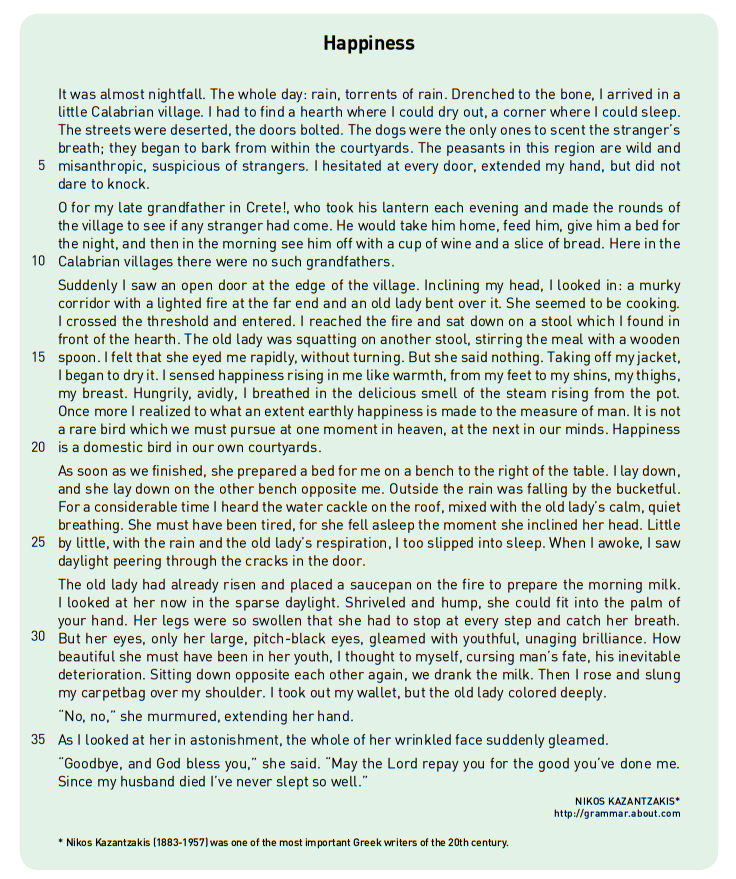
The first paragraph describes the terrible weather, the physical state of the narrator and his unfavorable view of the village and its inhabitants.
From this beginning, one can infer that the narrator did not expect the peasants to:


( ) Short people don’t make as much money as tall people. ( ) Thin workers earn less money than fat ones. ( ) Short people can handle difficult situations more easily than tall ones. ( ) Tall people aren’t usually considered as intelligent as shorter ones.
The correct sequence, from top to bottom, is

The expression “take the lead” in this sentence should be understood as
The answer to this question is in
Fill in the parentheses with True or False.
According to the text, it’s correct to say:
( ) Concentrating Solar Power (CSP) is a great achievement in energy production.
( ) Most of the European countries are already importing electricity from the plants in the Sahara desert.
( ) Only one CSP factory is enough to provide all the energy needed by a modern city.
( ) An advantage of CSP towers is that they can work with just one large mirror.
The correct sequence, from top to bottom, is
Tate Modern – London
Hélio Oiticica
Until Summer 2019

Tropicália
Tropicália is used to describe the explosion of cultural creativity in Rio de Janeiro and São Paulo in 1968 as Brazil’s military regime tightened its grip on power.
Many of the artists, writers and musicians associated with Tropicália came of age during the 1950s in a time of intense optimism when the cultural world had been encouraged to play a central role in the creation of a democratic, socially just and modern Brazil. Nevertheless, a military coup in 1964 had brought to power a right-wing regime at odds with the concerns of left-wing artists. Tropicália became a way of exposing the contradictions of modernisation under such an authoritarian rule.
The word Tropicália comes from an installation by the artist Hélio Oiticica, who created environments that were designed to encourage the viewer’s emotional and intellectual participation. Oiticica called them “penetrables” because people were originally encouraged to enter them. They mimic the improvised, colourful dwellings in Rio de Janeiro’s favelas, or shanty towns. The lush plants and sand help to convey a sense of the tropical character of the city. When Oiticica exhibited the work, he also included live parrots.
From its beginning, Tropicália was seen as a re-articulation of Anthropophagia (“cannibalism”), an artistic ideology promoted by Oswald de Andrade.
(www.tate.org.uk. Adaptado.)
Tate Modern – London
Hélio Oiticica
Until Summer 2019
Tropicália
Tropicália is used to describe the explosion of cultural creativity in Rio de Janeiro and São Paulo in 1968 as Brazil’s military regime tightened its grip on power.
Many of the artists, writers and musicians associated with Tropicália came of age during the 1950s in a time of intense optimism when the cultural world had been encouraged to play a central role in the creation of a democratic, socially just and modern Brazil. Nevertheless, a military coup in 1964 had brought to power a right-wing regime at odds with the concerns of left-wing artists. Tropicália became a way of exposing the contradictions of modernisation under such an authoritarian rule.
The word Tropicália comes from an installation by the artist Hélio Oiticica, who created environments that were designed to encourage the viewer’s emotional and intellectual participation. Oiticica called them “penetrables” because people were originally encouraged to enter them. They mimic the improvised, colourful dwellings in Rio de Janeiro’s favelas, or shanty towns. The lush plants and sand help to convey a sense of the tropical character of the city. When Oiticica exhibited the work, he also included live parrots.
From its beginning, Tropicália was seen as a re-articulation of Anthropophagia (“cannibalism”), an artistic ideology promoted by Oswald de Andrade.
(www.tate.org.uk. Adaptado.)
Tate Modern – London
Hélio Oiticica
Until Summer 2019
Tropicália
Tropicália is used to describe the explosion of cultural creativity in Rio de Janeiro and São Paulo in 1968 as Brazil’s military regime tightened its grip on power.
Many of the artists, writers and musicians associated with Tropicália came of age during the 1950s in a time of intense optimism when the cultural world had been encouraged to play a central role in the creation of a democratic, socially just and modern Brazil. Nevertheless, a military coup in 1964 had brought to power a right-wing regime at odds with the concerns of left-wing artists. Tropicália became a way of exposing the contradictions of modernisation under such an authoritarian rule.
The word Tropicália comes from an installation by the artist Hélio Oiticica, who created environments that were designed to encourage the viewer’s emotional and intellectual participation. Oiticica called them “penetrables” because people were originally encouraged to enter them. They mimic the improvised, colourful dwellings in Rio de Janeiro’s favelas, or shanty towns. The lush plants and sand help to convey a sense of the tropical character of the city. When Oiticica exhibited the work, he also included live parrots.
From its beginning, Tropicália was seen as a re-articulation of Anthropophagia (“cannibalism”), an artistic ideology promoted by Oswald de Andrade.
(www.tate.org.uk. Adaptado.)

 Conheça nossos planos