Questões de Vestibular Comentadas sobre inglês
Foram encontradas 2.761 questões
Why so few nurses are men

Ask health professionals in any country what the biggest problem in their health-care system is and one of the most common answers is the shortage of nurses. In ageing rich countries, demand for nursing care is becoming increasingly insatiable. Britain’s National Health Service, for example, has 40,000-odd nurse vacancies. Poor countries struggle with the emigration of nurses for greener pastures. One obvious solution seems neglected: recruit more men. Typically, just 5-10% of nurses registered in a given country are men. Why so few?
Views of nursing as a “woman’s job” have deep roots. Florence Nightingale, who established the principles of modern nursing in the 1860s, insisted that men’s “hard and horny” hands were “not fitted to touch, bathe and dress wounded limbs”. In Britain the Royal College of Nursing, the profession’s union, did not even admit men as members until 1960. Some nursing schools in America started admitting men only in 1982, after a Supreme Court ruling forced them to. Senior nurse titles such as “sister” (a ward manager) and “matron” (which in some countries is used for men as well) do not help matters. Unsurprisingly, some older people do not even know that men can be nurses too. Male nurses often encounter patients who assume they are doctors.
Another problem is that beliefs about what a nursing job entails are often outdated – in ways that may be particularly off-putting for men. In films, nurses are commonly portrayed as the helpers of heroic male doctors. In fact, nurses do most of their work independently and are the first responders to patients in crisis. To dispel myths, nurse-recruitment campaigns display nursing as a professional job with career progression, specialisms like anaesthetics, cardiology or emergency care, and use for skills related to technology, innovation and leadership. However, attracting men without playing to gender stereotypes can be tricky. “Are you man enough to be a nurse?”, the slogan of an American campaign, was involved in controversy.
Nursing is not a career many boys aspire to, or are encouraged to consider. Only two-fifths of British parents say they would be proud if their son became a nurse. Because of all this, men who go into nursing are usually already closely familiar with the job. Some are following in the career footsteps of their mothers. Others decide that the job would suit them after they see a male nurse care for a relative or they themselves get care from a male nurse when hospitalised. Although many gender stereotypes about jobs and caring have crumbled, nursing has, so far, remained unaffected.
(www.economist.com, 22.08.2018. Adaptado.)
Why so few nurses are men

Ask health professionals in any country what the biggest problem in their health-care system is and one of the most common answers is the shortage of nurses. In ageing rich countries, demand for nursing care is becoming increasingly insatiable. Britain’s National Health Service, for example, has 40,000-odd nurse vacancies. Poor countries struggle with the emigration of nurses for greener pastures. One obvious solution seems neglected: recruit more men. Typically, just 5-10% of nurses registered in a given country are men. Why so few?
Views of nursing as a “woman’s job” have deep roots. Florence Nightingale, who established the principles of modern nursing in the 1860s, insisted that men’s “hard and horny” hands were “not fitted to touch, bathe and dress wounded limbs”. In Britain the Royal College of Nursing, the profession’s union, did not even admit men as members until 1960. Some nursing schools in America started admitting men only in 1982, after a Supreme Court ruling forced them to. Senior nurse titles such as “sister” (a ward manager) and “matron” (which in some countries is used for men as well) do not help matters. Unsurprisingly, some older people do not even know that men can be nurses too. Male nurses often encounter patients who assume they are doctors.
Another problem is that beliefs about what a nursing job entails are often outdated – in ways that may be particularly off-putting for men. In films, nurses are commonly portrayed as the helpers of heroic male doctors. In fact, nurses do most of their work independently and are the first responders to patients in crisis. To dispel myths, nurse-recruitment campaigns display nursing as a professional job with career progression, specialisms like anaesthetics, cardiology or emergency care, and use for skills related to technology, innovation and leadership. However, attracting men without playing to gender stereotypes can be tricky. “Are you man enough to be a nurse?”, the slogan of an American campaign, was involved in controversy.
Nursing is not a career many boys aspire to, or are encouraged to consider. Only two-fifths of British parents say they would be proud if their son became a nurse. Because of all this, men who go into nursing are usually already closely familiar with the job. Some are following in the career footsteps of their mothers. Others decide that the job would suit them after they see a male nurse care for a relative or they themselves get care from a male nurse when hospitalised. Although many gender stereotypes about jobs and caring have crumbled, nursing has, so far, remained unaffected.
(www.economist.com, 22.08.2018. Adaptado.)
Why so few nurses are men

Ask health professionals in any country what the biggest problem in their health-care system is and one of the most common answers is the shortage of nurses. In ageing rich countries, demand for nursing care is becoming increasingly insatiable. Britain’s National Health Service, for example, has 40,000-odd nurse vacancies. Poor countries struggle with the emigration of nurses for greener pastures. One obvious solution seems neglected: recruit more men. Typically, just 5-10% of nurses registered in a given country are men. Why so few?
Views of nursing as a “woman’s job” have deep roots. Florence Nightingale, who established the principles of modern nursing in the 1860s, insisted that men’s “hard and horny” hands were “not fitted to touch, bathe and dress wounded limbs”. In Britain the Royal College of Nursing, the profession’s union, did not even admit men as members until 1960. Some nursing schools in America started admitting men only in 1982, after a Supreme Court ruling forced them to. Senior nurse titles such as “sister” (a ward manager) and “matron” (which in some countries is used for men as well) do not help matters. Unsurprisingly, some older people do not even know that men can be nurses too. Male nurses often encounter patients who assume they are doctors.
Another problem is that beliefs about what a nursing job entails are often outdated – in ways that may be particularly off-putting for men. In films, nurses are commonly portrayed as the helpers of heroic male doctors. In fact, nurses do most of their work independently and are the first responders to patients in crisis. To dispel myths, nurse-recruitment campaigns display nursing as a professional job with career progression, specialisms like anaesthetics, cardiology or emergency care, and use for skills related to technology, innovation and leadership. However, attracting men without playing to gender stereotypes can be tricky. “Are you man enough to be a nurse?”, the slogan of an American campaign, was involved in controversy.
Nursing is not a career many boys aspire to, or are encouraged to consider. Only two-fifths of British parents say they would be proud if their son became a nurse. Because of all this, men who go into nursing are usually already closely familiar with the job. Some are following in the career footsteps of their mothers. Others decide that the job would suit them after they see a male nurse care for a relative or they themselves get care from a male nurse when hospitalised. Although many gender stereotypes about jobs and caring have crumbled, nursing has, so far, remained unaffected.
(www.economist.com, 22.08.2018. Adaptado.)
Why so few nurses are men

Ask health professionals in any country what the biggest problem in their health-care system is and one of the most common answers is the shortage of nurses. In ageing rich countries, demand for nursing care is becoming increasingly insatiable. Britain’s National Health Service, for example, has 40,000-odd nurse vacancies. Poor countries struggle with the emigration of nurses for greener pastures. One obvious solution seems neglected: recruit more men. Typically, just 5-10% of nurses registered in a given country are men. Why so few?
Views of nursing as a “woman’s job” have deep roots. Florence Nightingale, who established the principles of modern nursing in the 1860s, insisted that men’s “hard and horny” hands were “not fitted to touch, bathe and dress wounded limbs”. In Britain the Royal College of Nursing, the profession’s union, did not even admit men as members until 1960. Some nursing schools in America started admitting men only in 1982, after a Supreme Court ruling forced them to. Senior nurse titles such as “sister” (a ward manager) and “matron” (which in some countries is used for men as well) do not help matters. Unsurprisingly, some older people do not even know that men can be nurses too. Male nurses often encounter patients who assume they are doctors.
Another problem is that beliefs about what a nursing job entails are often outdated – in ways that may be particularly off-putting for men. In films, nurses are commonly portrayed as the helpers of heroic male doctors. In fact, nurses do most of their work independently and are the first responders to patients in crisis. To dispel myths, nurse-recruitment campaigns display nursing as a professional job with career progression, specialisms like anaesthetics, cardiology or emergency care, and use for skills related to technology, innovation and leadership. However, attracting men without playing to gender stereotypes can be tricky. “Are you man enough to be a nurse?”, the slogan of an American campaign, was involved in controversy.
Nursing is not a career many boys aspire to, or are encouraged to consider. Only two-fifths of British parents say they would be proud if their son became a nurse. Because of all this, men who go into nursing are usually already closely familiar with the job. Some are following in the career footsteps of their mothers. Others decide that the job would suit them after they see a male nurse care for a relative or they themselves get care from a male nurse when hospitalised. Although many gender stereotypes about jobs and caring have crumbled, nursing has, so far, remained unaffected.
(www.economist.com, 22.08.2018. Adaptado.)
Why so few nurses are men

Ask health professionals in any country what the biggest problem in their health-care system is and one of the most common answers is the shortage of nurses. In ageing rich countries, demand for nursing care is becoming increasingly insatiable. Britain’s National Health Service, for example, has 40,000-odd nurse vacancies. Poor countries struggle with the emigration of nurses for greener pastures. One obvious solution seems neglected: recruit more men. Typically, just 5-10% of nurses registered in a given country are men. Why so few?
Views of nursing as a “woman’s job” have deep roots. Florence Nightingale, who established the principles of modern nursing in the 1860s, insisted that men’s “hard and horny” hands were “not fitted to touch, bathe and dress wounded limbs”. In Britain the Royal College of Nursing, the profession’s union, did not even admit men as members until 1960. Some nursing schools in America started admitting men only in 1982, after a Supreme Court ruling forced them to. Senior nurse titles such as “sister” (a ward manager) and “matron” (which in some countries is used for men as well) do not help matters. Unsurprisingly, some older people do not even know that men can be nurses too. Male nurses often encounter patients who assume they are doctors.
Another problem is that beliefs about what a nursing job entails are often outdated – in ways that may be particularly off-putting for men. In films, nurses are commonly portrayed as the helpers of heroic male doctors. In fact, nurses do most of their work independently and are the first responders to patients in crisis. To dispel myths, nurse-recruitment campaigns display nursing as a professional job with career progression, specialisms like anaesthetics, cardiology or emergency care, and use for skills related to technology, innovation and leadership. However, attracting men without playing to gender stereotypes can be tricky. “Are you man enough to be a nurse?”, the slogan of an American campaign, was involved in controversy.
Nursing is not a career many boys aspire to, or are encouraged to consider. Only two-fifths of British parents say they would be proud if their son became a nurse. Because of all this, men who go into nursing are usually already closely familiar with the job. Some are following in the career footsteps of their mothers. Others decide that the job would suit them after they see a male nurse care for a relative or they themselves get care from a male nurse when hospitalised. Although many gender stereotypes about jobs and caring have crumbled, nursing has, so far, remained unaffected.
(www.economist.com, 22.08.2018. Adaptado.)
Why so few nurses are men

Ask health professionals in any country what the biggest problem in their health-care system is and one of the most common answers is the shortage of nurses. In ageing rich countries, demand for nursing care is becoming increasingly insatiable. Britain’s National Health Service, for example, has 40,000-odd nurse vacancies. Poor countries struggle with the emigration of nurses for greener pastures. One obvious solution seems neglected: recruit more men. Typically, just 5-10% of nurses registered in a given country are men. Why so few?
Views of nursing as a “woman’s job” have deep roots. Florence Nightingale, who established the principles of modern nursing in the 1860s, insisted that men’s “hard and horny” hands were “not fitted to touch, bathe and dress wounded limbs”. In Britain the Royal College of Nursing, the profession’s union, did not even admit men as members until 1960. Some nursing schools in America started admitting men only in 1982, after a Supreme Court ruling forced them to. Senior nurse titles such as “sister” (a ward manager) and “matron” (which in some countries is used for men as well) do not help matters. Unsurprisingly, some older people do not even know that men can be nurses too. Male nurses often encounter patients who assume they are doctors.
Another problem is that beliefs about what a nursing job entails are often outdated – in ways that may be particularly off-putting for men. In films, nurses are commonly portrayed as the helpers of heroic male doctors. In fact, nurses do most of their work independently and are the first responders to patients in crisis. To dispel myths, nurse-recruitment campaigns display nursing as a professional job with career progression, specialisms like anaesthetics, cardiology or emergency care, and use for skills related to technology, innovation and leadership. However, attracting men without playing to gender stereotypes can be tricky. “Are you man enough to be a nurse?”, the slogan of an American campaign, was involved in controversy.
Nursing is not a career many boys aspire to, or are encouraged to consider. Only two-fifths of British parents say they would be proud if their son became a nurse. Because of all this, men who go into nursing are usually already closely familiar with the job. Some are following in the career footsteps of their mothers. Others decide that the job would suit them after they see a male nurse care for a relative or they themselves get care from a male nurse when hospitalised. Although many gender stereotypes about jobs and caring have crumbled, nursing has, so far, remained unaffected.
(www.economist.com, 22.08.2018. Adaptado.)
Why so few nurses are men

Ask health professionals in any country what the biggest problem in their health-care system is and one of the most common answers is the shortage of nurses. In ageing rich countries, demand for nursing care is becoming increasingly insatiable. Britain’s National Health Service, for example, has 40,000-odd nurse vacancies. Poor countries struggle with the emigration of nurses for greener pastures. One obvious solution seems neglected: recruit more men. Typically, just 5-10% of nurses registered in a given country are men. Why so few?
Views of nursing as a “woman’s job” have deep roots. Florence Nightingale, who established the principles of modern nursing in the 1860s, insisted that men’s “hard and horny” hands were “not fitted to touch, bathe and dress wounded limbs”. In Britain the Royal College of Nursing, the profession’s union, did not even admit men as members until 1960. Some nursing schools in America started admitting men only in 1982, after a Supreme Court ruling forced them to. Senior nurse titles such as “sister” (a ward manager) and “matron” (which in some countries is used for men as well) do not help matters. Unsurprisingly, some older people do not even know that men can be nurses too. Male nurses often encounter patients who assume they are doctors.
Another problem is that beliefs about what a nursing job entails are often outdated – in ways that may be particularly off-putting for men. In films, nurses are commonly portrayed as the helpers of heroic male doctors. In fact, nurses do most of their work independently and are the first responders to patients in crisis. To dispel myths, nurse-recruitment campaigns display nursing as a professional job with career progression, specialisms like anaesthetics, cardiology or emergency care, and use for skills related to technology, innovation and leadership. However, attracting men without playing to gender stereotypes can be tricky. “Are you man enough to be a nurse?”, the slogan of an American campaign, was involved in controversy.
Nursing is not a career many boys aspire to, or are encouraged to consider. Only two-fifths of British parents say they would be proud if their son became a nurse. Because of all this, men who go into nursing are usually already closely familiar with the job. Some are following in the career footsteps of their mothers. Others decide that the job would suit them after they see a male nurse care for a relative or they themselves get care from a male nurse when hospitalised. Although many gender stereotypes about jobs and caring have crumbled, nursing has, so far, remained unaffected.
(www.economist.com, 22.08.2018. Adaptado.)

The woman
Words that define the presente
At a time when the world is changing more quickly than ever before, we need a new vocabulary to help us grasp what’s happening.

Catfishing. This word would make more sense if it referred to fishing for cats, but in fact, it refers to people who construct false identities online. Whether out of boredom, loneliness or malice, they lure other people into continued messaging correspondence, thereby building false relationships with them (the apparent source of the term “catfish” is a 2010 documentary called Catfish, whose verity, ironically enough, has been questioned).
There are two ways of looking at this: 1) The internet/ cyberspace is wonderful, because it gives people the freedom to augment or totally change their identities, and this is a marvellous new dawn for human expression, a new step in human evolution. 2) Nah, it’s a false dawn, because the internet is essentially a libertarian arena, and, as such, an amoral one (lots of “freedoms” but with no attendant social obligations); it is a new jungle where we must watch our backs and struggle for survival, surely a backward step in evolution. I lean toward the latter.
(Cameron Laux. www.bbc.com, 08.08.2018. Adaptado.)
Words that define the presente
At a time when the world is changing more quickly than ever before, we need a new vocabulary to help us grasp what’s happening.

Catfishing. This word would make more sense if it referred to fishing for cats, but in fact, it refers to people who construct false identities online. Whether out of boredom, loneliness or malice, they lure other people into continued messaging correspondence, thereby building false relationships with them (the apparent source of the term “catfish” is a 2010 documentary called Catfish, whose verity, ironically enough, has been questioned).
There are two ways of looking at this: 1) The internet/ cyberspace is wonderful, because it gives people the freedom to augment or totally change their identities, and this is a marvellous new dawn for human expression, a new step in human evolution. 2) Nah, it’s a false dawn, because the internet is essentially a libertarian arena, and, as such, an amoral one (lots of “freedoms” but with no attendant social obligations); it is a new jungle where we must watch our backs and struggle for survival, surely a backward step in evolution. I lean toward the latter.
(Cameron Laux. www.bbc.com, 08.08.2018. Adaptado.)
Words that define the presente
At a time when the world is changing more quickly than ever before, we need a new vocabulary to help us grasp what’s happening.

Catfishing. This word would make more sense if it referred to fishing for cats, but in fact, it refers to people who construct false identities online. Whether out of boredom, loneliness or malice, they lure other people into continued messaging correspondence, thereby building false relationships with them (the apparent source of the term “catfish” is a 2010 documentary called Catfish, whose verity, ironically enough, has been questioned).
There are two ways of looking at this: 1) The internet/ cyberspace is wonderful, because it gives people the freedom to augment or totally change their identities, and this is a marvellous new dawn for human expression, a new step in human evolution. 2) Nah, it’s a false dawn, because the internet is essentially a libertarian arena, and, as such, an amoral one (lots of “freedoms” but with no attendant social obligations); it is a new jungle where we must watch our backs and struggle for survival, surely a backward step in evolution. I lean toward the latter.
(Cameron Laux. www.bbc.com, 08.08.2018. Adaptado.)
Words that define the presente
At a time when the world is changing more quickly than ever before, we need a new vocabulary to help us grasp what’s happening.

Catfishing. This word would make more sense if it referred to fishing for cats, but in fact, it refers to people who construct false identities online. Whether out of boredom, loneliness or malice, they lure other people into continued messaging correspondence, thereby building false relationships with them (the apparent source of the term “catfish” is a 2010 documentary called Catfish, whose verity, ironically enough, has been questioned).
There are two ways of looking at this: 1) The internet/ cyberspace is wonderful, because it gives people the freedom to augment or totally change their identities, and this is a marvellous new dawn for human expression, a new step in human evolution. 2) Nah, it’s a false dawn, because the internet is essentially a libertarian arena, and, as such, an amoral one (lots of “freedoms” but with no attendant social obligations); it is a new jungle where we must watch our backs and struggle for survival, surely a backward step in evolution. I lean toward the latter.
(Cameron Laux. www.bbc.com, 08.08.2018. Adaptado.)
Words that define the presente
At a time when the world is changing more quickly than ever before, we need a new vocabulary to help us grasp what’s happening.

Catfishing. This word would make more sense if it referred to fishing for cats, but in fact, it refers to people who construct false identities online. Whether out of boredom, loneliness or malice, they lure other people into continued messaging correspondence, thereby building false relationships with them (the apparent source of the term “catfish” is a 2010 documentary called Catfish, whose verity, ironically enough, has been questioned).
There are two ways of looking at this: 1) The internet/ cyberspace is wonderful, because it gives people the freedom to augment or totally change their identities, and this is a marvellous new dawn for human expression, a new step in human evolution. 2) Nah, it’s a false dawn, because the internet is essentially a libertarian arena, and, as such, an amoral one (lots of “freedoms” but with no attendant social obligations); it is a new jungle where we must watch our backs and struggle for survival, surely a backward step in evolution. I lean toward the latter.
(Cameron Laux. www.bbc.com, 08.08.2018. Adaptado.)
CAGED BIRD
Maya Angelou
A free bird leaps
on the back of the wind
and floats downstream
till the current ends
and dips his wing
in the orange sun rays
and dares to claim the sky.
But a bird that stalks
down his narrow cage
can seldom see through
his bars of rage
his wings are clipped and
his feet are tied
so he opens his throat to sing.
The caged bird sings
with a fearful trill
of things unknown
but longed for still
and his tune is heard
on the distant hill
for the caged bird
sings of freedom.
The free bird thinks of another breeze
and the trade winds soft through the sighing trees
and the fat worms waiting on a dawn bright lawn
and he names the sky his own.
But a caged bird stands on the grave of dreams
his shadow shouts on a nightmare scream
his wings are clipped and his feet are tied
so he opens his throat to sing.
Adaptado de ANGELOU, M. “Caged Bird” In: The Poetry Foundation (website). Disponível em www.poetryfoundation.org
Nota sobre a autora: Maya Angelou (1924-2014) foi uma poeta norte-americana que explorou em suas obras
temas como a segregação racial, a desigualdade de gêneros e a opressão social entre outros.
CAGED BIRD
Maya Angelou
A free bird leaps
on the back of the wind
and floats downstream
till the current ends
and dips his wing
in the orange sun rays
and dares to claim the sky.
But a bird that stalks
down his narrow cage
can seldom see through
his bars of rage
his wings are clipped and
his feet are tied
so he opens his throat to sing.
The caged bird sings
with a fearful trill
of things unknown
but longed for still
and his tune is heard
on the distant hill
for the caged bird
sings of freedom.
The free bird thinks of another breeze
and the trade winds soft through the sighing trees
and the fat worms waiting on a dawn bright lawn
and he names the sky his own.
But a caged bird stands on the grave of dreams
his shadow shouts on a nightmare scream
his wings are clipped and his feet are tied
so he opens his throat to sing.
Adaptado de ANGELOU, M. “Caged Bird” In: The Poetry Foundation (website). Disponível em www.poetryfoundation.org
Nota sobre a autora: Maya Angelou (1924-2014) foi uma poeta norte-americana que explorou em suas obras
temas como a segregação racial, a desigualdade de gêneros e a opressão social entre outros.
Em relação à comparação entre os pássaros presente no poema, considere as afirmativas a seguir.
I. Os verbos “leaps”, “floats” e “dips”, na primeira estrofe, descrevem a relação positiva que o pássaro tem com a natureza, decorrente de sua liberdade.
II. As palavras “narrow” e “seldom”, na segunda estrofe, enfatizam a sensação de aprisionamento do pássaro engaiolado.
III. O uso do adjetivo “fearful” em “fearful trill” remete ao tom ameaçador do canto do pássaro engaiolado.
IV. No verso “and dares to claim the sky”, o verbo “to claim” é utilizado para realçar o egoísmo do pássaro livre.
Assinale a alternativa correta.
CAGED BIRD
Maya Angelou
A free bird leaps
on the back of the wind
and floats downstream
till the current ends
and dips his wing
in the orange sun rays
and dares to claim the sky.
But a bird that stalks
down his narrow cage
can seldom see through
his bars of rage
his wings are clipped and
his feet are tied
so he opens his throat to sing.
The caged bird sings
with a fearful trill
of things unknown
but longed for still
and his tune is heard
on the distant hill
for the caged bird
sings of freedom.
The free bird thinks of another breeze
and the trade winds soft through the sighing trees
and the fat worms waiting on a dawn bright lawn
and he names the sky his own.
But a caged bird stands on the grave of dreams
his shadow shouts on a nightmare scream
his wings are clipped and his feet are tied
so he opens his throat to sing.
Adaptado de ANGELOU, M. “Caged Bird” In: The Poetry Foundation (website). Disponível em www.poetryfoundation.org
Nota sobre a autora: Maya Angelou (1924-2014) foi uma poeta norte-americana que explorou em suas obras
temas como a segregação racial, a desigualdade de gêneros e a opressão social entre outros.

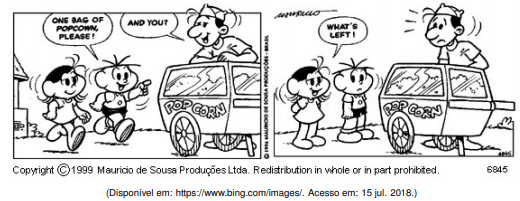
Mafalda, personagem famosa por seu pensamento crítico, discute um tema de grande importância para o mundo.
Aponte a alternativa que melhor explica o contido na tirinha lida.
Texto 4:
Venezuelan official suggests migrant crisis is staged to undermine government
Diosdado Cabello implied that photos and news of refugees fleeing through South America on foot are fake as the UN warns the situation is nearing a ‘crisis moment’
Tom Phillips Latin America correspondent
Venezuela’s number two official has suggested his country’s escalating migration crisis – described by the United Nations as one of the worst in Latin American history – is being staged as part of a rightwing ruse to undermine his government.
Speaking at a congress of the ruling United Social party this week, Diosdado Cabello implied that images of Venezuelans fleeing through South America on foot had been manufactured. “It’s as if it was: ‘Lights, camera, action!’ It is a campaign against our country – a campaign of extraordinary dimensions,” Cabello added.
The UN estimates 2.3 million Venezuelans have fled since
2015 with Colombia expecting 2 million more to follow by
2020. That would mean 4.3 million people – 14% of
Venezuela’s population – had left. Last week, the UN’s
migration agency warned the mass migration is nearing a
“crisis moment” comparable to events involving refugees in
the Mediterranean. Many of those now heading into
neighbouring countries such as Brazil and Colombia are so
impoverished they do so on foot.

The UN estimates 2.3 million Venezuelans have fled since 2015 with Colombia expecting 2 million more to follow by 2020. Photograph: Evelin Rosas/EPA
On Tuesday, Venezuelan state media trumpeted the “repatriation” of 89 migrants who had reportedly been flown home from Peru free of charge after suffering exploitation abroad.
Disponível em https://www.theguardian.com/world/2018/aug/28/venezuela-diosdado-cabello-refugee-footage-fake. Acessado em 22/10/2018
O jornal The Guardian retrata um problema social vivido, sobretudo, em 2018, pelos venezuelanos. Com base no texto
lido, aponte a alternativa que retrata mais adequadamente a posição do governo da Venezuela sobre o assunto:
Texto 3:
Born Too Soon in a Country at War. Their Only Hope? This Clinic. By Kassie Bracken and Megan Special August 27, 2018
The baby girl has stopped breathing. She was born prematurely and is only 3 weeks old. Her mother, Restina Boniface, took her to the only public neonatal clinic in South Sudan. The country is one of the toughest places in the world for newborns with health problems to survive. Ten feet away sits a donated respiratory machine that could save the baby. But lacking a critical part, it goes unused. The doctor tries to resuscitate the baby for several minutes. Finally, she begins breathing on her own. One in 10 babies brought to this clinic will die, most from treatable conditions. But many mothers have nowhere else to go.
South Sudan, the world’s youngest nation, is in the midst of a humanitarian crisis. A brutal civil war has drained the economy. As hospitals closed, doctors were forced to flee. Inside the clinic, many babies remain nameless. Their mothers know they may not make it. “Our mothers here, they come for help,” said Rose Tongan, a pediatrician. “And you pity them. You can’t do anything.” Electricity cuts out for days at a time. There is no formula for the premature babies, no lab for blood tests, no facility for X-rays. There are no beds for breast-feeding mothers. They must sleep outside, where they are at risk of infection and vulnerable to assault. “I feel like: What can I do?” Dr. Tongan said.
Hellen Sitima’s 3-day-old daughter is sick. “When we get home, then that’s the time to name the baby,” she says. Dr. Tongan has no access to lab tests, but she determines that Ms. Sitima’s baby has a respiratory infection. The infection clears, and Ms. Sitima takes her daughter home. She names her Gift.
Disponível em https://www.nytimes.com/interactive/2018/08/28/multimedia/ south-sudan-babies.html. Acessado em 22/10/2018
O texto relata a situação crítica em que se encontram hospitais no Sudão do Sul e de alguns pacientes que deles precisam para sobreviver. Assim sendo, assinale a alternativa que corresponde ao lido:
Texto 2:
Are LED lights making us ill?
By Lucy Jones
Over the last decade, much of Europe and the US have changed the way they illuminate city and town streets. They have replaced high-energy sodium bulbs (the warmer, yellow ones) with energy-saving LED bulbs (with a blue light emitting diode, which can feel harsh in comparison). As well as street lights, most of us are exposed to blue light through smartphones, computers, TVs, and in the home.
The World Journal of Biological Psychiatry published a paper that warned of the potential effects of LED lighting on mental illness. It raised concerns about the influence of blue light on sleep, other circadian-mediated symptoms, use of digital healthcare apps and devices, and the higher sensitivity of teenagers to blue light. Specifically, the researchers are concerned about the relationship between light exposure and the occurrence of manic and mixed symptoms in bipolar disorder, having adverse effects on manic states and the sleep-wake cycle. For example, the use of smartphones or computers by those people before bed could have a bad effect on their sleep, circadian rhythms and health.
Studies of the impact of blue light on healthy adults show it inhibits melatonin secretion which disrupts sleep and can affect quality of life, physical and mental health and susceptibility to illness.
Previous studies of sleep disorders in children and adolescents show a clear and consistent relationship between sleep disorders and frequency of digital device usage.
Currently, the National Sleep Foundation guidelines suggest not using technology 30 minutes before bed and removing technology for the bedroom. However, there are currently no specific guidelines for people with an underlying mental illness or sensitivity to circadian disruption.
As LED technology has rapidly spread across the globe, the focus has been on the visual element and the energysaving element. Now, scientists, health professionals and the LED industry are working to minimise the blue light in LEDs and create customisable lights that won’t harm those suffering from psychiatric disorders.
Disponível em https://www.bbcearth.com/blog/?article=are-led-lights-making-us-ill Acessado em 22/10/2018
A rápida substituição de lâmpadas comuns por lâmpadas de LED em todos os setores e locais tiveram duas razões
principais: a visual e a economia de energia. Porém, importantes estudos estão investigando se há consequências
deste uso para a saúde. Assim, de acordo com o texto, é possível dizer que: