Questões de Vestibular Comentadas sobre inglês
Foram encontradas 2.807 questões


Q229464
Inglês
Texto associado
Leia o texto abaixo e responda às questões de 1 a 3.
Hitting Children is Wrong and the Law Must Say So - Now
NEWELL, Peter. Disponível em: . Acesso em: 16 ago. 2010. (Adaptado).
Hitting Children is Wrong and the Law Must Say So - Now
Ending corporal punishment is an issue which touches most people very personally. Most of us were hit as
children; most parents have hit their growing children. So far, globally, only about 17 states have completely
prohibited all corporal punishment, with six or seven more committed to do so. In this region, I know that at least
two – Brazil and Costa Rica – have had prohibition Bills presented to their Parliaments.
At the first two Regional Consultations for the UN Secretary General’s Study, in the Caribbean and two weeks
ago in South Asia, clear recommendations to prohibit all corporal punishment, including in the family, were
adopted. But I still heard government officials and NGOs and others making more excuses: “We must wait until
there is more support for parents; more training for teachers; smaller classes. Let’s educate first and then
change the law…” and so on. From children’s perspective this is intolerable. From the perspective of
international human rights law it is illegal. Why should children wait? Would we wait to prohibit violence against
women until we can provide full employment and universal anger management classes for men? Would we wait
to ban hitting of elderly confused relatives until we have full-time nursing care, and full training for all carers,
available for them?
No more excuses: this UN Study provides the opportunity to move quickly on, to put in the past the idea that
states should authorise violence against children and instead focus on giving priority to ending all violence
against children. State governments and all of us have to take a deep breath and stop deceiving ourselves -
hitting children is wrong and the law must say so - now.
children; most parents have hit their growing children. So far, globally, only about 17 states have completely
prohibited all corporal punishment, with six or seven more committed to do so. In this region, I know that at least
two – Brazil and Costa Rica – have had prohibition Bills presented to their Parliaments.
At the first two Regional Consultations for the UN Secretary General’s Study, in the Caribbean and two weeks
ago in South Asia, clear recommendations to prohibit all corporal punishment, including in the family, were
adopted. But I still heard government officials and NGOs and others making more excuses: “We must wait until
there is more support for parents; more training for teachers; smaller classes. Let’s educate first and then
change the law…” and so on. From children’s perspective this is intolerable. From the perspective of
international human rights law it is illegal. Why should children wait? Would we wait to prohibit violence against
women until we can provide full employment and universal anger management classes for men? Would we wait
to ban hitting of elderly confused relatives until we have full-time nursing care, and full training for all carers,
available for them?
No more excuses: this UN Study provides the opportunity to move quickly on, to put in the past the idea that
states should authorise violence against children and instead focus on giving priority to ending all violence
against children. State governments and all of us have to take a deep breath and stop deceiving ourselves -
hitting children is wrong and the law must say so - now.
NEWELL, Peter. Disponível em:
. Acesso em: 16 ago. 2010. (Adaptado).
De acordo com o conteúdo do texto, é CORRETO afirmar:
Q228717
Inglês
Read the comics below to answer question 29
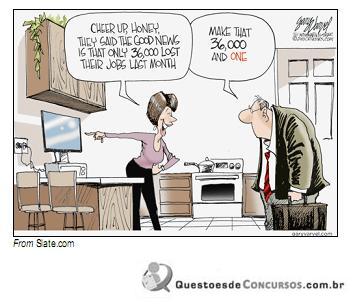
Considering the sentence "They said the good news is that only 36,000 lost their jobs last month", if we change the pronoun they for he, the word their in the same sentence must:
Considering the sentence "They said the good news is that only 36,000 lost their jobs last month", if we change the pronoun they for he, the word their in the same sentence must:
Q228630
Inglês
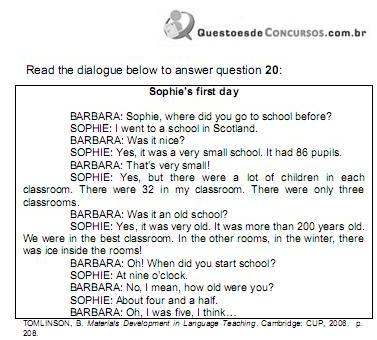
Read the statements below and mark the INCORRECT one according to the text:
Q228629
Inglês
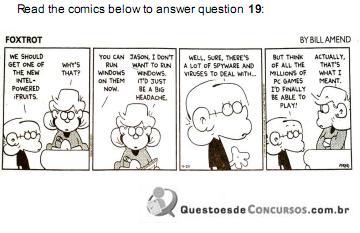
Read the statements below and mark the CORRECT answer:
Q222451
Inglês
According to Chimamanda Adichie, “The single story creates stereotypes. And the problem with stereotypes is not that they are untrue, but that they are incomplete. They make one story become the only story”. Which of these statements is a stereotype about Nigeria?
Q222331
Inglês
“They can’t put up with this any longer” means:
Q222330
Inglês
Choose the alternative that best completes the sentence:
Charles normally ________ water, but now he ________ coke.
Charles normally ________ water, but now he ________ coke.
Q215699
Inglês
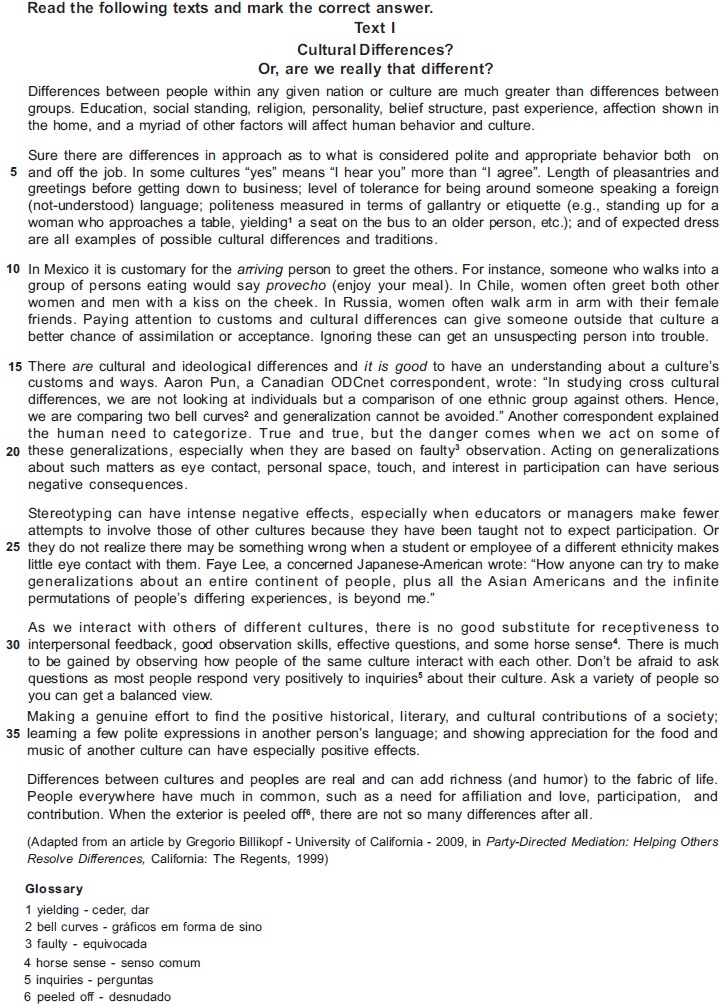
In Text II, the cartoon shows people from different continents, consequently from different cultures, interacting in real time on the internet. Mark the excerpt from Text I which may establish a link with Text II.
Q215698
Inglês
EXEMPLIFICATION is used by the author of the text to develop his argumentation. In paragraph 7, through the use of exemplification, the author
Q215697
Inglês
In “There is much to be gained by observing how people of the same culture interact with each other” (lines 30-31), the expression in bold could be replaced by
Q215696
Inglês
Discourse markers are used to provide cohesion to the text. In the excerpt “Hence, we are comparing two bell curves and generalization cannot be avoided” (lines 17-18), the discourse marker in bold expresses the following semantic relation:
Q215695
Inglês
According to what is stated in the 2nd paragraph, offering a seat on the bus to an older person is an example of
Q215694
Inglês
The meaning of unsuspecting (line 14) is
Q215693
Inglês
According to Text I, in order to interact successfully with people from a different culture, one must
Q215692
Inglês
The title of Text I reflects the author’s position regarding culture. Choose the statement in which this position is best conveyed.
Ano: 2010
Banca:
VUNESP
Órgão:
UNIFESP
Prova:
VUNESP - 2010 - UNIFESP - Vestibular - Língua Portuguesa, Língua Estrangeira e Redação |
Q215447
Inglês
Texto associado
Instrução: Leia o texto para responder às questões de números 40 a 45.
To Scientists, Laughter Is No Joke - It’s Serious
March 31, 2010.
(www.nytimes.com. Adaptado.)
To Scientists, Laughter Is No Joke - It’s Serious
March 31, 2010.
So a scientist walks into a shopping mall to watch people laugh. There’s no punchline. Laughter is a serious scientific subject, one that researchers are still trying to figure out. Laughing is primal, our first way of communicating. Apes laugh. So do dogs and rats. Babies laugh long before they speak. No one teaches you how to laugh. You just do. And often you laugh involuntarily, in a specific rhythm and in certain spots in conversation.
You may laugh at a prank on April Fools’ Day. But surprisingly, only 10 to 15 percent of laughter is the result of someone making a joke, said Baltimore neuroscientist Robert Provine, who has studied laughter for decades. Laughter is mostly about social responses rather than reaction to a joke. “Laughter above all else is a social thing,’’ Provine said. “The requirement for laughter is another person.’’
Over the years, Provine, a professor with the University of Maryland Baltimore County, has boiled laughter down to its basics. “All language groups laugh ‘ha-ha-ha’ basically the same way,’’ he said. “Whether you speak Mandarin, French or English, everyone will understand laughter. ... There’s a pattern generator in our brain that produces this sound.’’
Each “ha’’ is about one-15th of a second, repeated every fifth of a second, he said. Laugh faster or slower than that and it sounds more like panting or something else. Deaf people laugh without hearing, and people on cell phones laugh without seeing, illustrating that laughter isn’t dependent on a single sense but on social interactions, said Provine, author of the book “Laughter: A Scientific Investigation.’’
“It’s joy, it’s positive engagement with life,’’ said Jaak Panksepp, a Bowling Green University psychology professor. “It’s deeply social.’’ And it’s not just a people thing either. Chimps tickle each other and even laugh when another chimp pretends to tickle them. By studying rats, Panksepp and other scientists can figure out what’s going on in the brain during laughter. And it holds promise for human ills.
Northwestern biomedical engineering professor Jeffrey Burgdorf has found that laughter in rats produces an insulin-like growth factor chemical that acts as an antidepressant and anxietyreducer. He thinks the same thing probably happens in humans, too. This would give doctors a new chemical target in the brain in their effort to develop drugs that fight depression and anxiety in people. Even so, laughter itself hasn’t been proven to be the best medicine, experts said.
You may laugh at a prank on April Fools’ Day. But surprisingly, only 10 to 15 percent of laughter is the result of someone making a joke, said Baltimore neuroscientist Robert Provine, who has studied laughter for decades. Laughter is mostly about social responses rather than reaction to a joke. “Laughter above all else is a social thing,’’ Provine said. “The requirement for laughter is another person.’’
Over the years, Provine, a professor with the University of Maryland Baltimore County, has boiled laughter down to its basics. “All language groups laugh ‘ha-ha-ha’ basically the same way,’’ he said. “Whether you speak Mandarin, French or English, everyone will understand laughter. ... There’s a pattern generator in our brain that produces this sound.’’
Each “ha’’ is about one-15th of a second, repeated every fifth of a second, he said. Laugh faster or slower than that and it sounds more like panting or something else. Deaf people laugh without hearing, and people on cell phones laugh without seeing, illustrating that laughter isn’t dependent on a single sense but on social interactions, said Provine, author of the book “Laughter: A Scientific Investigation.’’
“It’s joy, it’s positive engagement with life,’’ said Jaak Panksepp, a Bowling Green University psychology professor. “It’s deeply social.’’ And it’s not just a people thing either. Chimps tickle each other and even laugh when another chimp pretends to tickle them. By studying rats, Panksepp and other scientists can figure out what’s going on in the brain during laughter. And it holds promise for human ills.
Northwestern biomedical engineering professor Jeffrey Burgdorf has found that laughter in rats produces an insulin-like growth factor chemical that acts as an antidepressant and anxietyreducer. He thinks the same thing probably happens in humans, too. This would give doctors a new chemical target in the brain in their effort to develop drugs that fight depression and anxiety in people. Even so, laughter itself hasn’t been proven to be the best medicine, experts said.
(www.nytimes.com. Adaptado.)
No trecho do quarto parágrafo – Laugh faster or slower than that and it sounds more like panting or something else. – a palavra like indica
Ano: 2010
Banca:
VUNESP
Órgão:
UNIFESP
Prova:
VUNESP - 2010 - UNIFESP - Vestibular - Língua Portuguesa, Língua Estrangeira e Redação |
Q215446
Inglês
Texto associado
Instrução: Leia o texto para responder às questões de números 40 a 45.
To Scientists, Laughter Is No Joke - It’s Serious
March 31, 2010.
(www.nytimes.com. Adaptado.)
To Scientists, Laughter Is No Joke - It’s Serious
March 31, 2010.
So a scientist walks into a shopping mall to watch people laugh. There’s no punchline. Laughter is a serious scientific subject, one that researchers are still trying to figure out. Laughing is primal, our first way of communicating. Apes laugh. So do dogs and rats. Babies laugh long before they speak. No one teaches you how to laugh. You just do. And often you laugh involuntarily, in a specific rhythm and in certain spots in conversation.
You may laugh at a prank on April Fools’ Day. But surprisingly, only 10 to 15 percent of laughter is the result of someone making a joke, said Baltimore neuroscientist Robert Provine, who has studied laughter for decades. Laughter is mostly about social responses rather than reaction to a joke. “Laughter above all else is a social thing,’’ Provine said. “The requirement for laughter is another person.’’
Over the years, Provine, a professor with the University of Maryland Baltimore County, has boiled laughter down to its basics. “All language groups laugh ‘ha-ha-ha’ basically the same way,’’ he said. “Whether you speak Mandarin, French or English, everyone will understand laughter. ... There’s a pattern generator in our brain that produces this sound.’’
Each “ha’’ is about one-15th of a second, repeated every fifth of a second, he said. Laugh faster or slower than that and it sounds more like panting or something else. Deaf people laugh without hearing, and people on cell phones laugh without seeing, illustrating that laughter isn’t dependent on a single sense but on social interactions, said Provine, author of the book “Laughter: A Scientific Investigation.’’
“It’s joy, it’s positive engagement with life,’’ said Jaak Panksepp, a Bowling Green University psychology professor. “It’s deeply social.’’ And it’s not just a people thing either. Chimps tickle each other and even laugh when another chimp pretends to tickle them. By studying rats, Panksepp and other scientists can figure out what’s going on in the brain during laughter. And it holds promise for human ills.
Northwestern biomedical engineering professor Jeffrey Burgdorf has found that laughter in rats produces an insulin-like growth factor chemical that acts as an antidepressant and anxietyreducer. He thinks the same thing probably happens in humans, too. This would give doctors a new chemical target in the brain in their effort to develop drugs that fight depression and anxiety in people. Even so, laughter itself hasn’t been proven to be the best medicine, experts said.
You may laugh at a prank on April Fools’ Day. But surprisingly, only 10 to 15 percent of laughter is the result of someone making a joke, said Baltimore neuroscientist Robert Provine, who has studied laughter for decades. Laughter is mostly about social responses rather than reaction to a joke. “Laughter above all else is a social thing,’’ Provine said. “The requirement for laughter is another person.’’
Over the years, Provine, a professor with the University of Maryland Baltimore County, has boiled laughter down to its basics. “All language groups laugh ‘ha-ha-ha’ basically the same way,’’ he said. “Whether you speak Mandarin, French or English, everyone will understand laughter. ... There’s a pattern generator in our brain that produces this sound.’’
Each “ha’’ is about one-15th of a second, repeated every fifth of a second, he said. Laugh faster or slower than that and it sounds more like panting or something else. Deaf people laugh without hearing, and people on cell phones laugh without seeing, illustrating that laughter isn’t dependent on a single sense but on social interactions, said Provine, author of the book “Laughter: A Scientific Investigation.’’
“It’s joy, it’s positive engagement with life,’’ said Jaak Panksepp, a Bowling Green University psychology professor. “It’s deeply social.’’ And it’s not just a people thing either. Chimps tickle each other and even laugh when another chimp pretends to tickle them. By studying rats, Panksepp and other scientists can figure out what’s going on in the brain during laughter. And it holds promise for human ills.
Northwestern biomedical engineering professor Jeffrey Burgdorf has found that laughter in rats produces an insulin-like growth factor chemical that acts as an antidepressant and anxietyreducer. He thinks the same thing probably happens in humans, too. This would give doctors a new chemical target in the brain in their effort to develop drugs that fight depression and anxiety in people. Even so, laughter itself hasn’t been proven to be the best medicine, experts said.
(www.nytimes.com. Adaptado.)
No trecho do terceiro parágrafo – Whether you speak Mandarin, French or English, everyone will understand laughter. – a palavra whether pode ser substituída, sem alteração de sentido, por
Ano: 2010
Banca:
VUNESP
Órgão:
UNIFESP
Prova:
VUNESP - 2010 - UNIFESP - Vestibular - Língua Portuguesa, Língua Estrangeira e Redação |
Q215445
Inglês
Texto associado
Instrução: Leia o texto para responder às questões de números 40 a 45.
To Scientists, Laughter Is No Joke - It’s Serious
March 31, 2010.
(www.nytimes.com. Adaptado.)
To Scientists, Laughter Is No Joke - It’s Serious
March 31, 2010.
So a scientist walks into a shopping mall to watch people laugh. There’s no punchline. Laughter is a serious scientific subject, one that researchers are still trying to figure out. Laughing is primal, our first way of communicating. Apes laugh. So do dogs and rats. Babies laugh long before they speak. No one teaches you how to laugh. You just do. And often you laugh involuntarily, in a specific rhythm and in certain spots in conversation.
You may laugh at a prank on April Fools’ Day. But surprisingly, only 10 to 15 percent of laughter is the result of someone making a joke, said Baltimore neuroscientist Robert Provine, who has studied laughter for decades. Laughter is mostly about social responses rather than reaction to a joke. “Laughter above all else is a social thing,’’ Provine said. “The requirement for laughter is another person.’’
Over the years, Provine, a professor with the University of Maryland Baltimore County, has boiled laughter down to its basics. “All language groups laugh ‘ha-ha-ha’ basically the same way,’’ he said. “Whether you speak Mandarin, French or English, everyone will understand laughter. ... There’s a pattern generator in our brain that produces this sound.’’
Each “ha’’ is about one-15th of a second, repeated every fifth of a second, he said. Laugh faster or slower than that and it sounds more like panting or something else. Deaf people laugh without hearing, and people on cell phones laugh without seeing, illustrating that laughter isn’t dependent on a single sense but on social interactions, said Provine, author of the book “Laughter: A Scientific Investigation.’’
“It’s joy, it’s positive engagement with life,’’ said Jaak Panksepp, a Bowling Green University psychology professor. “It’s deeply social.’’ And it’s not just a people thing either. Chimps tickle each other and even laugh when another chimp pretends to tickle them. By studying rats, Panksepp and other scientists can figure out what’s going on in the brain during laughter. And it holds promise for human ills.
Northwestern biomedical engineering professor Jeffrey Burgdorf has found that laughter in rats produces an insulin-like growth factor chemical that acts as an antidepressant and anxietyreducer. He thinks the same thing probably happens in humans, too. This would give doctors a new chemical target in the brain in their effort to develop drugs that fight depression and anxiety in people. Even so, laughter itself hasn’t been proven to be the best medicine, experts said.
You may laugh at a prank on April Fools’ Day. But surprisingly, only 10 to 15 percent of laughter is the result of someone making a joke, said Baltimore neuroscientist Robert Provine, who has studied laughter for decades. Laughter is mostly about social responses rather than reaction to a joke. “Laughter above all else is a social thing,’’ Provine said. “The requirement for laughter is another person.’’
Over the years, Provine, a professor with the University of Maryland Baltimore County, has boiled laughter down to its basics. “All language groups laugh ‘ha-ha-ha’ basically the same way,’’ he said. “Whether you speak Mandarin, French or English, everyone will understand laughter. ... There’s a pattern generator in our brain that produces this sound.’’
Each “ha’’ is about one-15th of a second, repeated every fifth of a second, he said. Laugh faster or slower than that and it sounds more like panting or something else. Deaf people laugh without hearing, and people on cell phones laugh without seeing, illustrating that laughter isn’t dependent on a single sense but on social interactions, said Provine, author of the book “Laughter: A Scientific Investigation.’’
“It’s joy, it’s positive engagement with life,’’ said Jaak Panksepp, a Bowling Green University psychology professor. “It’s deeply social.’’ And it’s not just a people thing either. Chimps tickle each other and even laugh when another chimp pretends to tickle them. By studying rats, Panksepp and other scientists can figure out what’s going on in the brain during laughter. And it holds promise for human ills.
Northwestern biomedical engineering professor Jeffrey Burgdorf has found that laughter in rats produces an insulin-like growth factor chemical that acts as an antidepressant and anxietyreducer. He thinks the same thing probably happens in humans, too. This would give doctors a new chemical target in the brain in their effort to develop drugs that fight depression and anxiety in people. Even so, laughter itself hasn’t been proven to be the best medicine, experts said.
(www.nytimes.com. Adaptado.)
The excerpt of the first paragraph – You just do. – means that
Ano: 2010
Banca:
VUNESP
Órgão:
UNIFESP
Prova:
VUNESP - 2010 - UNIFESP - Vestibular - Língua Portuguesa, Língua Estrangeira e Redação |
Q215444
Inglês
Texto associado
Instrução: Leia o texto para responder às questões de números 40 a 45.
To Scientists, Laughter Is No Joke - It’s Serious
March 31, 2010.
(www.nytimes.com. Adaptado.)
To Scientists, Laughter Is No Joke - It’s Serious
March 31, 2010.
So a scientist walks into a shopping mall to watch people laugh. There’s no punchline. Laughter is a serious scientific subject, one that researchers are still trying to figure out. Laughing is primal, our first way of communicating. Apes laugh. So do dogs and rats. Babies laugh long before they speak. No one teaches you how to laugh. You just do. And often you laugh involuntarily, in a specific rhythm and in certain spots in conversation.
You may laugh at a prank on April Fools’ Day. But surprisingly, only 10 to 15 percent of laughter is the result of someone making a joke, said Baltimore neuroscientist Robert Provine, who has studied laughter for decades. Laughter is mostly about social responses rather than reaction to a joke. “Laughter above all else is a social thing,’’ Provine said. “The requirement for laughter is another person.’’
Over the years, Provine, a professor with the University of Maryland Baltimore County, has boiled laughter down to its basics. “All language groups laugh ‘ha-ha-ha’ basically the same way,’’ he said. “Whether you speak Mandarin, French or English, everyone will understand laughter. ... There’s a pattern generator in our brain that produces this sound.’’
Each “ha’’ is about one-15th of a second, repeated every fifth of a second, he said. Laugh faster or slower than that and it sounds more like panting or something else. Deaf people laugh without hearing, and people on cell phones laugh without seeing, illustrating that laughter isn’t dependent on a single sense but on social interactions, said Provine, author of the book “Laughter: A Scientific Investigation.’’
“It’s joy, it’s positive engagement with life,’’ said Jaak Panksepp, a Bowling Green University psychology professor. “It’s deeply social.’’ And it’s not just a people thing either. Chimps tickle each other and even laugh when another chimp pretends to tickle them. By studying rats, Panksepp and other scientists can figure out what’s going on in the brain during laughter. And it holds promise for human ills.
Northwestern biomedical engineering professor Jeffrey Burgdorf has found that laughter in rats produces an insulin-like growth factor chemical that acts as an antidepressant and anxietyreducer. He thinks the same thing probably happens in humans, too. This would give doctors a new chemical target in the brain in their effort to develop drugs that fight depression and anxiety in people. Even so, laughter itself hasn’t been proven to be the best medicine, experts said.
You may laugh at a prank on April Fools’ Day. But surprisingly, only 10 to 15 percent of laughter is the result of someone making a joke, said Baltimore neuroscientist Robert Provine, who has studied laughter for decades. Laughter is mostly about social responses rather than reaction to a joke. “Laughter above all else is a social thing,’’ Provine said. “The requirement for laughter is another person.’’
Over the years, Provine, a professor with the University of Maryland Baltimore County, has boiled laughter down to its basics. “All language groups laugh ‘ha-ha-ha’ basically the same way,’’ he said. “Whether you speak Mandarin, French or English, everyone will understand laughter. ... There’s a pattern generator in our brain that produces this sound.’’
Each “ha’’ is about one-15th of a second, repeated every fifth of a second, he said. Laugh faster or slower than that and it sounds more like panting or something else. Deaf people laugh without hearing, and people on cell phones laugh without seeing, illustrating that laughter isn’t dependent on a single sense but on social interactions, said Provine, author of the book “Laughter: A Scientific Investigation.’’
“It’s joy, it’s positive engagement with life,’’ said Jaak Panksepp, a Bowling Green University psychology professor. “It’s deeply social.’’ And it’s not just a people thing either. Chimps tickle each other and even laugh when another chimp pretends to tickle them. By studying rats, Panksepp and other scientists can figure out what’s going on in the brain during laughter. And it holds promise for human ills.
Northwestern biomedical engineering professor Jeffrey Burgdorf has found that laughter in rats produces an insulin-like growth factor chemical that acts as an antidepressant and anxietyreducer. He thinks the same thing probably happens in humans, too. This would give doctors a new chemical target in the brain in their effort to develop drugs that fight depression and anxiety in people. Even so, laughter itself hasn’t been proven to be the best medicine, experts said.
(www.nytimes.com. Adaptado.)
Jeffrey Burgdorf discovered that
Ano: 2010
Banca:
VUNESP
Órgão:
UNIFESP
Prova:
VUNESP - 2010 - UNIFESP - Vestibular - Língua Portuguesa, Língua Estrangeira e Redação |
Q215443
Inglês
Texto associado
Instrução: Leia o texto para responder às questões de números 40 a 45.
To Scientists, Laughter Is No Joke - It’s Serious
March 31, 2010.
(www.nytimes.com. Adaptado.)
To Scientists, Laughter Is No Joke - It’s Serious
March 31, 2010.
So a scientist walks into a shopping mall to watch people laugh. There’s no punchline. Laughter is a serious scientific subject, one that researchers are still trying to figure out. Laughing is primal, our first way of communicating. Apes laugh. So do dogs and rats. Babies laugh long before they speak. No one teaches you how to laugh. You just do. And often you laugh involuntarily, in a specific rhythm and in certain spots in conversation.
You may laugh at a prank on April Fools’ Day. But surprisingly, only 10 to 15 percent of laughter is the result of someone making a joke, said Baltimore neuroscientist Robert Provine, who has studied laughter for decades. Laughter is mostly about social responses rather than reaction to a joke. “Laughter above all else is a social thing,’’ Provine said. “The requirement for laughter is another person.’’
Over the years, Provine, a professor with the University of Maryland Baltimore County, has boiled laughter down to its basics. “All language groups laugh ‘ha-ha-ha’ basically the same way,’’ he said. “Whether you speak Mandarin, French or English, everyone will understand laughter. ... There’s a pattern generator in our brain that produces this sound.’’
Each “ha’’ is about one-15th of a second, repeated every fifth of a second, he said. Laugh faster or slower than that and it sounds more like panting or something else. Deaf people laugh without hearing, and people on cell phones laugh without seeing, illustrating that laughter isn’t dependent on a single sense but on social interactions, said Provine, author of the book “Laughter: A Scientific Investigation.’’
“It’s joy, it’s positive engagement with life,’’ said Jaak Panksepp, a Bowling Green University psychology professor. “It’s deeply social.’’ And it’s not just a people thing either. Chimps tickle each other and even laugh when another chimp pretends to tickle them. By studying rats, Panksepp and other scientists can figure out what’s going on in the brain during laughter. And it holds promise for human ills.
Northwestern biomedical engineering professor Jeffrey Burgdorf has found that laughter in rats produces an insulin-like growth factor chemical that acts as an antidepressant and anxietyreducer. He thinks the same thing probably happens in humans, too. This would give doctors a new chemical target in the brain in their effort to develop drugs that fight depression and anxiety in people. Even so, laughter itself hasn’t been proven to be the best medicine, experts said.
You may laugh at a prank on April Fools’ Day. But surprisingly, only 10 to 15 percent of laughter is the result of someone making a joke, said Baltimore neuroscientist Robert Provine, who has studied laughter for decades. Laughter is mostly about social responses rather than reaction to a joke. “Laughter above all else is a social thing,’’ Provine said. “The requirement for laughter is another person.’’
Over the years, Provine, a professor with the University of Maryland Baltimore County, has boiled laughter down to its basics. “All language groups laugh ‘ha-ha-ha’ basically the same way,’’ he said. “Whether you speak Mandarin, French or English, everyone will understand laughter. ... There’s a pattern generator in our brain that produces this sound.’’
Each “ha’’ is about one-15th of a second, repeated every fifth of a second, he said. Laugh faster or slower than that and it sounds more like panting or something else. Deaf people laugh without hearing, and people on cell phones laugh without seeing, illustrating that laughter isn’t dependent on a single sense but on social interactions, said Provine, author of the book “Laughter: A Scientific Investigation.’’
“It’s joy, it’s positive engagement with life,’’ said Jaak Panksepp, a Bowling Green University psychology professor. “It’s deeply social.’’ And it’s not just a people thing either. Chimps tickle each other and even laugh when another chimp pretends to tickle them. By studying rats, Panksepp and other scientists can figure out what’s going on in the brain during laughter. And it holds promise for human ills.
Northwestern biomedical engineering professor Jeffrey Burgdorf has found that laughter in rats produces an insulin-like growth factor chemical that acts as an antidepressant and anxietyreducer. He thinks the same thing probably happens in humans, too. This would give doctors a new chemical target in the brain in their effort to develop drugs that fight depression and anxiety in people. Even so, laughter itself hasn’t been proven to be the best medicine, experts said.
(www.nytimes.com. Adaptado.)
According to the text,

 Conheça nossos planos