🎯 Saiba o que estudar

Avançado com Treinador a partir de R$ 0,76/dia

Questões de Vestibular Sobre inglês

Questões Discursivas

Foram encontradas 6.365 questões
Ano: 2025 Banca: UFRGS Órgão: UFRGS Prova: UFRGS - 2025 - UFRGS - Vestibular - 2º Dia |
Q4130706 Inglês
Instrução: A questão está relacionada ao texto abaixo.

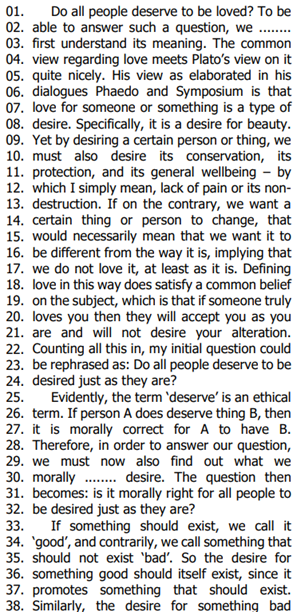
Q9_15.png (293×612)
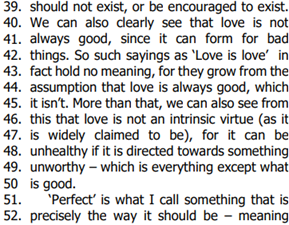
Q9_15_.png (289×225)
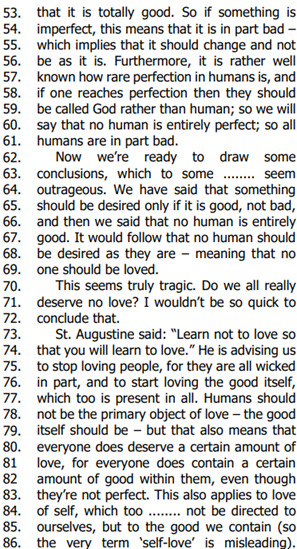
Q9_15___.png (297×273)


Adapted from: TANASĂ, Matei. The Unlovable Parts of a Loving Society. 2022. Retrieved from: . Accessed: 18 Sep. 2025.
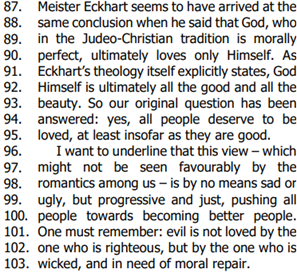
Select the sequence of phrasal verbs that replaces the single verbs satisfy (l. 18), promotes (l. 37), and arrived at (l. 87) adequately and without changes in meaning.
Alternativas
Ano: 2025 Banca: UFRGS Órgão: UFRGS Prova: UFRGS - 2025 - UFRGS - Vestibular - 2º Dia |
Q4130705 Inglês
Instrução: A questão está relacionada ao texto abaixo.

Q9_15.png (293×612)
Q9_15_.png (289×225)
Q9_15___.png (297×273)


Adapted from: TANASĂ, Matei. The Unlovable Parts of a Loving Society. 2022. Retrieved from: . Accessed: 18 Sep. 2025.
Mark the statements below with T (true) or F (false), according to the text.

( ) The phrase ‘Love is love’ is based on the assumption that love is always good, so it does not make sense because it might be bad.
( ) The term ‘self-love’ is deceiving because it suggests one should love oneself instead of the good that is within one.
( ) Love, as an intrinsic virtue, may be harmful when directed to something or someone undeserving.
( ) If someone enjoys evil, it is a sign that they are morally flawed and in need of change.

The sequence should read, from top to bottom, is
Alternativas
Ano: 2025 Banca: UFRGS Órgão: UFRGS Prova: UFRGS - 2025 - UFRGS - Vestibular - 2º Dia |
Q4130704 Inglês
Instrução: A questão está relacionada ao texto abaixo.

Q9_15.png (293×612)
Q9_15_.png (289×225)
Q9_15___.png (297×273)


Adapted from: TANASĂ, Matei. The Unlovable Parts of a Loving Society. 2022. Retrieved from: . Accessed: 18 Sep. 2025.
Consider the statements below.

I - In Phaedo and Symposium, Plato suggests that love is a desire for beauty and that when we love something or someone we want it as it is.
II - St. Augustine suggests we should not love people, but instead love the good that is in each person.
III- Meister Eckhart suggests that God contains all the good and all the beauty and thus loves us all.

Which ones are correct according to the text?
Alternativas
Ano: 2025 Banca: UFRGS Órgão: UFRGS Prova: UFRGS - 2025 - UFRGS - Vestibular - 2º Dia |
Q4130703 Inglês
Instrução: A questão está relacionada ao texto abaixo.

Q9_15.png (293×612)
Q9_15_.png (289×225)
Q9_15___.png (297×273)


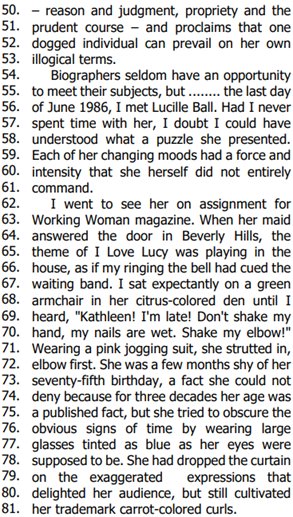
Adapted from: TANASĂ, Matei. The Unlovable Parts of a Loving Society. 2022. Retrieved from: . Accessed: 18 Sep. 2025.
Select the alternative that adequately fills in the blanks in lines 02, 30, 63 and 84.
Alternativas
Ano: 2025 Banca: UFRGS Órgão: UFRGS Prova: UFRGS - 2025 - UFRGS - Vestibular - 2º Dia |
Q4130702 Inglês
Instrução: A questão está relacionada ao texto abaixo.


Q__8.png (293×580)
Q1_8_.png (292×205)
Q1_8__.png (293×517)

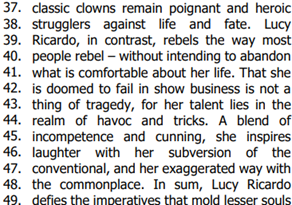
Extraído de: BRADY, Kathleen. Lucille: The Life of Lucille Ball. Hyperion, 1994.
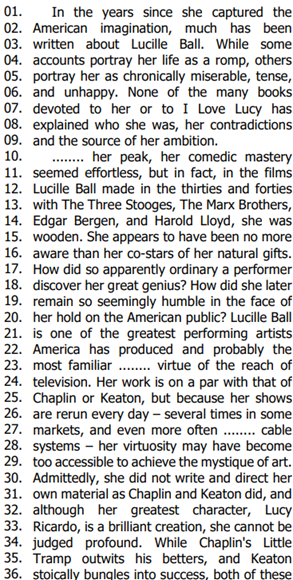
Assinale a alternativa que apresenta a transposição correta para discurso indireto do segmento “Kathleen! I'm late! Don't shake my hand, my nails are wet. Shake my elbow!" (l. 69-70).
Alternativas
Ano: 2025 Banca: UFRGS Órgão: UFRGS Prova: UFRGS - 2025 - UFRGS - Vestibular - 2º Dia |
Q4130701 Inglês
Instrução: A questão está relacionada ao texto abaixo.


Q__8.png (293×580)
Q1_8_.png (292×205)
Q1_8__.png (293×517)

Extraído de: BRADY, Kathleen. Lucille: The Life of Lucille Ball. Hyperion, 1994.
Considere as seguintes possibilidades de reescrita da frase How did so apparently ordinary a performer discover her great genius? (l. 17-18).

I - How did a performer who seemed to be so ordinary discover her great genius?
II - How did a performer of so ordinary appearance discover her genius?
III- How did a performer whose ordinary work was so apparent discover her great genius?

Quais poderiam substituir a frase, sem prejuízo do sentido original e da correção gramatical? 
Alternativas
Ano: 2025 Banca: UFRGS Órgão: UFRGS Prova: UFRGS - 2025 - UFRGS - Vestibular - 2º Dia |
Q4130700 Inglês
Instrução: A questão está relacionada ao texto abaixo.


Q__8.png (293×580)
Q1_8_.png (292×205)
Q1_8__.png (293×517)

Extraído de: BRADY, Kathleen. Lucille: The Life of Lucille Ball. Hyperion, 1994.
Assinale a alternativa que apresenta termos que, conforme empregados no texto, operam como adjetivos.
Alternativas
Ano: 2025 Banca: UFRGS Órgão: UFRGS Prova: UFRGS - 2025 - UFRGS - Vestibular - 2º Dia |
Q4130699 Inglês
Instrução: A questão está relacionada ao texto abaixo.


Q__8.png (293×580)
Q1_8_.png (292×205)
Q1_8__.png (293×517)

Extraído de: BRADY, Kathleen. Lucille: The Life of Lucille Ball. Hyperion, 1994.
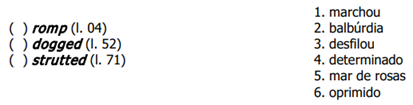
Associe as palavras da coluna da esquerda às suas respectivas traduções, na coluna da direita, de acordo com o sentido que têm no texto.

Q5.png (413×105)

A sequência correta de preenchimento dos parênteses, de cima para baixo, é 
Alternativas
Ano: 2025 Banca: UFRGS Órgão: UFRGS Prova: UFRGS - 2025 - UFRGS - Vestibular - 2º Dia |
Q4130698 Inglês
Instrução: A questão está relacionada ao texto abaixo.


Q__8.png (293×580)
Q1_8_.png (292×205)
Q1_8__.png (293×517)

Extraído de: BRADY, Kathleen. Lucille: The Life of Lucille Ball. Hyperion, 1994.
Assinale com V (verdadeiro) ou F (falso) as afirmações abaixo, acerca do texto.

( ) As palavras she (l. 01), she (l. 45), her (l. 57) e herself (l. 60) têm o mesmo referente.
( ) A palavra did (l. 30) substitui o segmento direct her own material (l. 30-31), evitando portanto a repetição desse segmento.
( ) O pronome his (l. 35) refere-se a Chaplin’s Little Tramp (l. 34-35).
( ) O segmento reason and judgment, propriety and the prudent course (l. 50-51) é um aposto que se refere à palavra imperatives (l. 49).

A sequência correta de preenchimento dos parênteses, de cima para baixo, é
Alternativas
Ano: 2025 Banca: UFRGS Órgão: UFRGS Prova: UFRGS - 2025 - UFRGS - Vestibular - 2º Dia |
Q4130696 Inglês
Instrução: A questão está relacionada ao texto abaixo.


Q__8.png (293×580)
Q1_8_.png (292×205)
Q1_8__.png (293×517)

Extraído de: BRADY, Kathleen. Lucille: The Life of Lucille Ball. Hyperion, 1994.
Assinale a alternativa correta em relação ao texto.  
Alternativas
Ano: 2025 Banca: UFRGS Órgão: UFRGS Prova: UFRGS - 2025 - UFRGS - Vestibular - 2º Dia |
Q4130695 Inglês
Instrução: A questão está relacionada ao texto abaixo.


Q__8.png (293×580)
Q1_8_.png (292×205)
Q1_8__.png (293×517)

Extraído de: BRADY, Kathleen. Lucille: The Life of Lucille Ball. Hyperion, 1994.
Assinale a alternativa que preenche adequadamente as lacunas das linhas 10, 23, 27 e 55, nesta ordem.
Alternativas
Ano: 2025 Banca: VUNESP Órgão: EINSTEIN Prova: VUNESP - 2025 - EINSTEIN - Vestibular - Prova I - 1º Semestre 2026 |
Q4116344 Inglês

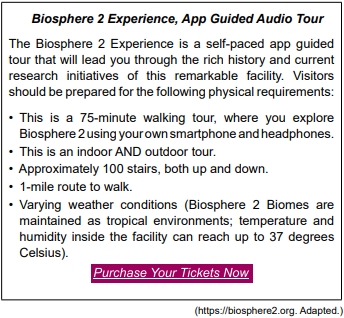
Read the informational guide provided by Biosphere 2.

15.jpg (344×318)


The guide informs potential visitors to the Biosphere 2 project about
Alternativas
Ano: 2025 Banca: VUNESP Órgão: EINSTEIN Prova: VUNESP - 2025 - EINSTEIN - Vestibular - Prova I - 1º Semestre 2026 |
Q4116343 Inglês
texto_11-14.jpg (343×192)       

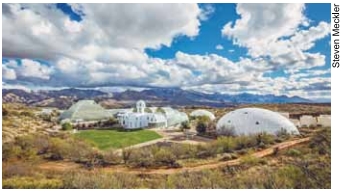
        In the middle of the vast Arizona desert, in the United States, there’s a structure that seems taken straight out of the pages of science fiction. Inside a massive complex of glass pyramids and towers, spread across 1.2 hectares, stands a tropical rainforest topped by a 7.6-meter-high waterfall, a savannah and a fog desert. It’s seemingly a little capsule of Earth, which is why the structure is called Biosphere 2 — named after our own planet, Biosphere 1.

        The scenery forms the perfect background for the futuristic experiment that once took place here. In the early 1990s, eight people locked themselves inside, sealed off from the outside world for two years, to explore the challenges of living in a self-contained system — a prerequisite for building colonies in outer space. They fed themselves from the crops they grew, they recycled their own wastewater and they cared for the plants that produced their oxygen.

        In terms of sustaining human life, the experiment did not go well. Oxygen levels fell significantly, making the inhabitants sick, while carbon dioxide (CO2) levels increased. Countless animals died, including the pollinators the plants needed to reproduce. And although the “biospherians” did survive on their homegrown food, they lost weight to the point where they became a case study for calorie restriction. When supplementary oxygen needed to be brought in, commentators blamed the project as a failure, calling it a “new-age silliness masquerading as science”. In recent years, however, many experts have come to see the Biosphere 2 experiment in a new light, with valuable lessons about ecology, atmospheric science and importantly, the irreplaceability of our own planet.

(Katarina Zimmer. www.bbc.com, 05.07.2025. Adapted.)
According to the third paragraph, one major ecological imbalance that compromised human habitability in Biosphere 2 was the
Alternativas
Ano: 2025 Banca: VUNESP Órgão: EINSTEIN Prova: VUNESP - 2025 - EINSTEIN - Vestibular - Prova I - 1º Semestre 2026 |
Q4116342 Inglês
texto_11-14.jpg (343×192)       

        In the middle of the vast Arizona desert, in the United States, there’s a structure that seems taken straight out of the pages of science fiction. Inside a massive complex of glass pyramids and towers, spread across 1.2 hectares, stands a tropical rainforest topped by a 7.6-meter-high waterfall, a savannah and a fog desert. It’s seemingly a little capsule of Earth, which is why the structure is called Biosphere 2 — named after our own planet, Biosphere 1.

        The scenery forms the perfect background for the futuristic experiment that once took place here. In the early 1990s, eight people locked themselves inside, sealed off from the outside world for two years, to explore the challenges of living in a self-contained system — a prerequisite for building colonies in outer space. They fed themselves from the crops they grew, they recycled their own wastewater and they cared for the plants that produced their oxygen.

        In terms of sustaining human life, the experiment did not go well. Oxygen levels fell significantly, making the inhabitants sick, while carbon dioxide (CO2) levels increased. Countless animals died, including the pollinators the plants needed to reproduce. And although the “biospherians” did survive on their homegrown food, they lost weight to the point where they became a case study for calorie restriction. When supplementary oxygen needed to be brought in, commentators blamed the project as a failure, calling it a “new-age silliness masquerading as science”. In recent years, however, many experts have come to see the Biosphere 2 experiment in a new light, with valuable lessons about ecology, atmospheric science and importantly, the irreplaceability of our own planet.

(Katarina Zimmer. www.bbc.com, 05.07.2025. Adapted.)
In the excerpt from the second paragraph “The scenery forms the perfect background for the futuristic experiment that once took place here”, the underlined term refers to
Alternativas
Ano: 2025 Banca: VUNESP Órgão: EINSTEIN Prova: VUNESP - 2025 - EINSTEIN - Vestibular - Prova I - 1º Semestre 2026 |
Q4116341 Inglês
texto_11-14.jpg (343×192)       

        In the middle of the vast Arizona desert, in the United States, there’s a structure that seems taken straight out of the pages of science fiction. Inside a massive complex of glass pyramids and towers, spread across 1.2 hectares, stands a tropical rainforest topped by a 7.6-meter-high waterfall, a savannah and a fog desert. It’s seemingly a little capsule of Earth, which is why the structure is called Biosphere 2 — named after our own planet, Biosphere 1.

        The scenery forms the perfect background for the futuristic experiment that once took place here. In the early 1990s, eight people locked themselves inside, sealed off from the outside world for two years, to explore the challenges of living in a self-contained system — a prerequisite for building colonies in outer space. They fed themselves from the crops they grew, they recycled their own wastewater and they cared for the plants that produced their oxygen.

        In terms of sustaining human life, the experiment did not go well. Oxygen levels fell significantly, making the inhabitants sick, while carbon dioxide (CO2) levels increased. Countless animals died, including the pollinators the plants needed to reproduce. And although the “biospherians” did survive on their homegrown food, they lost weight to the point where they became a case study for calorie restriction. When supplementary oxygen needed to be brought in, commentators blamed the project as a failure, calling it a “new-age silliness masquerading as science”. In recent years, however, many experts have come to see the Biosphere 2 experiment in a new light, with valuable lessons about ecology, atmospheric science and importantly, the irreplaceability of our own planet.

(Katarina Zimmer. www.bbc.com, 05.07.2025. Adapted.)
In the fragment from the first paragraph “It’s seemingly a little capsule of Earth”, the underlined expression means 
Alternativas
Ano: 2025 Banca: VUNESP Órgão: EINSTEIN Prova: VUNESP - 2025 - EINSTEIN - Vestibular - Prova I - 1º Semestre 2026 |
Q4116340 Inglês
texto_11-14.jpg (343×192)       

        In the middle of the vast Arizona desert, in the United States, there’s a structure that seems taken straight out of the pages of science fiction. Inside a massive complex of glass pyramids and towers, spread across 1.2 hectares, stands a tropical rainforest topped by a 7.6-meter-high waterfall, a savannah and a fog desert. It’s seemingly a little capsule of Earth, which is why the structure is called Biosphere 2 — named after our own planet, Biosphere 1.

        The scenery forms the perfect background for the futuristic experiment that once took place here. In the early 1990s, eight people locked themselves inside, sealed off from the outside world for two years, to explore the challenges of living in a self-contained system — a prerequisite for building colonies in outer space. They fed themselves from the crops they grew, they recycled their own wastewater and they cared for the plants that produced their oxygen.

        In terms of sustaining human life, the experiment did not go well. Oxygen levels fell significantly, making the inhabitants sick, while carbon dioxide (CO2) levels increased. Countless animals died, including the pollinators the plants needed to reproduce. And although the “biospherians” did survive on their homegrown food, they lost weight to the point where they became a case study for calorie restriction. When supplementary oxygen needed to be brought in, commentators blamed the project as a failure, calling it a “new-age silliness masquerading as science”. In recent years, however, many experts have come to see the Biosphere 2 experiment in a new light, with valuable lessons about ecology, atmospheric science and importantly, the irreplaceability of our own planet.

(Katarina Zimmer. www.bbc.com, 05.07.2025. Adapted.)
The text is mainly about
Alternativas
Q4115804 Inglês

Leia o texto para responder à questão.


The Red Cross

12-15.jpg (248×142)


        The International Red Cross movement started in 1863 and was inspired by Swiss businessman Henry Dunant. The suffering of thousands of men on both sides of the Battle of Solferino in 1859 upset Dunant. Many were left to die due to lack of care. He proposed creating national relief societies, made up of volunteers, trained in peacetime to provide neutral and impartial help to relieve suffering in times of war.


        In response to these ideas, a committee (which later became the International Committee of the Red Cross) was established in Geneva. Dunant also proposed that countries adopt an international agreement, which would recognise the status of medical services and of the injured on the battlefield. This agreement was adopted in 1864.


        The formation of the British Red Cross occurred during the war between France and Prussia in July 1870, Colonel Loyd-Lindsay wrote a letter to the newspaper The Times. He called for a National Society to be formed in Britain just like in other European nations. On 4 August 1870, a public meeting was held in London and a resolution passed authorizing the formation of The British National Society for Aid to the Sick and Wounded in War. It gave aid and relief to both warring armies during the Franco-Prussian War and in other wars and campaigns during the 19th century. This was done under the protection of the red cross emblem.


        In 1905, the British National Society for Aid to the Sick and Wounded in War was renamed as the British Red Cross. The Red Cross needed many skilled volunteers for its wartime role. The Voluntary Aid Scheme was introduced in 1909 and ensured that Voluntary Aid Detachments were formed across the United Kingdom. Their members would provide aid to the territorial medical forces in times of war.


(www.redcross.org.uk. Adaptado.)

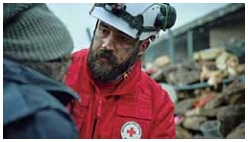
The word from the text which best describes the image below the title is
Alternativas
Q4115803 Inglês

Leia o texto para responder à questão.


The Red Cross


12-15.jpg (248×142)


        The International Red Cross movement started in 1863 and was inspired by Swiss businessman Henry Dunant. The suffering of thousands of men on both sides of the Battle of Solferino in 1859 upset Dunant. Many were left to die due to lack of care. He proposed creating national relief societies, made up of volunteers, trained in peacetime to provide neutral and impartial help to relieve suffering in times of war.


        In response to these ideas, a committee (which later became the International Committee of the Red Cross) was established in Geneva. Dunant also proposed that countries adopt an international agreement, which would recognise the status of medical services and of the injured on the battlefield. This agreement was adopted in 1864.


        The formation of the British Red Cross occurred during the war between France and Prussia in July 1870, Colonel Loyd-Lindsay wrote a letter to the newspaper The Times. He called for a National Society to be formed in Britain just like in other European nations. On 4 August 1870, a public meeting was held in London and a resolution passed authorizing the formation of The British National Society for Aid to the Sick and Wounded in War. It gave aid and relief to both warring armies during the Franco-Prussian War and in other wars and campaigns during the 19th century. This was done under the protection of the red cross emblem.


        In 1905, the British National Society for Aid to the Sick and Wounded in War was renamed as the British Red Cross. The Red Cross needed many skilled volunteers for its wartime role. The Voluntary Aid Scheme was introduced in 1909 and ensured that Voluntary Aid Detachments were formed across the United Kingdom. Their members would provide aid to the territorial medical forces in times of war.


(www.redcross.org.uk. Adaptado.)

A Sociedade Nacional Britânica de Ajuda aos Doentes e Feridos de Guerra, mencionada a partir do terceiro parágrafo do texto, foi
Alternativas
Q4115802 Inglês

Leia o texto para responder à questão.


The Red Cross


12-15.jpg (248×142)


        The International Red Cross movement started in 1863 and was inspired by Swiss businessman Henry Dunant. The suffering of thousands of men on both sides of the Battle of Solferino in 1859 upset Dunant. Many were left to die due to lack of care. He proposed creating national relief societies, made up of volunteers, trained in peacetime to provide neutral and impartial help to relieve suffering in times of war.


        In response to these ideas, a committee (which later became the International Committee of the Red Cross) was established in Geneva. Dunant also proposed that countries adopt an international agreement, which would recognise the status of medical services and of the injured on the battlefield. This agreement was adopted in 1864.


        The formation of the British Red Cross occurred during the war between France and Prussia in July 1870, Colonel Loyd-Lindsay wrote a letter to the newspaper The Times. He called for a National Society to be formed in Britain just like in other European nations. On 4 August 1870, a public meeting was held in London and a resolution passed authorizing the formation of The British National Society for Aid to the Sick and Wounded in War. It gave aid and relief to both warring armies during the Franco-Prussian War and in other wars and campaigns during the 19th century. This was done under the protection of the red cross emblem.


        In 1905, the British National Society for Aid to the Sick and Wounded in War was renamed as the British Red Cross. The Red Cross needed many skilled volunteers for its wartime role. The Voluntary Aid Scheme was introduced in 1909 and ensured that Voluntary Aid Detachments were formed across the United Kingdom. Their members would provide aid to the territorial medical forces in times of war.


(www.redcross.org.uk. Adaptado.)

No fragmento do segundo parágrafo “In response to these ideas, a committee was established in Geneva”, os termos sublinhados referem-se
Alternativas
Q4115801 Inglês

Leia o texto para responder à questão.


The Red Cross


12-15.jpg (248×142)


        The International Red Cross movement started in 1863 and was inspired by Swiss businessman Henry Dunant. The suffering of thousands of men on both sides of the Battle of Solferino in 1859 upset Dunant. Many were left to die due to lack of care. He proposed creating national relief societies, made up of volunteers, trained in peacetime to provide neutral and impartial help to relieve suffering in times of war.


        In response to these ideas, a committee (which later became the International Committee of the Red Cross) was established in Geneva. Dunant also proposed that countries adopt an international agreement, which would recognise the status of medical services and of the injured on the battlefield. This agreement was adopted in 1864.


        The formation of the British Red Cross occurred during the war between France and Prussia in July 1870, Colonel Loyd-Lindsay wrote a letter to the newspaper The Times. He called for a National Society to be formed in Britain just like in other European nations. On 4 August 1870, a public meeting was held in London and a resolution passed authorizing the formation of The British National Society for Aid to the Sick and Wounded in War. It gave aid and relief to both warring armies during the Franco-Prussian War and in other wars and campaigns during the 19th century. This was done under the protection of the red cross emblem.


        In 1905, the British National Society for Aid to the Sick and Wounded in War was renamed as the British Red Cross. The Red Cross needed many skilled volunteers for its wartime role. The Voluntary Aid Scheme was introduced in 1909 and ensured that Voluntary Aid Detachments were formed across the United Kingdom. Their members would provide aid to the territorial medical forces in times of war.


(www.redcross.org.uk. Adaptado.)

The main purpose of the text is to
Alternativas
Respostas
61: B
62: D
63: C
64: C
65: E
66: A
67: C
68: A
69: B
70: D
71: A
72: D
73: E
74: C
75: A
76: A
77: E
78: C
79: A
80: D