🎯 Saiba o que estudar

Avançado com Treinador a partir de R$ 0,76/dia

Questões de Vestibular Sobre inglês

Questões Discursivas

Foram encontradas 6.365 questões

Ano: 2023 Banca: UFRGS Órgão: UFRGS Prova: UFRGS - 2023 - UFRGS - Vestibular - 2º Dia |
Q4162866 Inglês

Instrução: A questão está relacionada ao texto abaixo.
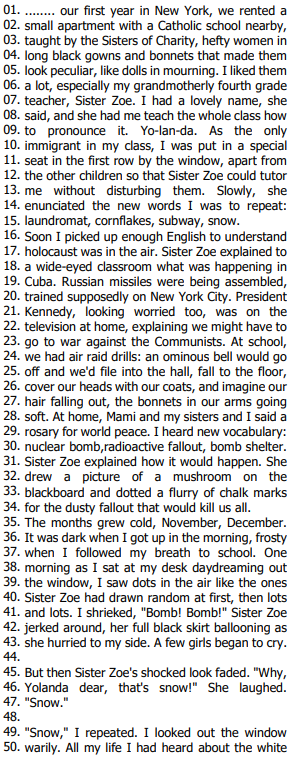


Adaptado de: ÁLVAREZ, J. Snow. In: Castillo-Speed, L. Latina – Women’s voices from the borderlands. New York: Touchstone, 1995. 

Além de shriek, vários vocábulos em inglês podem ser traduzidos como “gritar”. Assinale a alternativa que apresenta a nuance de sentido que a autora deu ao texto ao empregar a forma verbal shrieked (l. 41).
Alternativas
Ano: 2023 Banca: UFRGS Órgão: UFRGS Prova: UFRGS - 2023 - UFRGS - Vestibular - 2º Dia |
Q4162865 Inglês

Instrução: A questão está relacionada ao texto abaixo.
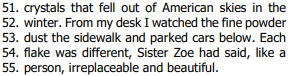


Adaptado de: ÁLVAREZ, J. Snow. In: Castillo-Speed, L. Latina – Women’s voices from the borderlands. New York: Touchstone, 1995. 
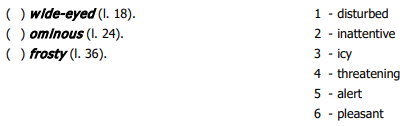
Associe as palavras da coluna da esquerda aos seus respectivos sinônimos, na coluna da direita, de acordo com o sentido que têm no texto.


Imagem associada para resolução da questão

A sequência correta de preenchimento dos parênteses, de cima para baixo, é 
Alternativas
Ano: 2023 Banca: UFRGS Órgão: UFRGS Prova: UFRGS - 2023 - UFRGS - Vestibular - 2º Dia |
Q4162864 Inglês

Instrução: A questão está relacionada ao texto abaixo.


Adaptado de: ÁLVAREZ, J. Snow. In: Castillo-Speed, L. Latina – Women’s voices from the borderlands. New York: Touchstone, 1995. 

Assinale a alternativa que apresenta termos que, conforme empregados no texto, operam como membros de uma mesma classe de palavras.
Alternativas
Ano: 2023 Banca: UFRGS Órgão: UFRGS Prova: UFRGS - 2023 - UFRGS - Vestibular - 2º Dia |
Q4162863 Inglês

Instrução: A questão está relacionada ao texto abaixo.


Adaptado de: ÁLVAREZ, J. Snow. In: Castillo-Speed, L. Latina – Women’s voices from the borderlands. New York: Touchstone, 1995. 

Assinale com V (verdadeiro) ou F (falso) as afirmações abaixo, acerca da estrutura do texto.

( ) O trecho taught by the Sisters of Charity (l. 03) pode ser substituído por which was taught by the Sisters of Charity, sem prejuízo da correção gramatical e do significado original do texto.
( ) O trecho I was put in a special seat (l. 10-11) pode ser substituído por Sister Zoe put me in a special sit, sem prejuízo da correção gramatical e do significado original do texto.
( ) A expressão so that (l. 12) pode ser substituída por in order to, sem prejuízo da correção gramatical e do significado original do texto.
( ) A oração I follow ed my breath to school (l. 37) faz referência ao fato de a respiração da menina gerar um vapor visível à sua frente, nas manhãs geladas de Nova Iorque.

A sequência correta de preenchimento dos parênteses, de cima para baixo, é
Alternativas
Ano: 2023 Banca: UFRGS Órgão: UFRGS Prova: UFRGS - 2023 - UFRGS - Vestibular - 2º Dia |
Q4162862 Inglês

Instrução: A questão está relacionada ao texto abaixo.


Adaptado de: ÁLVAREZ, J. Snow. In: Castillo-Speed, L. Latina – Women’s voices from the borderlands. New York: Touchstone, 1995. 

Assinale com V (verdadeiro) ou F (falso) as afirmações abaixo, acerca do texto.

( ) Embora já conhecesse e mesmo repetisse a palavra snow, Yolanda nunca entendera do que se tratava, razão pela qual ficou assustada quando viu neve pela primeira vez.
( ) Apesar do tom leve, o texto faz uma crítica à forma assustadora com que até mesmo crianças foram envolvidas na paranoia atômica da Guerra Fria.
( ) Com carinho, Yolanda lembra a Irmã Zoe pelo esforço da religiosa em fazer com a menina, uma imigrante hispânica, não se sentisse agredida por manifestações xenófobas, em função da crise dos mísseis em Cuba.
( ) Apesar de seu favoritismo na infância, Yolanda deixa clara sua reprovação à forma como a Irmã Zoe incutiu medos infundados e gerou traumas nas crianças de sua turma.

A sequência correta de preenchimento dos parênteses, de cima para baixo, é 
Alternativas
Ano: 2023 Banca: UFRGS Órgão: UFRGS Prova: UFRGS - 2023 - UFRGS - Vestibular - 2º Dia |
Q4162861 Inglês

Instrução: A questão está relacionada ao texto abaixo.


Adaptado de: ÁLVAREZ, J. Snow. In: Castillo-Speed, L. Latina – Women’s voices from the borderlands. New York: Touchstone, 1995. 

Assinale a alternativa que resume adequadamente o texto.
Alternativas
Ano: 2023 Banca: UFRGS Órgão: UFRGS Prova: UFRGS - 2023 - UFRGS - Vestibular - 2º Dia |
Q4162860 Inglês

Instrução: A questão está relacionada ao texto abaixo.


Adaptado de: ÁLVAREZ, J. Snow. In: Castillo-Speed, L. Latina – Women’s voices from the borderlands. New York: Touchstone, 1995. 

Assinale a alternativa que apresenta um conjunto de preposições que poderiam preencher adequadamente a lacuna da linha 01.
Alternativas
Ano: 2023 Banca: VUNESP Órgão: FCM/SANTA CASA Prova: VUNESP - 2023 - FCM/SANTA CASA - Vestibular |
Q4150350 Inglês

Leia o cartum publicado por @successpictures em sua conta no Instagram.



Imagem associada para resolução da questão


No contexto do cartum, a frase “You always want what you don’t have” pode ser associada ao seguinte ditado popular:
Alternativas
Ano: 2023 Banca: VUNESP Órgão: FCM/SANTA CASA Prova: VUNESP - 2023 - FCM/SANTA CASA - Vestibular |
Q4150349 Inglês
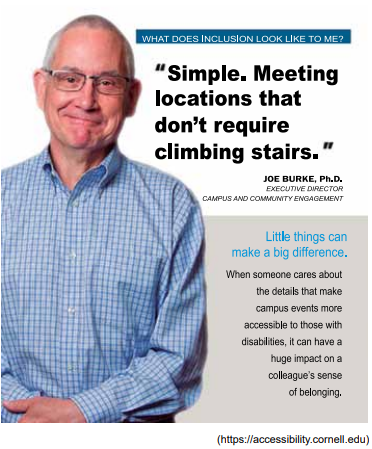
Leia o pôster de uma campanha da Universidade Cornell sobre a inclusão de pessoas com deficiência.

Imagem associada para resolução da questão


De acordo com o pôster, a universidade pretende
Alternativas
Ano: 2023 Banca: VUNESP Órgão: FCM/SANTA CASA Prova: VUNESP - 2023 - FCM/SANTA CASA - Vestibular |
Q4150348 Inglês
   British workers are increasingly likely to work into their 70s, according to a research that found the cost of living crisis has left older people with little choice but to stay in employment. There were 446,601 people above the age of 70 still in work in 2022, a rise of 61% compared with 277,926 in 2012, said Rest Less, an online community for the over-50s that offers advice to older workers.
   While most of the over-70s workforce is male, the rise has been more significant among women, most likely in response to the gradual equalisation of pension ages between 2010 and 2020. Women were previously able to retire five years earlier. The number of women working beyond the age of 70 is up 66% since 2012, compared with an increase of 58% for men.
    Stuart Lewis, the chief executive of Rest Less, drew a comparison between older workers and King Charles, but acknowledged that most continue working “for very different reasons” to the hereditary monarch. “At the age of 74, King Charles is a fantastic example of someone who both enjoys, and benefits from, continuing to work post-state pension1 age,” said Lewis. “Our latest analysis shows that there are far more over-70s in the workplace today than a decade ago. Until Covid hit and life expectancy dropped for the first time in a decade, there were more people reaching their state pension age than ever before, which meant there were more experienced people in the workplace than ever before too.”
    Lewis said many of those reaching the theoretical age of retirement were staying in the workplace for lack of any other option. “Like King Charles, many of these people will have no choice but to work, although for very different reasons to the king. We see many older workers today who are struggling to survive amidst the cost of living crisis, with inadequate retirement savings meaning they must work in order to survive financially.” The state pension age in the United Kingdom (UK) is 66 for men and women but is due to start rising from 2026.

(Rob Davies. www.theguardian.com, 30.04.2023. Adaptado.)

1      state pension: a regular payment from the government to someone who does not work anymore.
No trecho do quarto parágrafo “in order to survive financially”, a expressão sublinhada transmite a ideia de 
Alternativas
Ano: 2023 Banca: VUNESP Órgão: FCM/SANTA CASA Prova: VUNESP - 2023 - FCM/SANTA CASA - Vestibular |
Q4150347 Inglês
   British workers are increasingly likely to work into their 70s, according to a research that found the cost of living crisis has left older people with little choice but to stay in employment. There were 446,601 people above the age of 70 still in work in 2022, a rise of 61% compared with 277,926 in 2012, said Rest Less, an online community for the over-50s that offers advice to older workers.
   While most of the over-70s workforce is male, the rise has been more significant among women, most likely in response to the gradual equalisation of pension ages between 2010 and 2020. Women were previously able to retire five years earlier. The number of women working beyond the age of 70 is up 66% since 2012, compared with an increase of 58% for men.
    Stuart Lewis, the chief executive of Rest Less, drew a comparison between older workers and King Charles, but acknowledged that most continue working “for very different reasons” to the hereditary monarch. “At the age of 74, King Charles is a fantastic example of someone who both enjoys, and benefits from, continuing to work post-state pension1 age,” said Lewis. “Our latest analysis shows that there are far more over-70s in the workplace today than a decade ago. Until Covid hit and life expectancy dropped for the first time in a decade, there were more people reaching their state pension age than ever before, which meant there were more experienced people in the workplace than ever before too.”
    Lewis said many of those reaching the theoretical age of retirement were staying in the workplace for lack of any other option. “Like King Charles, many of these people will have no choice but to work, although for very different reasons to the king. We see many older workers today who are struggling to survive amidst the cost of living crisis, with inadequate retirement savings meaning they must work in order to survive financially.” The state pension age in the United Kingdom (UK) is 66 for men and women but is due to start rising from 2026.

(Rob Davies. www.theguardian.com, 30.04.2023. Adaptado.)

1      state pension: a regular payment from the government to someone who does not work anymore.
No trecho do terceiro parágrafo “most continue working”, o termo sublinhado refere-se
Alternativas
Ano: 2023 Banca: VUNESP Órgão: FCM/SANTA CASA Prova: VUNESP - 2023 - FCM/SANTA CASA - Vestibular |
Q4150346 Inglês
   British workers are increasingly likely to work into their 70s, according to a research that found the cost of living crisis has left older people with little choice but to stay in employment. There were 446,601 people above the age of 70 still in work in 2022, a rise of 61% compared with 277,926 in 2012, said Rest Less, an online community for the over-50s that offers advice to older workers.
   While most of the over-70s workforce is male, the rise has been more significant among women, most likely in response to the gradual equalisation of pension ages between 2010 and 2020. Women were previously able to retire five years earlier. The number of women working beyond the age of 70 is up 66% since 2012, compared with an increase of 58% for men.
    Stuart Lewis, the chief executive of Rest Less, drew a comparison between older workers and King Charles, but acknowledged that most continue working “for very different reasons” to the hereditary monarch. “At the age of 74, King Charles is a fantastic example of someone who both enjoys, and benefits from, continuing to work post-state pension1 age,” said Lewis. “Our latest analysis shows that there are far more over-70s in the workplace today than a decade ago. Until Covid hit and life expectancy dropped for the first time in a decade, there were more people reaching their state pension age than ever before, which meant there were more experienced people in the workplace than ever before too.”
    Lewis said many of those reaching the theoretical age of retirement were staying in the workplace for lack of any other option. “Like King Charles, many of these people will have no choice but to work, although for very different reasons to the king. We see many older workers today who are struggling to survive amidst the cost of living crisis, with inadequate retirement savings meaning they must work in order to survive financially.” The state pension age in the United Kingdom (UK) is 66 for men and women but is due to start rising from 2026.

(Rob Davies. www.theguardian.com, 30.04.2023. Adaptado.)

1      state pension: a regular payment from the government to someone who does not work anymore.
De acordo com o texto,
Alternativas
Ano: 2023 Banca: VUNESP Órgão: FCM/SANTA CASA Prova: VUNESP - 2023 - FCM/SANTA CASA - Vestibular |
Q4150345 Inglês
   British workers are increasingly likely to work into their 70s, according to a research that found the cost of living crisis has left older people with little choice but to stay in employment. There were 446,601 people above the age of 70 still in work in 2022, a rise of 61% compared with 277,926 in 2012, said Rest Less, an online community for the over-50s that offers advice to older workers.
   While most of the over-70s workforce is male, the rise has been more significant among women, most likely in response to the gradual equalisation of pension ages between 2010 and 2020. Women were previously able to retire five years earlier. The number of women working beyond the age of 70 is up 66% since 2012, compared with an increase of 58% for men.
    Stuart Lewis, the chief executive of Rest Less, drew a comparison between older workers and King Charles, but acknowledged that most continue working “for very different reasons” to the hereditary monarch. “At the age of 74, King Charles is a fantastic example of someone who both enjoys, and benefits from, continuing to work post-state pension1 age,” said Lewis. “Our latest analysis shows that there are far more over-70s in the workplace today than a decade ago. Until Covid hit and life expectancy dropped for the first time in a decade, there were more people reaching their state pension age than ever before, which meant there were more experienced people in the workplace than ever before too.”
    Lewis said many of those reaching the theoretical age of retirement were staying in the workplace for lack of any other option. “Like King Charles, many of these people will have no choice but to work, although for very different reasons to the king. We see many older workers today who are struggling to survive amidst the cost of living crisis, with inadequate retirement savings meaning they must work in order to survive financially.” The state pension age in the United Kingdom (UK) is 66 for men and women but is due to start rising from 2026.

(Rob Davies. www.theguardian.com, 30.04.2023. Adaptado.)

1      state pension: a regular payment from the government to someone who does not work anymore.
The main purpose of the text is to show that many British workers over 70
Alternativas
Ano: 2023 Banca: VUNESP Órgão: FCM/SANTA CASA Prova: VUNESP - 2023 - FCM/SANTA CASA - Vestibular - Medicina |
Q4149756 Inglês
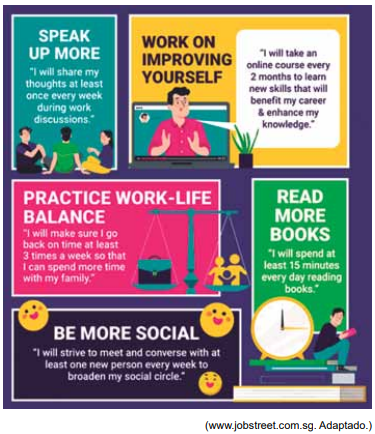
In the section “Be more social”, the expression “I will strive” means to
Alternativas
Ano: 2023 Banca: VUNESP Órgão: FCM/SANTA CASA Prova: VUNESP - 2023 - FCM/SANTA CASA - Vestibular - Medicina |
Q4149755 Inglês
The main purpose of the infographic is to present 
Alternativas
Ano: 2023 Banca: VUNESP Órgão: FCM/SANTA CASA Prova: VUNESP - 2023 - FCM/SANTA CASA - Vestibular - Medicina |
Q4149754 Inglês
     Some of the world’s leading artificial intelligence (AI) researchers are calling for a pause on research into AI, claiming that safety issues must first be urgently addressed. If not, the outcomes could be devastating for humanity. Others say any pause in development would not only be impractical to enforce on a global scale, but could also stand in the way of advances that could both improve and save lives.
     The AI that is currently available already has the power to radically alter society, in new ways that we are seeing every day. So how might it progress over the coming years? Are we on the brink of an artificial intelligence-powered utopia or dystopia?
     Firstly, technology has been automating jobs since the Industrial Revolution, though never before has it happened on this scale. Everyone from truck drivers to voice over artists are at risk of being replaced by AI. A recent study found that just over 30 jobs are considered safe from automation in the near future. They range from mechanics to athletes, though they represent just a sliver of the current labour market. While new jobs will be created, there is a significant chance that the majority of the population will be left jobless. This could either lead to:
     Utopia: A new leisure class emerges, living off a universal basic income funded by taxes on robots and the companies that operate them.
    Dystopia: Mass unemployment results in social unrest, similar to the way laid off factory workers trashed the machines that replaced them. With so many jobs at risk and the potential for huge wealth inequality, some fear it could ultimately result in societal collapse.
    Secondly, artificial intelligence is already contributing to major scientific advances, dramatically accelerating the time it takes to make discoveries. It has been used to invent millions of materials that did not previously exist, find potential drug molecules 1,000 times faster than previous methods, and improve our understanding of the universe. This could either lead to:
      Utopia: Cancer and all other life-threatening diseases are cured, leading to a new age of health and prosperity. Scientists are already using AI tools to make breakthroughs in longevity medicine, which aims to end or even reverse ageing.
     Dystopia: The same AI-enabled technology could be used for malevolent purposes, creating entirely new diseases and viruses. These could be used as bioweapons, capable of devastating populations that don’t have access to cures or the tech needed to develop them.


(Anthony Cuthbertson. www.independent.co.uk, 03.05.2023. Adaptado.)
In the excerpt from the seventh paragraph “which aims to end or even reverse ageing”, the underlined word refers to 
Alternativas
Ano: 2023 Banca: VUNESP Órgão: FCM/SANTA CASA Prova: VUNESP - 2023 - FCM/SANTA CASA - Vestibular - Medicina |
Q4149753 Inglês
     Some of the world’s leading artificial intelligence (AI) researchers are calling for a pause on research into AI, claiming that safety issues must first be urgently addressed. If not, the outcomes could be devastating for humanity. Others say any pause in development would not only be impractical to enforce on a global scale, but could also stand in the way of advances that could both improve and save lives.
     The AI that is currently available already has the power to radically alter society, in new ways that we are seeing every day. So how might it progress over the coming years? Are we on the brink of an artificial intelligence-powered utopia or dystopia?
     Firstly, technology has been automating jobs since the Industrial Revolution, though never before has it happened on this scale. Everyone from truck drivers to voice over artists are at risk of being replaced by AI. A recent study found that just over 30 jobs are considered safe from automation in the near future. They range from mechanics to athletes, though they represent just a sliver of the current labour market. While new jobs will be created, there is a significant chance that the majority of the population will be left jobless. This could either lead to:
     Utopia: A new leisure class emerges, living off a universal basic income funded by taxes on robots and the companies that operate them.
    Dystopia: Mass unemployment results in social unrest, similar to the way laid off factory workers trashed the machines that replaced them. With so many jobs at risk and the potential for huge wealth inequality, some fear it could ultimately result in societal collapse.
    Secondly, artificial intelligence is already contributing to major scientific advances, dramatically accelerating the time it takes to make discoveries. It has been used to invent millions of materials that did not previously exist, find potential drug molecules 1,000 times faster than previous methods, and improve our understanding of the universe. This could either lead to:
      Utopia: Cancer and all other life-threatening diseases are cured, leading to a new age of health and prosperity. Scientists are already using AI tools to make breakthroughs in longevity medicine, which aims to end or even reverse ageing.
     Dystopia: The same AI-enabled technology could be used for malevolent purposes, creating entirely new diseases and viruses. These could be used as bioweapons, capable of devastating populations that don’t have access to cures or the tech needed to develop them.


(Anthony Cuthbertson. www.independent.co.uk, 03.05.2023. Adaptado.)
No terceiro parágrafo, a expressão “be left jobless” pode ser associada ao seguinte trecho do texto:
Alternativas
Ano: 2023 Banca: VUNESP Órgão: FCM/SANTA CASA Prova: VUNESP - 2023 - FCM/SANTA CASA - Vestibular - Medicina |
Q4149752 Inglês
     Some of the world’s leading artificial intelligence (AI) researchers are calling for a pause on research into AI, claiming that safety issues must first be urgently addressed. If not, the outcomes could be devastating for humanity. Others say any pause in development would not only be impractical to enforce on a global scale, but could also stand in the way of advances that could both improve and save lives.
     The AI that is currently available already has the power to radically alter society, in new ways that we are seeing every day. So how might it progress over the coming years? Are we on the brink of an artificial intelligence-powered utopia or dystopia?
     Firstly, technology has been automating jobs since the Industrial Revolution, though never before has it happened on this scale. Everyone from truck drivers to voice over artists are at risk of being replaced by AI. A recent study found that just over 30 jobs are considered safe from automation in the near future. They range from mechanics to athletes, though they represent just a sliver of the current labour market. While new jobs will be created, there is a significant chance that the majority of the population will be left jobless. This could either lead to:
     Utopia: A new leisure class emerges, living off a universal basic income funded by taxes on robots and the companies that operate them.
    Dystopia: Mass unemployment results in social unrest, similar to the way laid off factory workers trashed the machines that replaced them. With so many jobs at risk and the potential for huge wealth inequality, some fear it could ultimately result in societal collapse.
    Secondly, artificial intelligence is already contributing to major scientific advances, dramatically accelerating the time it takes to make discoveries. It has been used to invent millions of materials that did not previously exist, find potential drug molecules 1,000 times faster than previous methods, and improve our understanding of the universe. This could either lead to:
      Utopia: Cancer and all other life-threatening diseases are cured, leading to a new age of health and prosperity. Scientists are already using AI tools to make breakthroughs in longevity medicine, which aims to end or even reverse ageing.
     Dystopia: The same AI-enabled technology could be used for malevolent purposes, creating entirely new diseases and viruses. These could be used as bioweapons, capable of devastating populations that don’t have access to cures or the tech needed to develop them.


(Anthony Cuthbertson. www.independent.co.uk, 03.05.2023. Adaptado.)
O termo “while”, no trecho do terceiro parágrafo “While new jobs will be created, there is a significant chance that the majority of the population will be left jobless”, é empregado com o mesmo sentido em:
Alternativas
Ano: 2023 Banca: VUNESP Órgão: FCM/SANTA CASA Prova: VUNESP - 2023 - FCM/SANTA CASA - Vestibular - Medicina |
Q4149751 Inglês
     Some of the world’s leading artificial intelligence (AI) researchers are calling for a pause on research into AI, claiming that safety issues must first be urgently addressed. If not, the outcomes could be devastating for humanity. Others say any pause in development would not only be impractical to enforce on a global scale, but could also stand in the way of advances that could both improve and save lives.
     The AI that is currently available already has the power to radically alter society, in new ways that we are seeing every day. So how might it progress over the coming years? Are we on the brink of an artificial intelligence-powered utopia or dystopia?
     Firstly, technology has been automating jobs since the Industrial Revolution, though never before has it happened on this scale. Everyone from truck drivers to voice over artists are at risk of being replaced by AI. A recent study found that just over 30 jobs are considered safe from automation in the near future. They range from mechanics to athletes, though they represent just a sliver of the current labour market. While new jobs will be created, there is a significant chance that the majority of the population will be left jobless. This could either lead to:
     Utopia: A new leisure class emerges, living off a universal basic income funded by taxes on robots and the companies that operate them.
    Dystopia: Mass unemployment results in social unrest, similar to the way laid off factory workers trashed the machines that replaced them. With so many jobs at risk and the potential for huge wealth inequality, some fear it could ultimately result in societal collapse.
    Secondly, artificial intelligence is already contributing to major scientific advances, dramatically accelerating the time it takes to make discoveries. It has been used to invent millions of materials that did not previously exist, find potential drug molecules 1,000 times faster than previous methods, and improve our understanding of the universe. This could either lead to:
      Utopia: Cancer and all other life-threatening diseases are cured, leading to a new age of health and prosperity. Scientists are already using AI tools to make breakthroughs in longevity medicine, which aims to end or even reverse ageing.
     Dystopia: The same AI-enabled technology could be used for malevolent purposes, creating entirely new diseases and viruses. These could be used as bioweapons, capable of devastating populations that don’t have access to cures or the tech needed to develop them.


(Anthony Cuthbertson. www.independent.co.uk, 03.05.2023. Adaptado.)
No trecho do terceiro parágrafo “though never before has it happened on this scale”, o termo sublinhado expressa, no contexto apresentado, ideia de 
Alternativas
Ano: 2023 Banca: VUNESP Órgão: FCM/SANTA CASA Prova: VUNESP - 2023 - FCM/SANTA CASA - Vestibular - Medicina |
Q4149750 Inglês
     Some of the world’s leading artificial intelligence (AI) researchers are calling for a pause on research into AI, claiming that safety issues must first be urgently addressed. If not, the outcomes could be devastating for humanity. Others say any pause in development would not only be impractical to enforce on a global scale, but could also stand in the way of advances that could both improve and save lives.
     The AI that is currently available already has the power to radically alter society, in new ways that we are seeing every day. So how might it progress over the coming years? Are we on the brink of an artificial intelligence-powered utopia or dystopia?
     Firstly, technology has been automating jobs since the Industrial Revolution, though never before has it happened on this scale. Everyone from truck drivers to voice over artists are at risk of being replaced by AI. A recent study found that just over 30 jobs are considered safe from automation in the near future. They range from mechanics to athletes, though they represent just a sliver of the current labour market. While new jobs will be created, there is a significant chance that the majority of the population will be left jobless. This could either lead to:
     Utopia: A new leisure class emerges, living off a universal basic income funded by taxes on robots and the companies that operate them.
    Dystopia: Mass unemployment results in social unrest, similar to the way laid off factory workers trashed the machines that replaced them. With so many jobs at risk and the potential for huge wealth inequality, some fear it could ultimately result in societal collapse.
    Secondly, artificial intelligence is already contributing to major scientific advances, dramatically accelerating the time it takes to make discoveries. It has been used to invent millions of materials that did not previously exist, find potential drug molecules 1,000 times faster than previous methods, and improve our understanding of the universe. This could either lead to:
      Utopia: Cancer and all other life-threatening diseases are cured, leading to a new age of health and prosperity. Scientists are already using AI tools to make breakthroughs in longevity medicine, which aims to end or even reverse ageing.
     Dystopia: The same AI-enabled technology could be used for malevolent purposes, creating entirely new diseases and viruses. These could be used as bioweapons, capable of devastating populations that don’t have access to cures or the tech needed to develop them.


(Anthony Cuthbertson. www.independent.co.uk, 03.05.2023. Adaptado.)
According to the text, in a utopian future empowered by artificial intelligence, AI could be 
Alternativas
Respostas
401: A
402: D
403: E
404: C
405: E
406: B
407: A
408: E
409: C
410: D
411: B
412: C
413: B
414: D
415: B
416: C
417: E
418: A
419: D
420: B
