Questões de Vestibular Sobre inglês
Foram encontradas 6.365 questões


Leia o texto e examine o gráfico para responder à questão.
When Tinder (a mobile dating app) was launched on college campuses in America in 2012, it quickly became a hit. Although online dating had been around since Match.com, a website for lonely hearts, launched in 1995, it had long struggled to shed1 an image of desperation. But Tinder, by letting users sift through photos of countless potential dates with a simple swipe, made it easy and fun.
Soon Tinder and its rivals had transformed dating. A report found that 30% of American adults had used an online dating service, including more than half of those aged between 18 and 29. One in five couples of that age had met through such a service. Usage surged during the pandemic, as lonely locked- -down singles searched for partners. The market capitalisation of Bumble, a rival to Tinder, surged to $13 billion on its first day of trading2 in February 2021. Later that year the value of Match Group, which owns Tinder, Hinge and scores of other dating services, reached nearly $50 billion.
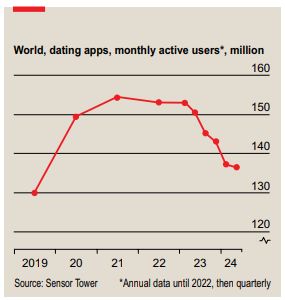
Today roughly 350 million people around the world have a dating app on their phone, up from 250 million in 2018, according to a research firm. In June 2024 Tokyo’s government even said it would launch a matchmaking app of its own to pair up singles in the city. Yet lately online dating has lost its spark. The apps were downloaded 237 million times globally in 2023, down from 287 million in 2020. According to a research firm, the number of people who use them at least once a month has dwindled from 154 million in 2021 to 137 million in the second quarter of 2024.
(www.economist.com, 08.08.2024. Adaptado.)
1 to shed: to get rid of something that is no longer wanted.
2 trading: the activity of buying and selling things.
Leia o texto e examine o gráfico para responder à questão.
When Tinder (a mobile dating app) was launched on college campuses in America in 2012, it quickly became a hit. Although online dating had been around since Match.com, a website for lonely hearts, launched in 1995, it had long struggled to shed1 an image of desperation. But Tinder, by letting users sift through photos of countless potential dates with a simple swipe, made it easy and fun.
Soon Tinder and its rivals had transformed dating. A report found that 30% of American adults had used an online dating service, including more than half of those aged between 18 and 29. One in five couples of that age had met through such a service. Usage surged during the pandemic, as lonely locked- -down singles searched for partners. The market capitalisation of Bumble, a rival to Tinder, surged to $13 billion on its first day of trading2 in February 2021. Later that year the value of Match Group, which owns Tinder, Hinge and scores of other dating services, reached nearly $50 billion.
Today roughly 350 million people around the world have a dating app on their phone, up from 250 million in 2018, according to a research firm. In June 2024 Tokyo’s government even said it would launch a matchmaking app of its own to pair up singles in the city. Yet lately online dating has lost its spark. The apps were downloaded 237 million times globally in 2023, down from 287 million in 2020. According to a research firm, the number of people who use them at least once a month has dwindled from 154 million in 2021 to 137 million in the second quarter of 2024.
(www.economist.com, 08.08.2024. Adaptado.)
1 to shed: to get rid of something that is no longer wanted.
2 trading: the activity of buying and selling things.
Leia o texto e examine o gráfico para responder à questão.
When Tinder (a mobile dating app) was launched on college campuses in America in 2012, it quickly became a hit. Although online dating had been around since Match.com, a website for lonely hearts, launched in 1995, it had long struggled to shed1 an image of desperation. But Tinder, by letting users sift through photos of countless potential dates with a simple swipe, made it easy and fun.
Soon Tinder and its rivals had transformed dating. A report found that 30% of American adults had used an online dating service, including more than half of those aged between 18 and 29. One in five couples of that age had met through such a service. Usage surged during the pandemic, as lonely locked- -down singles searched for partners. The market capitalisation of Bumble, a rival to Tinder, surged to $13 billion on its first day of trading2 in February 2021. Later that year the value of Match Group, which owns Tinder, Hinge and scores of other dating services, reached nearly $50 billion.
Today roughly 350 million people around the world have a dating app on their phone, up from 250 million in 2018, according to a research firm. In June 2024 Tokyo’s government even said it would launch a matchmaking app of its own to pair up singles in the city. Yet lately online dating has lost its spark. The apps were downloaded 237 million times globally in 2023, down from 287 million in 2020. According to a research firm, the number of people who use them at least once a month has dwindled from 154 million in 2021 to 137 million in the second quarter of 2024.
(www.economist.com, 08.08.2024. Adaptado.)
1 to shed: to get rid of something that is no longer wanted.
2 trading: the activity of buying and selling things.
Leia o texto e examine o gráfico para responder à questão.
When Tinder (a mobile dating app) was launched on college campuses in America in 2012, it quickly became a hit. Although online dating had been around since Match.com, a website for lonely hearts, launched in 1995, it had long struggled to shed1 an image of desperation. But Tinder, by letting users sift through photos of countless potential dates with a simple swipe, made it easy and fun.
Soon Tinder and its rivals had transformed dating. A report found that 30% of American adults had used an online dating service, including more than half of those aged between 18 and 29. One in five couples of that age had met through such a service. Usage surged during the pandemic, as lonely locked- -down singles searched for partners. The market capitalisation of Bumble, a rival to Tinder, surged to $13 billion on its first day of trading2 in February 2021. Later that year the value of Match Group, which owns Tinder, Hinge and scores of other dating services, reached nearly $50 billion.
Today roughly 350 million people around the world have a dating app on their phone, up from 250 million in 2018, according to a research firm. In June 2024 Tokyo’s government even said it would launch a matchmaking app of its own to pair up singles in the city. Yet lately online dating has lost its spark. The apps were downloaded 237 million times globally in 2023, down from 287 million in 2020. According to a research firm, the number of people who use them at least once a month has dwindled from 154 million in 2021 to 137 million in the second quarter of 2024.
(www.economist.com, 08.08.2024. Adaptado.)
1 to shed: to get rid of something that is no longer wanted.
2 trading: the activity of buying and selling things.
Leia a tirinha de Alex Hallatt para responder à questão.
(www.alexhallatt.com. Adaptado.)
Leia a tirinha de Alex Hallatt para responder à questão.
(www.alexhallatt.com. Adaptado.)
Examine o meme publicado pelo perfil @classicaldamn no Instagram em 16.04.2024.

O conteúdo explorado pelo meme relaciona-se diretamente com aquele explorado pela seguinte fábula de Esopo:
To the Editor:
Defective airplanes, tobacco products, cars without seatbelts and social media posts: One of these things is not like the others.
The surgeon general Dr. Vivek Murthy proposes applying warning labels to social media platforms as if they are surely dangerous, like cigarettes and airplanes whose doors fall off during a flight. But there’s another way social media is different: It’s a tool we use to express ourselves. As such, its use is protected by the First Amendment1 .
This isn’t the first time the government has tried to regulate expression in the name of protecting kids. It tried to do so in the 1950s with comics, the 1980s with rock music and the 1990s with video games. We now look back on these efforts as misguided and unconstitutional.
Nico Perrino
Washington
The writer is the executive vice president of FIRE, the Foundation for Individual Rights and Expression.
(www.nytimes.com, 24.06.2024. Adapted.)
1First Amendment: an item in the American Constitution that guarantees the people freedom concerning religion and expression, among other rights.
It is the letter writer’s explicit position on protection protocols:

 Conheça nossos planos