Questões de Vestibular
Sobre interpretação de texto | reading comprehension em inglês
Foram encontradas 5.299 questões
“Weird.” “Curious.” “Baffling.” “Quite Stupid.” These words all once described Alexa, the voice-activated digital assistant on Amazon’s Echo device. But Amazon says the Echo Dot, a smaller, less expensive version of the Echo, was its “top-selling device” during the holiday season.
In 2014, it was odd to even consider owning an Echo — and impossible to buy without an invitation from Amazon. Today, you can pick from five Echo models. Or, you can try Google’s version: the Google Home, Google Home Mini or Google Home Max. Apple has also released a digital assistant device, the HomePod, which is fully capable with Siri. You can have your pick of digital assistants — each with varying capabilities of improving your life.
Alexa now has more than 15,000 skills, meaning any Echo device can go beyond describing the weather or playing music. The Google Assistant, first released in 2016, is catching up.
So why buy one now? First, they’re relatively inexpensive and far easier to use and understand than they were when first released. Think back to MP3 players or early smartphones: people learned a lot about using the products and became so adjusted to them that they didn’t know how to go back. Second, the future is paved with smart home devices, and voice-activated assistants to control them are becoming ubiquitous. The Echo and Google Home are no longer “test products” — the companies behind them want them to last.
Disponı́vel em: <www.nytimes.com>. Acesso em: 10 mar. 2018
Com base no texto, afirma-se que
I. existem vários modelos de assistentes digitais ativados por voz no mercado. II. Alexa ainda é bastante limitada, mas descreve o tempo e toca músicas., III. Google, Apple e Amazon desenvolveram assistentes digitais em parceria. IV. há justificativas para a compra de um Echo Dot ou de um Google Home. V. alguns dos assistentes digitais mencionados ainda se encontram em fase de testes.
Assinale a alternativa que apresenta apenas afirmativas corretas.
Nuclear bombs can destroy us. Facebook undermines our privacy. Artificial intelligence (AI) and robots can enslave us (or, worse, take our jobs). Synthetic biology and geneediting have humans playing God. Social media make us depressed: we’ve never been so connected yet never so alone.
Those are just a few of the complaints leveled against technology. For most of human history, however, technology was mostly seen as a force for good. More people would live because of technical progress, from refrigeration to vaccination, than perish because of it, despite lethal inventions such as gunpowder.

Disponı́vel em: <https://www.economist.com >. Acesso em: 25 mar. 2018.
After reading this text, one could state that

Disponı́vel em: <http://time.com>. Acesso em: 24 abr. 2018.
De acordo com o texto, infere-se que
Does cell phone radiation cause cancer? New studies show a correlation in lab rats, but the evidence may not resolve ongoing debates over causality or whether any effects arise in people.
The ionizing radiation given off by sources such as x-ray machines and the sun boosts cancer risk by shredding molecules in the body. But the nonionizing radio-frequency (RF) radiation that cell phones and other wireless devices emit has just one known biological effect: an ability to heat tissue by exciting its molecules. Still, evidence advanced by the studies shows prolonged exposure to even very low levels of RF radiation, perhaps by mechanisms other than heating that remain unknown, makes rats uniquely prone to a rare tumor called a schwannoma, which affects a type of neuron (or nerve cell) called a Schwann cell.

Disponı́vel em: <https://www.scientificamerican.com>. Acesso em: 29 mar. 2018.
Com base no texto, afirma-se que
Do Gun Owners Want Gun Control?
By Jess Bidgood and Sabrina Tavernise
Tom Galinat signed a letter to lawmakers, urging them to expand background checks for gun purchases. Mr. Galinat, 35, a farmer and hunter who owns nine guns, traveled last month from his home in Peacham, Vt., to Montpelier, the state capital, with a firm goal in mind: Convince lawmakers to enact a ban on high-capacity magazines.
Jonathan Leach, 56, a policy analyst in Augusta, Me., and the owner of about 10 guns, testified before Maine legislators in favor of a bill to let judges order people deemed dangerous to surrender their firearms. Mr. Leach said he wanted to serve as a counterweight to gun rights enthusiasts he knew would speak against the idea.
Disponı́vel em: <www.nytimes.com>. Acesso em: 24 Abr. 2018.
Com base no texto, é correto afirmar que

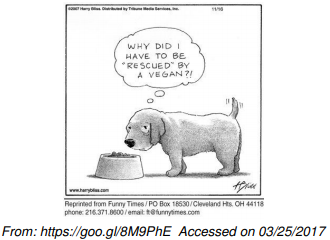
Sobre a tirinha, pode-se concluir que o efeito de humor ocorre devido ao fato
The veteran fashionistas launched their brand in 1985 and continue to work together despite breaking up as a couple in 2004. “When we split up, we said to ourselves that it was better to divide up everything, because if I took a blow to the head the next day he would have found himself dealing with someone not involved in the industry, like for example my cousin, who could ruin the business,” Gabbana said. “We have created a trust neither of us can touch.”
Dolce, 59, added that the pair had refused “every offer to buy the brand”. “You can have all the money in the world, but if you are not free, what do you do? You don’t go to the grave with a coffin stuffed with money,” he said.
Designer Stefano Gabbana says he is tired of being labelled as gay. “I’m too busy working. I don’t care about becoming richer – my goal is to be successful,” he said. The two men said they still share an exceptional bond, even though they are no longer romantically linked. “Even today, what is mine is his, and what is his is mine ...”

Disponı́vel em: <https://www.theguardian.com>. Acesso em: 24 mar. 2018.
According to the text,
I. Domenico and Stefano imply the Dolce & Gabbana label will die with them. II. The Italian designers still maintain a romantic and long lasting relationship. III. For them, success in their careers seems to be more important than money. IV. Gabbana said he only trusts Dolce and his own cousin to run their business. V. Even though they love each other, their fortunes are kept apart from one another.
Assinale a alternativa que apresenta apenas afirmativas corretas.
Read TEXT 9 and answer to the question.
TEXT 9

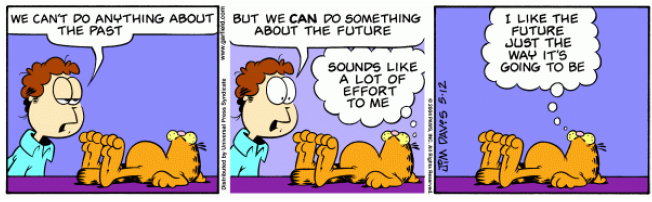
WATTERSON, Bill. Available at: <https://br.pinterest.com/pin/300685712614333926/>. Accessed: May 09th 2018 (adapted).
TEXT 9 suggests that
Read TEXT 8 and answer to the question.
TEXT 8

Available at: <https://www.kulzy.com/work/147877/religare-health-insurance/direct-responsemailers/weight-loss/>. Accessed: May 09th 2018 (adapted).
Read TEXT 8 and answer to the question.
TEXT 8

Available at: <https://www.kulzy.com/work/147877/religare-health-insurance/direct-responsemailers/weight-loss/>. Accessed: May 09th 2018 (adapted).
Read TEXT 7 and answer to the question.
TEXT 7
FACEBOOK ADDS DATING APP

Read the following statements about TEXT 7 and choose the CORRECT answer.
I. Through his new product, Zuckerberg intends to increase the low rate of marriages.
II. The Facebook dating app account and the main one are the same.
III.Online relationships are trendy in The USA.
IV.Most Facebook users are single.
V. It is already possible to see the impact of Facebook’s new product.
The CORRECT statements are only
Read TEXT 7 and answer to the question.
TEXT 7
FACEBOOK ADDS DATING APP

So You Want to Be a Space Tourist? Here Are Your Options
by Adam Mann / Jul.21.2017 /11:30 AM ET
Though we’ve been living in the Space Age for more than half a century, going into space remains an extreme rarity. Fewer than 600 people have gone above the Kármán line — the point, about 62 miles above Earth, that marks the beginning of space — and all were put there by the U.S. or another nation's government.
But the rise of private spaceflight companies like Virgin Galactic and Space X means that the final frontier may soon be within reach of a great many more of us. The firms have announced plans to put private astronauts, a.k.a. space tourists, on orbital or suborbital flights within the next few years.
Initially, the cost of a ride on one of these rockets will be hundreds of thousands of dollars at a minimum. That puts the experience within reach of only the wealthiest people. But advances in rocket and capsule design are expected to lower the price to the point that people of more modest fortunes are able to afford a ticket.
Some projections put the global space tourism market at approximately $34 billion by 2021.
What Space Tourists Can Expect
What exactly is in store for space tourists? The excitement of a rocket ride and a chance to experience weightlessness, for starters. And the bragging rights are hard to beat. But some say the biggest benefit of going into space is getting a dramatic new outlook on life on the fragile blue marble we call home. It’s a perspective shift that could have profound implications not just for individuals but also for society at large.
“I personally believe the planetary perspective is going to be crucial to solving humanity’s biggest challenges over the next century,” says Virgin Galactic CEO George Whitesides. “I’m inspired that we’ll take people up so they can experience that view, which is said to change your world view in a fundamental way.”
Adapted from: https://www.nbcnews.com/mach/science/so-you-want-be-space-tourist-here-are-your-options-ncna784166
Glossary
weightlessness: ausência de peso; bragging rights: direito
de gabar-se; to afford: poder comprar.
So You Want to Be a Space Tourist? Here Are Your Options
by Adam Mann / Jul.21.2017 /11:30 AM ET
Though we’ve been living in the Space Age for more than half a century, going into space remains an extreme rarity. Fewer than 600 people have gone above the Kármán line — the point, about 62 miles above Earth, that marks the beginning of space — and all were put there by the U.S. or another nation's government.
But the rise of private spaceflight companies like Virgin Galactic and Space X means that the final frontier may soon be within reach of a great many more of us. The firms have announced plans to put private astronauts, a.k.a. space tourists, on orbital or suborbital flights within the next few years.
Initially, the cost of a ride on one of these rockets will be hundreds of thousands of dollars at a minimum. That puts the experience within reach of only the wealthiest people. But advances in rocket and capsule design are expected to lower the price to the point that people of more modest fortunes are able to afford a ticket.
Some projections put the global space tourism market at approximately $34 billion by 2021.
What Space Tourists Can Expect
What exactly is in store for space tourists? The excitement of a rocket ride and a chance to experience weightlessness, for starters. And the bragging rights are hard to beat. But some say the biggest benefit of going into space is getting a dramatic new outlook on life on the fragile blue marble we call home. It’s a perspective shift that could have profound implications not just for individuals but also for society at large.
“I personally believe the planetary perspective is going to be crucial to solving humanity’s biggest challenges over the next century,” says Virgin Galactic CEO George Whitesides. “I’m inspired that we’ll take people up so they can experience that view, which is said to change your world view in a fundamental way.”
Adapted from: https://www.nbcnews.com/mach/science/so-you-want-be-space-tourist-here-are-your-options-ncna784166
Glossary
weightlessness: ausência de peso; bragging rights: direito
de gabar-se; to afford: poder comprar.
So You Want to Be a Space Tourist? Here Are Your Options
by Adam Mann / Jul.21.2017 /11:30 AM ET
Though we’ve been living in the Space Age for more than half a century, going into space remains an extreme rarity. Fewer than 600 people have gone above the Kármán line — the point, about 62 miles above Earth, that marks the beginning of space — and all were put there by the U.S. or another nation's government.
But the rise of private spaceflight companies like Virgin Galactic and Space X means that the final frontier may soon be within reach of a great many more of us. The firms have announced plans to put private astronauts, a.k.a. space tourists, on orbital or suborbital flights within the next few years.
Initially, the cost of a ride on one of these rockets will be hundreds of thousands of dollars at a minimum. That puts the experience within reach of only the wealthiest people. But advances in rocket and capsule design are expected to lower the price to the point that people of more modest fortunes are able to afford a ticket.
Some projections put the global space tourism market at approximately $34 billion by 2021.
What Space Tourists Can Expect
What exactly is in store for space tourists? The excitement of a rocket ride and a chance to experience weightlessness, for starters. And the bragging rights are hard to beat. But some say the biggest benefit of going into space is getting a dramatic new outlook on life on the fragile blue marble we call home. It’s a perspective shift that could have profound implications not just for individuals but also for society at large.
“I personally believe the planetary perspective is going to be crucial to solving humanity’s biggest challenges over the next century,” says Virgin Galactic CEO George Whitesides. “I’m inspired that we’ll take people up so they can experience that view, which is said to change your world view in a fundamental way.”
Adapted from: https://www.nbcnews.com/mach/science/so-you-want-be-space-tourist-here-are-your-options-ncna784166
Glossary
weightlessness: ausência de peso; bragging rights: direito
de gabar-se; to afford: poder comprar.
So You Want to Be a Space Tourist? Here Are Your Options
by Adam Mann / Jul.21.2017 /11:30 AM ET
Though we’ve been living in the Space Age for more than half a century, going into space remains an extreme rarity. Fewer than 600 people have gone above the Kármán line — the point, about 62 miles above Earth, that marks the beginning of space — and all were put there by the U.S. or another nation's government.
But the rise of private spaceflight companies like Virgin Galactic and Space X means that the final frontier may soon be within reach of a great many more of us. The firms have announced plans to put private astronauts, a.k.a. space tourists, on orbital or suborbital flights within the next few years.
Initially, the cost of a ride on one of these rockets will be hundreds of thousands of dollars at a minimum. That puts the experience within reach of only the wealthiest people. But advances in rocket and capsule design are expected to lower the price to the point that people of more modest fortunes are able to afford a ticket.
Some projections put the global space tourism market at approximately $34 billion by 2021.
What Space Tourists Can Expect
What exactly is in store for space tourists? The excitement of a rocket ride and a chance to experience weightlessness, for starters. And the bragging rights are hard to beat. But some say the biggest benefit of going into space is getting a dramatic new outlook on life on the fragile blue marble we call home. It’s a perspective shift that could have profound implications not just for individuals but also for society at large.
“I personally believe the planetary perspective is going to be crucial to solving humanity’s biggest challenges over the next century,” says Virgin Galactic CEO George Whitesides. “I’m inspired that we’ll take people up so they can experience that view, which is said to change your world view in a fundamental way.”
Adapted from: https://www.nbcnews.com/mach/science/so-you-want-be-space-tourist-here-are-your-options-ncna784166
Glossary
weightlessness: ausência de peso; bragging rights: direito
de gabar-se; to afford: poder comprar.
the question is not if another outbreak will happen, but when, (l. 28-29)
The underlined words present the health community’s opinion concerning new outbreaks of epidemics.
According to their opinion, future outbreaks are seen as:
The texts “Três teses sobre o avanço da febre amarela” and “The effect of climate change on epidemic risk” mention possible reasons for disease outbreaks.
The reason which is presented in both texts is:

In today’s political climate, it sometimes feels like we can’t even agree on basic facts. We bombard each other with statistics and figures, hoping that more data will make a difference. A progressive person might show you the same climate change graphs over and over while a conservative person might point to the trillions of dollars of growing national debt. We’re left wondering, “Why can’t they just see? It’s so obvious!”
Certain myths are so pervasive that no matter how many experts disprove them, they only seem to grow in popularity. There’s no shortage of serious studies showing no link between autism and vaccines, for example, but these are no match for an emotional appeal to parents worried for their young children.
Tali Sharot, a cognitive neuroscientist at University College London, studies how our minds work and how we process new information. In her upcoming book, The Influential Mind, she explores why we ignore facts and how we can get people to actually listen to the truth. Tali shows that we’re open to new information – but only if it confirms our existing beliefs. We find ways to ignore facts that challenge our ideals. And as neuroscientist Bahador Bahrami and colleagues have found, we weigh all opinions as equally valid, regardless of expertise.
So, having the data on your side is not always enough. For better or for worse, Sharot says, emotions may be the key to changing minds.
(Shankar Vedantam. www.npr.org. Adaptado.)

In today’s political climate, it sometimes feels like we can’t even agree on basic facts. We bombard each other with statistics and figures, hoping that more data will make a difference. A progressive person might show you the same climate change graphs over and over while a conservative person might point to the trillions of dollars of growing national debt. We’re left wondering, “Why can’t they just see? It’s so obvious!”
Certain myths are so pervasive that no matter how many experts disprove them, they only seem to grow in popularity. There’s no shortage of serious studies showing no link between autism and vaccines, for example, but these are no match for an emotional appeal to parents worried for their young children.
Tali Sharot, a cognitive neuroscientist at University College London, studies how our minds work and how we process new information. In her upcoming book, The Influential Mind, she explores why we ignore facts and how we can get people to actually listen to the truth. Tali shows that we’re open to new information – but only if it confirms our existing beliefs. We find ways to ignore facts that challenge our ideals. And as neuroscientist Bahador Bahrami and colleagues have found, we weigh all opinions as equally valid, regardless of expertise.
So, having the data on your side is not always enough. For better or for worse, Sharot says, emotions may be the key to changing minds.
(Shankar Vedantam. www.npr.org. Adaptado.)