Questões de Vestibular Comentadas sobre interpretação de texto | reading comprehension em inglês

Foram encontradas 2.261 questões

Ano: 2015 Banca: FATEC Órgão: FATEC Prova: FATEC - 2015 - FATEC - Vestibular - Primeiro Semestre |
Q1265092 Inglês

Learn ‘n’ go

How quickly can people learn new skills?

Jan 25th 2014 – from the print edition


      In 2012, Erik Brynjolfsson and Andrew McAfee took a ride in one of Google’s driverless cars. The car’s performance, they report, was flawless, boring and, above all, “weird”. Only a few years earlier, “We were sure that computers would not be able to drive cars.” Only humans, they thought, could make sense of the countless, shifting patterns of driving a car – with oncoming1 traffic, changing lights and wayward2 jaywalkers3 .

      Machines have mastered driving. And not just driving. In ways that are only now becoming apparent, the authors argue, machines can forecast home prices, design beer bottles, teach at universities, grade exams and do countless other things better and more cheaply than humans. (…)

      This will have one principal good consequence, and one bad. The good is bounty4 . Households will spend less on groceries, utilities and clothing; the deaf will be able to hear, the blind to see. The bad is spread5 . The gap is growing between the lucky few whose abilities and skills are enhanced6 by technology, and the far more numerous middle-skilled people competing for the remaining7 jobs that machines cannot do, such as folding towels and waiting at tables. (…) People should develop skills that complement, rather than compete with computers, such as idea generation and complex communication. (…)

<http://tinyurl.com/m2zmazg>Acesso em: 27.07.2015. Adaptado.

Glossário

1oncoming: iminente; próximo.

2wayward: desobediente; instável.

3jaywalker: pedestre imprudente.

4bounty: recompensa.

5spread: propagação; extensão.

6enhanced: aprimorado(a).

7remaining: remanescente.

De acordo com o primeiro parágrafo, em 2012, Erik Brynjolfsson e Andrew McAfee
Alternativas
Ano: 2015 Banca: FATEC Órgão: FATEC Prova: FATEC - 2015 - FATEC - Vestibular - Primeiro Semestre |
Q1265091 Inglês

Learn ‘n’ go

How quickly can people learn new skills?

Jan 25th 2014 – from the print edition


      In 2012, Erik Brynjolfsson and Andrew McAfee took a ride in one of Google’s driverless cars. The car’s performance, they report, was flawless, boring and, above all, “weird”. Only a few years earlier, “We were sure that computers would not be able to drive cars.” Only humans, they thought, could make sense of the countless, shifting patterns of driving a car – with oncoming1 traffic, changing lights and wayward2 jaywalkers3 .

      Machines have mastered driving. And not just driving. In ways that are only now becoming apparent, the authors argue, machines can forecast home prices, design beer bottles, teach at universities, grade exams and do countless other things better and more cheaply than humans. (…)

      This will have one principal good consequence, and one bad. The good is bounty4 . Households will spend less on groceries, utilities and clothing; the deaf will be able to hear, the blind to see. The bad is spread5 . The gap is growing between the lucky few whose abilities and skills are enhanced6 by technology, and the far more numerous middle-skilled people competing for the remaining7 jobs that machines cannot do, such as folding towels and waiting at tables. (…) People should develop skills that complement, rather than compete with computers, such as idea generation and complex communication. (…)

<http://tinyurl.com/m2zmazg>Acesso em: 27.07.2015. Adaptado.

Glossário

1oncoming: iminente; próximo.

2wayward: desobediente; instável.

3jaywalker: pedestre imprudente.

4bounty: recompensa.

5spread: propagação; extensão.

6enhanced: aprimorado(a).

7remaining: remanescente.

Ainda conforme o primeiro parágrafo, a performance do carro desenvolvido pelo Google foi avaliada por Erik Brynjolfsson e Andrew McAfee como
Alternativas
Ano: 2015 Banca: PUC-PR Órgão: PUC - PR Prova: PUC-PR - 2015 - PUC - PR - Vestibular - Medicina |
Q809843 Inglês

 Read the text and choose the best alternative.


                                Don’t Set Goals: Use Systems


Have you already set your goals for the New Year? Do you want to lose 10 kilos, run a marathon or speak fluent English? Some experts believe that you need systems, not goals. A system is something you do on a regular basis. This means focusing on what you can control (your actions) rather than what you can’t (the unpredictable). For example, don’t focus on losing 10 kilos, focus on shopping for healthy food and cooking something light every day. Don’t focus on the marathon; focus on the training schedule. Invent a system to improve your English, one step at a time. Good luck!

Disponível em: . Acesso em: junho de 2015.


According to the text we can state that:


I. In order to achieve something you should focus on your actions.

II. In order to achieve something you should eat healthy food every day.

III. In order to achieve something you should set your systems for the New Year.

IV. In order to achieve something you should take one step at a time.  

Alternativas
Ano: 2015 Banca: PUC-PR Órgão: PUC - PR Prova: PUC-PR - 2015 - PUC - PR - Vestibular - Medicina |
Q809842 Inglês

Read the text and choose the best alternative for the underlined word.


                       Pictures of Ascent in the Fiction of Edgar Allan Poe.

                                                                                                    By Douglas Anderson.

                                             New York: Palgrave Macmillan. 2009. xi, 201 pp. $ 80.00.


The material world and the ability to transcend it are at the heart of this study of Edgar Allan Poe’s writings. In chapters such as “Problems of Disposal” and “The Gravity of Things,” Anderson contrasts the “weight of living” present in Poe’s life and work with, in Italo Calvino’s words, the “lightness of thoughtfulness.” This book provides a taxonomy of Poe’s literary imagination through suggestive literary analyses of the fictive environments that inhabit and undergird his stories, and it expands the purview of Poe studies as well as of nineteenth-century American literature.

Available in: <http://americanliterature.dukejournals.org/content/82/3/663.full.pdf> . Access on: August 2015.


Taxonomy means 

Alternativas
Ano: 2015 Banca: PUC-PR Órgão: PUC - PR Prova: PUC-PR - 2015 - PUC - PR - Vestibular - Medicina |
Q809841 Inglês

Read the text below:


                Study: Junk Food Doesn’t Only Make You Fat, It Makes You Lazy


According to a recent study by researchers at the University of California Los Angeles, a diet rich in processed food and fat leads not only to excess weight but also to less motivation. Researchers found that rats on a junk food diet were significantly fatter than rats on a healthy diet. But the rats with the unhealthy diet also were less active and mentally slower. "Our data suggest that diet-induced obesity is a cause, rather than an effect, of laziness. Either the highly processed diet causes fatigue or the diet causes obesity, which causes fatigue," says lead researcher Aaron Blaisdell.

Disponível em: <http://www.shortnews.com/start.cfm?id=94296> . Acesso em: abril de 2015.


According to the text, it is possible to state that:

I. Rats which ate healthy food were thinner than the ones which ate junk food.

II. Laziness is a consequence from obesity.

III. Obesity can be considered as an effect of laziness.

IV. Less motivation is one of the causes which make junk food ingestion attractive.

V. Rats on a healthy diet were more active.


Alternativas
Ano: 2015 Banca: PUC-PR Órgão: PUC - PR Prova: PUC-PR - 2015 - PUC - PR - Vestibular - Medicina |
Q809840 Inglês

Read the text and choose the best alternative.


                                Solar eclipse in Europe

The UK could be plunged into darkness next month, as experts warn there could be the biggest solar eclipse since 1999. Nearly 90% of the sun's rays are expected to be blocked out in parts of Europe on March 20th.

In London and the Southeast, 85% of the sun will be obscured by the moon, while in northern Scotland, more than 95% will be covered.

But the National Grid warns there could be a solar power outage as a result. Solar power isn’t widely used in the UK, but other parts of Europe that heavily rely on it could be out of electricity for a short while.

There's no need to worry, though – the European Network Transmission System Operators for Electricity have been planning for the event for months.

The eclipse will last for around two hours at 8:40 a.m. The next one will not be until 2026.

Disponível em: <http://www.newsinlevels.com/products/solar-eclipse-in-europe-level-3/> . Acesso em: março 2015.


Check the statements according to lexical-semantic aspects from the text above:


I. In: ‘The UK could be plunged into darkness next month…’, the verb in bold could be changed to ‘immersed’ without changing the meaning of the sentence.

II. The word ‘warn’ in the first paragraph means to make someone conscious of a possible problem or danger so they will not be hurt or affected by it.

III. In the sentence: ‘In London and the Southeast, 85% of the sun will be obscured by the moon, while in northern Scotland, more than 95% will be covered.’; the conjunction ‘while’ means that the same exact thing will be happening in the entire area.

IV. Read the sentence: ‘But the National Grid warns there could be a solar power outage as a result.’ The words in bold ‘as a result’ mean that a solar power outage could happen because of the solar eclipse.

V. The meaning of the word ‘eclipse’ in the last paragraph is ‘decline’.


Choose the CORRECT alternative.  

Alternativas
Ano: 2015 Banca: PUC-PR Órgão: PUC - PR Prova: PUC-PR - 2015 - PUC - PR - Vestibular - Medicina |
Q809839 Inglês

Read the text and answer the question.


                  Life stress may lead to cognitive developmental delays in children


According to a new study, children living in harsh or unstable environments are more likely to experience learning and cognitive delays by age 4.

Researchers examined the cortisol levels and cognitive delays of 201 children from low-income families in the northeastern United States. It was found that those kids with higher levels of cortisol experienced harsh or insensitive caregiving.

"We discovered that exposure to specific forms of family adversity when children were 2 years old predicted their cortisol profile, which in turn was linked with notable differences in children´s cognitive functioning at age 4," the researchers say.

Disponível em: <http://www.shortnews.com/start.cfm?id=100733> . Acesso em: 16/06/15.


According to the research, we can state that:


I. Children who are more stressed may have cognitive delay.

II. Children who are stresser may have developmental delays.

III. Children from more rich families were evaluated in this research.

IV. Children from richer families were evaluated in this research.

V. Children from poorer families were evaluated in this research. 

Alternativas
Ano: 2015 Banca: PUC - Campinas Órgão: PUC - Campinas Prova: PUC - Campinas - 2015 - PUC - Campinas - Vestibular - Conhecimentos Gerais |
Q809573 Inglês

Atenção: Para responder à questão, considere o texto abaixo.

The colors of the rainbow so pretty in the sky

Are also on the faces of people passing .. I...

I see friends ..II.. hands

Saying, "how do you do?"

They're really saying,

I love you. 

The word that correctly fills the blank ..I.. is
Alternativas
Ano: 2015 Banca: PUC-PR Órgão: PUC - PR Prova: PUC-PR - 2015 - PUC - PR - Vestibular |
Q809308 Inglês

Opera

Opera refers to a dramatic art form, originating in Europe, in which the emotional content is conveyed to the audience as much through music, both vocal and instrumental, as it is through the lyrics. By contrast, in musical theater an actor's dramatic performance is primary, and the music plays a lesser role. The drama in opera is presented using the primary elements of theater such as scenery, costumes, and acting. However, the words of the opera, or libretto, are sung rather than spoken. The singers are accompanied by a musical ensemble ranging from a small instrumental ensemble to a full symphonic orchestra.

Disponível em: <http://www.grammarbank.com/short-reading-comprehension-passages.html> . Acesso em: novembro 2014.

Select the alternative that is TRUE, according to the text.

Alternativas
Ano: 2015 Banca: PUC-PR Órgão: PUC - PR Prova: PUC-PR - 2015 - PUC - PR - Vestibular |
Q809304 Inglês

India Cheating Scandal: 600 Students Expelled at Bihar Schools

More than 600 students have been expelled from school in India amid widespread cheating — with some having friends scale the walls of exam centers to pass notes through windows, officials said Friday. The students were among more than 1.4 million high school students taking their 10th grade school finals in the eastern state of Bihar. Many of those caught cheating had smuggled textbooks or scraps of paper to be used for cheating, police and education officials said. Friends, parents and other relatives of the teenagers were seen climbing the sides of some exam centers on Wednesday and Thursday as they tried to reach the windows of the classrooms where the students were taking their exams. They appeared to be trying to pass on cheat sheets with answers written on them. Bihar's education minister, P K Shahi, said the scale of the cheating made it impossible for officials alone to contain and that families should help.

Disponível em:: <http://www.nbcnews.com/news/world/six-hundred-students-caught-cheating-bihar-india-schools-n327066> . Acesso em: abril de 2015.

According to the text, choose the alternative which shows the CORRECT sequence of T (true) or F (false).

I. 600 students quit school.

II. Families tried to help the students to cheat.

III. In the education minister’s perspective, it turned out to be ok the families’ help.

IV. At least 1.4 million students were taking the test.

V. They took this test because they did not have good grades during the semester.

Alternativas
Ano: 2015 Banca: PUC-PR Órgão: PUC - PR Prova: PUC-PR - 2015 - PUC - PR - Vestibular |
Q809303 Inglês

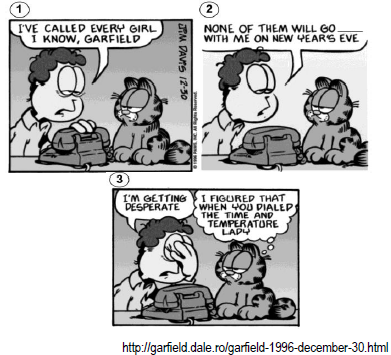
When Garfield says “could’ve used a little salt”, what is he expressing?

Imagem associada para resolução da questão

Alternativas
Ano: 2015 Banca: UECE-CEV Órgão: UECE Prova: UECE-CEV - 2015 - UECE - Língua Inglesa - 2ª Fase - 1º dia |
Q705496 Inglês

TEXT

    A library tradition is being refashioned to emphasize early literacy and better prepare young children for school, and drawing many new fans in the process.

    Among parents of the under-5 set, spots for story time have become as coveted as seats for a hot Broadway show like “Hamilton.” Lines stretch down the block at some branches, with tickets given out on a first-come-first-served basis because there is not enough room to accommodate all of the children who show up.

    Workers at the 67th Street Library on the Upper East Side of Manhattan turn away at least 10 people from every reading. They have been so overwhelmed by the rush at story time — held in the branch’s largest room, on the third floor — that once the space is full, they close the door and shut down the elevator. “It is so crowded and so popular, it’s insane,” Jacqueline Schector, a librarian, said.

    Story time is drawing capacity crowds at public libraries across New York and across the country at a time when, more than ever, educators are emphasizing the importance of early literacy in preparing children for school and for developing critical thinking skills. The demand crosses economic lines, with parents at all income levels vying to get in.

    Many libraries have refashioned the traditional readings to include enrichment activities such as counting numbers and naming colors, as well as music and dance. And many parents have made story time a fixture in their family routines alongside school pickups and playground outings — and, for those who employ nannies, a nonnegotiable requirement of the job.

    In New York, demand for story time has surged across the city’s three library systems — the New York Public Library, the Brooklyn Public Library, and the Queens Library — and has posed logistical challenges for some branches, particularly those in small or cramped buildings. Citywide, story time attendance rose to 510,367 people in fiscal year 2015, up nearly 28 percent from 399,751 in fiscal 2013.

    “The secret’s out,” said Lucy Yates, 44, an opera coach with two sons who goes to story time at the Fort Washington Library every week.

    Stroller-pushing parents and nannies begin to line up for story time outside some branches an hour before doors open. To prevent overcrowding, tickets are given out at the New Amsterdam and Webster branches, both in Manhattan, the Parkchester branch in the Bronx, and a half-dozen branches in Brooklyn, including in Park Slope, Kensington and Bay Ridge.

    The 67th Street branch keeps adding story times — there are now six a week — and holds sessions outdoors in the summer, when crowds can swell to 200 people.

    In Queens, 41 library branches are scheduled to add weekend hours this month, and many will undoubtedly include weekend story times. As Joanne King, a spokeswoman for the library explained, parents have been begging for them and “every story time is full, every time we have one.”

    Long a library staple, story time has typically been an informal reading to a small group of boys and girls sitting in a circle. Today’s story times involve carefully planned lessons by specially trained librarians that emphasize education as much as entertainment, and often include suggestions for parents and caregivers about how to reinforce what children have learned, library officials said.

    Libraries around the country have expanded story time and other children’s programs in recent years, attracting a new generation of patrons in an age when online offerings sometimes make trips to the book stacks unnecessary. Sari Feldman, president of the American Library Association, said such early-literacy efforts are part of a larger transformation libraries are undergoing to become active learning centers for their communities by offering services like classes in English as a second language, computer skills and career counseling.

    Ms. Feldman said the increased demand for story time was a product, in part, of more than a decade of work by the library association and others to encourage libraries to play a larger role in preparing young children for school. In 2004, as part of that effort, the association developed a curriculum, “Every Child Ready to Read,” that she said is now used by thousands of libraries.

    The New York Public Library is adding 45 children’s librarians to support story time and other programs, some of which are run in partnership with the city government. It has also designated 20 of its 88 neighborhood branches, including the Fort Washington Library, as “enhanced literary sites.” As such, they will double their story time sessions, to an average of four a week, and distribute 15,000 “family literacy kits” that include a book and a schedule of story times.

    “It is clear that reading and being exposed to books early in life are critical factors in student success,” Anthony W. Marx, president of the New York Public Library, said. “The library is playing an increasingly important role in strengthening early literacy in this city, expanding efforts to bring reading to children and their families through quality, free story times, curated literacy programs, after-school programs and more.”

    For its part, the Queens Library plans to expand a “Kick Off to Kindergarten” program that attracted more than 180 families for a series of workshops last year. Library officials said that more than three-quarters of the children who enrolled, many of whom spoke a language other than English at home, developed measurable classroom skills.

From: www.nytimes.com/2015/11/02

According to the president of the American Library Association, Sari Feldman, story time is part of a larger change that libraries are going through by offering other services like
Alternativas
Ano: 2015 Banca: UECE-CEV Órgão: UECE Prova: UECE-CEV - 2015 - UECE - Língua Inglesa - 2ª Fase - 1º dia |
Q705495 Inglês

TEXT

    A library tradition is being refashioned to emphasize early literacy and better prepare young children for school, and drawing many new fans in the process.

    Among parents of the under-5 set, spots for story time have become as coveted as seats for a hot Broadway show like “Hamilton.” Lines stretch down the block at some branches, with tickets given out on a first-come-first-served basis because there is not enough room to accommodate all of the children who show up.

    Workers at the 67th Street Library on the Upper East Side of Manhattan turn away at least 10 people from every reading. They have been so overwhelmed by the rush at story time — held in the branch’s largest room, on the third floor — that once the space is full, they close the door and shut down the elevator. “It is so crowded and so popular, it’s insane,” Jacqueline Schector, a librarian, said.

    Story time is drawing capacity crowds at public libraries across New York and across the country at a time when, more than ever, educators are emphasizing the importance of early literacy in preparing children for school and for developing critical thinking skills. The demand crosses economic lines, with parents at all income levels vying to get in.

    Many libraries have refashioned the traditional readings to include enrichment activities such as counting numbers and naming colors, as well as music and dance. And many parents have made story time a fixture in their family routines alongside school pickups and playground outings — and, for those who employ nannies, a nonnegotiable requirement of the job.

    In New York, demand for story time has surged across the city’s three library systems — the New York Public Library, the Brooklyn Public Library, and the Queens Library — and has posed logistical challenges for some branches, particularly those in small or cramped buildings. Citywide, story time attendance rose to 510,367 people in fiscal year 2015, up nearly 28 percent from 399,751 in fiscal 2013.

    “The secret’s out,” said Lucy Yates, 44, an opera coach with two sons who goes to story time at the Fort Washington Library every week.

    Stroller-pushing parents and nannies begin to line up for story time outside some branches an hour before doors open. To prevent overcrowding, tickets are given out at the New Amsterdam and Webster branches, both in Manhattan, the Parkchester branch in the Bronx, and a half-dozen branches in Brooklyn, including in Park Slope, Kensington and Bay Ridge.

    The 67th Street branch keeps adding story times — there are now six a week — and holds sessions outdoors in the summer, when crowds can swell to 200 people.

    In Queens, 41 library branches are scheduled to add weekend hours this month, and many will undoubtedly include weekend story times. As Joanne King, a spokeswoman for the library explained, parents have been begging for them and “every story time is full, every time we have one.”

    Long a library staple, story time has typically been an informal reading to a small group of boys and girls sitting in a circle. Today’s story times involve carefully planned lessons by specially trained librarians that emphasize education as much as entertainment, and often include suggestions for parents and caregivers about how to reinforce what children have learned, library officials said.

    Libraries around the country have expanded story time and other children’s programs in recent years, attracting a new generation of patrons in an age when online offerings sometimes make trips to the book stacks unnecessary. Sari Feldman, president of the American Library Association, said such early-literacy efforts are part of a larger transformation libraries are undergoing to become active learning centers for their communities by offering services like classes in English as a second language, computer skills and career counseling.

    Ms. Feldman said the increased demand for story time was a product, in part, of more than a decade of work by the library association and others to encourage libraries to play a larger role in preparing young children for school. In 2004, as part of that effort, the association developed a curriculum, “Every Child Ready to Read,” that she said is now used by thousands of libraries.

    The New York Public Library is adding 45 children’s librarians to support story time and other programs, some of which are run in partnership with the city government. It has also designated 20 of its 88 neighborhood branches, including the Fort Washington Library, as “enhanced literary sites.” As such, they will double their story time sessions, to an average of four a week, and distribute 15,000 “family literacy kits” that include a book and a schedule of story times.

    “It is clear that reading and being exposed to books early in life are critical factors in student success,” Anthony W. Marx, president of the New York Public Library, said. “The library is playing an increasingly important role in strengthening early literacy in this city, expanding efforts to bring reading to children and their families through quality, free story times, curated literacy programs, after-school programs and more.”

    For its part, the Queens Library plans to expand a “Kick Off to Kindergarten” program that attracted more than 180 families for a series of workshops last year. Library officials said that more than three-quarters of the children who enrolled, many of whom spoke a language other than English at home, developed measurable classroom skills.

From: www.nytimes.com/2015/11/02

One of the amazing facts about story time is that its seats in some of the New York libraries are
Alternativas
Ano: 2015 Banca: UECE-CEV Órgão: UECE Prova: UECE-CEV - 2015 - UECE - Língua Inglesa - 2ª Fase - 1º dia |
Q705494 Inglês

TEXT

    A library tradition is being refashioned to emphasize early literacy and better prepare young children for school, and drawing many new fans in the process.

    Among parents of the under-5 set, spots for story time have become as coveted as seats for a hot Broadway show like “Hamilton.” Lines stretch down the block at some branches, with tickets given out on a first-come-first-served basis because there is not enough room to accommodate all of the children who show up.

    Workers at the 67th Street Library on the Upper East Side of Manhattan turn away at least 10 people from every reading. They have been so overwhelmed by the rush at story time — held in the branch’s largest room, on the third floor — that once the space is full, they close the door and shut down the elevator. “It is so crowded and so popular, it’s insane,” Jacqueline Schector, a librarian, said.

    Story time is drawing capacity crowds at public libraries across New York and across the country at a time when, more than ever, educators are emphasizing the importance of early literacy in preparing children for school and for developing critical thinking skills. The demand crosses economic lines, with parents at all income levels vying to get in.

    Many libraries have refashioned the traditional readings to include enrichment activities such as counting numbers and naming colors, as well as music and dance. And many parents have made story time a fixture in their family routines alongside school pickups and playground outings — and, for those who employ nannies, a nonnegotiable requirement of the job.

    In New York, demand for story time has surged across the city’s three library systems — the New York Public Library, the Brooklyn Public Library, and the Queens Library — and has posed logistical challenges for some branches, particularly those in small or cramped buildings. Citywide, story time attendance rose to 510,367 people in fiscal year 2015, up nearly 28 percent from 399,751 in fiscal 2013.

    “The secret’s out,” said Lucy Yates, 44, an opera coach with two sons who goes to story time at the Fort Washington Library every week.

    Stroller-pushing parents and nannies begin to line up for story time outside some branches an hour before doors open. To prevent overcrowding, tickets are given out at the New Amsterdam and Webster branches, both in Manhattan, the Parkchester branch in the Bronx, and a half-dozen branches in Brooklyn, including in Park Slope, Kensington and Bay Ridge.

    The 67th Street branch keeps adding story times — there are now six a week — and holds sessions outdoors in the summer, when crowds can swell to 200 people.

    In Queens, 41 library branches are scheduled to add weekend hours this month, and many will undoubtedly include weekend story times. As Joanne King, a spokeswoman for the library explained, parents have been begging for them and “every story time is full, every time we have one.”

    Long a library staple, story time has typically been an informal reading to a small group of boys and girls sitting in a circle. Today’s story times involve carefully planned lessons by specially trained librarians that emphasize education as much as entertainment, and often include suggestions for parents and caregivers about how to reinforce what children have learned, library officials said.

    Libraries around the country have expanded story time and other children’s programs in recent years, attracting a new generation of patrons in an age when online offerings sometimes make trips to the book stacks unnecessary. Sari Feldman, president of the American Library Association, said such early-literacy efforts are part of a larger transformation libraries are undergoing to become active learning centers for their communities by offering services like classes in English as a second language, computer skills and career counseling.

    Ms. Feldman said the increased demand for story time was a product, in part, of more than a decade of work by the library association and others to encourage libraries to play a larger role in preparing young children for school. In 2004, as part of that effort, the association developed a curriculum, “Every Child Ready to Read,” that she said is now used by thousands of libraries.

    The New York Public Library is adding 45 children’s librarians to support story time and other programs, some of which are run in partnership with the city government. It has also designated 20 of its 88 neighborhood branches, including the Fort Washington Library, as “enhanced literary sites.” As such, they will double their story time sessions, to an average of four a week, and distribute 15,000 “family literacy kits” that include a book and a schedule of story times.

    “It is clear that reading and being exposed to books early in life are critical factors in student success,” Anthony W. Marx, president of the New York Public Library, said. “The library is playing an increasingly important role in strengthening early literacy in this city, expanding efforts to bring reading to children and their families through quality, free story times, curated literacy programs, after-school programs and more.”

    For its part, the Queens Library plans to expand a “Kick Off to Kindergarten” program that attracted more than 180 families for a series of workshops last year. Library officials said that more than three-quarters of the children who enrolled, many of whom spoke a language other than English at home, developed measurable classroom skills.

From: www.nytimes.com/2015/11/02

New York Public Library's president believes that students can succeed
Alternativas
Ano: 2015 Banca: UECE-CEV Órgão: UECE Prova: UECE-CEV - 2015 - UECE - Língua Inglesa - 2ª Fase - 1º dia |
Q705493 Inglês

TEXT

    A library tradition is being refashioned to emphasize early literacy and better prepare young children for school, and drawing many new fans in the process.

    Among parents of the under-5 set, spots for story time have become as coveted as seats for a hot Broadway show like “Hamilton.” Lines stretch down the block at some branches, with tickets given out on a first-come-first-served basis because there is not enough room to accommodate all of the children who show up.

    Workers at the 67th Street Library on the Upper East Side of Manhattan turn away at least 10 people from every reading. They have been so overwhelmed by the rush at story time — held in the branch’s largest room, on the third floor — that once the space is full, they close the door and shut down the elevator. “It is so crowded and so popular, it’s insane,” Jacqueline Schector, a librarian, said.

    Story time is drawing capacity crowds at public libraries across New York and across the country at a time when, more than ever, educators are emphasizing the importance of early literacy in preparing children for school and for developing critical thinking skills. The demand crosses economic lines, with parents at all income levels vying to get in.

    Many libraries have refashioned the traditional readings to include enrichment activities such as counting numbers and naming colors, as well as music and dance. And many parents have made story time a fixture in their family routines alongside school pickups and playground outings — and, for those who employ nannies, a nonnegotiable requirement of the job.

    In New York, demand for story time has surged across the city’s three library systems — the New York Public Library, the Brooklyn Public Library, and the Queens Library — and has posed logistical challenges for some branches, particularly those in small or cramped buildings. Citywide, story time attendance rose to 510,367 people in fiscal year 2015, up nearly 28 percent from 399,751 in fiscal 2013.

    “The secret’s out,” said Lucy Yates, 44, an opera coach with two sons who goes to story time at the Fort Washington Library every week.

    Stroller-pushing parents and nannies begin to line up for story time outside some branches an hour before doors open. To prevent overcrowding, tickets are given out at the New Amsterdam and Webster branches, both in Manhattan, the Parkchester branch in the Bronx, and a half-dozen branches in Brooklyn, including in Park Slope, Kensington and Bay Ridge.

    The 67th Street branch keeps adding story times — there are now six a week — and holds sessions outdoors in the summer, when crowds can swell to 200 people.

    In Queens, 41 library branches are scheduled to add weekend hours this month, and many will undoubtedly include weekend story times. As Joanne King, a spokeswoman for the library explained, parents have been begging for them and “every story time is full, every time we have one.”

    Long a library staple, story time has typically been an informal reading to a small group of boys and girls sitting in a circle. Today’s story times involve carefully planned lessons by specially trained librarians that emphasize education as much as entertainment, and often include suggestions for parents and caregivers about how to reinforce what children have learned, library officials said.

    Libraries around the country have expanded story time and other children’s programs in recent years, attracting a new generation of patrons in an age when online offerings sometimes make trips to the book stacks unnecessary. Sari Feldman, president of the American Library Association, said such early-literacy efforts are part of a larger transformation libraries are undergoing to become active learning centers for their communities by offering services like classes in English as a second language, computer skills and career counseling.

    Ms. Feldman said the increased demand for story time was a product, in part, of more than a decade of work by the library association and others to encourage libraries to play a larger role in preparing young children for school. In 2004, as part of that effort, the association developed a curriculum, “Every Child Ready to Read,” that she said is now used by thousands of libraries.

    The New York Public Library is adding 45 children’s librarians to support story time and other programs, some of which are run in partnership with the city government. It has also designated 20 of its 88 neighborhood branches, including the Fort Washington Library, as “enhanced literary sites.” As such, they will double their story time sessions, to an average of four a week, and distribute 15,000 “family literacy kits” that include a book and a schedule of story times.

    “It is clear that reading and being exposed to books early in life are critical factors in student success,” Anthony W. Marx, president of the New York Public Library, said. “The library is playing an increasingly important role in strengthening early literacy in this city, expanding efforts to bring reading to children and their families through quality, free story times, curated literacy programs, after-school programs and more.”

    For its part, the Queens Library plans to expand a “Kick Off to Kindergarten” program that attracted more than 180 families for a series of workshops last year. Library officials said that more than three-quarters of the children who enrolled, many of whom spoke a language other than English at home, developed measurable classroom skills.

From: www.nytimes.com/2015/11/02

One of the reasons for the relevance of early literacy is that it
Alternativas
Ano: 2015 Banca: UECE-CEV Órgão: UECE Prova: UECE-CEV - 2015 - UECE - Língua Inglesa - 2ª Fase - 1º dia |
Q705492 Inglês

TEXT

    A library tradition is being refashioned to emphasize early literacy and better prepare young children for school, and drawing many new fans in the process.

    Among parents of the under-5 set, spots for story time have become as coveted as seats for a hot Broadway show like “Hamilton.” Lines stretch down the block at some branches, with tickets given out on a first-come-first-served basis because there is not enough room to accommodate all of the children who show up.

    Workers at the 67th Street Library on the Upper East Side of Manhattan turn away at least 10 people from every reading. They have been so overwhelmed by the rush at story time — held in the branch’s largest room, on the third floor — that once the space is full, they close the door and shut down the elevator. “It is so crowded and so popular, it’s insane,” Jacqueline Schector, a librarian, said.

    Story time is drawing capacity crowds at public libraries across New York and across the country at a time when, more than ever, educators are emphasizing the importance of early literacy in preparing children for school and for developing critical thinking skills. The demand crosses economic lines, with parents at all income levels vying to get in.

    Many libraries have refashioned the traditional readings to include enrichment activities such as counting numbers and naming colors, as well as music and dance. And many parents have made story time a fixture in their family routines alongside school pickups and playground outings — and, for those who employ nannies, a nonnegotiable requirement of the job.

    In New York, demand for story time has surged across the city’s three library systems — the New York Public Library, the Brooklyn Public Library, and the Queens Library — and has posed logistical challenges for some branches, particularly those in small or cramped buildings. Citywide, story time attendance rose to 510,367 people in fiscal year 2015, up nearly 28 percent from 399,751 in fiscal 2013.

    “The secret’s out,” said Lucy Yates, 44, an opera coach with two sons who goes to story time at the Fort Washington Library every week.

    Stroller-pushing parents and nannies begin to line up for story time outside some branches an hour before doors open. To prevent overcrowding, tickets are given out at the New Amsterdam and Webster branches, both in Manhattan, the Parkchester branch in the Bronx, and a half-dozen branches in Brooklyn, including in Park Slope, Kensington and Bay Ridge.

    The 67th Street branch keeps adding story times — there are now six a week — and holds sessions outdoors in the summer, when crowds can swell to 200 people.

    In Queens, 41 library branches are scheduled to add weekend hours this month, and many will undoubtedly include weekend story times. As Joanne King, a spokeswoman for the library explained, parents have been begging for them and “every story time is full, every time we have one.”

    Long a library staple, story time has typically been an informal reading to a small group of boys and girls sitting in a circle. Today’s story times involve carefully planned lessons by specially trained librarians that emphasize education as much as entertainment, and often include suggestions for parents and caregivers about how to reinforce what children have learned, library officials said.

    Libraries around the country have expanded story time and other children’s programs in recent years, attracting a new generation of patrons in an age when online offerings sometimes make trips to the book stacks unnecessary. Sari Feldman, president of the American Library Association, said such early-literacy efforts are part of a larger transformation libraries are undergoing to become active learning centers for their communities by offering services like classes in English as a second language, computer skills and career counseling.

    Ms. Feldman said the increased demand for story time was a product, in part, of more than a decade of work by the library association and others to encourage libraries to play a larger role in preparing young children for school. In 2004, as part of that effort, the association developed a curriculum, “Every Child Ready to Read,” that she said is now used by thousands of libraries.

    The New York Public Library is adding 45 children’s librarians to support story time and other programs, some of which are run in partnership with the city government. It has also designated 20 of its 88 neighborhood branches, including the Fort Washington Library, as “enhanced literary sites.” As such, they will double their story time sessions, to an average of four a week, and distribute 15,000 “family literacy kits” that include a book and a schedule of story times.

    “It is clear that reading and being exposed to books early in life are critical factors in student success,” Anthony W. Marx, president of the New York Public Library, said. “The library is playing an increasingly important role in strengthening early literacy in this city, expanding efforts to bring reading to children and their families through quality, free story times, curated literacy programs, after-school programs and more.”

    For its part, the Queens Library plans to expand a “Kick Off to Kindergarten” program that attracted more than 180 families for a series of workshops last year. Library officials said that more than three-quarters of the children who enrolled, many of whom spoke a language other than English at home, developed measurable classroom skills.

From: www.nytimes.com/2015/11/02

One of the New York branches continues to add story times and
Alternativas
Ano: 2015 Banca: UECE-CEV Órgão: UECE Prova: UECE-CEV - 2015 - UECE - Língua Inglesa - 2ª Fase - 1º dia |
Q705491 Inglês

TEXT

    A library tradition is being refashioned to emphasize early literacy and better prepare young children for school, and drawing many new fans in the process.

    Among parents of the under-5 set, spots for story time have become as coveted as seats for a hot Broadway show like “Hamilton.” Lines stretch down the block at some branches, with tickets given out on a first-come-first-served basis because there is not enough room to accommodate all of the children who show up.

    Workers at the 67th Street Library on the Upper East Side of Manhattan turn away at least 10 people from every reading. They have been so overwhelmed by the rush at story time — held in the branch’s largest room, on the third floor — that once the space is full, they close the door and shut down the elevator. “It is so crowded and so popular, it’s insane,” Jacqueline Schector, a librarian, said.

    Story time is drawing capacity crowds at public libraries across New York and across the country at a time when, more than ever, educators are emphasizing the importance of early literacy in preparing children for school and for developing critical thinking skills. The demand crosses economic lines, with parents at all income levels vying to get in.

    Many libraries have refashioned the traditional readings to include enrichment activities such as counting numbers and naming colors, as well as music and dance. And many parents have made story time a fixture in their family routines alongside school pickups and playground outings — and, for those who employ nannies, a nonnegotiable requirement of the job.

    In New York, demand for story time has surged across the city’s three library systems — the New York Public Library, the Brooklyn Public Library, and the Queens Library — and has posed logistical challenges for some branches, particularly those in small or cramped buildings. Citywide, story time attendance rose to 510,367 people in fiscal year 2015, up nearly 28 percent from 399,751 in fiscal 2013.

    “The secret’s out,” said Lucy Yates, 44, an opera coach with two sons who goes to story time at the Fort Washington Library every week.

    Stroller-pushing parents and nannies begin to line up for story time outside some branches an hour before doors open. To prevent overcrowding, tickets are given out at the New Amsterdam and Webster branches, both in Manhattan, the Parkchester branch in the Bronx, and a half-dozen branches in Brooklyn, including in Park Slope, Kensington and Bay Ridge.

    The 67th Street branch keeps adding story times — there are now six a week — and holds sessions outdoors in the summer, when crowds can swell to 200 people.

    In Queens, 41 library branches are scheduled to add weekend hours this month, and many will undoubtedly include weekend story times. As Joanne King, a spokeswoman for the library explained, parents have been begging for them and “every story time is full, every time we have one.”

    Long a library staple, story time has typically been an informal reading to a small group of boys and girls sitting in a circle. Today’s story times involve carefully planned lessons by specially trained librarians that emphasize education as much as entertainment, and often include suggestions for parents and caregivers about how to reinforce what children have learned, library officials said.

    Libraries around the country have expanded story time and other children’s programs in recent years, attracting a new generation of patrons in an age when online offerings sometimes make trips to the book stacks unnecessary. Sari Feldman, president of the American Library Association, said such early-literacy efforts are part of a larger transformation libraries are undergoing to become active learning centers for their communities by offering services like classes in English as a second language, computer skills and career counseling.

    Ms. Feldman said the increased demand for story time was a product, in part, of more than a decade of work by the library association and others to encourage libraries to play a larger role in preparing young children for school. In 2004, as part of that effort, the association developed a curriculum, “Every Child Ready to Read,” that she said is now used by thousands of libraries.

    The New York Public Library is adding 45 children’s librarians to support story time and other programs, some of which are run in partnership with the city government. It has also designated 20 of its 88 neighborhood branches, including the Fort Washington Library, as “enhanced literary sites.” As such, they will double their story time sessions, to an average of four a week, and distribute 15,000 “family literacy kits” that include a book and a schedule of story times.

    “It is clear that reading and being exposed to books early in life are critical factors in student success,” Anthony W. Marx, president of the New York Public Library, said. “The library is playing an increasingly important role in strengthening early literacy in this city, expanding efforts to bring reading to children and their families through quality, free story times, curated literacy programs, after-school programs and more.”

    For its part, the Queens Library plans to expand a “Kick Off to Kindergarten” program that attracted more than 180 families for a series of workshops last year. Library officials said that more than three-quarters of the children who enrolled, many of whom spoke a language other than English at home, developed measurable classroom skills.

From: www.nytimes.com/2015/11/02

Many people attending this story time in American libraries
Alternativas
Ano: 2015 Banca: UECE-CEV Órgão: UECE Prova: UECE-CEV - 2015 - UECE - Língua Inglesa - 2ª Fase - 1º dia |
Q705490 Inglês

TEXT

    A library tradition is being refashioned to emphasize early literacy and better prepare young children for school, and drawing many new fans in the process.

    Among parents of the under-5 set, spots for story time have become as coveted as seats for a hot Broadway show like “Hamilton.” Lines stretch down the block at some branches, with tickets given out on a first-come-first-served basis because there is not enough room to accommodate all of the children who show up.

    Workers at the 67th Street Library on the Upper East Side of Manhattan turn away at least 10 people from every reading. They have been so overwhelmed by the rush at story time — held in the branch’s largest room, on the third floor — that once the space is full, they close the door and shut down the elevator. “It is so crowded and so popular, it’s insane,” Jacqueline Schector, a librarian, said.

    Story time is drawing capacity crowds at public libraries across New York and across the country at a time when, more than ever, educators are emphasizing the importance of early literacy in preparing children for school and for developing critical thinking skills. The demand crosses economic lines, with parents at all income levels vying to get in.

    Many libraries have refashioned the traditional readings to include enrichment activities such as counting numbers and naming colors, as well as music and dance. And many parents have made story time a fixture in their family routines alongside school pickups and playground outings — and, for those who employ nannies, a nonnegotiable requirement of the job.

    In New York, demand for story time has surged across the city’s three library systems — the New York Public Library, the Brooklyn Public Library, and the Queens Library — and has posed logistical challenges for some branches, particularly those in small or cramped buildings. Citywide, story time attendance rose to 510,367 people in fiscal year 2015, up nearly 28 percent from 399,751 in fiscal 2013.

    “The secret’s out,” said Lucy Yates, 44, an opera coach with two sons who goes to story time at the Fort Washington Library every week.

    Stroller-pushing parents and nannies begin to line up for story time outside some branches an hour before doors open. To prevent overcrowding, tickets are given out at the New Amsterdam and Webster branches, both in Manhattan, the Parkchester branch in the Bronx, and a half-dozen branches in Brooklyn, including in Park Slope, Kensington and Bay Ridge.

    The 67th Street branch keeps adding story times — there are now six a week — and holds sessions outdoors in the summer, when crowds can swell to 200 people.

    In Queens, 41 library branches are scheduled to add weekend hours this month, and many will undoubtedly include weekend story times. As Joanne King, a spokeswoman for the library explained, parents have been begging for them and “every story time is full, every time we have one.”

    Long a library staple, story time has typically been an informal reading to a small group of boys and girls sitting in a circle. Today’s story times involve carefully planned lessons by specially trained librarians that emphasize education as much as entertainment, and often include suggestions for parents and caregivers about how to reinforce what children have learned, library officials said.

    Libraries around the country have expanded story time and other children’s programs in recent years, attracting a new generation of patrons in an age when online offerings sometimes make trips to the book stacks unnecessary. Sari Feldman, president of the American Library Association, said such early-literacy efforts are part of a larger transformation libraries are undergoing to become active learning centers for their communities by offering services like classes in English as a second language, computer skills and career counseling.

    Ms. Feldman said the increased demand for story time was a product, in part, of more than a decade of work by the library association and others to encourage libraries to play a larger role in preparing young children for school. In 2004, as part of that effort, the association developed a curriculum, “Every Child Ready to Read,” that she said is now used by thousands of libraries.

    The New York Public Library is adding 45 children’s librarians to support story time and other programs, some of which are run in partnership with the city government. It has also designated 20 of its 88 neighborhood branches, including the Fort Washington Library, as “enhanced literary sites.” As such, they will double their story time sessions, to an average of four a week, and distribute 15,000 “family literacy kits” that include a book and a schedule of story times.

    “It is clear that reading and being exposed to books early in life are critical factors in student success,” Anthony W. Marx, president of the New York Public Library, said. “The library is playing an increasingly important role in strengthening early literacy in this city, expanding efforts to bring reading to children and their families through quality, free story times, curated literacy programs, after-school programs and more.”

    For its part, the Queens Library plans to expand a “Kick Off to Kindergarten” program that attracted more than 180 families for a series of workshops last year. Library officials said that more than three-quarters of the children who enrolled, many of whom spoke a language other than English at home, developed measurable classroom skills.

From: www.nytimes.com/2015/11/02

A librarian who participates in the program has stated that the huge attendance and popularity make it
Alternativas
Ano: 2015 Banca: UECE-CEV Órgão: UECE Prova: UECE-CEV - 2015 - UECE - Língua Inglesa - 2ª Fase - 1º dia |
Q705489 Inglês

TEXT

    A library tradition is being refashioned to emphasize early literacy and better prepare young children for school, and drawing many new fans in the process.

    Among parents of the under-5 set, spots for story time have become as coveted as seats for a hot Broadway show like “Hamilton.” Lines stretch down the block at some branches, with tickets given out on a first-come-first-served basis because there is not enough room to accommodate all of the children who show up.

    Workers at the 67th Street Library on the Upper East Side of Manhattan turn away at least 10 people from every reading. They have been so overwhelmed by the rush at story time — held in the branch’s largest room, on the third floor — that once the space is full, they close the door and shut down the elevator. “It is so crowded and so popular, it’s insane,” Jacqueline Schector, a librarian, said.

    Story time is drawing capacity crowds at public libraries across New York and across the country at a time when, more than ever, educators are emphasizing the importance of early literacy in preparing children for school and for developing critical thinking skills. The demand crosses economic lines, with parents at all income levels vying to get in.

    Many libraries have refashioned the traditional readings to include enrichment activities such as counting numbers and naming colors, as well as music and dance. And many parents have made story time a fixture in their family routines alongside school pickups and playground outings — and, for those who employ nannies, a nonnegotiable requirement of the job.

    In New York, demand for story time has surged across the city’s three library systems — the New York Public Library, the Brooklyn Public Library, and the Queens Library — and has posed logistical challenges for some branches, particularly those in small or cramped buildings. Citywide, story time attendance rose to 510,367 people in fiscal year 2015, up nearly 28 percent from 399,751 in fiscal 2013.

    “The secret’s out,” said Lucy Yates, 44, an opera coach with two sons who goes to story time at the Fort Washington Library every week.

    Stroller-pushing parents and nannies begin to line up for story time outside some branches an hour before doors open. To prevent overcrowding, tickets are given out at the New Amsterdam and Webster branches, both in Manhattan, the Parkchester branch in the Bronx, and a half-dozen branches in Brooklyn, including in Park Slope, Kensington and Bay Ridge.

    The 67th Street branch keeps adding story times — there are now six a week — and holds sessions outdoors in the summer, when crowds can swell to 200 people.

    In Queens, 41 library branches are scheduled to add weekend hours this month, and many will undoubtedly include weekend story times. As Joanne King, a spokeswoman for the library explained, parents have been begging for them and “every story time is full, every time we have one.”

    Long a library staple, story time has typically been an informal reading to a small group of boys and girls sitting in a circle. Today’s story times involve carefully planned lessons by specially trained librarians that emphasize education as much as entertainment, and often include suggestions for parents and caregivers about how to reinforce what children have learned, library officials said.

    Libraries around the country have expanded story time and other children’s programs in recent years, attracting a new generation of patrons in an age when online offerings sometimes make trips to the book stacks unnecessary. Sari Feldman, president of the American Library Association, said such early-literacy efforts are part of a larger transformation libraries are undergoing to become active learning centers for their communities by offering services like classes in English as a second language, computer skills and career counseling.

    Ms. Feldman said the increased demand for story time was a product, in part, of more than a decade of work by the library association and others to encourage libraries to play a larger role in preparing young children for school. In 2004, as part of that effort, the association developed a curriculum, “Every Child Ready to Read,” that she said is now used by thousands of libraries.

    The New York Public Library is adding 45 children’s librarians to support story time and other programs, some of which are run in partnership with the city government. It has also designated 20 of its 88 neighborhood branches, including the Fort Washington Library, as “enhanced literary sites.” As such, they will double their story time sessions, to an average of four a week, and distribute 15,000 “family literacy kits” that include a book and a schedule of story times.

    “It is clear that reading and being exposed to books early in life are critical factors in student success,” Anthony W. Marx, president of the New York Public Library, said. “The library is playing an increasingly important role in strengthening early literacy in this city, expanding efforts to bring reading to children and their families through quality, free story times, curated literacy programs, after-school programs and more.”

    For its part, the Queens Library plans to expand a “Kick Off to Kindergarten” program that attracted more than 180 families for a series of workshops last year. Library officials said that more than three-quarters of the children who enrolled, many of whom spoke a language other than English at home, developed measurable classroom skills.

From: www.nytimes.com/2015/11/02

According to the text, not only parents but also nannies start lining up for the reading of stories
Alternativas
Ano: 2015 Banca: UECE-CEV Órgão: UECE Prova: UECE-CEV - 2015 - UECE - Vestibular - Primeiro Semestre |
Q700807 Inglês

TEXT

    Five years ago, the book world was seized by collective panic over the uncertain future of print.

    As readers migrated to new digital devices, ebook sales soared, up 1,260 percent between 2008 and 2010, alarming booksellers that watched consumers use their stores to find titles they would later buy online. Print sales dwindled, bookstores struggled to stay open, and publishers and authors feared that cheaper e-books would cannibalize their business.

    Then in 2011, the industry’s fears were realized when Borders declared bankruptcy.

    “E-books were this rocket ship going straight up,” said Len Vlahos, a former executive director of the Book Industry Study Group, a nonprofit research group that tracks the publishing industry. “Just about everybody you talked to thought we were going the way of digital music.”

    But the digital apocalypse never arrived, or at least not on schedule. While analysts once predicted that e-books would overtake print by 2015, digital sales have instead slowed sharply.

    Now, there are signs that some e-book adopters are returning to print, or becoming hybrid readers, who juggle devices and paper. E-book sales fell by 10 percent in the first five months of this year, according to the Association of American Publishers, which collects data from nearly 1,200 publishers. Digital books accounted last year for around 20 percent of the market, roughly the same as they did a few years ago.

    E-books’ declining popularity may signal that publishing, while not immune to technological upheaval, will weather the tidal wave of digital technology better than other forms of media, like music and television.

    E-book subscription services, modeled on companies like Netflix and Pandora, have struggled to convert book lovers into digital binge readers, and some have shut down. Sales of dedicated e-reading devices have plunged as consumers migrated to tablets and smartphones. And according to some surveys, young readers who are digital natives still prefer reading on paper.

    The surprising resilience of print has provided a lift to many booksellers. Independent bookstores, which were battered by the recession and competition from Amazon, are showing strong signs of resurgence. The American Booksellers Association counted 1,712 member stores in 2,227 locations in 2015, up from 1,410 in 1,660 locations five years ago.

    Publishers, seeking to capitalize on the shift, are pouring money into their print infrastructures and distribution. Penguin Random House has invested nearly $100 million in expanding and updating its warehouses and speeding up distribution of its books. It added 365,000 square feet last year to its warehouse in Crawfordsville, Ind., more than doubling the size of the warehouse.

    “People talked about the demise of physical books as if it was only a matter of time, but even 50 to 100 years from now, print will be a big chunk of our business,” said Markus Dohle, the chief executive of Penguin Random House, which has nearly 250 imprints globally. Print books account for more than 70 percent of the company’s sales in the United States.

    Some 12 million e-readers were sold last year, a steep drop from the nearly 20 million sold in 2011, according to Forrester Research. The portion of people who read books primarily on e-readers fell to 32 percent in the first quarter of 2015, from 50 percent in 2012, a Nielsen survey showed.

    The tug of war between pixels and print almost certainly isn’t over. Industry analysts and publishing executives say it is too soon to declare the death of the digital publishing revolution. An appealing new device might come along. Already, a growing number of people are reading e-books on their cellphones. Amazon recently unveiled a new tablet for $50, which could draw a new wave of customers to e-books (the first-generation Kindle cost $400)

    At Amazon, digital book sales have maintained their upward trajectory, according to Russell Grandinetti, senior vice president of Kindle. Last year, Amazon, which controls some 65 percent of the e-book market, introduced an e-book subscription service that allows readers to pay a flat monthly fee of $10 for unlimited digital reading. It offers more than a million titles, many of them from selfpublished authors.

    Some publishing executives say the world is changing too quickly to declare that the digital tide is waning.

    “Maybe it’s just a pause here,” said Carolyn Reidy, the president and chief executive of Simon & Schuster. “Will the next generation want to read books on their smartphones, and will we see another burst come?”

www.nytimes.com/2015/09/23

As to the waning of the digital tide, Carolyn Reidy, from Simon & Schuster, thinks that
Alternativas
Respostas
1521: C
1522: A
1523: D
1524: B
1525: D
1526: E
1527: B
1528: C
1529: C
1530: D
1531: C
1532: D
1533: C
1534: B
1535: B
1536: A
1537: C
1538: D
1539: C
1540: D