🎯 Saiba o que estudar

Avançado com Treinador a partir de R$ 0,76/dia

Questões de Vestibular Comentadas sobre interpretação de texto | reading comprehension em inglês

Foram encontradas 2.293 questões

Ano: 2017 Banca: INEP Órgão: IF-RR Prova: INEP - 2017 - IF-RR - Vestibular - Primeiro Semestre |
Q1273609 Inglês
TEXT
       Roraima  also differs from other areas of the Amazon, given the timid way in which corporate capital has ventured into the region. Despite its natural riches, there are no large-scale mining or timber operations, and local industries are embryonic. Resulting from the mild stage of capitalist exploration, and relatively recent human occupation, the number and intensity of conflicts over regional resources are substantially smaller.
      Migration represented a leading role in the territorial, political and cultural formation of Roraima. During the 1970s and 1980s the state received a considerable influx of migrants from the North and Northeast regions of Brazil, especially from Ceará, Maranhão, Pará and Amazonas states. Overtime migration flows were perpetuated due to the workings of very active migrant social networks, linking very specific communities at origins and destinations. Internally, the city of Boa Vista has played a paramount role attracting immigrants from other states and then redistributing them to other municipalities. The importance of Boa Vista can be grasped from a quick examination of Roraima's urban network, where it exerts the role of a primate city in a highly unbalanced system.
         The tremendous influx of migrants over the 1970s and 1980s had a direct impact in the creation of new municipalities, promoting regional development and economic change, which, in turn, fueled renewed migratory flows. The 1990s and 2000s witnessed an augmentation of such moves projecting an inversion in terms of importance of inter and intrastate moves in future years. After all, interstate long distance moves have historically dominated Roraima's migration system; nonetheless, over the last decades intrastate migration has grown at a much faster pace than longer moves.
           In the near future Roraima is likely to continue drawing migrants from traditional areas given the organic nature of migrant social networks and its tendency to remain active over time. On the other hand, new migration flows are likely to arise and intensify as regional development will create economic opportunities for many, intensifying formal and informal communication channels. Within this context, the service sector, especially the public administration system will allure urban bound migrants from various Brazilian cities. However, one cannot deny the fact that Roraima remains an active agriculture frontier, where the perspective of acquiring a free plot of land is still viable. Thus, Roraima will still receive large waves of landless peasants in the near future, most likely from traditional source areas. Nevertheless, in order to become a valid alternative for the Brazilian poor, it is imperative that current abandonment rates within colonization projects are diminished, preventing them from turning into a demographic void, while the peripheral areas of the encroaching urban places become increasingly plagued with poverty.

(Fragment from “The Colonization of Roraima State, Brazil: an Analysis of its Major Migration Flows (1970 to 2010)”, by Alexandre Magno Alves Diniz and Elisângela Gonçalves Lacerda, Espace populations sociétés [Online], 2014/2-3 | 2015, Online since 01 December 2014, connection on 10 January 2017. URL : http://eps.revues.org/5817 ; DOI : 10.4000/eps.5817)
Choose the only alternative which shows what it is CORRECT to say about the text:
Alternativas
Ano: 2017 Banca: FUNTEF - PR Órgão: IF-PR Prova: FUNTEF-PR - 2017 - IF-PR - Vestibular |
Q1271512 Inglês

August 16, 2017 / 10:00 AM

Four years without Big Ben’s bongs? It can’t be right, says UK PM May

    LONDON (Reuters) - Prime Minister Theresa May said on Wednesday it could not be right for “Big Ben”, the bell in the British parliament’s clock tower whose bongs (1)_______, to fall silent for four years during renovations. May joined other politicians who have protested at the news that the great bell, which has rung every hour for most of the past 157 years, would cease its bongs to ensure the safety of workers carrying out renovations on the tower.

    “Of course we want to ensure that people are safe at work, but it can’t be right for Big Ben to be silent for four years,” May told reporters.

    “I hope that the Speaker (of the House of Commons) ... will urgently look into this and ensure that we can hear Big Ben through those four years.”

    Big Ben’s bongs, which are heard marking the start of some of the BBC’s flagship news bulletins, are part of the soundtrack of daily life in the British capital and beyond.

    Officially known as the Elizabeth Tower, the clock tower that houses Big Ben is believed to be the most photographed building in the United Kingdom. May’s comments were more restrained than those of her Brexit minister, David Davis, who said on Tuesday that (2)_____.

    Another Conservative politician, member of parliament Nigel Evans, suggested earlier on Wednesday that the bongs could be switched back on every evening when the workers carrying out the renovations of the clock tower finished for the day.

    Steve Jaggs, parliament’s Keeper of the Great Clock, had announced this week that Big Ben would stop its regular chimes at midday (1100 GMT) on Monday, Aug. 21, inviting members of the public to gather nearby to hear the final bongs.

    The bell will still toll for important (3)_____ but will otherwise remain silent until 2021.

Reporting by Estelle Shirbon; editing by Michael Holden (Adaptado de Acesso em 16/08/2017) 

Which” in the sentence “(…) the great bell, which has rung every hour for most of the past 157 years, would cease its bongs (…)” refers to:
Alternativas
Ano: 2017 Banca: FUNTEF - PR Órgão: IF-PR Prova: FUNTEF-PR - 2017 - IF-PR - Vestibular |
Q1271511 Inglês

August 16, 2017 / 10:00 AM

Four years without Big Ben’s bongs? It can’t be right, says UK PM May

    LONDON (Reuters) - Prime Minister Theresa May said on Wednesday it could not be right for “Big Ben”, the bell in the British parliament’s clock tower whose bongs (1)_______, to fall silent for four years during renovations. May joined other politicians who have protested at the news that the great bell, which has rung every hour for most of the past 157 years, would cease its bongs to ensure the safety of workers carrying out renovations on the tower.

    “Of course we want to ensure that people are safe at work, but it can’t be right for Big Ben to be silent for four years,” May told reporters.

    “I hope that the Speaker (of the House of Commons) ... will urgently look into this and ensure that we can hear Big Ben through those four years.”

    Big Ben’s bongs, which are heard marking the start of some of the BBC’s flagship news bulletins, are part of the soundtrack of daily life in the British capital and beyond.

    Officially known as the Elizabeth Tower, the clock tower that houses Big Ben is believed to be the most photographed building in the United Kingdom. May’s comments were more restrained than those of her Brexit minister, David Davis, who said on Tuesday that (2)_____.

    Another Conservative politician, member of parliament Nigel Evans, suggested earlier on Wednesday that the bongs could be switched back on every evening when the workers carrying out the renovations of the clock tower finished for the day.

    Steve Jaggs, parliament’s Keeper of the Great Clock, had announced this week that Big Ben would stop its regular chimes at midday (1100 GMT) on Monday, Aug. 21, inviting members of the public to gather nearby to hear the final bongs.

    The bell will still toll for important (3)_____ but will otherwise remain silent until 2021.

Reporting by Estelle Shirbon; editing by Michael Holden (Adaptado de Acesso em 16/08/2017) 

When will the bongs begin again regularly?
Alternativas
Ano: 2017 Banca: FUNTEF - PR Órgão: IF-PR Prova: FUNTEF-PR - 2017 - IF-PR - Vestibular |
Q1271510 Inglês

August 16, 2017 / 10:00 AM

Four years without Big Ben’s bongs? It can’t be right, says UK PM May

    LONDON (Reuters) - Prime Minister Theresa May said on Wednesday it could not be right for “Big Ben”, the bell in the British parliament’s clock tower whose bongs (1)_______, to fall silent for four years during renovations. May joined other politicians who have protested at the news that the great bell, which has rung every hour for most of the past 157 years, would cease its bongs to ensure the safety of workers carrying out renovations on the tower.

    “Of course we want to ensure that people are safe at work, but it can’t be right for Big Ben to be silent for four years,” May told reporters.

    “I hope that the Speaker (of the House of Commons) ... will urgently look into this and ensure that we can hear Big Ben through those four years.”

    Big Ben’s bongs, which are heard marking the start of some of the BBC’s flagship news bulletins, are part of the soundtrack of daily life in the British capital and beyond.

    Officially known as the Elizabeth Tower, the clock tower that houses Big Ben is believed to be the most photographed building in the United Kingdom. May’s comments were more restrained than those of her Brexit minister, David Davis, who said on Tuesday that (2)_____.

    Another Conservative politician, member of parliament Nigel Evans, suggested earlier on Wednesday that the bongs could be switched back on every evening when the workers carrying out the renovations of the clock tower finished for the day.

    Steve Jaggs, parliament’s Keeper of the Great Clock, had announced this week that Big Ben would stop its regular chimes at midday (1100 GMT) on Monday, Aug. 21, inviting members of the public to gather nearby to hear the final bongs.

    The bell will still toll for important (3)_____ but will otherwise remain silent until 2021.

Reporting by Estelle Shirbon; editing by Michael Holden (Adaptado de Acesso em 16/08/2017) 

What is the official name of the clock tower that houses the famous bell?
Alternativas
Ano: 2017 Banca: FUNTEF - PR Órgão: IF-PR Prova: FUNTEF-PR - 2017 - IF-PR - Vestibular |
Q1271509 Inglês

August 16, 2017 / 10:00 AM

Four years without Big Ben’s bongs? It can’t be right, says UK PM May

    LONDON (Reuters) - Prime Minister Theresa May said on Wednesday it could not be right for “Big Ben”, the bell in the British parliament’s clock tower whose bongs (1)_______, to fall silent for four years during renovations. May joined other politicians who have protested at the news that the great bell, which has rung every hour for most of the past 157 years, would cease its bongs to ensure the safety of workers carrying out renovations on the tower.

    “Of course we want to ensure that people are safe at work, but it can’t be right for Big Ben to be silent for four years,” May told reporters.

    “I hope that the Speaker (of the House of Commons) ... will urgently look into this and ensure that we can hear Big Ben through those four years.”

    Big Ben’s bongs, which are heard marking the start of some of the BBC’s flagship news bulletins, are part of the soundtrack of daily life in the British capital and beyond.

    Officially known as the Elizabeth Tower, the clock tower that houses Big Ben is believed to be the most photographed building in the United Kingdom. May’s comments were more restrained than those of her Brexit minister, David Davis, who said on Tuesday that (2)_____.

    Another Conservative politician, member of parliament Nigel Evans, suggested earlier on Wednesday that the bongs could be switched back on every evening when the workers carrying out the renovations of the clock tower finished for the day.

    Steve Jaggs, parliament’s Keeper of the Great Clock, had announced this week that Big Ben would stop its regular chimes at midday (1100 GMT) on Monday, Aug. 21, inviting members of the public to gather nearby to hear the final bongs.

    The bell will still toll for important (3)_____ but will otherwise remain silent until 2021.

Reporting by Estelle Shirbon; editing by Michael Holden (Adaptado de Acesso em 16/08/2017) 

Why will Big Ben be silent for four years?
Alternativas
Ano: 2017 Banca: FUNTEF - PR Órgão: IF-PR Prova: FUNTEF-PR - 2017 - IF-PR - Vestibular |
Q1271508 Inglês

August 16, 2017 / 10:00 AM

Four years without Big Ben’s bongs? It can’t be right, says UK PM May

    LONDON (Reuters) - Prime Minister Theresa May said on Wednesday it could not be right for “Big Ben”, the bell in the British parliament’s clock tower whose bongs (1)_______, to fall silent for four years during renovations. May joined other politicians who have protested at the news that the great bell, which has rung every hour for most of the past 157 years, would cease its bongs to ensure the safety of workers carrying out renovations on the tower.

    “Of course we want to ensure that people are safe at work, but it can’t be right for Big Ben to be silent for four years,” May told reporters.

    “I hope that the Speaker (of the House of Commons) ... will urgently look into this and ensure that we can hear Big Ben through those four years.”

    Big Ben’s bongs, which are heard marking the start of some of the BBC’s flagship news bulletins, are part of the soundtrack of daily life in the British capital and beyond.

    Officially known as the Elizabeth Tower, the clock tower that houses Big Ben is believed to be the most photographed building in the United Kingdom. May’s comments were more restrained than those of her Brexit minister, David Davis, who said on Tuesday that (2)_____.

    Another Conservative politician, member of parliament Nigel Evans, suggested earlier on Wednesday that the bongs could be switched back on every evening when the workers carrying out the renovations of the clock tower finished for the day.

    Steve Jaggs, parliament’s Keeper of the Great Clock, had announced this week that Big Ben would stop its regular chimes at midday (1100 GMT) on Monday, Aug. 21, inviting members of the public to gather nearby to hear the final bongs.

    The bell will still toll for important (3)_____ but will otherwise remain silent until 2021.

Reporting by Estelle Shirbon; editing by Michael Holden (Adaptado de Acesso em 16/08/2017) 

In the previous text, three parts of sentences have been removed. Below you will find the three removed parts PLUS one which doesn’t fit. Choose from the parts of sentences (I – IV) the one which fits each gap (1 – 3). Remember, there is one extra sentence you do not need to use. Sentences I) the House of Commons said on Monday II) events such as New Year’s Eve celebrations III) are one of the country’s most familiar sounds IV) the silencing of Big Ben for such a long period was “mad”
Now choose the correct alternative.
Alternativas
Ano: 2017 Banca: IF SUL - MG Órgão: IF Sul - MG Prova: IF SUL - MG - 2017 - IF Sul - MG - Vestibular - Segundo Semestre |
Q1271227 Inglês
AI Picks Up Racial and Gender Biases When Learning from What Humans Write

AI1 picks up racial and gender biases2 when learning language from text, researchers say. Without any supervision, a machine learning algorithm learns to associate female names more with family words than career words, and black names as being more unpleasant than white names.

For a study published today in Science, researchers tested the bias of a common AI model, and then matched the results against a well-known psychological test that measures bias in humans. The team replicated in the algorithm all the psychological biases they tested, according to a study from co-author Aylin Caliskan, a post-doc at Princeton University. Because machine learning algorithms are so common, influencing everything from translation to scanning names on resumes, this research shows that the biases are pervasive, too. 

An algorithm is a set of instructions that humans write to help computers learn. Think of it like a recipe, says Zachary Lipton, an AI researcher at UC San Diego who was not involved in the study. Because algorithms use existing materials — like books or text on the internet — it’s obvious that AI can pick up biases if the materials themselves are biased. (For example, Google Photos tagged black users as gorillas.) We’ve known for a while, for instance, that language algorithms learn to associate the word “man” with “professor” and the word “woman” with “assistant professor.” But this paper is interesting because it incorporates previous work done in psychology on human biases, Lipton says.

For today’s study, Caliskan’s team created a test that resembles the Implicit Association Test (IAT), which is commonly used in psychology to measure how biased people are (though there has been some controversy over its accuracy). In the IAT, subjects are presented with two images — say, a white man and a black man — and words like “pleasant” or “unpleasant.” The IAT calculates how quickly you match up “white man” and “pleasant” versus “black man” and “pleasant,” and vice versa. The idea is that the longer it takes you to match up two concepts, the more trouble you have associating them.

The test developed by the researchers also calculates bias, but instead of measuring “response time”, it measures the mathematical distance between two words. In other words, if there’s a bigger numerical distance between a black name and the concept of “pleasant” than a white name and “pleasant”, the model’s association between the two isn’t as strong. The further apart the words are, the less the algorithm associates them together.

Caliskan’s team then tested their method on one particular algorithm: Global Vectors for Word Representation (GLoVe) from Stanford University. GLoVe basically crawls the web to find data and learns associations between billions of words. The researchers found that, in GLoVe, female words are more associated with arts than with math or science, and black names are seen as more unpleasant than white names. That doesn’t mean there’s anything wrong with the AI system, per se, or how the AI is learning — there’s something wrong with the material.

1AI: Artificial Intelligence
2bias: prejudice; preconception

Disponível em <http://www.theverge.com/>. Acesso em: 18/04/2017.
Why does Artificial Intelligence (AI) pick up biases?
Alternativas
Ano: 2017 Banca: IF SUL - MG Órgão: IF Sul - MG Prova: IF SUL - MG - 2017 - IF Sul - MG - Vestibular - Segundo Semestre |
Q1271226 Inglês
AI Picks Up Racial and Gender Biases When Learning from What Humans Write

AI1 picks up racial and gender biases2 when learning language from text, researchers say. Without any supervision, a machine learning algorithm learns to associate female names more with family words than career words, and black names as being more unpleasant than white names.

For a study published today in Science, researchers tested the bias of a common AI model, and then matched the results against a well-known psychological test that measures bias in humans. The team replicated in the algorithm all the psychological biases they tested, according to a study from co-author Aylin Caliskan, a post-doc at Princeton University. Because machine learning algorithms are so common, influencing everything from translation to scanning names on resumes, this research shows that the biases are pervasive, too. 

An algorithm is a set of instructions that humans write to help computers learn. Think of it like a recipe, says Zachary Lipton, an AI researcher at UC San Diego who was not involved in the study. Because algorithms use existing materials — like books or text on the internet — it’s obvious that AI can pick up biases if the materials themselves are biased. (For example, Google Photos tagged black users as gorillas.) We’ve known for a while, for instance, that language algorithms learn to associate the word “man” with “professor” and the word “woman” with “assistant professor.” But this paper is interesting because it incorporates previous work done in psychology on human biases, Lipton says.

For today’s study, Caliskan’s team created a test that resembles the Implicit Association Test (IAT), which is commonly used in psychology to measure how biased people are (though there has been some controversy over its accuracy). In the IAT, subjects are presented with two images — say, a white man and a black man — and words like “pleasant” or “unpleasant.” The IAT calculates how quickly you match up “white man” and “pleasant” versus “black man” and “pleasant,” and vice versa. The idea is that the longer it takes you to match up two concepts, the more trouble you have associating them.

The test developed by the researchers also calculates bias, but instead of measuring “response time”, it measures the mathematical distance between two words. In other words, if there’s a bigger numerical distance between a black name and the concept of “pleasant” than a white name and “pleasant”, the model’s association between the two isn’t as strong. The further apart the words are, the less the algorithm associates them together.

Caliskan’s team then tested their method on one particular algorithm: Global Vectors for Word Representation (GLoVe) from Stanford University. GLoVe basically crawls the web to find data and learns associations between billions of words. The researchers found that, in GLoVe, female words are more associated with arts than with math or science, and black names are seen as more unpleasant than white names. That doesn’t mean there’s anything wrong with the AI system, per se, or how the AI is learning — there’s something wrong with the material.

1AI: Artificial Intelligence
2bias: prejudice; preconception

Disponível em <http://www.theverge.com/>. Acesso em: 18/04/2017.
Com relação ao teste desenvolvido pelos pesquisadores para calcular o preconceito, assinale a alternativa correta.
Alternativas
Ano: 2017 Banca: IF SUL - MG Órgão: IF Sul - MG Prova: IF SUL - MG - 2017 - IF Sul - MG - Vestibular - Segundo Semestre |
Q1271225 Inglês
AI Picks Up Racial and Gender Biases When Learning from What Humans Write

AI1 picks up racial and gender biases2 when learning language from text, researchers say. Without any supervision, a machine learning algorithm learns to associate female names more with family words than career words, and black names as being more unpleasant than white names.

For a study published today in Science, researchers tested the bias of a common AI model, and then matched the results against a well-known psychological test that measures bias in humans. The team replicated in the algorithm all the psychological biases they tested, according to a study from co-author Aylin Caliskan, a post-doc at Princeton University. Because machine learning algorithms are so common, influencing everything from translation to scanning names on resumes, this research shows that the biases are pervasive, too. 

An algorithm is a set of instructions that humans write to help computers learn. Think of it like a recipe, says Zachary Lipton, an AI researcher at UC San Diego who was not involved in the study. Because algorithms use existing materials — like books or text on the internet — it’s obvious that AI can pick up biases if the materials themselves are biased. (For example, Google Photos tagged black users as gorillas.) We’ve known for a while, for instance, that language algorithms learn to associate the word “man” with “professor” and the word “woman” with “assistant professor.” But this paper is interesting because it incorporates previous work done in psychology on human biases, Lipton says.

For today’s study, Caliskan’s team created a test that resembles the Implicit Association Test (IAT), which is commonly used in psychology to measure how biased people are (though there has been some controversy over its accuracy). In the IAT, subjects are presented with two images — say, a white man and a black man — and words like “pleasant” or “unpleasant.” The IAT calculates how quickly you match up “white man” and “pleasant” versus “black man” and “pleasant,” and vice versa. The idea is that the longer it takes you to match up two concepts, the more trouble you have associating them.

The test developed by the researchers also calculates bias, but instead of measuring “response time”, it measures the mathematical distance between two words. In other words, if there’s a bigger numerical distance between a black name and the concept of “pleasant” than a white name and “pleasant”, the model’s association between the two isn’t as strong. The further apart the words are, the less the algorithm associates them together.

Caliskan’s team then tested their method on one particular algorithm: Global Vectors for Word Representation (GLoVe) from Stanford University. GLoVe basically crawls the web to find data and learns associations between billions of words. The researchers found that, in GLoVe, female words are more associated with arts than with math or science, and black names are seen as more unpleasant than white names. That doesn’t mean there’s anything wrong with the AI system, per se, or how the AI is learning — there’s something wrong with the material.

1AI: Artificial Intelligence
2bias: prejudice; preconception

Disponível em <http://www.theverge.com/>. Acesso em: 18/04/2017.
Assinale a alternativa que está de acordo com o texto.
Alternativas
Ano: 2017 Banca: IF-TO Órgão: IF-TO Prova: IF-TO - 2017 - IF-TO - Vestibular - Segundo Semestre |
Q1270280 Inglês
Brazil Committee Head Confident Pension Reforms Will Pass
By Thomson Reuters.

Brasilia (Reuters) - The head of the committee in Brazil's lower house of Congress that is examining a landmark pension reform proposal said he is confident the measure would easily pass the committee on Wednesday.
Deputy Carlos Marun told reporters he thinks at least 22 of the 37 members of the committee will approve the measure - three more than necessary - and that it would be taken up by the full house in the second half of this month.
The unpopular constitutional amendment would make Brazilians work longer and reduce some pension benefits to plug a widening budget deficit at the root of the country's worst recession ever. (Reporting by Maria Carolina Marcello; Writing by Brad Brooks; Editing by Daniel Flynn)
Copyright 2017 Thomson Reuters.
https://www.usnews.com/news/world/articles/2017-05-03/brazilcommittee-head-confident-pension-reforms.Acesso: 11/05/2017
O trecho sublinhado no texto relata que o Deputado Carlos Marun
Alternativas
Ano: 2017 Banca: IF-TO Órgão: IF-TO Prova: IF-TO - 2017 - IF-TO - Vestibular - Segundo Semestre |
Q1270279 Inglês
Brazil Committee Head Confident Pension Reforms Will Pass
By Thomson Reuters.

Brasilia (Reuters) - The head of the committee in Brazil's lower house of Congress that is examining a landmark pension reform proposal said he is confident the measure would easily pass the committee on Wednesday.
Deputy Carlos Marun told reporters he thinks at least 22 of the 37 members of the committee will approve the measure - three more than necessary - and that it would be taken up by the full house in the second half of this month.
The unpopular constitutional amendment would make Brazilians work longer and reduce some pension benefits to plug a widening budget deficit at the root of the country's worst recession ever. (Reporting by Maria Carolina Marcello; Writing by Brad Brooks; Editing by Daniel Flynn)
Copyright 2017 Thomson Reuters.
https://www.usnews.com/news/world/articles/2017-05-03/brazilcommittee-head-confident-pension-reforms.Acesso: 11/05/2017
Leia as afirmativas a seguir atenciosamente. Elas se referem ao texto acima.

I) Todos os parágrafos do texto têm como assunto central a reforma da Previdência social e dos direitos trabalhistas, valorizando os idosos.
II) O primeiro parágrafo do texto relata que a proposta de reformas do sistema de pensões poderá ser facilmente aprovada.
III)O segundo parágrafo expõe que o deputado Carlos Marun acredita que pelo menos 22 dos 37 membros do comitê aprovarão a proposta
IV)O terceiro parágrafo expressa que, com emenda constitucional, os brasileiros poderão trabalhar por mais tempo e terem seus benefícios pensionistas reduzidos, como meta de conter o déficit orçamentário da pior recessão do país.
V) O terceiro parágrafo apresenta soluções para os problemas dos trabalhadores brasileiros priorizando os seus benefícios e direitos trabalhistas

Marque a alternativa que contenha afirmações falsas com relação ao texto:
Alternativas
Ano: 2017 Banca: IF-TO Órgão: IF-TO Prova: IF-TO - 2017 - IF-TO - Vestibular - Segundo Semestre |
Q1270278 Inglês
Be proactive and protect yourself from yellow fever

By World Health Organization
People living in or travelling to potentially endemic areas of yellow fever transmission should protect themselves. The yellow fever vaccine provides lifelong protection against the disease. You should protect yourself from mosquito bites by wearing light-coloured, long-sleeved shirts and trousers, sleeping under a bed net day and night, using insect repellents and getting rid of stagnant water from places where mosquitoes breed.

Information products on yellow fever and vaccination are available in multiple languages including Portuguese.
http://www.who.int/csr/disease/yellowfev/en/Acesso:12/05/2017.
O segmento “using insect repellents and getting rid of stagnant water from places where mosquitoes breed” diz respeito a
Alternativas
Ano: 2017 Banca: IF-TO Órgão: IF-TO Prova: IF-TO - 2017 - IF-TO - Vestibular - Segundo Semestre |
Q1270276 Inglês
Be proactive and protect yourself from yellow fever

By World Health Organization
People living in or travelling to potentially endemic areas of yellow fever transmission should protect themselves. The yellow fever vaccine provides lifelong protection against the disease. You should protect yourself from mosquito bites by wearing light-coloured, long-sleeved shirts and trousers, sleeping under a bed net day and night, using insect repellents and getting rid of stagnant water from places where mosquitoes breed.

Information products on yellow fever and vaccination are available in multiple languages including Portuguese.
http://www.who.int/csr/disease/yellowfev/en/Acesso:12/05/2017.
Levando em conta o assunto central do texto, qual das afirmativas está correta
Alternativas
Ano: 2017 Banca: IF SUL - MG Órgão: IF Sul - MG Prova: IF SUL - MG - 2017 - IF Sul - MG - Vestibular - Primeiro Semestre |
Q1268749 Inglês
• Leia o texto e responda às questões:
How has Princess Diana's death changed the Royal Family?
The death of Princess Diana in 1997, and the public's response to it, shook the House of Windsor.

Twenty years on, there's been a coup at the palace. It was bloodless. All the royals remain standing. But the power has shifted.
The departure, earlier this month, of the Queen's dedicated senior official Sir Christopher Geidt has meant her eldest son can exert more control over the monarchy's direction of travel.
The comings and goings of courtiers excite those on the inside and leave outsiders cold.
However, recent changes should cheer Prince Charles. The heir who's waited and waited is more content and less anguished.
He's still driven by a desire to deliver change but the royal prophet in the wilderness on climate change has been embraced by the mainstream.
A prince once derided for talking to plants is praised for trying to save the planet.
With each year that passes, his mother will do less and he will do more.
There are fewer clouds on his horizon. It's a horizon that was once obscured by the War of the Waleses:
his televised admission of adultery, and his leaked comments about tampons.

Lasting influence

And yet, and yet. Whatever accommodation he reached with his first wife in life hasn't survived her death. Diana haunts Charles.
A recent YouGov poll commissioned by the Press Association suggested that the number of people who believe the Prince of Wales has made a positive contribution to the Royal Family has fallen over the past four years, down from 60% to 36%.
This polling took place at a time when it was hard to escape references to Charles's painful past.
Newspapers and television channels have reflected at length on the influence of Diana, Princess of Wales, an influence that stretched from fashion to the British monarchy.
It's been a month of coverage that must have perplexed anyone under the age of 25 and would have confused a visiting Martian.
Charles's many supporters will argue that Diana's adverse impact on his popularity will recede with each passing year. But 20 years on, her influence still registers.(...)

Disponível em: <http://www.bbc.com/news/uk-41094816/. Acesso em: Agosto de 2017)


Observe a seguinte frase:
“And yet and yet. Whatever accommodation he reached with his first wife in life hasn't survived her death. Diana haunts Charles”.
Uma tradução para o termo grifado “Whatever” no context da frase seria:
Alternativas
Ano: 2017 Banca: IF SUL - MG Órgão: IF Sul - MG Prova: IF SUL - MG - 2017 - IF Sul - MG - Vestibular - Primeiro Semestre |
Q1268746 Inglês
• Leia o texto e responda às questões:
How has Princess Diana's death changed the Royal Family?
The death of Princess Diana in 1997, and the public's response to it, shook the House of Windsor.

Twenty years on, there's been a coup at the palace. It was bloodless. All the royals remain standing. But the power has shifted.
The departure, earlier this month, of the Queen's dedicated senior official Sir Christopher Geidt has meant her eldest son can exert more control over the monarchy's direction of travel.
The comings and goings of courtiers excite those on the inside and leave outsiders cold.
However, recent changes should cheer Prince Charles. The heir who's waited and waited is more content and less anguished.
He's still driven by a desire to deliver change but the royal prophet in the wilderness on climate change has been embraced by the mainstream.
A prince once derided for talking to plants is praised for trying to save the planet.
With each year that passes, his mother will do less and he will do more.
There are fewer clouds on his horizon. It's a horizon that was once obscured by the War of the Waleses:
his televised admission of adultery, and his leaked comments about tampons.

Lasting influence

And yet, and yet. Whatever accommodation he reached with his first wife in life hasn't survived her death. Diana haunts Charles.
A recent YouGov poll commissioned by the Press Association suggested that the number of people who believe the Prince of Wales has made a positive contribution to the Royal Family has fallen over the past four years, down from 60% to 36%.
This polling took place at a time when it was hard to escape references to Charles's painful past.
Newspapers and television channels have reflected at length on the influence of Diana, Princess of Wales, an influence that stretched from fashion to the British monarchy.
It's been a month of coverage that must have perplexed anyone under the age of 25 and would have confused a visiting Martian.
Charles's many supporters will argue that Diana's adverse impact on his popularity will recede with each passing year. But 20 years on, her influence still registers.(...)

Disponível em: <http://www.bbc.com/news/uk-41094816/. Acesso em: Agosto de 2017)


Escolha a alternativa FALSA sobre o texto:
Alternativas
Ano: 2017 Banca: IF-TO Órgão: IF-TO Prova: IF-TO - 2017 - IF-TO - Vestibular - Primeiro Semestre |
Q1268579 Inglês

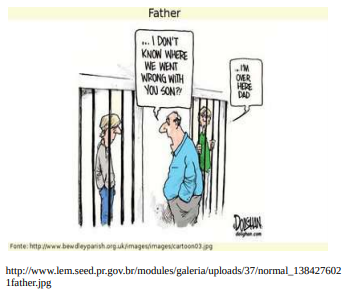
Imagem associada para resolução da questão

Charges são produzidas com o intuito de satirizar comportamentos humanos e assim oportunizarem a reflexão sobre nossos próprios comportamentos e atitudes. Nessa charge, a linguagem utilizada pelas personagens em uma conversa em inglês evidencia:


I - a confusão mental do pai ao visitar o filho na cadeia e confundi-lo com outro presidiário.

II - o diálogo entre dois presidiários e um carcereiro a respeito do sistema carcerário no Brasil.

III - a ausência de comunicação no sistema carcerário.

IV - a distração do pai ao visitar o sobrinho preso na cadeia e confundi-lo com outro presidiário.

V - a ausência de comunicação entre pais e filhos.


Assinale a alternativa correta.

Alternativas
Ano: 2017 Banca: IF-TO Órgão: IF-TO Prova: IF-TO - 2017 - IF-TO - Vestibular - Primeiro Semestre |
Q1268577 Inglês

How English evolved into a global language


        As the British Library charts the evolution of English in a new major exhibition, author Michael Rosen gives a brief history of a language that has grown to world domination with phrases such as "cool" and "go to it".

        The need for an international language has always existed. In the past it was about religion and intellectual debate. With the technologies of today, it's about communicating with others anywhere in the world in a matter of moments.

          Two events, separated by nearly 400 years, show how this need has always been present.

         Firstly, sitting in front of me I have a copy of the celebrated book Utopia, by Sir Thomas More. This particular edition is published in 1629 in Amsterdam, not in English, not in Dutch, but in Latin.

       The second event was a talk I recently had with a German scientist. He said that he knew of scientific conferences taking place in Germany, where all the people attending were German and yet the conference was conducted in English.


 Source: <http://www.bbc.com/news/magazine-12017753>

De acordo com a abordagem do texto, podemos inferir que a alternativa que contém a melhor interpretação para o título (How English evolved into a global language) é:
Alternativas
Ano: 2017 Banca: IF-TO Órgão: IF-TO Prova: IF-TO - 2017 - IF-TO - Vestibular - Primeiro Semestre |
Q1268576 Inglês
Imagem associada para resolução da questão Observe o anúncio e marque V (verdadeiro) ou F (falso) nos itens a seguir. Logo após, assinale a alternativa correta.

( ) O anúncio faz a divulgação de vagas de estágio.
( ) O anúncio não exige conhecimento para o preenchimento das vagas.
( ) Para todas as vagas é exigida somente a formação em nível médio.
( ) As vagas de emprego são para uma estação de metrô.
( ) O anúncio informa que são mais de 34.400 lojas em todo o mundo.
Alternativas
Ano: 2017 Banca: IF-PE Órgão: IF-PE Prova: IF-PE - 2017 - IF-PE - Vestibular - Técnico Superior |
Q1267504 Inglês

TEXTO 8

AUGUST 2017 WAS THE SECOND WARMEST ON RECORD


      August 2017 was the second warmest August in 137 years of modern record-keeping, according to a monthly analysis of global temperatures by scientists at NASA's Goddard Institute for Space Studies (GISS) in New York.

      The measured value is consistent with the trend in global average surface temperatures that has been observed during the past few decades. Last month was +0.85 degrees Celsius warmer than the mean August temperature from 1951-1980.

      It was surpassed by August 2016, which was still affected by the 2015-2016 El Niño and was 0.99 degrees Celsius warmer than normal. However, August 2017 was about +0.2 degrees warmer than the August following the last large El Niño event in 1997-1998.

      The monthly analysis by the GISS team is assembled from publicly available data acquired by about 6,300 meteorological stations around the world, ship- and buoy-based instruments measuring sea surface temperature, and Antarctic research stations.

      The modern global temperature record begins around 1880 because previous observations didn't cover enough of the planet. Monthly analyses are sometimes updated when additional data becomes available, and the results are subject to change.

NASA’S GODDARD INSTITUTE FOR SPACE STUDIES. August 2017 was the second warmest on record. Disponível em: Acesso: 09 out. 2017. Adaptado.

O TEXTO 8, que apresenta um recente estudo feito pela NASA sobre a temperatura da Terra, traz a informação de que
Alternativas
Ano: 2017 Banca: IF-PE Órgão: IF-PE Prova: IF-PE - 2017 - IF-PE - Vestibular - Técnico Superior |
Q1267502 Inglês

TEXTO 7

AMERICA’S OPINION OF TRUMP ARE FULLY BAKED, IN ONE CHART

      Washington (CNN) - Everyone has an opinion of President Donald Trump - and they're sticking to it. The President's approval rating has remained in a narrow 10 percentage point window for his entire first nine months in office, the smallest range for new presidents in almost a half century.

      Trump kicked off his presidency at a 45% approval rating during his first week, sinking slightly over his term so far to the high 30s, where it's remained mostly steady since May, according to a CNN analysis of weekly approval numbers from Gallup.

      The numbers show just how baked in Americans' approval (or disapproval) of Donald Trump is. His approval rating among Democrats has remained mired at historic lows, while Republicans have consistently maintained their strong support for his White House.

      A separate poll found that six in 10 people who approve of Trump (and disapprove of Trump) say they can't imagine anything he could do to make them change their minds.

      Approval ratings historically have experienced some turbulence during their first nine months, as honeymoon periods wear off and presidents face the first tests of their tenures.

      Barack Obama's approval sank from two-thirds of Americans to half in this time span. George W. Bush's spiked after the 9/11 terrorist attacks — a broad 39-point swing. Bill Clinton's fell 22 points over his first several months to a low in June.

      In fact, Trump's approval rating window marks the third narrowest in data stretching back to the 1940s -- wider than only Richard Nixon and Lyndon B. Johnson.

      Not to mention, most presidents see some significant movement among independents -- the most volatile group -- in the first nine months. The last seven presidents have experienced at least a 20-point swing among independents to this point, but Trump's approval among independents has remained in just a 13-point range.

      The consistency in Trump's approval rating, however, comes amid a mixed first nine months for his White House; strong economic numbers have combined with derailed major legislative priorities and battles with his own party, the National Football League and the intelligence community.

STRUYK, Ryan. America’s opinion of Trump are fully baked, in one chart. Disponível em:<http://edition.cnn.com/2017/10/03/politics/trump-approval-flat-decades-gallup/index.html?iid=ob_article_footer_expansion> . Acesso: 09 out. 2017. Adaptado. 

Analise as proposições abaixo.


I. A taxa de aprovação do presidente Donald Trump, nos seus nove primeiros meses de governo, é a mais baixa para novos presidentes em quase 50 anos.

II. Há uma grande diferença entre a taxa de aprovação do presidente Donald Trump pelos democratas e a sua taxa de aprovação pelos republicanos.

III. A taxa de aprovação de Barack Obama, nos seus primeiros nove meses de governo, cresceu bastante.

IV. Richard Nixon e Lyndon B. Johnson tiveram uma taxa de aprovação maior do que a de Donald Trump.

V. Assim como ocorreu com a maioria dos presidentes, a taxa de aprovação de Donald Trump entre os eleitores independentes oscilou bastante em seus nove primeiros meses de governo.


De acordo com o TEXTO 7, são verdadeiras, apenas, as proposições

Alternativas
Respostas
1141: C
1142: D
1143: A
1144: D
1145: C
1146: B
1147: B
1148: A
1149: C
1150: A
1151: D
1152: B
1153: D
1154: B
1155: C
1156: D
1157: D
1158: B
1159: A
1160: E