Questões de Vestibular
Comentadas sobre interpretação de texto | reading comprehension em inglês
Foram encontradas 2.293 questões


( ) Society are obsessed with machines which save us time and this is why we have less free time than our parents and grandparents had. ( ) In the USA, a book called One-Minute Bedtime Stories were made for 'busy parents', because they want to save time. ( ) Nowadays most people don't have enough time to read the articles. This is why the headlines are growing larger and the articles are ever smaller.
The CORRECT alternative respectively is:
Text 1: Brazil judge lifts WhatsApp suspension
A judge in Brazil has ordered that a suspension of the popular messaging application WhatsApp be lifted. Judge Xavier de Souza said the service should be re-instated immediately. A court had ordered the service be suspended for 48 hours on Thursday for failing to comply with a court order to provide investigators with information relating to a criminal court case.
Judge Souza said it was “not reasonable that millions of users be affected by the inertia of the company”. “Extreme ruling” Brazilians had complained bitterly on social media about the suspension of Whatsapp, which is a hugely popular app used by many to communicate with family, friends and colleagues both inside of Brazil and abroad. Ninety-three per cent of the country's internet population use Whatsapp, according to the TechCrunch website, with many young and poor Brazilians taking advantage of its free text message and internet telephone service.
Within hours of the suspension being coming into force, the hashtag #Nessas48HorasEuVou (#Inthese48hoursIwill) began trending on Twitter, with Brazilians joking about all the things they would do during the suspension. Impact of the WhatsApp ban - Paula K, a Brazilian living in London In a country where mobile providers charge a fortune for a monthly plan – not to mention the high cost of making international calls – the use of WhatsApp for both texts and internet calls allows expats like me to keep a direct line with family, friends or even colleagues back home.
It’s worth remembering that Brazil already has a high cost of living – services and products often cost the same price as they do in the UK – but people often only earn about a third of the wage they would here. One of my friends who works for one of the major mobile providers in Brazil said it was advising people to download alternative apps such as Viber and/or create a group on Messenger to keep the communication flowing. “I am stunned that our efforts to protect people’s data would result in such an extreme decision by a single judge to punish every person in Brazil who uses WhatsApp,” Mr. Zuckerberg wrote in a post on Facebook.
The suspension was ordered after WhatsApp failed to comply with a court order. The court which ordered the suspension gave little detail, apart from saying that the order related to a criminal case. But Brazilian media said WhatsApp had been asked to provide details of communication by a suspected gang member who is alleged to have used WhatsApp to organise illegal activity. Separately from the court case, Brazilian phone companies have urged the government to restrict the use of free voice-over-internet services offered through WhatsApp.
The phone companies argue that the rise of WhatsApp has damaged their businesses. Meanwhile other messaging services said they had benefited from the temporary absence of WhatsApp. One such company, Telegram, said on Twitter that more than 1.5 million Brazilian users had joined up since the court order was handed down.
(Disponível em: <http://www.bbc.com/news/world-latin-america>
Text 1: Brazil judge lifts WhatsApp suspension
A judge in Brazil has ordered that a suspension of the popular messaging application WhatsApp be lifted. Judge Xavier de Souza said the service should be re-instated immediately. A court had ordered the service be suspended for 48 hours on Thursday for failing to comply with a court order to provide investigators with information relating to a criminal court case.
Judge Souza said it was “not reasonable that millions of users be affected by the inertia of the company”. “Extreme ruling” Brazilians had complained bitterly on social media about the suspension of Whatsapp, which is a hugely popular app used by many to communicate with family, friends and colleagues both inside of Brazil and abroad. Ninety-three per cent of the country's internet population use Whatsapp, according to the TechCrunch website, with many young and poor Brazilians taking advantage of its free text message and internet telephone service.
Within hours of the suspension being coming into force, the hashtag #Nessas48HorasEuVou (#Inthese48hoursIwill) began trending on Twitter, with Brazilians joking about all the things they would do during the suspension. Impact of the WhatsApp ban - Paula K, a Brazilian living in London In a country where mobile providers charge a fortune for a monthly plan – not to mention the high cost of making international calls – the use of WhatsApp for both texts and internet calls allows expats like me to keep a direct line with family, friends or even colleagues back home.
It’s worth remembering that Brazil already has a high cost of living – services and products often cost the same price as they do in the UK – but people often only earn about a third of the wage they would here. One of my friends who works for one of the major mobile providers in Brazil said it was advising people to download alternative apps such as Viber and/or create a group on Messenger to keep the communication flowing. “I am stunned that our efforts to protect people’s data would result in such an extreme decision by a single judge to punish every person in Brazil who uses WhatsApp,” Mr. Zuckerberg wrote in a post on Facebook.
The suspension was ordered after WhatsApp failed to comply with a court order. The court which ordered the suspension gave little detail, apart from saying that the order related to a criminal case. But Brazilian media said WhatsApp had been asked to provide details of communication by a suspected gang member who is alleged to have used WhatsApp to organise illegal activity. Separately from the court case, Brazilian phone companies have urged the government to restrict the use of free voice-over-internet services offered through WhatsApp.
The phone companies argue that the rise of WhatsApp has damaged their businesses. Meanwhile other messaging services said they had benefited from the temporary absence of WhatsApp. One such company, Telegram, said on Twitter that more than 1.5 million Brazilian users had joined up since the court order was handed down.
(Disponível em: <http://www.bbc.com/news/world-latin-america>
Read TEXT 2 below and answer question
TEXT 2
Tracking 130,000 people in 17 countries, both rich and poor, the study found that whether it’s going to the gym, walking to work, or tackling household chores like laundry or gardening, being physically active extends life and reduces illness. The researchers, led by Scott Lear, a heart specialist at St Paul’s Hospital in Canada, also found a so-called dose response: The more people exercise, the greater the reductions are in their risks of getting heart disease or dying early. The study found “no ceiling effect”, the researchers said, and “no risks associated with extremely high levels of physical activity,” defined as more than 2,500 minutes, or more than 41 hours, per week.
Cardiovascular disease is the world’s leading cause of death and a major economic burden in treatment and care for those who develop it. It killed 9.48 million people globally in 2016.
“Walking for as little as 30 minutes most days of the week has a substantial benefit, and higher physical activity is associated with even lower risks,” Lear said in a comment about the findings, published on Friday in The Lancet medical journal. He also noted that some measures to prevent or treat heart disease, such as taking medicines or eating more fruit and vegetables, can be unaffordable for the world’s poorest people. Yet walking is free and brings substantial health gains.
The World Health Organization recommends that adults aged 18 to 64 do at least 150 minutes of moderate-intensity aerobic physical activity throughout each week, as well as muscle strengthening exercises at least two days a week. But experts estimate almost a quarter of the world’s people do not reach these guideline levels.
Lear’s team said their study findings suggest that if the entire population were to meet the guidelines, one in 12 of the world’s premature deaths would be averted and 4.6 percent of heart disease cases prevented.
Read TEXT 2 below and answer question
TEXT 2
Tracking 130,000 people in 17 countries, both rich and poor, the study found that whether it’s going to the gym, walking to work, or tackling household chores like laundry or gardening, being physically active extends life and reduces illness. The researchers, led by Scott Lear, a heart specialist at St Paul’s Hospital in Canada, also found a so-called dose response: The more people exercise, the greater the reductions are in their risks of getting heart disease or dying early. The study found “no ceiling effect”, the researchers said, and “no risks associated with extremely high levels of physical activity,” defined as more than 2,500 minutes, or more than 41 hours, per week.
Cardiovascular disease is the world’s leading cause of death and a major economic burden in treatment and care for those who develop it. It killed 9.48 million people globally in 2016.
“Walking for as little as 30 minutes most days of the week has a substantial benefit, and higher physical activity is associated with even lower risks,” Lear said in a comment about the findings, published on Friday in The Lancet medical journal. He also noted that some measures to prevent or treat heart disease, such as taking medicines or eating more fruit and vegetables, can be unaffordable for the world’s poorest people. Yet walking is free and brings substantial health gains.
The World Health Organization recommends that adults aged 18 to 64 do at least 150 minutes of moderate-intensity aerobic physical activity throughout each week, as well as muscle strengthening exercises at least two days a week. But experts estimate almost a quarter of the world’s people do not reach these guideline levels.
Lear’s team said their study findings suggest that if the entire population were to meet the guidelines, one in 12 of the world’s premature deaths would be averted and 4.6 percent of heart disease cases prevented.
Read TEXT 1 below and answer question
TEXT 1
World Health Officials Describe Progress Against Tetanus, H.I.V. and Malaria
Infant and maternal tetanus was officially eliminated from the Americas this year, the Pan American Health Organization
announced on Thursday. At one time, the infection killed about 10,000 newborns annually in the Western Hemisphere; tetanus
still kills about 35,000 infants around the world. It was one of several significant global health advances, including new programs
against malaria and H.I.V., announced last week in conjunction with the meeting of the United Nations General Assembly in
New York.
Haiti was the last country in the Americas to eliminate neonatal tetanus. That does not mean complete eradication,
because the bacteria that cause tetanus exist everywhere in soil and animal droppings. Rather, elimination means that
thanks to vaccination of mothers and clean birth procedures — less than one case occurs per 1,000 live births.
The Americas have generally led the world in eliminating diseases for which vaccines exist. In this hemisphere, smallpox
was eliminated in 1971, polio in 1994, rubella in 2015 and measles in 2016 (the diseases are sometimes reintroduced, as
measles was at Disneyland in 2014, but outbreaks are usually brought quickly under control).
Also this week, the President’s Malaria Initiative said it would expand its work to new countries in West and Central
Africa, protecting 90 million more people. The initiative, founded in 2005 as part of the United States Agency for International
Development, has been a major force in driving down worldwide malaria deaths by about 40 percent in the past decade. The
disease most often kills young children and pregnant women. The expansion in Cameroon, Ivory Coast, Niger, Sierra Leone
and Burkina Faso was made possible because Congress increased funding for the initiative in fiscal year 2017, a representativ
said
In his speech to the United Nations on Tuesday, President Trump praised the malaria initiative and the President’s
Emergency Plan for AIDS Relief as examples of leadership in humanitarian assistance by the United States.
A combination of aid agencies, drug companies and g
cocktail to treat H.I.V. would soon be available to 92 countries, including virtually all of Africa, for about $75 a year. The new AIDS cocktail is the first available in poor countries to contain dolutegravir, which is widely used in wealthy countries because it is highly effective and has few side effects. The pill also contains lamivudine, an older but still effective drug, and tenof
disoproxil fumarate, another modern drug whose inclus
effects and resistance.
Almost 37 million people in the world have H.I.V., according to Unaids, the U.N.’s AIDS-fighting agency, but fewer than 20 million are now on antiretroviral medicine, which not only saves their lives but prevents them from passing on the disease.
McNEIL Jr., Donald. Disponível em: < https://www.nytimes.com/2017/09/22/health/world-health-tetanus-infants.html?mcubz=1>. Acesso em: 22/09/2017.
Read TEXT 1 below and answer question
TEXT 1
World Health Officials Describe Progress Against Tetanus, H.I.V. and Malaria
Infant and maternal tetanus was officially eliminated from the Americas this year, the Pan American Health Organization
announced on Thursday. At one time, the infection killed about 10,000 newborns annually in the Western Hemisphere; tetanus
still kills about 35,000 infants around the world. It was one of several significant global health advances, including new programs
against malaria and H.I.V., announced last week in conjunction with the meeting of the United Nations General Assembly in
New York.
Haiti was the last country in the Americas to eliminate neonatal tetanus. That does not mean complete eradication,
because the bacteria that cause tetanus exist everywhere in soil and animal droppings. Rather, elimination means that
thanks to vaccination of mothers and clean birth procedures — less than one case occurs per 1,000 live births.
The Americas have generally led the world in eliminating diseases for which vaccines exist. In this hemisphere, smallpox
was eliminated in 1971, polio in 1994, rubella in 2015 and measles in 2016 (the diseases are sometimes reintroduced, as
measles was at Disneyland in 2014, but outbreaks are usually brought quickly under control).
Also this week, the President’s Malaria Initiative said it would expand its work to new countries in West and Central
Africa, protecting 90 million more people. The initiative, founded in 2005 as part of the United States Agency for International
Development, has been a major force in driving down worldwide malaria deaths by about 40 percent in the past decade. The
disease most often kills young children and pregnant women. The expansion in Cameroon, Ivory Coast, Niger, Sierra Leone
and Burkina Faso was made possible because Congress increased funding for the initiative in fiscal year 2017, a representativ
said
In his speech to the United Nations on Tuesday, President Trump praised the malaria initiative and the President’s
Emergency Plan for AIDS Relief as examples of leadership in humanitarian assistance by the United States.
A combination of aid agencies, drug companies and g
cocktail to treat H.I.V. would soon be available to 92 countries, including virtually all of Africa, for about $75 a year. The new AIDS cocktail is the first available in poor countries to contain dolutegravir, which is widely used in wealthy countries because it is highly effective and has few side effects. The pill also contains lamivudine, an older but still effective drug, and tenof
disoproxil fumarate, another modern drug whose inclus
effects and resistance.
Almost 37 million people in the world have H.I.V., according to Unaids, the U.N.’s AIDS-fighting agency, but fewer than 20 million are now on antiretroviral medicine, which not only saves their lives but prevents them from passing on the disease.
McNEIL Jr., Donald. Disponível em: < https://www.nytimes.com/2017/09/22/health/world-health-tetanus-infants.html?mcubz=1>. Acesso em: 22/09/2017.
Read TEXT 1 below and answer question
TEXT 1
World Health Officials Describe Progress Against Tetanus, H.I.V. and Malaria
Infant and maternal tetanus was officially eliminated from the Americas this year, the Pan American Health Organization
announced on Thursday. At one time, the infection killed about 10,000 newborns annually in the Western Hemisphere; tetanus
still kills about 35,000 infants around the world. It was one of several significant global health advances, including new programs
against malaria and H.I.V., announced last week in conjunction with the meeting of the United Nations General Assembly in
New York.
Haiti was the last country in the Americas to eliminate neonatal tetanus. That does not mean complete eradication,
because the bacteria that cause tetanus exist everywhere in soil and animal droppings. Rather, elimination means that
thanks to vaccination of mothers and clean birth procedures — less than one case occurs per 1,000 live births.
The Americas have generally led the world in eliminating diseases for which vaccines exist. In this hemisphere, smallpox
was eliminated in 1971, polio in 1994, rubella in 2015 and measles in 2016 (the diseases are sometimes reintroduced, as
measles was at Disneyland in 2014, but outbreaks are usually brought quickly under control).
Also this week, the President’s Malaria Initiative said it would expand its work to new countries in West and Central
Africa, protecting 90 million more people. The initiative, founded in 2005 as part of the United States Agency for International
Development, has been a major force in driving down worldwide malaria deaths by about 40 percent in the past decade. The
disease most often kills young children and pregnant women. The expansion in Cameroon, Ivory Coast, Niger, Sierra Leone
and Burkina Faso was made possible because Congress increased funding for the initiative in fiscal year 2017, a representativ
said
In his speech to the United Nations on Tuesday, President Trump praised the malaria initiative and the President’s
Emergency Plan for AIDS Relief as examples of leadership in humanitarian assistance by the United States.
A combination of aid agencies, drug companies and g
cocktail to treat H.I.V. would soon be available to 92 countries, including virtually all of Africa, for about $75 a year. The new AIDS cocktail is the first available in poor countries to contain dolutegravir, which is widely used in wealthy countries because it is highly effective and has few side effects. The pill also contains lamivudine, an older but still effective drug, and tenof
disoproxil fumarate, another modern drug whose inclus
effects and resistance.
Almost 37 million people in the world have H.I.V., according to Unaids, the U.N.’s AIDS-fighting agency, but fewer than 20 million are now on antiretroviral medicine, which not only saves their lives but prevents them from passing on the disease.
McNEIL Jr., Donald. Disponível em: < https://www.nytimes.com/2017/09/22/health/world-health-tetanus-infants.html?mcubz=1>. Acesso em: 22/09/2017.
Text 2
Your Meal Has Six Times More Salt Than You Think
How much salt was in your lunch? Whatever your guess, chances are you’re off. By a lot.
In a new study, published in the journal Appetite, researchers stood outside fast-food restaurants and asked people to guess
how much sodium they just ate. Their answers were almost always six times too low.
That's because people don't tend to use a lot of salt to season meals cooked at home, but restaurants use much more of it to
enhance the flavor of their meals. It’s also used in food additives and as a preservative to extend shelf life, so even foods that
don’t taste salty, like pastries, donuts and bread, can have a lot of it.
As a result, 89% of Americans eat too much salt. People should get no more than 2,300 milligrams of sodium a day — about
one teaspoon, public health groups recommend — but the average American eats about 3,600 mg every day. Eating too much
salt makes the body retain more water, which raises blood pressure and can affect the heart, blood vessels, brain and kidneys.
Overconsuming sodium can lead to hypertension, heart attack and stroke, according to the Harvard T.H. Chan School of Public
Health.
To test the sodium knowledge of real-world eaters, researchers stationed themselves at several fast-food restaurants —
McDonald’s, Burger King, Subway, Wendy’s, Kentucky Fried Chicken and Dunkin’ Donuts — and polled adolescents and adults
on their sodium consumption. When people approached the entrance, the researchers asked them to save their receipts; on
their way out, they estimated how much sodium they ate.
Adults ate about 1,300 mg of sodium in a single fast-food sitting, which is more than half of the upper recommended limit for the
day. Yet the average guess was just 200 mg, says study author Alyssa Moran, a registered dietitian and doctoral student at the
Harvard School of Public Health. They were off by about 650%.
That's when they ventured a guess at all. “25% of the people we approached had absolutely no idea about the amount of
sodium in their meal and couldn’t even provide an estimate,” Moran says.
Sodium information isn't visibly published in chain restaurants. But in 2015, New York became the first city in the country to
require chains to post warning labels on menu items with more than 2,300 mg of sodium. "Right now it's only in New York City,
but we have a feeling that other local governments will probably follow suit," Moran says. "We saw that that happened when
New York City started posting calories on menu boards."
Doing so may finally help people learn how much sodium is in their food, and it may even encourage companies to reformulate
the worst offenders.
Text 2
Your Meal Has Six Times More Salt Than You Think
How much salt was in your lunch? Whatever your guess, chances are you’re off. By a lot.
In a new study, published in the journal Appetite, researchers stood outside fast-food restaurants and asked people to guess
how much sodium they just ate. Their answers were almost always six times too low.
That's because people don't tend to use a lot of salt to season meals cooked at home, but restaurants use much more of it to
enhance the flavor of their meals. It’s also used in food additives and as a preservative to extend shelf life, so even foods that
don’t taste salty, like pastries, donuts and bread, can have a lot of it.
As a result, 89% of Americans eat too much salt. People should get no more than 2,300 milligrams of sodium a day — about
one teaspoon, public health groups recommend — but the average American eats about 3,600 mg every day. Eating too much
salt makes the body retain more water, which raises blood pressure and can affect the heart, blood vessels, brain and kidneys.
Overconsuming sodium can lead to hypertension, heart attack and stroke, according to the Harvard T.H. Chan School of Public
Health.
To test the sodium knowledge of real-world eaters, researchers stationed themselves at several fast-food restaurants —
McDonald’s, Burger King, Subway, Wendy’s, Kentucky Fried Chicken and Dunkin’ Donuts — and polled adolescents and adults
on their sodium consumption. When people approached the entrance, the researchers asked them to save their receipts; on
their way out, they estimated how much sodium they ate.
Adults ate about 1,300 mg of sodium in a single fast-food sitting, which is more than half of the upper recommended limit for the
day. Yet the average guess was just 200 mg, says study author Alyssa Moran, a registered dietitian and doctoral student at the
Harvard School of Public Health. They were off by about 650%.
That's when they ventured a guess at all. “25% of the people we approached had absolutely no idea about the amount of
sodium in their meal and couldn’t even provide an estimate,” Moran says.
Sodium information isn't visibly published in chain restaurants. But in 2015, New York became the first city in the country to
require chains to post warning labels on menu items with more than 2,300 mg of sodium. "Right now it's only in New York City,
but we have a feeling that other local governments will probably follow suit," Moran says. "We saw that that happened when
New York City started posting calories on menu boards."
Doing so may finally help people learn how much sodium is in their food, and it may even encourage companies to reformulate
the worst offenders.
Text1
Autism's Drug Problem
Many people on the spectrum take multiple medications, which can lead to serious side effects and may not even be effective
Connor was diagnosed with autism early — when he was just 18 months old. His condition was already obvious by then. “He
was lining things up, switching lights on and off, on and off,” says his mother, Melissa. He was bright, but he didn’t speak much
until age 3, and he was easily frustrated. Once he started school, he couldn’t sit still in class, called out answers without raising
his hand and got visibly upset when he couldn’t master a math concept or a handwriting task quickly enough. “One time, he
rolled himself up into the carpet like a burrito and wouldn’t come out until I got there,” Melissa recalls. (All families in this story
are identified by first name only, to protect their privacy.)
Connor was prescribed his first psychiatric drug, methylphenidate (Ritalin), at age 6. That didn’t last long, but when he was 7,
his parents tried again. A psychiatrist suggested a low dose of amphetamine and dextroamphetamine (Adderall), a stimulant
commonly used to treat attention deficit hyperactivity disorder (ADHD). The drug seemed to improve his time at school: He was
able to sit still for longer periods of time and focus on what his teachers were saying. His chicken-scratch handwriting became
legible. Then, it became neat. Then perfect. And then it became something Connor began to obsess over.
“We were told that these are the gives and takes; if it’s helping him enough to get through school, you have to decide if it’s worth
it,” Melissa says. It was worth it — for a while.
But when the Adderall wore off each day, Connor had a tougher time than ever. He spent afternoons crying and refusing to do
much of anything. The stimulant made it difficult for him to fall asleep at night. So after a month or two, his psychiatrist added a
second medication — guanfacine (Intuniv), which is commonly prescribed for ADHD, anxiety and hypertension, but can also
help with insomnia. The psychiatrist hoped it might both ease Connor’s afternoons and help him sleep.
In some ways, it had the opposite effect. His afternoons did get slightly better, but Connor developed intense mood swings and
was so irritable that every evening was a struggle. Rather than simply tossing and turning in bed, he refused to even get under
the covers. “He wouldn’t go to bed because he was always angry about something,” Melissa says. “He was getting himself all
wound up, carrying on, getting upset at night and crying.”
wound up, carrying on, getting upset at night and crying.”
After seven months, his parents declared the combination unsustainable. They swapped guanfacine for over-the-counter
melatonin, which helped Connor fall asleep with no noticeable side effects. But within a year, he had acquired a tolerance for
Adderall. Connor’s psychiatrist increased his dosage and that, in turn, triggered tics: Connor began jerking his head and
snorting. Finally, at his 9-year physical, his doctor discovered that he’d only grown a few inches since age 7. He also hadn’t
gained any weight in two years; he’d dropped from the 50th percentile in weight to the 5th.
That was the end of all the experiments. His parents took him off all prescription drugs, and today, at almost 13 years old,
Connor is still medication-free. His tics have mostly disappeared. Although he has trouble maintaining focus in class, his mother
says that the risk-benefit ratio of trying another drug doesn’t seem worth it. “Right now we’re able to handle life without it, so we
do.”
(...)
For Connor, eliminating prescription drugs was difficult, but doable. For others, multiple medications may seem indispensable.
It’s not unusual for children with autism to take two, three, even four medications at once. Many adults with the condition do so,
too. Data are scant in both populations, but what little information there is suggests multiple prescriptions are even more
common among adults with autism than in children. Clinicians are particularly concerned about children with the condition
because psychiatric medications can have long-lasting effects on their developing brains, and yet are rarely tested in children.
In general, polypharmacy — most often defined as taking more than one prescription medication at once — is commonplace in
people with autism. In one study of more than 33,000 people under age 21 with the condition, at least 35 percent had taken two
psychotropic medications simultaneously; 15 percent had taken three.
“Psychotropic medications are used pretty extensively in people with autism because there aren’t a lot of treatments available,”
says Lisa Croen, director of the Autism Research Program at Kaiser Permanente in Oakland, California. “Is heavy drug use
bad? That’s the question. We don’t know; it hasn’t been studied.”
Disponível em: <https://www.scientificamerican.com/article/autisms-drug-problem/>. Texto adaptado.
Text1
Autism's Drug Problem
Many people on the spectrum take multiple medications, which can lead to serious side effects and may not even be effective
Connor was diagnosed with autism early — when he was just 18 months old. His condition was already obvious by then. “He
was lining things up, switching lights on and off, on and off,” says his mother, Melissa. He was bright, but he didn’t speak much
until age 3, and he was easily frustrated. Once he started school, he couldn’t sit still in class, called out answers without raising
his hand and got visibly upset when he couldn’t master a math concept or a handwriting task quickly enough. “One time, he
rolled himself up into the carpet like a burrito and wouldn’t come out until I got there,” Melissa recalls. (All families in this story
are identified by first name only, to protect their privacy.)
Connor was prescribed his first psychiatric drug, methylphenidate (Ritalin), at age 6. That didn’t last long, but when he was 7,
his parents tried again. A psychiatrist suggested a low dose of amphetamine and dextroamphetamine (Adderall), a stimulant
commonly used to treat attention deficit hyperactivity disorder (ADHD). The drug seemed to improve his time at school: He was
able to sit still for longer periods of time and focus on what his teachers were saying. His chicken-scratch handwriting became
legible. Then, it became neat. Then perfect. And then it became something Connor began to obsess over.
“We were told that these are the gives and takes; if it’s helping him enough to get through school, you have to decide if it’s worth
it,” Melissa says. It was worth it — for a while.
But when the Adderall wore off each day, Connor had a tougher time than ever. He spent afternoons crying and refusing to do
much of anything. The stimulant made it difficult for him to fall asleep at night. So after a month or two, his psychiatrist added a
second medication — guanfacine (Intuniv), which is commonly prescribed for ADHD, anxiety and hypertension, but can also
help with insomnia. The psychiatrist hoped it might both ease Connor’s afternoons and help him sleep.
In some ways, it had the opposite effect. His afternoons did get slightly better, but Connor developed intense mood swings and
was so irritable that every evening was a struggle. Rather than simply tossing and turning in bed, he refused to even get under
the covers. “He wouldn’t go to bed because he was always angry about something,” Melissa says. “He was getting himself all
wound up, carrying on, getting upset at night and crying.”
wound up, carrying on, getting upset at night and crying.”
After seven months, his parents declared the combination unsustainable. They swapped guanfacine for over-the-counter
melatonin, which helped Connor fall asleep with no noticeable side effects. But within a year, he had acquired a tolerance for
Adderall. Connor’s psychiatrist increased his dosage and that, in turn, triggered tics: Connor began jerking his head and
snorting. Finally, at his 9-year physical, his doctor discovered that he’d only grown a few inches since age 7. He also hadn’t
gained any weight in two years; he’d dropped from the 50th percentile in weight to the 5th.
That was the end of all the experiments. His parents took him off all prescription drugs, and today, at almost 13 years old,
Connor is still medication-free. His tics have mostly disappeared. Although he has trouble maintaining focus in class, his mother
says that the risk-benefit ratio of trying another drug doesn’t seem worth it. “Right now we’re able to handle life without it, so we
do.”
(...)
For Connor, eliminating prescription drugs was difficult, but doable. For others, multiple medications may seem indispensable.
It’s not unusual for children with autism to take two, three, even four medications at once. Many adults with the condition do so,
too. Data are scant in both populations, but what little information there is suggests multiple prescriptions are even more
common among adults with autism than in children. Clinicians are particularly concerned about children with the condition
because psychiatric medications can have long-lasting effects on their developing brains, and yet are rarely tested in children.
In general, polypharmacy — most often defined as taking more than one prescription medication at once — is commonplace in
people with autism. In one study of more than 33,000 people under age 21 with the condition, at least 35 percent had taken two
psychotropic medications simultaneously; 15 percent had taken three.
“Psychotropic medications are used pretty extensively in people with autism because there aren’t a lot of treatments available,”
says Lisa Croen, director of the Autism Research Program at Kaiser Permanente in Oakland, California. “Is heavy drug use
bad? That’s the question. We don’t know; it hasn’t been studied.”
Disponível em: <https://www.scientificamerican.com/article/autisms-drug-problem/>. Texto adaptado.
Text1
Autism's Drug Problem
Many people on the spectrum take multiple medications, which can lead to serious side effects and may not even be effective
Connor was diagnosed with autism early — when he was just 18 months old. His condition was already obvious by then. “He
was lining things up, switching lights on and off, on and off,” says his mother, Melissa. He was bright, but he didn’t speak much
until age 3, and he was easily frustrated. Once he started school, he couldn’t sit still in class, called out answers without raising
his hand and got visibly upset when he couldn’t master a math concept or a handwriting task quickly enough. “One time, he
rolled himself up into the carpet like a burrito and wouldn’t come out until I got there,” Melissa recalls. (All families in this story
are identified by first name only, to protect their privacy.)
Connor was prescribed his first psychiatric drug, methylphenidate (Ritalin), at age 6. That didn’t last long, but when he was 7,
his parents tried again. A psychiatrist suggested a low dose of amphetamine and dextroamphetamine (Adderall), a stimulant
commonly used to treat attention deficit hyperactivity disorder (ADHD). The drug seemed to improve his time at school: He was
able to sit still for longer periods of time and focus on what his teachers were saying. His chicken-scratch handwriting became
legible. Then, it became neat. Then perfect. And then it became something Connor began to obsess over.
“We were told that these are the gives and takes; if it’s helping him enough to get through school, you have to decide if it’s worth
it,” Melissa says. It was worth it — for a while.
But when the Adderall wore off each day, Connor had a tougher time than ever. He spent afternoons crying and refusing to do
much of anything. The stimulant made it difficult for him to fall asleep at night. So after a month or two, his psychiatrist added a
second medication — guanfacine (Intuniv), which is commonly prescribed for ADHD, anxiety and hypertension, but can also
help with insomnia. The psychiatrist hoped it might both ease Connor’s afternoons and help him sleep.
In some ways, it had the opposite effect. His afternoons did get slightly better, but Connor developed intense mood swings and
was so irritable that every evening was a struggle. Rather than simply tossing and turning in bed, he refused to even get under
the covers. “He wouldn’t go to bed because he was always angry about something,” Melissa says. “He was getting himself all
wound up, carrying on, getting upset at night and crying.”
wound up, carrying on, getting upset at night and crying.”
After seven months, his parents declared the combination unsustainable. They swapped guanfacine for over-the-counter
melatonin, which helped Connor fall asleep with no noticeable side effects. But within a year, he had acquired a tolerance for
Adderall. Connor’s psychiatrist increased his dosage and that, in turn, triggered tics: Connor began jerking his head and
snorting. Finally, at his 9-year physical, his doctor discovered that he’d only grown a few inches since age 7. He also hadn’t
gained any weight in two years; he’d dropped from the 50th percentile in weight to the 5th.
That was the end of all the experiments. His parents took him off all prescription drugs, and today, at almost 13 years old,
Connor is still medication-free. His tics have mostly disappeared. Although he has trouble maintaining focus in class, his mother
says that the risk-benefit ratio of trying another drug doesn’t seem worth it. “Right now we’re able to handle life without it, so we
do.”
(...)
For Connor, eliminating prescription drugs was difficult, but doable. For others, multiple medications may seem indispensable.
It’s not unusual for children with autism to take two, three, even four medications at once. Many adults with the condition do so,
too. Data are scant in both populations, but what little information there is suggests multiple prescriptions are even more
common among adults with autism than in children. Clinicians are particularly concerned about children with the condition
because psychiatric medications can have long-lasting effects on their developing brains, and yet are rarely tested in children.
In general, polypharmacy — most often defined as taking more than one prescription medication at once — is commonplace in
people with autism. In one study of more than 33,000 people under age 21 with the condition, at least 35 percent had taken two
psychotropic medications simultaneously; 15 percent had taken three.
“Psychotropic medications are used pretty extensively in people with autism because there aren’t a lot of treatments available,”
says Lisa Croen, director of the Autism Research Program at Kaiser Permanente in Oakland, California. “Is heavy drug use
bad? That’s the question. We don’t know; it hasn’t been studied.”
Disponível em: <https://www.scientificamerican.com/article/autisms-drug-problem/>. Texto adaptado.
Leia o texto publicitário abaixo e responda:
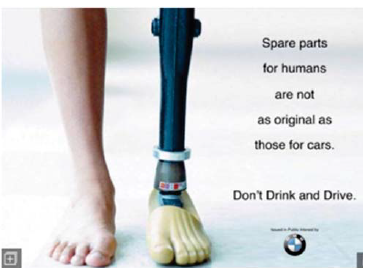
Esta campanha publicitária busca conscientizar as
pessoas acerca do perigo da associação entre bebida
alcoólica e condução de veículos automotores. Que
mensagem a campanha constrói para convencer as
pessoas em relação ao perigo dessa associação?
War Pigs
Generals gathered in their masses Just like witches at black masses Evil minds that plot destruction Sorcerers of death’s construction In the fields the bodies burning As the war machine keeps turning Death and hatred to mankind Poisoning their brainwashed minds Oh, Lord, yeah!
Politicians hide themselves away They only started the war Why should they go out to fight? They leave that role to the poor, yeah!
Time will tell on their power minds Making war just for fun Treating people just like pawns in chess Wait ‘till their judgement day comes, yeah!
Now in darkness, world stops turning Ashes where their bodies burning No more war pigs of the power Hand of God has stuck the hour Day of judgement, God is calling On their knees, the war pigs crawling Begging mercy for their sins Satan, laughing, spreads his wings Oh, Lord, yeah!
War Pigs, do grupo britânico de rock heavy metal Black Sabbath, critica as guerras, que causam morte e destruição. Com base na letra acima, responda quem são os “war pigs” referidos na música?
A partir da leitura da tirinha abaixo, pode-se inferir que:


 Conheça nossos planos