Questões de Vestibular
Comentadas sobre interpretação de texto | reading comprehension em inglês
Foram encontradas 2.293 questões


TEXTO
Brazil has declared an end to its public health emergency over the Zika virus, 18 months after a surge in cases drew headlines around the world.
The mosquito-borne virus was not considered a major health threat until the 2015 outbreak revealed that Zika can lead to severe birth defects. One of those defects, microcephaly, causes babies to be born with skulls much smaller than expected.
Photos of babies with the defect spread panic around the globe as the virus was reported in dozens of countries. Many would-be travellers cancelled their trips to Zika-infected places. The concern spread even more widely when health officials said it could also be transmitted through sexual contact with an infected person.
The health scare came just as Brazil, the epicentre of the outbreak, was preparing to host the 2016 Olympics, fuelling concerns the Games could help spread the virus. One athlete, a Spanish wind surfer, said she got Zika while training in Brazil ahead of the Games.
In response to the outbreak, Brazil launched a mosquito-eradication campaign. The health ministry said those efforts have helped to dramatically reduce cases of Zika. Between January and mid-April, 95% fewer cases were recorded than during the same period last year. The incidence of microcephaly has fallen as well.
The World Health Organization (WHO) lifted its own international emergency in November, even while saying the virus remained a threat.
“The end of the emergency doesn’t mean the end of surveillance or assistance” to affected families, said Adeilson Cavalcante, the secretary for health surveillance at Brazil’s health ministry. “The health ministry and other organisations involved in this area will maintain a policy of fighting Zika, dengue and chikungunya.”
All three diseases are carried by the Aedes aegypti mosquito.
But the WHO has warned that Zika is “here to stay,” even when cases of it fall off, and that fighting the disease will be an ongoing battle.
(Fonte: Associated Press, Friday 12 May 2017 10.18 BST.
Last modified on Friday 12 May 2017 22.00 BST)
TEXTO
Brazil has declared an end to its public health emergency over the Zika virus, 18 months after a surge in cases drew headlines around the world.
The mosquito-borne virus was not considered a major health threat until the 2015 outbreak revealed that Zika can lead to severe birth defects. One of those defects, microcephaly, causes babies to be born with skulls much smaller than expected.
Photos of babies with the defect spread panic around the globe as the virus was reported in dozens of countries. Many would-be travellers cancelled their trips to Zika-infected places. The concern spread even more widely when health officials said it could also be transmitted through sexual contact with an infected person.
The health scare came just as Brazil, the epicentre of the outbreak, was preparing to host the 2016 Olympics, fuelling concerns the Games could help spread the virus. One athlete, a Spanish wind surfer, said she got Zika while training in Brazil ahead of the Games.
In response to the outbreak, Brazil launched a mosquito-eradication campaign. The health ministry said those efforts have helped to dramatically reduce cases of Zika. Between January and mid-April, 95% fewer cases were recorded than during the same period last year. The incidence of microcephaly has fallen as well.
The World Health Organization (WHO) lifted its own international emergency in November, even while saying the virus remained a threat.
“The end of the emergency doesn’t mean the end of surveillance or assistance” to affected families, said Adeilson Cavalcante, the secretary for health surveillance at Brazil’s health ministry. “The health ministry and other organisations involved in this area will maintain a policy of fighting Zika, dengue and chikungunya.”
All three diseases are carried by the Aedes aegypti mosquito.
But the WHO has warned that Zika is “here to stay,” even when cases of it fall off, and that fighting the disease will be an ongoing battle.
(Fonte: Associated Press, Friday 12 May 2017 10.18 BST.
Last modified on Friday 12 May 2017 22.00 BST)
Anna Karenina
By Leo Tolstoy - PART ONE - Chapter 1
Happy families are all alike; every unhappy family is unhappy in its own way.
Everything was in confusion in the Oblonskys’ house. The wife had discovered that the husband was carrying on an intrigue with a French girl, who had been a governess in their family, and she had announced to her husband that she could not go on living in the same house with him. This position of affairs had now lasted three days, and not only the husband and wife themselves, but all the members of their family and household, were painfully conscious of it. Every person in the house felt that there was no sense in their living together, and that the stray people brought together by chance in any inn had more in common with one another than they, the members of the family and household of the Oblonskys. The wife did not leave her own room, the husband had not been at home for three days. The children ran wild all over the house; the English governess quarreled with the housekeeper, and wrote to a friend asking her to look out for a new situation for her; the man-cook had walked off the day before just at dinner time; the kitchen-maid, and the coachman had given warning.
1994, Ramdom House, Inc.
Russia covered up a nuclear disaster in Kazakhstan in the 1950s that was FOUR TIMES worse than Chernobyl reveals secret report
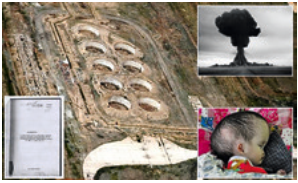
Fallout from a Soviet nuclear weapons test at Semipalatinsk in August 1956 resulted in more than 600 people in a town over 100 miles (175 km) away ending up in hospital with radiation sickness. The secret report (bottom left) was recently found at the test facility, where the first Soviet nuclear test was conducted on August 29, 1949 (top right). Between 1949 and 1989 some 456 nuclear tests were carried out, and children in the region are still being born with birth defects to this day (bottom right).
http://www.dailymail.co.uk/sciencetech/article-4346408/Russia-covered-nuclear-disaster-worse-Chernobyl.html Acessado em 14/03/2017 - Adaptado para fins educacionais.
• As informações contidas na notícia permitem afirmar que:
Free Cone Day 2017, create some buzz

This year, Hӓagen-Dazz® is dedicating Free Cone Day to some of our hardest workers – the honey bees. So, this May 9th, we won’t just be giving away free ice cream, we’ll be giving our flying friends some much needed recognition – and we’re inviting our fans to join us.
In exchange for the free treat, Hӓagen-Dazz® hopes “guests will pay it forward by planting wildflowers native to their region to help keep bees buzzing,” the company said in a news release.
• Relacionando-se figura e texto escrito, percebe-se que o objetivo da promoção da Hӓagen-Dazz®
este ano é

• The headline that better suits the text and
the photo above is:
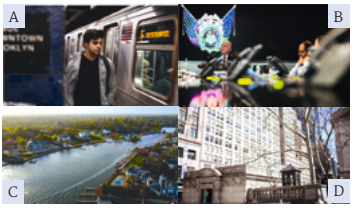
• As sentenças abaixo apresentam notícias e as fotos as ilustram. Escolha a alternativa que apresenta a relação correta entre as notícias e as fotos.
1. The newly renovated bathrooms at Bryant Park, which The Times has described as the “Tiffany’s of public restrooms,” reopened last month after a $280,000 makeover.
2. The internal investigator at Rikers Island was placed on modified duty in response to accusations that he had spied on city investigators.
3. A witness gives an account of what happened when a homeless man fell onto the subway tracks.
4. The water crises on Long Island has resulted in “dead rivers, closed beaches, harmful algal blooms.”
Read the lyrics below.
Don’t laugh at me
Mark Wills
I’m a little boy with glasses
The one they call the geek
A little girl who never smiles
’Cause I’ve got braces on my teeth
And I know how it feels
To cry myself to sleep
I’m that kid on every playground
Who’s always chosen last
A single teenage mother
Tryin’ to overcome my past
You don’t have to be my friend
But is it too much to ask
Don’t laugh at me
Don’t call me names
Don’t get your pleasure from my pain
In God’s eyes we’re all the same
Someday we’ll all have perfect wings
Don’t laugh at me (…)
Disponível em:<https://www.vagalume.com.br|> . Acesso em: 15 Set. 2017.
Will human beings ever live on other planets?
(1) __________ we have become accustomed to the idea of space travel, and in films and fiction it seems as tough space travel is inevitable, it appears unlikely that human beings will ever get any further than Mars, our nearest neighbor. No matter how many films we make about space travel, the fact is that it remains technologically challenging, and extremely expensive. (2) __________ the distances involved are immense, any voyage outside the solar system would take hundreds of years using current technology. Wherever human beings went into space, they would have problems of how to eat and breathe, and their spaceship would have to carry vast amounts of fuel (3) __________ cover the distance. Even Mars is so far away that it would take about six months to get there. (4) __________ the distance between Earth and Mars varies, astronauts would have to wait for nearly two years before they could return using the shortest journey time. (5) __________ it could cost as much as $ 100 billion, a manned mission to Mars is planned for sometime between 2010 and 2020.
VINCE, M. Macmillan English grammar in context. Macmillan, London. 2008. p. 165.
Check the CORRECT alternative.
O envelhecimento da população
O número de homens e mulheres nos EUA com 60 anos ou mais que ainda trabalham (1) __________ por mais de uma década. Economistas (2) __________ uma série de razões para essa tendência. Primeiro, desde 1985 a economia dos Estados Unidos (3) __________, portanto, tem havido um aumento da demanda por mão de obra. Ao mesmo tempo, o custo de alguns serviços, como cuidados de saúde, (4) __________, portanto, os trabalhadores precisam ganhar mais dinheiro mais tarde na vida. Além disso, as mudanças nas regras de benefícios da seguridade social (5) __________ um efeito considerável sobre os padrões de trabalho. (…)
VINCE, M. Macmillan English grammar in context. Macmillan, Londres. 2008. p. 23
Verifique a alternativa CORRETA .
Fonte: New York Times. Publicado em 10/10/2017. Disponível em: https://www.nytimes.com/2017/10/10/ opinion/giving-capitalism-a-social-conscience.html . Acesso em 06/11/2017. [Excerpt]
Fonte: New York Times. Publicado em 10/10/2017. Disponível em: https://www.nytimes.com/2017/10/10/ opinion/giving-capitalism-a-social-conscience.html . Acesso em 06/11/2017. [Excerpt]
A questao refere-se ao texto abaixo.
The Century Trilogy: An epic of Follett proportions
By Kevin Nance September 7, 2012
Well before blockbuster movies, there were blockbuster novels: big, juicy, page-turning epics, with dozens of characters, exotic settings and multiple plots playing out over several years, often against the backdrop of some extended historical conflict. Tolstoy largely invented the form in 1869 with “War and Peace,” and by the middle of the 20th century, its latter-day stalwarts — including James Jones, Herman Wouk and the tireless fiction factory known as James Michener — bestrode the bestseller lists like the titans they were. In recent years, however, the form has fallen somewhat out of favor with writers, if not with readers. Who wants to spend so much time, day in and day out, with the same set of protagonists? Who wants to do all that research? Who has the nerve, not to mention the patience, to keep all those narrative balls in the air over hundreds of pages?
Ken Follett, actually. At 63, the Welsh author is one of the last Mohicans of the form, having traded his highly successful thrillers (“Eye of the Needle,” “The Key to Rebecca”) for the multigenerational historical saga in 1989’s “The Pillars of the Earth” (adapted as a Starz miniseries in 2010) and its sequel, 2007’s “World Without End,” which premieres as a miniseries on Reelz next month.
Adaptado - Disponível em: https://www.washingtonpost.
com/entertainment/books/the-century-trilogy-an-epic-of-
-follett-proportions/2012/09/07.Acesso 22/9/16.
A questao refere-se ao texto abaixo.
The Century Trilogy: An epic of Follett proportions
By Kevin Nance September 7, 2012
Well before blockbuster movies, there were blockbuster novels: big, juicy, page-turning epics, with dozens of characters, exotic settings and multiple plots playing out over several years, often against the backdrop of some extended historical conflict. Tolstoy largely invented the form in 1869 with “War and Peace,” and by the middle of the 20th century, its latter-day stalwarts — including James Jones, Herman Wouk and the tireless fiction factory known as James Michener — bestrode the bestseller lists like the titans they were. In recent years, however, the form has fallen somewhat out of favor with writers, if not with readers. Who wants to spend so much time, day in and day out, with the same set of protagonists? Who wants to do all that research? Who has the nerve, not to mention the patience, to keep all those narrative balls in the air over hundreds of pages?
Ken Follett, actually. At 63, the Welsh author is one of the last Mohicans of the form, having traded his highly successful thrillers (“Eye of the Needle,” “The Key to Rebecca”) for the multigenerational historical saga in 1989’s “The Pillars of the Earth” (adapted as a Starz miniseries in 2010) and its sequel, 2007’s “World Without End,” which premieres as a miniseries on Reelz next month.
Adaptado - Disponível em: https://www.washingtonpost.
com/entertainment/books/the-century-trilogy-an-epic-of-
-follett-proportions/2012/09/07.Acesso 22/9/16.

 Conheça nossos planos