Questões de Vestibular
Comentadas sobre interpretação de texto | reading comprehension em inglês
Foram encontradas 2.293 questões


Leia o texto a seguir para responder a questão.
Global warming is intensifying El Niño weather
As humans put more and more heat-trapping gases into the atmosphere, the Earth warms. And the warming is causing changes that might surprise us. Not only is the warming causing long-term trends in heat, sea level rise, ice loss, etc.; it’s also making our weather more variable. It’s making otherwise natural cycles of weather more powerful.
Perhaps the most important natural fluctuation in the Earth’s climate is the El Niño process. El Niño refers to a short-term period of warm ocean surface temperatures in the tropical Pacific, basically stretching from South America towards Australia. When an El Niño happens, that region is warmer than usual. If the counterpart La Niña occurs, the region is colder than usual. Often times, neither an El Niño or La Niña is present and the waters are a normal temperature. This would be called a “neutral” state.
The ocean waters switch back and forth between El Niño and La Niña every few years. Not regularly, like a pendulum, but there is a pattern of oscillation. And regardless of which part of the cycle we are in (El Niño or La Niña), there are consequences for weather around the world. For instance, during an El Niño, we typically see cooler and wetter weather in the southern United States while it is hotter and drier in South America and Australia.
It’s really important to be able to predict El Niño/La Niña cycles in advance. It’s also important to be able to understand how these cycles will change in a warming planet.
El Niño cycles have been known for a long time. Their influence around the world has also been known for almost 100 years. Having observed the effects of El Niño for a century, scientists had the perspective to understand something might be changing.
The relationship between regional climate and the El Niño/La Niña status in climate model simulations of the past and future. It was found an intensification of El Niño/La Niña impacts in a warmer climate, especially for land regions in North America and Australia. Changes between El Niño/La Niña in other areas, like South America, were less clear. The intensification of weather was more prevalent over land regions.
And this conclusion can be extended to many other situations around the planet. Human pollution is making our Earth’s natural weather switch more strongly from one extreme to another. It’s a weather whiplash that will continue to get worse as we add pollution to the atmosphere.
Fortunately, every other country on the planet (with the exception of the US leadership) understands that climate change is an important issue and those countries are taking action. It isn’t too late to change our trajectory toward a better future for all of us. But the time is running out. The Earth is giving us a little nudge by showing us, via today’s intense weather, what tomorrow will be like if we don’t take action quickly.
Disponível em: <https://www.theguardian.com/environment/climate-consensus-97-per-cent/2018/aug/29/global-warming-is-intensifying-el-nino-weather>. Acesso
em: 19 set. 2018. (Adaptado)
Methods: Using data from the Survey of Lifestyle Attitudes and Nutrition (SLÁN) 2007 (), a protective lifestyle behaviour (PLB) score was constructed for 10 364 men and women (>18 years), and representative of the Republic of Ireland adult population (response rate 62%). Respondents scored a maximum of four points, one point each for being physically active, consuming five or more fruit and vegetable servings daily, a non-smoker and a moderate drinker.
Results: One-fifth of respondents (20%) adopted four PLBs, 35% adopted three, 29% two, 13% one and 2% adopted none. Compared to those with zero PLBs, those with four were seven times more likely to rate their general health as excellent/very good [OR 6.8 95% Cl (3.64- 12.82)] and four times more likely to have better mental health [OR 4.4 95% Cl (2.34-8.22)].
Conclusions: Adoption of core protective lifestyle factors known to increase life expectancy is associated with positive self-rated health, healthier weight and better mental health. These lifestyles have the potential to add quality and quantity to life.
Key words: lifestyle behaviours, self-rated, health, obesity, depression, protective factors.
Topic: ethanol, obesity, physical activity, smoking, depressive disorders, fruit, Ireland, life style, mental health, vegetables, overweight, feelings. Issue Section: Lifestyle and living conditions
Methods: Using data from the Survey of Lifestyle Attitudes and Nutrition (SLÁN) 2007 (), a protective lifestyle behaviour (PLB) score was constructed for 10 364 men and women (>18 years), and representative of the Republic of Ireland adult population (response rate 62%). Respondents scored a maximum of four points, one point each for being physically active, consuming five or more fruit and vegetable servings daily, a non-smoker and a moderate drinker.
Results: One-fifth of respondents (20%) adopted four PLBs, 35% adopted three, 29% two, 13% one and 2% adopted none. Compared to those with zero PLBs, those with four were seven times more likely to rate their general health as excellent/very good [OR 6.8 95% Cl (3.64- 12.82)] and four times more likely to have better mental health [OR 4.4 95% Cl (2.34-8.22)].
Conclusions: Adoption of core protective lifestyle factors known to increase life expectancy is associated with positive self-rated health, healthier weight and better mental health. These lifestyles have the potential to add quality and quantity to life.
Key words: lifestyle behaviours, self-rated, health, obesity, depression, protective factors.
Topic: ethanol, obesity, physical activity, smoking, depressive disorders, fruit, Ireland, life style, mental health, vegetables, overweight, feelings. Issue Section: Lifestyle and living conditions
Match the columns to have the right meaning from the Text.
I. Survey
II. Likely
III. Behavior
IV. Intake
V. Data
( ) conduct
( ) feasible
( ) scrutinity
( ) information in visible form
( ) consumption
Mark the alternative which shows de correct order, fron top to bottom.
Methods: Using data from the Survey of Lifestyle Attitudes and Nutrition (SLÁN) 2007 (), a protective lifestyle behaviour (PLB) score was constructed for 10 364 men and women (>18 years), and representative of the Republic of Ireland adult population (response rate 62%). Respondents scored a maximum of four points, one point each for being physically active, consuming five or more fruit and vegetable servings daily, a non-smoker and a moderate drinker.
Results: One-fifth of respondents (20%) adopted four PLBs, 35% adopted three, 29% two, 13% one and 2% adopted none. Compared to those with zero PLBs, those with four were seven times more likely to rate their general health as excellent/very good [OR 6.8 95% Cl (3.64- 12.82)] and four times more likely to have better mental health [OR 4.4 95% Cl (2.34-8.22)].
Conclusions: Adoption of core protective lifestyle factors known to increase life expectancy is associated with positive self-rated health, healthier weight and better mental health. These lifestyles have the potential to add quality and quantity to life.
Key words: lifestyle behaviours, self-rated, health, obesity, depression, protective factors.
Topic: ethanol, obesity, physical activity, smoking, depressive disorders, fruit, Ireland, life style, mental health, vegetables, overweight, feelings. Issue Section: Lifestyle and living conditions
Methods: Using data from the Survey of Lifestyle Attitudes and Nutrition (SLÁN) 2007 (), a protective lifestyle behaviour (PLB) score was constructed for 10 364 men and women (>18 years), and representative of the Republic of Ireland adult population (response rate 62%). Respondents scored a maximum of four points, one point each for being physically active, consuming five or more fruit and vegetable servings daily, a non-smoker and a moderate drinker.
Results: One-fifth of respondents (20%) adopted four PLBs, 35% adopted three, 29% two, 13% one and 2% adopted none. Compared to those with zero PLBs, those with four were seven times more likely to rate their general health as excellent/very good [OR 6.8 95% Cl (3.64- 12.82)] and four times more likely to have better mental health [OR 4.4 95% Cl (2.34-8.22)].
Conclusions: Adoption of core protective lifestyle factors known to increase life expectancy is associated with positive self-rated health, healthier weight and better mental health. These lifestyles have the potential to add quality and quantity to life.
Key words: lifestyle behaviours, self-rated, health, obesity, depression, protective factors.
Topic: ethanol, obesity, physical activity, smoking, depressive disorders, fruit, Ireland, life style, mental health, vegetables, overweight, feelings. Issue Section: Lifestyle and living conditions
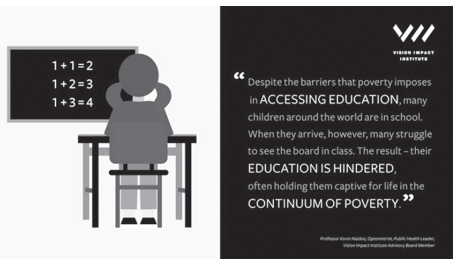
NAIDOO, Kovin, Disponível em: . Acesso em: 15 nov. 2018.
Fill in the parentheses with T (True) or F (False).
According to this quote by Professor Kovin Naidoo, it’s correct to say:
( ) Eye disability plays a minor role on an individual’s poverty status.
( ) Poor vision puts students at a disadvantage in the classroom.
( ) Poor eye health can lead to or worsen poverty.
( ) Vision impairment and poverty are linked to each other.
The correct sequence, from top to bottom, is
Leia o texto para responder à questão.
Dying to defend the planet: why Latin America
is the deadliest place for environmentalists

February 11, 2017
Defending nature is a dangerous occupation, especially in Latin America. According to a recent report by Global Witness, an NGO, 185 environmental activists were murdered worldwide in 2015, an increase of 59% from the year before. More than half the killings were in Latin America. In Brazil 50 green campaigners died in 2015. Honduras is especially dangerous: 123 activists have died there since 2010, the highest number of any country relative to its population. Berta Cáceres, an indigenous leader who was a prominent campaigner against dams and plantations, was murdered there.
Why is Latin America so deadly? One reason is its abundant natural resources, which attract enterprises of all sorts, from multinationals to mafias. When prices are low, as they are now, the most rapacious do not go away; to maintain their profits they become more aggressive, says David Kaimowitz of the Ford Foundation, which gives money to good causes. New technologies open up new battlefronts. Soya beans bred to grow in tropical conditions have encouraged farmers to displace cattle ranchers, who in turn have advanced into the rainforest. Small prospectors can now extract gold from soil rather than just hunting around. That opens up new areas for exploitation, such as San Rafael de Flores in south-eastern Guatemala, where activists have been murdered.
The odds of finding the criminals are greater if the victim is foreign. Dorothy Stang, an American nun who fought to protect the Amazon rainforest, was killed in Brazil 12 years ago. Both the gunman and a rancher who had hired him eventually went to jail. But that is an exception.
(https://www.economist.com/the-americas/2017/02/11/
why-latin-america-is-the-deadliest-place-for-environmentalists. Adaptado)
Leia o texto para responder à questão.
Dying to defend the planet: why Latin America
is the deadliest place for environmentalists
February 11, 2017
Defending nature is a dangerous occupation, especially in Latin America. According to a recent report by Global Witness, an NGO, 185 environmental activists were murdered worldwide in 2015, an increase of 59% from the year before. More than half the killings were in Latin America. In Brazil 50 green campaigners died in 2015. Honduras is especially dangerous: 123 activists have died there since 2010, the highest number of any country relative to its population. Berta Cáceres, an indigenous leader who was a prominent campaigner against dams and plantations, was murdered there.
Why is Latin America so deadly? One reason is its abundant natural resources, which attract enterprises of all sorts, from multinationals to mafias. When prices are low, as they are now, the most rapacious do not go away; to maintain their profits they become more aggressive, says David Kaimowitz of the Ford Foundation, which gives money to good causes. New technologies open up new battlefronts. Soya beans bred to grow in tropical conditions have encouraged farmers to displace cattle ranchers, who in turn have advanced into the rainforest. Small prospectors can now extract gold from soil rather than just hunting around. That opens up new areas for exploitation, such as San Rafael de Flores in south-eastern Guatemala, where activists have been murdered.
The odds of finding the criminals are greater if the victim is foreign. Dorothy Stang, an American nun who fought to protect the Amazon rainforest, was killed in Brazil 12 years ago. Both the gunman and a rancher who had hired him eventually went to jail. But that is an exception.
(https://www.economist.com/the-americas/2017/02/11/
why-latin-america-is-the-deadliest-place-for-environmentalists. Adaptado)
Leia o texto para responder à questão.
Dying to defend the planet: why Latin America
is the deadliest place for environmentalists
February 11, 2017
Defending nature is a dangerous occupation, especially in Latin America. According to a recent report by Global Witness, an NGO, 185 environmental activists were murdered worldwide in 2015, an increase of 59% from the year before. More than half the killings were in Latin America. In Brazil 50 green campaigners died in 2015. Honduras is especially dangerous: 123 activists have died there since 2010, the highest number of any country relative to its population. Berta Cáceres, an indigenous leader who was a prominent campaigner against dams and plantations, was murdered there.
Why is Latin America so deadly? One reason is its abundant natural resources, which attract enterprises of all sorts, from multinationals to mafias. When prices are low, as they are now, the most rapacious do not go away; to maintain their profits they become more aggressive, says David Kaimowitz of the Ford Foundation, which gives money to good causes. New technologies open up new battlefronts. Soya beans bred to grow in tropical conditions have encouraged farmers to displace cattle ranchers, who in turn have advanced into the rainforest. Small prospectors can now extract gold from soil rather than just hunting around. That opens up new areas for exploitation, such as San Rafael de Flores in south-eastern Guatemala, where activists have been murdered.
The odds of finding the criminals are greater if the victim is foreign. Dorothy Stang, an American nun who fought to protect the Amazon rainforest, was killed in Brazil 12 years ago. Both the gunman and a rancher who had hired him eventually went to jail. But that is an exception.
(https://www.economist.com/the-americas/2017/02/11/
why-latin-america-is-the-deadliest-place-for-environmentalists. Adaptado)
Leia o texto para responder à questão.
Dying to defend the planet: why Latin America
is the deadliest place for environmentalists
February 11, 2017
Defending nature is a dangerous occupation, especially in Latin America. According to a recent report by Global Witness, an NGO, 185 environmental activists were murdered worldwide in 2015, an increase of 59% from the year before. More than half the killings were in Latin America. In Brazil 50 green campaigners died in 2015. Honduras is especially dangerous: 123 activists have died there since 2010, the highest number of any country relative to its population. Berta Cáceres, an indigenous leader who was a prominent campaigner against dams and plantations, was murdered there.
Why is Latin America so deadly? One reason is its abundant natural resources, which attract enterprises of all sorts, from multinationals to mafias. When prices are low, as they are now, the most rapacious do not go away; to maintain their profits they become more aggressive, says David Kaimowitz of the Ford Foundation, which gives money to good causes. New technologies open up new battlefronts. Soya beans bred to grow in tropical conditions have encouraged farmers to displace cattle ranchers, who in turn have advanced into the rainforest. Small prospectors can now extract gold from soil rather than just hunting around. That opens up new areas for exploitation, such as San Rafael de Flores in south-eastern Guatemala, where activists have been murdered.
The odds of finding the criminals are greater if the victim is foreign. Dorothy Stang, an American nun who fought to protect the Amazon rainforest, was killed in Brazil 12 years ago. Both the gunman and a rancher who had hired him eventually went to jail. But that is an exception.
(https://www.economist.com/the-americas/2017/02/11/
why-latin-america-is-the-deadliest-place-for-environmentalists. Adaptado)
Leia o texto para responder à questão.
Dying to defend the planet: why Latin America
is the deadliest place for environmentalists
February 11, 2017
Defending nature is a dangerous occupation, especially in Latin America. According to a recent report by Global Witness, an NGO, 185 environmental activists were murdered worldwide in 2015, an increase of 59% from the year before. More than half the killings were in Latin America. In Brazil 50 green campaigners died in 2015. Honduras is especially dangerous: 123 activists have died there since 2010, the highest number of any country relative to its population. Berta Cáceres, an indigenous leader who was a prominent campaigner against dams and plantations, was murdered there.
Why is Latin America so deadly? One reason is its abundant natural resources, which attract enterprises of all sorts, from multinationals to mafias. When prices are low, as they are now, the most rapacious do not go away; to maintain their profits they become more aggressive, says David Kaimowitz of the Ford Foundation, which gives money to good causes. New technologies open up new battlefronts. Soya beans bred to grow in tropical conditions have encouraged farmers to displace cattle ranchers, who in turn have advanced into the rainforest. Small prospectors can now extract gold from soil rather than just hunting around. That opens up new areas for exploitation, such as San Rafael de Flores in south-eastern Guatemala, where activists have been murdered.
The odds of finding the criminals are greater if the victim is foreign. Dorothy Stang, an American nun who fought to protect the Amazon rainforest, was killed in Brazil 12 years ago. Both the gunman and a rancher who had hired him eventually went to jail. But that is an exception.
(https://www.economist.com/the-americas/2017/02/11/
why-latin-america-is-the-deadliest-place-for-environmentalists. Adaptado)
Leia o texto para responder à questão.
Dying to defend the planet: why Latin America
is the deadliest place for environmentalists
February 11, 2017
Defending nature is a dangerous occupation, especially in Latin America. According to a recent report by Global Witness, an NGO, 185 environmental activists were murdered worldwide in 2015, an increase of 59% from the year before. More than half the killings were in Latin America. In Brazil 50 green campaigners died in 2015. Honduras is especially dangerous: 123 activists have died there since 2010, the highest number of any country relative to its population. Berta Cáceres, an indigenous leader who was a prominent campaigner against dams and plantations, was murdered there.
Why is Latin America so deadly? One reason is its abundant natural resources, which attract enterprises of all sorts, from multinationals to mafias. When prices are low, as they are now, the most rapacious do not go away; to maintain their profits they become more aggressive, says David Kaimowitz of the Ford Foundation, which gives money to good causes. New technologies open up new battlefronts. Soya beans bred to grow in tropical conditions have encouraged farmers to displace cattle ranchers, who in turn have advanced into the rainforest. Small prospectors can now extract gold from soil rather than just hunting around. That opens up new areas for exploitation, such as San Rafael de Flores in south-eastern Guatemala, where activists have been murdered.
The odds of finding the criminals are greater if the victim is foreign. Dorothy Stang, an American nun who fought to protect the Amazon rainforest, was killed in Brazil 12 years ago. Both the gunman and a rancher who had hired him eventually went to jail. But that is an exception.
(https://www.economist.com/the-americas/2017/02/11/
why-latin-america-is-the-deadliest-place-for-environmentalists. Adaptado)
Read the article “The Olympic Games”, to answer question.
The Olympic Games
The ancient Olympic Games were originally a festival, or celebration of and for Zeus; later, events such as a footrace, a javelin contest, and wrestling matches were added. The Olympic Games were a series of athletic competitions among representatives of city-states and one of the Panhellenic Games of ancient Greece. They were held in honor of Zeus, and the Greeks gave them a mythological origin. The first Olympics is traditionally dated to 776 BC. They continued to be celebrated when Greece came under Roman rule, until the emperor Theodosius I suppressed them in AD 393 as part of the campaign to impose Christianity as the State religion of Rome. The games were held every four years, or olympiad, which became a unit of time in historical chronologies.
During the celebration of the games, an Olympic Truce was enacted so that athletes could travel from their cities to the games in safety. The prizes for the victors were olive leaf wreaths or crowns. The games became a political tool used by city-states to assert dominance over their rivals. Politicians would announce political alliances at the games, and in times of war, priests would offer sacrifices to the gods for victory. The games were also used to help spread Hellenistic culture throughout the Mediterranean. The Olympics also featured religious celebrations. The statue of Zeus at Olympia was counted as one of the seven wonders of the ancient world. Sculptors and poets would congregate each olympiad to display their works of art to would-be patrons.
The ancient Olympics had fewer events than the modern games, and only freeborn Greek men were allowed to participate, although there were victorious women chariot owners. As long as they met the entrance criteria, athletes from any Greek citystate and kingdom were allowed to participate, although the Hellanodikai, the officials in charge, allowed king Alexander I of Macedon to participate in the games only after he had proven his Greek ancestry. The games were always held at Olympia rather than moving between different locations as is the practice with the modern Olympic Games. Victors at the Olympics were honored, and their feats chronicled for future generations.
Available at:<https://en.wikipedia.org/wiki/Ancient_Olympic_Games> . Access on: 23 mar. 2018.
Leia o TEXTO 02 para responder à questão:

(Disponível em:.m:<http://www.incredibleteam.com/incredible-marketing-news/social-media-does-advertising-pay/> Acesso em: 10/09/2018)
Text II:
APPLE PIE RECIPE
6 cups thinly sliced apples
3/4 cup white sugar
1 tablespoon butter
1 teaspoon ground cinnamon
1 recipe pastry for a 9-inch double-crust pie
Prepare your pastry for a two crust pie. Wipe, quarter, core, peel, and slice apples; measure to 6 cups.
Combine sugar and cinnamon. The amount of sugar used depends on how tart your apples are. Arrange
apples in layers in pastry lined pie plate. Sprinkle each layer with sugar and cinnamon. Dot top layer with
small pieces of butter or margarine. Cover with top crust. Place on lowest rack in oven preheated to 450
degrees F (230 degrees C). Bake for 10 minutes, then reduce oven temperature to 350 degrees F (175
degrees C). Bake for 30 to 35 minutes longer. Serve warm or cold.
Source: < https://goo.gl/N6rWtZ > Date of retrieval: June 13th, 2018.
The Laziest Countries
Disponível em: <https://allthatsinteresting.com/worlds-laziest-countries> Acesso em 10 set. 2018
The Laziest Countries
Disponível em: <https://allthatsinteresting.com/worlds-laziest-countries> Acesso em 10 set. 2018
Assinale a sequência correta:
Leia a tirinha a seguir.
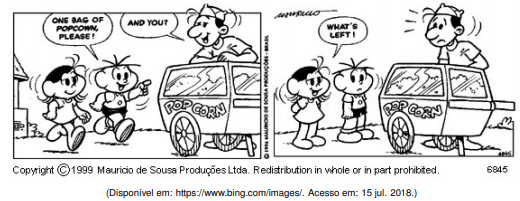
Na tirinha, o humor é evidenciado por meio

 Conheça nossos planos