Questões de Vestibular
Comentadas sobre interpretação de texto | reading comprehension em inglês
Foram encontradas 2.293 questões


Leia o texto para responder a questão.
Minority ethnic Britons face ‘shocking’ job discrimination
Haroon Siddique
Thu 17 Jan 2019 17.00 GMT Last modified on Fri 18 Jan 2019 00.50 GMT
A study by experts based at the Centre for Social Investigation at Nuffield College, University of Oxford, found applicants from minority ethnic backgrounds had to send 80% more applications to get a positive response from an employer than a white person of British origin.
A linked study by the same researchers, comparing their results with similar field experiments dating back to 1969, found discrimination against black Britons and those of south Asian origin – particularly Pakistanis – unchanged over almost 50 years.
The research, part of a larger cross-national project funded by the European Union and shared exclusively with the Guardian before its official launch, prompted concerns that race relations legislation had failed.
It echoes findings published as part of the Guardian’s Bias in Britain series that people from minority ethnic backgrounds face discrimination when seeking a room to rent. In a snapshot survey of online flatshare ads the Guardian found that an applicant called Muhammad was significantly less likely to receive a positive response than an applicant called David.
Prof Anthony Heath, co-author and emeritus fellow of Nuffield College, said: “The absence of any real decline in discrimination against black British and people of Pakistani background is a disturbing finding, which calls into question the effectiveness of previous policies. Ethnic inequality remains a burning injustice and there needs to be a radical rethink about how to tackle it.”
Dr Zubaida Haque, the deputy director of the race equality thinktank Runnymede, described the findings as shocking. They demonstrated that “it’s not just covert racism or unconscious bias that we need to worry about; it’s overt and conscious racism, where applicants are getting shortlisted on the basis of their ethnicity and/or name”, she said.
“It’s clear that race relations legislation is not sufficient to hold employers to account. There are no real consequences for employers of racially discriminating in subtle ways, but for BME* applicants or employees it means higher unemployment, lower wages, poorer conditions and less security in work and life.”
Leia a charge.
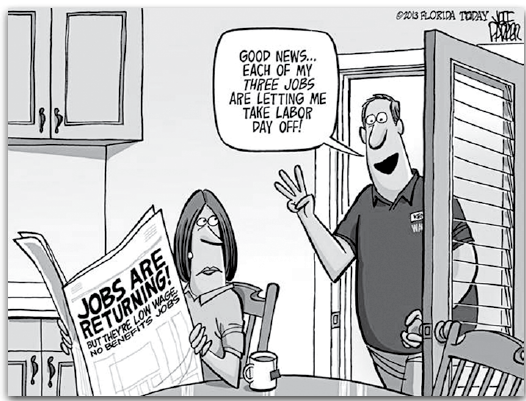
<https://tinyurl.com/y3lrke6a> Acesso em: 08.10.2019. Original colorido.
A ironia da charge se constrói no fato de
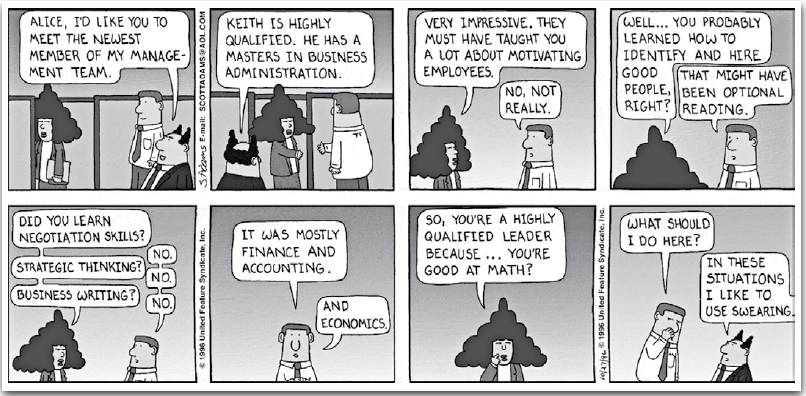
<https://tinyurl.com/y6fbtptu> Acesso em: 15.03.2019. Original colorido
Nos quadrinhos, pode-se observar que Alice se sente um tanto quanto decepcionada com a formação do novo líder
porque ele
What happens to a dream deferred?
Does it dry up like a raisin in the sun? Or fester like a sore — And then run? Does it stink like rotten meat? Or crust and sugar over — like a syrupy sweet?
Maybe it just sags like a heavy load.
Or does it explode?
Langston Hughes, Selected Poems of Langston Hughes (1990). Disponível em http://www.poetryfoundation.org/.
As tentativas de resposta do poeta à pergunta “What happens to a dream deferred?” evocam imagens de
 Disponível em https://www.facebook.com/groups/englishmemes/.
O efeito de comicidade que se obtém do meme decorre, sobretudo, da
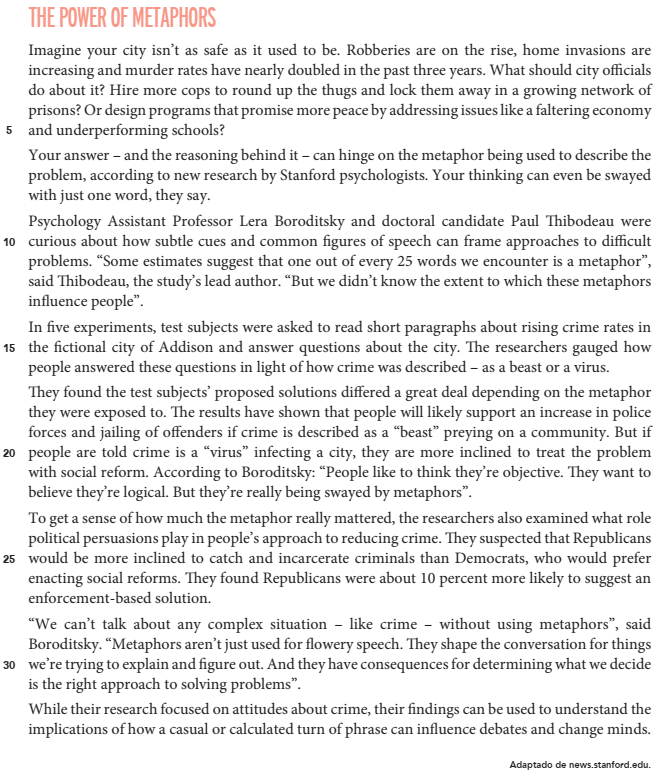
we didn’t know the extent to which these metaphors influence people. (ℓ. 12-13)
In the fragment above, the doubt expressed by the researcher can be formulated by the following question:
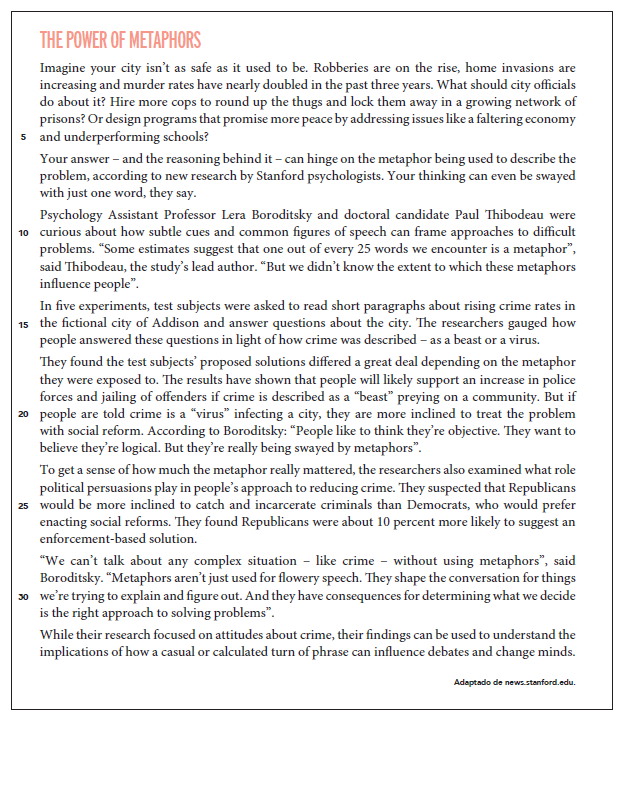
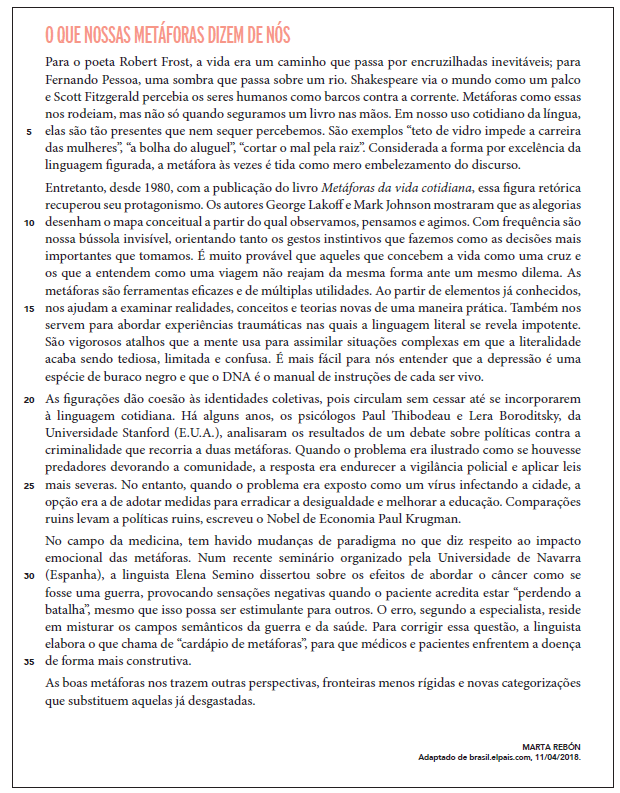
The power of metaphors discusses the use of metaphors in daily life, as well as the text O que nossas metáforas dizem de nós.
The following metaphor is present in both texts:
How a Canadian Chain Is Reinventing Book Selling
By Alexandra Alter
About a decade ago, Heather Reisman, the chief executive of Canada’s largest bookstore chain, was having tea with the novelist Margaret Atwood when Ms. Atwood inadvertently gave her an idea for a new product. Ms. Atwood announced that she planned to go home, put on a pair of cozy socks and curl up with a book. Ms. Reisman thought about how appealing that sounded. Not long after, her company, Indigo, developed its own brand of plush “reading socks.” They quickly became one of Indigo’s signature gift items.
“Last year, all my friends got reading socks,” said Arianna Huffington, the HuffPost cofounder and a friend of Ms. Reisman’s, who also gave the socks as gifts to employees at her organization Thrive. “Most people don’t have reading socks — not like Heather’s reading socks.”
Over the last few years, Indigo has designed dozens of other products, including beach mats, scented candles, inspirational wall art, Mason jars, crystal pillars, bento lunchboxes, herb growing kits, copper cheese knife sets, stemless champagne flutes, throw pillows and scarves.
It may seem strange for a bookstore chain to be developing and selling artisanal soup bowls and organic cotton baby onesies. But Indigo’s approach seems not only novel but crucial to its success and longevity. The superstore concept, with hulking retail spaces stocking 100,000 titles, has become increasingly hard to sustain in the era of online retail, when it’s impossible to match Amazon’s vast selection.
Indigo is experimenting with a new model, positioning itself as a “cultural department store” where customers who wander in to browse through books often end up lingering as they impulsively shop for cashmere slippers and crystal facial rollers, or a knife set to go with a new Paleo cookbook. Over the past few years, Ms. Reisman has reinvented Indigo as a Goop-like, curated lifestyle brand, with sections devoted to food, health and wellness, and home décor.
Ms. Reisman is now importing Indigo’s approach to the United States. Last year, Indigo opened its first American outpost, at a luxury mall in Millburn, N.J., and she eventually plans to open a cluster of Indigos in the Northeast. Indigo’s ascendance is all the more notable given the challenges that big bookstore chains have faced in the United States. Borders, which once had more than 650 locations, filed for bankruptcy in 2011. Barnes & Noble now operates 627 stores, down from 720 in 2010, and the company put itself up for sale last year. Lately, it has been opening smaller stores, including an 8,300-square-foot outlet in Fairfax County, Va.
“Cross-merchandising is Retail 101, and it’s hard to do in a typical bookstore,” said Peter Hildick-Smith, president of the Codex Group, which analyzes the book industry. “Indigo found a way to create an extra aura around the bookbuying experience, by creating a physical extension of what you’re reading about.”
The atmosphere is unabashedly intimate, cozy and feminine — an aesthetic choice that also makes commercial sense, given that women account for some 60 percent of book buyers. A section called “The Joy of the Table” stocks Indigobrand ceramics, glassware and acacia wood serving platters with the cookbooks. The home décor section has pillows and throws, woven baskets, vases and scented candles. There’s a subsection called “In Her Words,” which features idea-driven books and memoirs by women. An area labeled “A Room of Her Own” looks like a lush dressing room, with vegan leather purses, soft gray shawls, a velvet chair, scarves and journals alongside art, design and fashion books.
Books still account for just over 50 percent of Indigo’s sales and remain the central draw; the New Jersey store stocks around 55,000 titles. But they also serve another purpose: providing a window into consumers’ interests, hobbies, desires and anxieties, which makes it easier to develop and sell related products.
Publishing executives, who have watched with growing alarm as Barnes & Noble has struggled, have responded enthusiastically to Ms. Reisman’s strategy. “Heather pioneered and perfected the art of integrating books and nonbook products,” Markus Dohle, the chief executive of Penguin Random House, said in an email.
Ms. Reisman has made herself and her own tastes and interests central to the brand. The front of the New Jersey store features a section labeled “Heather’s Picks,” with a display table covered with dozens of titles. A sign identifies her as the chain’s “founder, C.E.O., Chief Booklover and the Heather in Heather’s Picks.” She appears regularly at author signings and store events, and has interviewed prominent authors like Malcolm Gladwell, James Comey, Sally Field, Bill Clinton and Nora Ephron.
When Ms. Reisman opened the first Indigo store in Burlington, Ontario, in 1997, she had already run her own consulting firm and later served as president of a soft drink and beverage company, Cott. Still, bookselling is an idiosyncratic industry, and many questioned whether Indigo could compete with Canada’s biggest bookseller, Chapters. Skepticism dissolved a few years later when Indigo merged with Chapters, inheriting its fleet of national stores. The company now has more than 200 outlets across Canada, including 89 “superstores.” Indigo opened its first revamped concept store in 2016.
The new approach has proved lucrative: In its 2017 fiscal year, the company’s revenue exceeded $1 billion Canadian for the first time. In its 2018 fiscal year, Indigo reported a revenue increase of nearly $60 million Canadian over the previous year, making it the most profitable year in the chain’s history.
The company’s dominance in Canada doesn’t guarantee it will thrive in the United States, where it has to compete not only with Amazon and Barnes & Noble, but with a resurgent wave of independent booksellers. After years of decline, independent stores have rebounded, with some 2,470 locations, up from 1,651 a decade ago, according to the American Booksellers Association. And Amazon has expanded into the physical retail market, with around 20 bookstores across the United States.
Ms. Reisman acknowledges that the company faces challenges as it expands southward. Still, she’s optimistic, and is already scouting locations for a second store near New York.
https://www.nytimes.com/2019/05/01
How a Canadian Chain Is Reinventing Book Selling
By Alexandra Alter
About a decade ago, Heather Reisman, the chief executive of Canada’s largest bookstore chain, was having tea with the novelist Margaret Atwood when Ms. Atwood inadvertently gave her an idea for a new product. Ms. Atwood announced that she planned to go home, put on a pair of cozy socks and curl up with a book. Ms. Reisman thought about how appealing that sounded. Not long after, her company, Indigo, developed its own brand of plush “reading socks.” They quickly became one of Indigo’s signature gift items.
“Last year, all my friends got reading socks,” said Arianna Huffington, the HuffPost cofounder and a friend of Ms. Reisman’s, who also gave the socks as gifts to employees at her organization Thrive. “Most people don’t have reading socks — not like Heather’s reading socks.”
Over the last few years, Indigo has designed dozens of other products, including beach mats, scented candles, inspirational wall art, Mason jars, crystal pillars, bento lunchboxes, herb growing kits, copper cheese knife sets, stemless champagne flutes, throw pillows and scarves.
It may seem strange for a bookstore chain to be developing and selling artisanal soup bowls and organic cotton baby onesies. But Indigo’s approach seems not only novel but crucial to its success and longevity. The superstore concept, with hulking retail spaces stocking 100,000 titles, has become increasingly hard to sustain in the era of online retail, when it’s impossible to match Amazon’s vast selection.
Indigo is experimenting with a new model, positioning itself as a “cultural department store” where customers who wander in to browse through books often end up lingering as they impulsively shop for cashmere slippers and crystal facial rollers, or a knife set to go with a new Paleo cookbook. Over the past few years, Ms. Reisman has reinvented Indigo as a Goop-like, curated lifestyle brand, with sections devoted to food, health and wellness, and home décor.
Ms. Reisman is now importing Indigo’s approach to the United States. Last year, Indigo opened its first American outpost, at a luxury mall in Millburn, N.J., and she eventually plans to open a cluster of Indigos in the Northeast. Indigo’s ascendance is all the more notable given the challenges that big bookstore chains have faced in the United States. Borders, which once had more than 650 locations, filed for bankruptcy in 2011. Barnes & Noble now operates 627 stores, down from 720 in 2010, and the company put itself up for sale last year. Lately, it has been opening smaller stores, including an 8,300-square-foot outlet in Fairfax County, Va.
“Cross-merchandising is Retail 101, and it’s hard to do in a typical bookstore,” said Peter Hildick-Smith, president of the Codex Group, which analyzes the book industry. “Indigo found a way to create an extra aura around the bookbuying experience, by creating a physical extension of what you’re reading about.”
The atmosphere is unabashedly intimate, cozy and feminine — an aesthetic choice that also makes commercial sense, given that women account for some 60 percent of book buyers. A section called “The Joy of the Table” stocks Indigobrand ceramics, glassware and acacia wood serving platters with the cookbooks. The home décor section has pillows and throws, woven baskets, vases and scented candles. There’s a subsection called “In Her Words,” which features idea-driven books and memoirs by women. An area labeled “A Room of Her Own” looks like a lush dressing room, with vegan leather purses, soft gray shawls, a velvet chair, scarves and journals alongside art, design and fashion books.
Books still account for just over 50 percent of Indigo’s sales and remain the central draw; the New Jersey store stocks around 55,000 titles. But they also serve another purpose: providing a window into consumers’ interests, hobbies, desires and anxieties, which makes it easier to develop and sell related products.
Publishing executives, who have watched with growing alarm as Barnes & Noble has struggled, have responded enthusiastically to Ms. Reisman’s strategy. “Heather pioneered and perfected the art of integrating books and nonbook products,” Markus Dohle, the chief executive of Penguin Random House, said in an email.
Ms. Reisman has made herself and her own tastes and interests central to the brand. The front of the New Jersey store features a section labeled “Heather’s Picks,” with a display table covered with dozens of titles. A sign identifies her as the chain’s “founder, C.E.O., Chief Booklover and the Heather in Heather’s Picks.” She appears regularly at author signings and store events, and has interviewed prominent authors like Malcolm Gladwell, James Comey, Sally Field, Bill Clinton and Nora Ephron.
When Ms. Reisman opened the first Indigo store in Burlington, Ontario, in 1997, she had already run her own consulting firm and later served as president of a soft drink and beverage company, Cott. Still, bookselling is an idiosyncratic industry, and many questioned whether Indigo could compete with Canada’s biggest bookseller, Chapters. Skepticism dissolved a few years later when Indigo merged with Chapters, inheriting its fleet of national stores. The company now has more than 200 outlets across Canada, including 89 “superstores.” Indigo opened its first revamped concept store in 2016.
The new approach has proved lucrative: In its 2017 fiscal year, the company’s revenue exceeded $1 billion Canadian for the first time. In its 2018 fiscal year, Indigo reported a revenue increase of nearly $60 million Canadian over the previous year, making it the most profitable year in the chain’s history.
The company’s dominance in Canada doesn’t guarantee it will thrive in the United States, where it has to compete not only with Amazon and Barnes & Noble, but with a resurgent wave of independent booksellers. After years of decline, independent stores have rebounded, with some 2,470 locations, up from 1,651 a decade ago, according to the American Booksellers Association. And Amazon has expanded into the physical retail market, with around 20 bookstores across the United States.
Ms. Reisman acknowledges that the company faces challenges as it expands southward. Still, she’s optimistic, and is already scouting locations for a second store near New York.
https://www.nytimes.com/2019/05/01
How a Canadian Chain Is Reinventing Book Selling
By Alexandra Alter
About a decade ago, Heather Reisman, the chief executive of Canada’s largest bookstore chain, was having tea with the novelist Margaret Atwood when Ms. Atwood inadvertently gave her an idea for a new product. Ms. Atwood announced that she planned to go home, put on a pair of cozy socks and curl up with a book. Ms. Reisman thought about how appealing that sounded. Not long after, her company, Indigo, developed its own brand of plush “reading socks.” They quickly became one of Indigo’s signature gift items.
“Last year, all my friends got reading socks,” said Arianna Huffington, the HuffPost cofounder and a friend of Ms. Reisman’s, who also gave the socks as gifts to employees at her organization Thrive. “Most people don’t have reading socks — not like Heather’s reading socks.”
Over the last few years, Indigo has designed dozens of other products, including beach mats, scented candles, inspirational wall art, Mason jars, crystal pillars, bento lunchboxes, herb growing kits, copper cheese knife sets, stemless champagne flutes, throw pillows and scarves.
It may seem strange for a bookstore chain to be developing and selling artisanal soup bowls and organic cotton baby onesies. But Indigo’s approach seems not only novel but crucial to its success and longevity. The superstore concept, with hulking retail spaces stocking 100,000 titles, has become increasingly hard to sustain in the era of online retail, when it’s impossible to match Amazon’s vast selection.
Indigo is experimenting with a new model, positioning itself as a “cultural department store” where customers who wander in to browse through books often end up lingering as they impulsively shop for cashmere slippers and crystal facial rollers, or a knife set to go with a new Paleo cookbook. Over the past few years, Ms. Reisman has reinvented Indigo as a Goop-like, curated lifestyle brand, with sections devoted to food, health and wellness, and home décor.
Ms. Reisman is now importing Indigo’s approach to the United States. Last year, Indigo opened its first American outpost, at a luxury mall in Millburn, N.J., and she eventually plans to open a cluster of Indigos in the Northeast. Indigo’s ascendance is all the more notable given the challenges that big bookstore chains have faced in the United States. Borders, which once had more than 650 locations, filed for bankruptcy in 2011. Barnes & Noble now operates 627 stores, down from 720 in 2010, and the company put itself up for sale last year. Lately, it has been opening smaller stores, including an 8,300-square-foot outlet in Fairfax County, Va.
“Cross-merchandising is Retail 101, and it’s hard to do in a typical bookstore,” said Peter Hildick-Smith, president of the Codex Group, which analyzes the book industry. “Indigo found a way to create an extra aura around the bookbuying experience, by creating a physical extension of what you’re reading about.”
The atmosphere is unabashedly intimate, cozy and feminine — an aesthetic choice that also makes commercial sense, given that women account for some 60 percent of book buyers. A section called “The Joy of the Table” stocks Indigobrand ceramics, glassware and acacia wood serving platters with the cookbooks. The home décor section has pillows and throws, woven baskets, vases and scented candles. There’s a subsection called “In Her Words,” which features idea-driven books and memoirs by women. An area labeled “A Room of Her Own” looks like a lush dressing room, with vegan leather purses, soft gray shawls, a velvet chair, scarves and journals alongside art, design and fashion books.
Books still account for just over 50 percent of Indigo’s sales and remain the central draw; the New Jersey store stocks around 55,000 titles. But they also serve another purpose: providing a window into consumers’ interests, hobbies, desires and anxieties, which makes it easier to develop and sell related products.
Publishing executives, who have watched with growing alarm as Barnes & Noble has struggled, have responded enthusiastically to Ms. Reisman’s strategy. “Heather pioneered and perfected the art of integrating books and nonbook products,” Markus Dohle, the chief executive of Penguin Random House, said in an email.
Ms. Reisman has made herself and her own tastes and interests central to the brand. The front of the New Jersey store features a section labeled “Heather’s Picks,” with a display table covered with dozens of titles. A sign identifies her as the chain’s “founder, C.E.O., Chief Booklover and the Heather in Heather’s Picks.” She appears regularly at author signings and store events, and has interviewed prominent authors like Malcolm Gladwell, James Comey, Sally Field, Bill Clinton and Nora Ephron.
When Ms. Reisman opened the first Indigo store in Burlington, Ontario, in 1997, she had already run her own consulting firm and later served as president of a soft drink and beverage company, Cott. Still, bookselling is an idiosyncratic industry, and many questioned whether Indigo could compete with Canada’s biggest bookseller, Chapters. Skepticism dissolved a few years later when Indigo merged with Chapters, inheriting its fleet of national stores. The company now has more than 200 outlets across Canada, including 89 “superstores.” Indigo opened its first revamped concept store in 2016.
The new approach has proved lucrative: In its 2017 fiscal year, the company’s revenue exceeded $1 billion Canadian for the first time. In its 2018 fiscal year, Indigo reported a revenue increase of nearly $60 million Canadian over the previous year, making it the most profitable year in the chain’s history.
The company’s dominance in Canada doesn’t guarantee it will thrive in the United States, where it has to compete not only with Amazon and Barnes & Noble, but with a resurgent wave of independent booksellers. After years of decline, independent stores have rebounded, with some 2,470 locations, up from 1,651 a decade ago, according to the American Booksellers Association. And Amazon has expanded into the physical retail market, with around 20 bookstores across the United States.
Ms. Reisman acknowledges that the company faces challenges as it expands southward. Still, she’s optimistic, and is already scouting locations for a second store near New York.
https://www.nytimes.com/2019/05/01
How a Canadian Chain Is Reinventing Book Selling
By Alexandra Alter
About a decade ago, Heather Reisman, the chief executive of Canada’s largest bookstore chain, was having tea with the novelist Margaret Atwood when Ms. Atwood inadvertently gave her an idea for a new product. Ms. Atwood announced that she planned to go home, put on a pair of cozy socks and curl up with a book. Ms. Reisman thought about how appealing that sounded. Not long after, her company, Indigo, developed its own brand of plush “reading socks.” They quickly became one of Indigo’s signature gift items.
“Last year, all my friends got reading socks,” said Arianna Huffington, the HuffPost cofounder and a friend of Ms. Reisman’s, who also gave the socks as gifts to employees at her organization Thrive. “Most people don’t have reading socks — not like Heather’s reading socks.”
Over the last few years, Indigo has designed dozens of other products, including beach mats, scented candles, inspirational wall art, Mason jars, crystal pillars, bento lunchboxes, herb growing kits, copper cheese knife sets, stemless champagne flutes, throw pillows and scarves.
It may seem strange for a bookstore chain to be developing and selling artisanal soup bowls and organic cotton baby onesies. But Indigo’s approach seems not only novel but crucial to its success and longevity. The superstore concept, with hulking retail spaces stocking 100,000 titles, has become increasingly hard to sustain in the era of online retail, when it’s impossible to match Amazon’s vast selection.
Indigo is experimenting with a new model, positioning itself as a “cultural department store” where customers who wander in to browse through books often end up lingering as they impulsively shop for cashmere slippers and crystal facial rollers, or a knife set to go with a new Paleo cookbook. Over the past few years, Ms. Reisman has reinvented Indigo as a Goop-like, curated lifestyle brand, with sections devoted to food, health and wellness, and home décor.
Ms. Reisman is now importing Indigo’s approach to the United States. Last year, Indigo opened its first American outpost, at a luxury mall in Millburn, N.J., and she eventually plans to open a cluster of Indigos in the Northeast. Indigo’s ascendance is all the more notable given the challenges that big bookstore chains have faced in the United States. Borders, which once had more than 650 locations, filed for bankruptcy in 2011. Barnes & Noble now operates 627 stores, down from 720 in 2010, and the company put itself up for sale last year. Lately, it has been opening smaller stores, including an 8,300-square-foot outlet in Fairfax County, Va.
“Cross-merchandising is Retail 101, and it’s hard to do in a typical bookstore,” said Peter Hildick-Smith, president of the Codex Group, which analyzes the book industry. “Indigo found a way to create an extra aura around the bookbuying experience, by creating a physical extension of what you’re reading about.”
The atmosphere is unabashedly intimate, cozy and feminine — an aesthetic choice that also makes commercial sense, given that women account for some 60 percent of book buyers. A section called “The Joy of the Table” stocks Indigobrand ceramics, glassware and acacia wood serving platters with the cookbooks. The home décor section has pillows and throws, woven baskets, vases and scented candles. There’s a subsection called “In Her Words,” which features idea-driven books and memoirs by women. An area labeled “A Room of Her Own” looks like a lush dressing room, with vegan leather purses, soft gray shawls, a velvet chair, scarves and journals alongside art, design and fashion books.
Books still account for just over 50 percent of Indigo’s sales and remain the central draw; the New Jersey store stocks around 55,000 titles. But they also serve another purpose: providing a window into consumers’ interests, hobbies, desires and anxieties, which makes it easier to develop and sell related products.
Publishing executives, who have watched with growing alarm as Barnes & Noble has struggled, have responded enthusiastically to Ms. Reisman’s strategy. “Heather pioneered and perfected the art of integrating books and nonbook products,” Markus Dohle, the chief executive of Penguin Random House, said in an email.
Ms. Reisman has made herself and her own tastes and interests central to the brand. The front of the New Jersey store features a section labeled “Heather’s Picks,” with a display table covered with dozens of titles. A sign identifies her as the chain’s “founder, C.E.O., Chief Booklover and the Heather in Heather’s Picks.” She appears regularly at author signings and store events, and has interviewed prominent authors like Malcolm Gladwell, James Comey, Sally Field, Bill Clinton and Nora Ephron.
When Ms. Reisman opened the first Indigo store in Burlington, Ontario, in 1997, she had already run her own consulting firm and later served as president of a soft drink and beverage company, Cott. Still, bookselling is an idiosyncratic industry, and many questioned whether Indigo could compete with Canada’s biggest bookseller, Chapters. Skepticism dissolved a few years later when Indigo merged with Chapters, inheriting its fleet of national stores. The company now has more than 200 outlets across Canada, including 89 “superstores.” Indigo opened its first revamped concept store in 2016.
The new approach has proved lucrative: In its 2017 fiscal year, the company’s revenue exceeded $1 billion Canadian for the first time. In its 2018 fiscal year, Indigo reported a revenue increase of nearly $60 million Canadian over the previous year, making it the most profitable year in the chain’s history.
The company’s dominance in Canada doesn’t guarantee it will thrive in the United States, where it has to compete not only with Amazon and Barnes & Noble, but with a resurgent wave of independent booksellers. After years of decline, independent stores have rebounded, with some 2,470 locations, up from 1,651 a decade ago, according to the American Booksellers Association. And Amazon has expanded into the physical retail market, with around 20 bookstores across the United States.
Ms. Reisman acknowledges that the company faces challenges as it expands southward. Still, she’s optimistic, and is already scouting locations for a second store near New York.
https://www.nytimes.com/2019/05/01
How a Canadian Chain Is Reinventing Book Selling
By Alexandra Alter
About a decade ago, Heather Reisman, the chief executive of Canada’s largest bookstore chain, was having tea with the novelist Margaret Atwood when Ms. Atwood inadvertently gave her an idea for a new product. Ms. Atwood announced that she planned to go home, put on a pair of cozy socks and curl up with a book. Ms. Reisman thought about how appealing that sounded. Not long after, her company, Indigo, developed its own brand of plush “reading socks.” They quickly became one of Indigo’s signature gift items.
“Last year, all my friends got reading socks,” said Arianna Huffington, the HuffPost cofounder and a friend of Ms. Reisman’s, who also gave the socks as gifts to employees at her organization Thrive. “Most people don’t have reading socks — not like Heather’s reading socks.”
Over the last few years, Indigo has designed dozens of other products, including beach mats, scented candles, inspirational wall art, Mason jars, crystal pillars, bento lunchboxes, herb growing kits, copper cheese knife sets, stemless champagne flutes, throw pillows and scarves.
It may seem strange for a bookstore chain to be developing and selling artisanal soup bowls and organic cotton baby onesies. But Indigo’s approach seems not only novel but crucial to its success and longevity. The superstore concept, with hulking retail spaces stocking 100,000 titles, has become increasingly hard to sustain in the era of online retail, when it’s impossible to match Amazon’s vast selection.
Indigo is experimenting with a new model, positioning itself as a “cultural department store” where customers who wander in to browse through books often end up lingering as they impulsively shop for cashmere slippers and crystal facial rollers, or a knife set to go with a new Paleo cookbook. Over the past few years, Ms. Reisman has reinvented Indigo as a Goop-like, curated lifestyle brand, with sections devoted to food, health and wellness, and home décor.
Ms. Reisman is now importing Indigo’s approach to the United States. Last year, Indigo opened its first American outpost, at a luxury mall in Millburn, N.J., and she eventually plans to open a cluster of Indigos in the Northeast. Indigo’s ascendance is all the more notable given the challenges that big bookstore chains have faced in the United States. Borders, which once had more than 650 locations, filed for bankruptcy in 2011. Barnes & Noble now operates 627 stores, down from 720 in 2010, and the company put itself up for sale last year. Lately, it has been opening smaller stores, including an 8,300-square-foot outlet in Fairfax County, Va.
“Cross-merchandising is Retail 101, and it’s hard to do in a typical bookstore,” said Peter Hildick-Smith, president of the Codex Group, which analyzes the book industry. “Indigo found a way to create an extra aura around the bookbuying experience, by creating a physical extension of what you’re reading about.”
The atmosphere is unabashedly intimate, cozy and feminine — an aesthetic choice that also makes commercial sense, given that women account for some 60 percent of book buyers. A section called “The Joy of the Table” stocks Indigobrand ceramics, glassware and acacia wood serving platters with the cookbooks. The home décor section has pillows and throws, woven baskets, vases and scented candles. There’s a subsection called “In Her Words,” which features idea-driven books and memoirs by women. An area labeled “A Room of Her Own” looks like a lush dressing room, with vegan leather purses, soft gray shawls, a velvet chair, scarves and journals alongside art, design and fashion books.
Books still account for just over 50 percent of Indigo’s sales and remain the central draw; the New Jersey store stocks around 55,000 titles. But they also serve another purpose: providing a window into consumers’ interests, hobbies, desires and anxieties, which makes it easier to develop and sell related products.
Publishing executives, who have watched with growing alarm as Barnes & Noble has struggled, have responded enthusiastically to Ms. Reisman’s strategy. “Heather pioneered and perfected the art of integrating books and nonbook products,” Markus Dohle, the chief executive of Penguin Random House, said in an email.
Ms. Reisman has made herself and her own tastes and interests central to the brand. The front of the New Jersey store features a section labeled “Heather’s Picks,” with a display table covered with dozens of titles. A sign identifies her as the chain’s “founder, C.E.O., Chief Booklover and the Heather in Heather’s Picks.” She appears regularly at author signings and store events, and has interviewed prominent authors like Malcolm Gladwell, James Comey, Sally Field, Bill Clinton and Nora Ephron.
When Ms. Reisman opened the first Indigo store in Burlington, Ontario, in 1997, she had already run her own consulting firm and later served as president of a soft drink and beverage company, Cott. Still, bookselling is an idiosyncratic industry, and many questioned whether Indigo could compete with Canada’s biggest bookseller, Chapters. Skepticism dissolved a few years later when Indigo merged with Chapters, inheriting its fleet of national stores. The company now has more than 200 outlets across Canada, including 89 “superstores.” Indigo opened its first revamped concept store in 2016.
The new approach has proved lucrative: In its 2017 fiscal year, the company’s revenue exceeded $1 billion Canadian for the first time. In its 2018 fiscal year, Indigo reported a revenue increase of nearly $60 million Canadian over the previous year, making it the most profitable year in the chain’s history.
The company’s dominance in Canada doesn’t guarantee it will thrive in the United States, where it has to compete not only with Amazon and Barnes & Noble, but with a resurgent wave of independent booksellers. After years of decline, independent stores have rebounded, with some 2,470 locations, up from 1,651 a decade ago, according to the American Booksellers Association. And Amazon has expanded into the physical retail market, with around 20 bookstores across the United States.
Ms. Reisman acknowledges that the company faces challenges as it expands southward. Still, she’s optimistic, and is already scouting locations for a second store near New York.
https://www.nytimes.com/2019/05/01
How a Canadian Chain Is Reinventing Book Selling
By Alexandra Alter
About a decade ago, Heather Reisman, the chief executive of Canada’s largest bookstore chain, was having tea with the novelist Margaret Atwood when Ms. Atwood inadvertently gave her an idea for a new product. Ms. Atwood announced that she planned to go home, put on a pair of cozy socks and curl up with a book. Ms. Reisman thought about how appealing that sounded. Not long after, her company, Indigo, developed its own brand of plush “reading socks.” They quickly became one of Indigo’s signature gift items.
“Last year, all my friends got reading socks,” said Arianna Huffington, the HuffPost cofounder and a friend of Ms. Reisman’s, who also gave the socks as gifts to employees at her organization Thrive. “Most people don’t have reading socks — not like Heather’s reading socks.”
Over the last few years, Indigo has designed dozens of other products, including beach mats, scented candles, inspirational wall art, Mason jars, crystal pillars, bento lunchboxes, herb growing kits, copper cheese knife sets, stemless champagne flutes, throw pillows and scarves.
It may seem strange for a bookstore chain to be developing and selling artisanal soup bowls and organic cotton baby onesies. But Indigo’s approach seems not only novel but crucial to its success and longevity. The superstore concept, with hulking retail spaces stocking 100,000 titles, has become increasingly hard to sustain in the era of online retail, when it’s impossible to match Amazon’s vast selection.
Indigo is experimenting with a new model, positioning itself as a “cultural department store” where customers who wander in to browse through books often end up lingering as they impulsively shop for cashmere slippers and crystal facial rollers, or a knife set to go with a new Paleo cookbook. Over the past few years, Ms. Reisman has reinvented Indigo as a Goop-like, curated lifestyle brand, with sections devoted to food, health and wellness, and home décor.
Ms. Reisman is now importing Indigo’s approach to the United States. Last year, Indigo opened its first American outpost, at a luxury mall in Millburn, N.J., and she eventually plans to open a cluster of Indigos in the Northeast. Indigo’s ascendance is all the more notable given the challenges that big bookstore chains have faced in the United States. Borders, which once had more than 650 locations, filed for bankruptcy in 2011. Barnes & Noble now operates 627 stores, down from 720 in 2010, and the company put itself up for sale last year. Lately, it has been opening smaller stores, including an 8,300-square-foot outlet in Fairfax County, Va.
“Cross-merchandising is Retail 101, and it’s hard to do in a typical bookstore,” said Peter Hildick-Smith, president of the Codex Group, which analyzes the book industry. “Indigo found a way to create an extra aura around the bookbuying experience, by creating a physical extension of what you’re reading about.”
The atmosphere is unabashedly intimate, cozy and feminine — an aesthetic choice that also makes commercial sense, given that women account for some 60 percent of book buyers. A section called “The Joy of the Table” stocks Indigobrand ceramics, glassware and acacia wood serving platters with the cookbooks. The home décor section has pillows and throws, woven baskets, vases and scented candles. There’s a subsection called “In Her Words,” which features idea-driven books and memoirs by women. An area labeled “A Room of Her Own” looks like a lush dressing room, with vegan leather purses, soft gray shawls, a velvet chair, scarves and journals alongside art, design and fashion books.
Books still account for just over 50 percent of Indigo’s sales and remain the central draw; the New Jersey store stocks around 55,000 titles. But they also serve another purpose: providing a window into consumers’ interests, hobbies, desires and anxieties, which makes it easier to develop and sell related products.
Publishing executives, who have watched with growing alarm as Barnes & Noble has struggled, have responded enthusiastically to Ms. Reisman’s strategy. “Heather pioneered and perfected the art of integrating books and nonbook products,” Markus Dohle, the chief executive of Penguin Random House, said in an email.
Ms. Reisman has made herself and her own tastes and interests central to the brand. The front of the New Jersey store features a section labeled “Heather’s Picks,” with a display table covered with dozens of titles. A sign identifies her as the chain’s “founder, C.E.O., Chief Booklover and the Heather in Heather’s Picks.” She appears regularly at author signings and store events, and has interviewed prominent authors like Malcolm Gladwell, James Comey, Sally Field, Bill Clinton and Nora Ephron.
When Ms. Reisman opened the first Indigo store in Burlington, Ontario, in 1997, she had already run her own consulting firm and later served as president of a soft drink and beverage company, Cott. Still, bookselling is an idiosyncratic industry, and many questioned whether Indigo could compete with Canada’s biggest bookseller, Chapters. Skepticism dissolved a few years later when Indigo merged with Chapters, inheriting its fleet of national stores. The company now has more than 200 outlets across Canada, including 89 “superstores.” Indigo opened its first revamped concept store in 2016.
The new approach has proved lucrative: In its 2017 fiscal year, the company’s revenue exceeded $1 billion Canadian for the first time. In its 2018 fiscal year, Indigo reported a revenue increase of nearly $60 million Canadian over the previous year, making it the most profitable year in the chain’s history.
The company’s dominance in Canada doesn’t guarantee it will thrive in the United States, where it has to compete not only with Amazon and Barnes & Noble, but with a resurgent wave of independent booksellers. After years of decline, independent stores have rebounded, with some 2,470 locations, up from 1,651 a decade ago, according to the American Booksellers Association. And Amazon has expanded into the physical retail market, with around 20 bookstores across the United States.
Ms. Reisman acknowledges that the company faces challenges as it expands southward. Still, she’s optimistic, and is already scouting locations for a second store near New York.
https://www.nytimes.com/2019/05/01
How a Canadian Chain Is Reinventing Book Selling
By Alexandra Alter
About a decade ago, Heather Reisman, the chief executive of Canada’s largest bookstore chain, was having tea with the novelist Margaret Atwood when Ms. Atwood inadvertently gave her an idea for a new product. Ms. Atwood announced that she planned to go home, put on a pair of cozy socks and curl up with a book. Ms. Reisman thought about how appealing that sounded. Not long after, her company, Indigo, developed its own brand of plush “reading socks.” They quickly became one of Indigo’s signature gift items.
“Last year, all my friends got reading socks,” said Arianna Huffington, the HuffPost cofounder and a friend of Ms. Reisman’s, who also gave the socks as gifts to employees at her organization Thrive. “Most people don’t have reading socks — not like Heather’s reading socks.”
Over the last few years, Indigo has designed dozens of other products, including beach mats, scented candles, inspirational wall art, Mason jars, crystal pillars, bento lunchboxes, herb growing kits, copper cheese knife sets, stemless champagne flutes, throw pillows and scarves.
It may seem strange for a bookstore chain to be developing and selling artisanal soup bowls and organic cotton baby onesies. But Indigo’s approach seems not only novel but crucial to its success and longevity. The superstore concept, with hulking retail spaces stocking 100,000 titles, has become increasingly hard to sustain in the era of online retail, when it’s impossible to match Amazon’s vast selection.
Indigo is experimenting with a new model, positioning itself as a “cultural department store” where customers who wander in to browse through books often end up lingering as they impulsively shop for cashmere slippers and crystal facial rollers, or a knife set to go with a new Paleo cookbook. Over the past few years, Ms. Reisman has reinvented Indigo as a Goop-like, curated lifestyle brand, with sections devoted to food, health and wellness, and home décor.
Ms. Reisman is now importing Indigo’s approach to the United States. Last year, Indigo opened its first American outpost, at a luxury mall in Millburn, N.J., and she eventually plans to open a cluster of Indigos in the Northeast. Indigo’s ascendance is all the more notable given the challenges that big bookstore chains have faced in the United States. Borders, which once had more than 650 locations, filed for bankruptcy in 2011. Barnes & Noble now operates 627 stores, down from 720 in 2010, and the company put itself up for sale last year. Lately, it has been opening smaller stores, including an 8,300-square-foot outlet in Fairfax County, Va.
“Cross-merchandising is Retail 101, and it’s hard to do in a typical bookstore,” said Peter Hildick-Smith, president of the Codex Group, which analyzes the book industry. “Indigo found a way to create an extra aura around the bookbuying experience, by creating a physical extension of what you’re reading about.”
The atmosphere is unabashedly intimate, cozy and feminine — an aesthetic choice that also makes commercial sense, given that women account for some 60 percent of book buyers. A section called “The Joy of the Table” stocks Indigobrand ceramics, glassware and acacia wood serving platters with the cookbooks. The home décor section has pillows and throws, woven baskets, vases and scented candles. There’s a subsection called “In Her Words,” which features idea-driven books and memoirs by women. An area labeled “A Room of Her Own” looks like a lush dressing room, with vegan leather purses, soft gray shawls, a velvet chair, scarves and journals alongside art, design and fashion books.
Books still account for just over 50 percent of Indigo’s sales and remain the central draw; the New Jersey store stocks around 55,000 titles. But they also serve another purpose: providing a window into consumers’ interests, hobbies, desires and anxieties, which makes it easier to develop and sell related products.
Publishing executives, who have watched with growing alarm as Barnes & Noble has struggled, have responded enthusiastically to Ms. Reisman’s strategy. “Heather pioneered and perfected the art of integrating books and nonbook products,” Markus Dohle, the chief executive of Penguin Random House, said in an email.
Ms. Reisman has made herself and her own tastes and interests central to the brand. The front of the New Jersey store features a section labeled “Heather’s Picks,” with a display table covered with dozens of titles. A sign identifies her as the chain’s “founder, C.E.O., Chief Booklover and the Heather in Heather’s Picks.” She appears regularly at author signings and store events, and has interviewed prominent authors like Malcolm Gladwell, James Comey, Sally Field, Bill Clinton and Nora Ephron.
When Ms. Reisman opened the first Indigo store in Burlington, Ontario, in 1997, she had already run her own consulting firm and later served as president of a soft drink and beverage company, Cott. Still, bookselling is an idiosyncratic industry, and many questioned whether Indigo could compete with Canada’s biggest bookseller, Chapters. Skepticism dissolved a few years later when Indigo merged with Chapters, inheriting its fleet of national stores. The company now has more than 200 outlets across Canada, including 89 “superstores.” Indigo opened its first revamped concept store in 2016.
The new approach has proved lucrative: In its 2017 fiscal year, the company’s revenue exceeded $1 billion Canadian for the first time. In its 2018 fiscal year, Indigo reported a revenue increase of nearly $60 million Canadian over the previous year, making it the most profitable year in the chain’s history.
The company’s dominance in Canada doesn’t guarantee it will thrive in the United States, where it has to compete not only with Amazon and Barnes & Noble, but with a resurgent wave of independent booksellers. After years of decline, independent stores have rebounded, with some 2,470 locations, up from 1,651 a decade ago, according to the American Booksellers Association. And Amazon has expanded into the physical retail market, with around 20 bookstores across the United States.
Ms. Reisman acknowledges that the company faces challenges as it expands southward. Still, she’s optimistic, and is already scouting locations for a second store near New York.
https://www.nytimes.com/2019/05/01

 Conheça nossos planos