🎯 Saiba o que estudar

Avançado com Treinador a partir de R$ 0,76/dia

Questões de Vestibular Comentadas sobre interpretação de texto | reading comprehension em inglês

Foram encontradas 2.293 questões

Ano: 2019 Banca: UniCEUB Órgão: UniCEUB Prova: UniCEUB - 2019 - UniCEUB - Vestibular de Medicina |
Q1342532 Inglês
Leia o texto para responder à questao.

Is there a scientific explanation for
 out-of-body experiences?

     Imagine feeling as though you are floating above your body, looking down upon your physical self. Some argue that such out-of-body experiences (OBEs) prove that the conscious mind — or even the soul — can leave the body. Supporting this interpretation, people who have survived a near-death experience often recall experiencing this out-ofbody sensation — as if their spiritual essence had separated from their corporeal existence.
    However, the scientific explanation for OBEs is more terrestrial. Neuroscientists and psychologists believe it has to do with neural processes going wrong. In those who come close to death, such as cardiac arrest survivors, it is the lack of oxygen to the brain, and the release of certain neurochemicals triggered by trauma, that interferes with the sensory functions that support our usual feelings of embodiment. People’s recollections of seeing themselves from above — such as observing surgeons working on their body — could be a form of hallucination or false memory, as they try to make sense of their experiences.
    Researchers have induced out-of-body states in healthy volunteers simply by confusing their sensory systems. For instance, scientists at the Karolinska Institute in Stockholm asked volunteers to wear goggles that showed the perspective of a camera placed behind them (so that they could see themselves from behind). When a researcher prodded the camera with a baton at the same time as prodding the person’s chest, the volunteer had the sensation that they were floating behind their physical body. The fact it is possible to induce an OBE argues against more mystical explanations.
                            (Christian Jarret. www.sciencefocus.com, 2019. Adaptado.)
O termo “however” torna explícita a relação entre o primeiro e segundo parágrafos e indica
Alternativas
Ano: 2019 Banca: UniCEUB Órgão: UniCEUB Prova: UniCEUB - 2019 - UniCEUB - Vestibular de Medicina |
Q1342531 Inglês
Leia o texto para responder à questao.

Is there a scientific explanation for
 out-of-body experiences?

     Imagine feeling as though you are floating above your body, looking down upon your physical self. Some argue that such out-of-body experiences (OBEs) prove that the conscious mind — or even the soul — can leave the body. Supporting this interpretation, people who have survived a near-death experience often recall experiencing this out-ofbody sensation — as if their spiritual essence had separated from their corporeal existence.
    However, the scientific explanation for OBEs is more terrestrial. Neuroscientists and psychologists believe it has to do with neural processes going wrong. In those who come close to death, such as cardiac arrest survivors, it is the lack of oxygen to the brain, and the release of certain neurochemicals triggered by trauma, that interferes with the sensory functions that support our usual feelings of embodiment. People’s recollections of seeing themselves from above — such as observing surgeons working on their body — could be a form of hallucination or false memory, as they try to make sense of their experiences.
    Researchers have induced out-of-body states in healthy volunteers simply by confusing their sensory systems. For instance, scientists at the Karolinska Institute in Stockholm asked volunteers to wear goggles that showed the perspective of a camera placed behind them (so that they could see themselves from behind). When a researcher prodded the camera with a baton at the same time as prodding the person’s chest, the volunteer had the sensation that they were floating behind their physical body. The fact it is possible to induce an OBE argues against more mystical explanations.
                            (Christian Jarret. www.sciencefocus.com, 2019. Adaptado.)
According to the text,
Alternativas
Ano: 2019 Banca: VUNESP Órgão: FAMERP Prova: VUNESP - 2019 - FAMERP - Conhecimentos Gerais |
Q1342403 Inglês

Observe the image.

Imagem associada para resolução da questão

(www.michaelkonik.com, 05.10.2013.)

The art print overlaps
Alternativas
Ano: 2019 Banca: VUNESP Órgão: FAMERP Prova: VUNESP - 2019 - FAMERP - Conhecimentos Gerais |
Q1342402 Inglês
Leia o texto para responder à questão.


    What does love look like? Love is accepting that your partner is not perfect, but you want to be with him or her anyway. Love is being grateful that you are accepted despite your imperfections. Love is still being happy to come home to that same person, even after 30 years.

(Harriet Koral. www.nytimes.com, 19.11.2017. Adaptado.)
O trecho “accepting that your partner is not perfect” pode ser associado ao seguinte provérbio:
Alternativas
Ano: 2019 Banca: VUNESP Órgão: FAMERP Prova: VUNESP - 2019 - FAMERP - Conhecimentos Gerais |
Q1342401 Inglês
Leia o texto para responder à questão.


    What does love look like? Love is accepting that your partner is not perfect, but you want to be with him or her anyway. Love is being grateful that you are accepted despite your imperfections. Love is still being happy to come home to that same person, even after 30 years.

(Harriet Koral. www.nytimes.com, 19.11.2017. Adaptado.)
O trecho dessa carta aberta publicada no jornal The New York Times é norteado pelo caráter
Alternativas
Ano: 2019 Banca: VUNESP Órgão: FAMERP Prova: VUNESP - 2019 - FAMERP - Conhecimentos Gerais |
Q1342400 Inglês
Leia o texto para responder à questão.


    The Mona Lisa was recently moved from her usual gallery in the Salle des États, currently being renovated, to a temporary home in the Galérie Médicis. Visitors to the Louvre who have queued patiently for hours are complaining that museum staff are allowing them less than a minute to view the masterpice. The relocation has created bottlenecks of visitors lining corridors and the Louvre is now advising that only those who have pre-booked will be guaranteed a glimpse of the world’s most famous portrait.

(David Chazan. www.telegraph.co.uk, 13.08.2019. Adaptado.)
In the excerpt “only those who have pre-booked will be guaranteed a glimpse of the world’s most famous portrait”, the underlined word refers to
Alternativas
Ano: 2019 Banca: VUNESP Órgão: FAMERP Prova: VUNESP - 2019 - FAMERP - Conhecimentos Gerais |
Q1342399 Inglês
Leia o texto para responder à questão.


    The Mona Lisa was recently moved from her usual gallery in the Salle des États, currently being renovated, to a temporary home in the Galérie Médicis. Visitors to the Louvre who have queued patiently for hours are complaining that museum staff are allowing them less than a minute to view the masterpice. The relocation has created bottlenecks of visitors lining corridors and the Louvre is now advising that only those who have pre-booked will be guaranteed a glimpse of the world’s most famous portrait.

(David Chazan. www.telegraph.co.uk, 13.08.2019. Adaptado.)
The author’s aim is to
Alternativas
Ano: 2019 Banca: VUNESP Órgão: FAMERP Prova: VUNESP - 2019 - FAMERP - Conhecimentos Gerais |
Q1342398 Inglês

Leia o infográfico para responder à questão.


(Karmen Clair. https://karmenclair.wordpress.com, 03.04.2019. Adaptado.)
In the excerpt from the fourth topic “continue to be a huge trend”, the underlined word can be replaced, without changing the meaning of the sentence, by
Alternativas
Ano: 2019 Banca: VUNESP Órgão: FAMERP Prova: VUNESP - 2019 - FAMERP - Conhecimentos Gerais |
Q1342397 Inglês

Leia o infográfico para responder à questão.


(Karmen Clair. https://karmenclair.wordpress.com, 03.04.2019. Adaptado.)
De acordo com o contexto do terceiro tópico, o trecho “the most bang for their buck” pode ser entendido como:
Alternativas
Ano: 2019 Banca: VUNESP Órgão: FAMERP Prova: VUNESP - 2019 - FAMERP - Conhecimentos Gerais |
Q1342396 Inglês

Leia o infográfico para responder à questão.


(Karmen Clair. https://karmenclair.wordpress.com, 03.04.2019. Adaptado.)
De acordo com o segundo tópico, atrações turísticas que exploram animais como entretenimento
Alternativas
Ano: 2019 Banca: VUNESP Órgão: FAMERP Prova: VUNESP - 2019 - FAMERP - Conhecimentos Gerais |
Q1342395 Inglês

Leia o infográfico para responder à questão.


(Karmen Clair. https://karmenclair.wordpress.com, 03.04.2019. Adaptado.)
According to the infographic, a mindful traveler should keep an eye on the following issue:
Alternativas
Ano: 2019 Banca: VUNESP Órgão: FAMERP Prova: VUNESP - 2019 - FAMERP - Conhecimentos Gerais |
Q1342394 Inglês

Leia o infográfico para responder à questão.


(Karmen Clair. https://karmenclair.wordpress.com, 03.04.2019. Adaptado.)
The purpose of this infographic is to
Alternativas
Ano: 2019 Banca: INEP Órgão: IF Goiano Prova: INEP - 2019 - IF Goiano - Vestibular Segundo Semestre |
Q1339453 Inglês
Brazilian scholar Sueli Carneiro (2011), arguing about the importance of black feminism in Brazil and Latin America, states that black women never recognized themselves in the myth of the female fragility, because they were never treated as fragile. This is shown in Text 1 through Maria’s life, since she is
Alternativas
Ano: 2019 Banca: INEP Órgão: IF Goiano Prova: INEP - 2019 - IF Goiano - Vestibular Segundo Semestre |
Q1339452 Inglês
According to Conceição Evaristo (2009), in an article entitled “Literatura Negra: uma poética de nossa afro-brasilidade”, Afro-Brazilian literature portrays the bodies of black people in a positive humanized manner, even when they are forced to live under dehumanizing circumstances. Similarly, the images 1 and 2 show black Brazilian men working under inadequate conditions, and yet they are standing up with
Alternativas
Ano: 2019 Banca: VUNESP Órgão: FAMEMA Prova: VUNESP - 2019 - FAMEMA - Vestibular 2020 - Prova II |
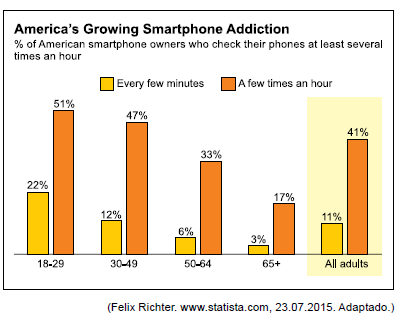
Q1339320 Inglês

Imagem associada para resolução da questão

According to the chart,

Alternativas
Ano: 2019 Banca: VUNESP Órgão: FAMEMA Prova: VUNESP - 2019 - FAMEMA - Vestibular 2020 - Prova II |
Q1339318 Inglês

               An increasing body of evidence suggests that the time we spend on our smartphones is interfering with our sleep, self-esteem, relationships, memory, attention spans, creativity, productivity and problem-solving and decision-making skills. But there is another reason for us to rethink our relationships with our devices. By chronically raising levels of cortisol, the body’s main stress hormone, our phones may be threatening our health and shortening our lives.

          If they happened only occasionally, phone-induced cortisol spikes might not matter. But the average American spends four hours a day staring at their smartphone and keeps it within arm’s reach nearly all the time, according to a tracking app called Moment.

         “Your cortisol levels are elevated when your phone is in sight or nearby, or when you hear it or even think you hear it,” says David Greenfield, professor of clinical psychiatry at the University of Connecticut School of Medicine and founder of the Center for Internet and Technology Addiction. “It’s a stress response, and it feels unpleasant, and the body’s natural response is to want to check the phone to make the stress go away.”

          But while doing so might soothe you for a second, it probably will make things worse in the long run. Any time you check your phone, you’re likely to find something else stressful waiting for you, leading to another spike in cortisol and another craving to check your phone to make your anxiety go away. This cycle, when continuously reinforced, leads to chronically elevated cortisol levels. And chronically elevated cortisol levels have been tied to an increased risk of serious health problems, including depression, obesity, metabolic syndrome, Type 2 diabetes, fertility issues, high blood pressure, heart attack, dementia and stroke.


(Catherine Price. www.nytimes.com, 24.04.2019. Adaptado.)

No trecho do segundo parágrafo “If they happened only occasionally”, o termo sublinhado refere-se a:
Alternativas
Ano: 2019 Banca: VUNESP Órgão: FAMEMA Prova: VUNESP - 2019 - FAMEMA - Vestibular 2020 - Prova II |
Q1339317 Inglês

               An increasing body of evidence suggests that the time we spend on our smartphones is interfering with our sleep, self-esteem, relationships, memory, attention spans, creativity, productivity and problem-solving and decision-making skills. But there is another reason for us to rethink our relationships with our devices. By chronically raising levels of cortisol, the body’s main stress hormone, our phones may be threatening our health and shortening our lives.

          If they happened only occasionally, phone-induced cortisol spikes might not matter. But the average American spends four hours a day staring at their smartphone and keeps it within arm’s reach nearly all the time, according to a tracking app called Moment.

         “Your cortisol levels are elevated when your phone is in sight or nearby, or when you hear it or even think you hear it,” says David Greenfield, professor of clinical psychiatry at the University of Connecticut School of Medicine and founder of the Center for Internet and Technology Addiction. “It’s a stress response, and it feels unpleasant, and the body’s natural response is to want to check the phone to make the stress go away.”

          But while doing so might soothe you for a second, it probably will make things worse in the long run. Any time you check your phone, you’re likely to find something else stressful waiting for you, leading to another spike in cortisol and another craving to check your phone to make your anxiety go away. This cycle, when continuously reinforced, leads to chronically elevated cortisol levels. And chronically elevated cortisol levels have been tied to an increased risk of serious health problems, including depression, obesity, metabolic syndrome, Type 2 diabetes, fertility issues, high blood pressure, heart attack, dementia and stroke.


(Catherine Price. www.nytimes.com, 24.04.2019. Adaptado.)

No trecho do primeiro parágrafo “But there is another reason for us to rethink our relationships with our devices”, o termo sublinhado introduz uma

Alternativas
Ano: 2019 Banca: VUNESP Órgão: FAMEMA Prova: VUNESP - 2019 - FAMEMA - Vestibular 2020 - Prova II |
Q1339316 Inglês

               An increasing body of evidence suggests that the time we spend on our smartphones is interfering with our sleep, self-esteem, relationships, memory, attention spans, creativity, productivity and problem-solving and decision-making skills. But there is another reason for us to rethink our relationships with our devices. By chronically raising levels of cortisol, the body’s main stress hormone, our phones may be threatening our health and shortening our lives.

          If they happened only occasionally, phone-induced cortisol spikes might not matter. But the average American spends four hours a day staring at their smartphone and keeps it within arm’s reach nearly all the time, according to a tracking app called Moment.

         “Your cortisol levels are elevated when your phone is in sight or nearby, or when you hear it or even think you hear it,” says David Greenfield, professor of clinical psychiatry at the University of Connecticut School of Medicine and founder of the Center for Internet and Technology Addiction. “It’s a stress response, and it feels unpleasant, and the body’s natural response is to want to check the phone to make the stress go away.”

          But while doing so might soothe you for a second, it probably will make things worse in the long run. Any time you check your phone, you’re likely to find something else stressful waiting for you, leading to another spike in cortisol and another craving to check your phone to make your anxiety go away. This cycle, when continuously reinforced, leads to chronically elevated cortisol levels. And chronically elevated cortisol levels have been tied to an increased risk of serious health problems, including depression, obesity, metabolic syndrome, Type 2 diabetes, fertility issues, high blood pressure, heart attack, dementia and stroke.


(Catherine Price. www.nytimes.com, 24.04.2019. Adaptado.)

According to the text, smartphones may
Alternativas
Ano: 2019 Banca: VUNESP Órgão: EINSTEIN Prova: VUNESP - 2019 - EINSTEIN - Vestibular 2020 - Prova 1 |
Q1338643 Inglês
The reading of the fourth paragraph implies that the author of the text
Alternativas
Ano: 2019 Banca: VUNESP Órgão: EINSTEIN Prova: VUNESP - 2019 - EINSTEIN - Vestibular 2020 - Prova 1 |
Q1338642 Inglês
Rio de Janeiro is mentioned in the third and fourth paragraphs because it
Alternativas
Respostas
581: E
582: D
583: C
584: B
585: E
586: E
587: C
588: B
589: E
590: B
591: C
592: E
593: C
594: D
595: B
596: C
597: A
598: D
599: B
600: C