Questões de Concurso
Nível superior
Foram encontradas 1.957.426 questões
Resolva questões gratuitamente!
Junte-se a mais de 4 milhões de concurseiros!


Ano: 2026
Banca:
Fundação La Salle
Órgão:
Prefeitura de Esteio - RS
Prova:
Fundação La Salle - 2026 - Prefeitura de Esteio - RS - Arquiteto |
Q4127889
Engenharia Hidráulica
Em sistemas de abastecimento de água, a implantação de DMCs (Distritos de Medição e Controle)
e SMs (Setores de Manobra) é uma importante estratégia para gestão operacional do sistema.
Sobre esses conceitos, assinale a alternativa correta:
Ano: 2026
Banca:
Fundação La Salle
Órgão:
Prefeitura de Esteio - RS
Prova:
Fundação La Salle - 2026 - Prefeitura de Esteio - RS - Arquiteto |
Q4127888
Legislação Estadual
De acordo com a Resolução Técnica CBMRS nº 11 – parte 01 Saídas de Emergência 2016, os
edifícios com dois ou mais pavimentos deverão ser dotados de diferentes tipos de escada, em
função da altura, área, uso, população, entre outros parâmetros. As escadas podem ser do tipo NE
(Escada não enclausurada), EP (Escada enclausurada protegida) e PF (Escada enclausurada à
prova de fumaça). As EPs deverão ter suas caixas isoladas por paredes resistentes a _____
minutos de fogo, no mínimo e portas de acesso do tipo portas corta (PCF) com resistência ao fogo
de _____ minutos. Já as PFs deverão ter suas caixas enclausuradas por paredes resistentes a
_____ minutos de fogo, no mínimo, ter ingresso por antecâmaras ventiladas, terraços ou balcões
e serem providas de portas corta-fogo (PCF) com resistência de _____ minutos.
Assinale a alternativa correspondente ao preenchimento correto e respectivo das lacunas.
Assinale a alternativa correspondente ao preenchimento correto e respectivo das lacunas.
Ano: 2026
Banca:
Fundação La Salle
Órgão:
Prefeitura de Esteio - RS
Prova:
Fundação La Salle - 2026 - Prefeitura de Esteio - RS - Arquiteto |
Q4127887
Arquitetura
Na execução de um degrau isolado a NBR 9050 prevê a instalação de uma barra de apoio, inclinada
ou vertical. As dimensões de A, e mínima de B, são respectivamente: 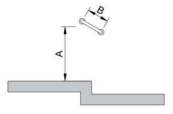
Ano: 2026
Banca:
Fundação La Salle
Órgão:
Prefeitura de Esteio - RS
Prova:
Fundação La Salle - 2026 - Prefeitura de Esteio - RS - Arquiteto |
Q4127886
Legislação dos Municípios do Estado do Rio Grande do Sul
A Lei Complementar Municipal nº 6.978/2018 que dispõe sobre o Código de Obras do Município de
Esteio, e dá outras providências, define que os diferentes serviços de construção e reforma se
enquadram em diferentes categorias: aqueles onde é necessária a aprovação do projeto; aqueles
isentos de projeto, mas que necessitam de licença para execução; aqueles isentos de qualquer
procedimento administrativo. Dentre as alternativas a seguir, selecione aquele serviço que se
enquadra na categoria II
Ano: 2026
Banca:
Fundação La Salle
Órgão:
Prefeitura de Esteio - RS
Prova:
Fundação La Salle - 2026 - Prefeitura de Esteio - RS - Arquiteto |
Q4127885
Direito Ambiental
A Resolução CONAMA nº 01/1986, estabelece diretrizes e métodos para elaboração de uma
Avaliação de Impacto Ambiental, analise as afirmativas a seguir sobre o Estudo de Impacto
Ambiental (EIA) e o Relatório de Impacto Ambiental (RIMA):
Ano: 2026
Banca:
Fundação La Salle
Órgão:
Prefeitura de Esteio - RS
Prova:
Fundação La Salle - 2026 - Prefeitura de Esteio - RS - Arquiteto |
Q4127884
Noções de Informática
No software de BIM Revit, a ferramenta utilizada para configuração das Unidades do projeto está
localizada na aba:
Ano: 2026
Banca:
Fundação La Salle
Órgão:
Prefeitura de Esteio - RS
Prova:
Fundação La Salle - 2026 - Prefeitura de Esteio - RS - Arquiteto |
Q4127883
Edificações
A respeito da utilização de chapas de gesso na construção civil considere as seguintes afirmações:
I. As chapas de gesso são classificadas em três categorias: ST, RU e RF.
II. No Brasil, montantes e guias de aço galvanizado para execução de drywall tem larguras padronizadas em 48mm, 70mm e 90mm.
III. Para execução de forros, as chapas de gesso devem ser sempre posicionadas paralelas à estrutura do gesso.
IV. Para aplicação de revestimentos cerâmicos colados às placas de gesso, devido à carga aplicada, devem ser utilizadas como suporte duas chapas de 12,5mm.
É correto o que se afirma em:
I. As chapas de gesso são classificadas em três categorias: ST, RU e RF.
II. No Brasil, montantes e guias de aço galvanizado para execução de drywall tem larguras padronizadas em 48mm, 70mm e 90mm.
III. Para execução de forros, as chapas de gesso devem ser sempre posicionadas paralelas à estrutura do gesso.
IV. Para aplicação de revestimentos cerâmicos colados às placas de gesso, devido à carga aplicada, devem ser utilizadas como suporte duas chapas de 12,5mm.
É correto o que se afirma em:
Ano: 2026
Banca:
Fundação La Salle
Órgão:
Prefeitura de Esteio - RS
Prova:
Fundação La Salle - 2026 - Prefeitura de Esteio - RS - Arquiteto |
Q4127882
Engenharia Civil
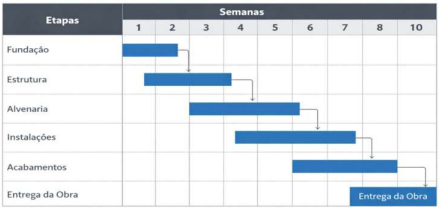
A figura abaixo apresenta as diferentes etapas de uma obra e a duração de cada uma. É conhecida
como:
Ano: 2026
Banca:
Fundação La Salle
Órgão:
Prefeitura de Esteio - RS
Prova:
Fundação La Salle - 2026 - Prefeitura de Esteio - RS - Arquiteto |
Q4127881
Arquitetura
O tipo e o posicionamento de difusores e grelhas de insuflamento de ar-condicionado devem
atender às disposições da NBR 16401-2. A escolha do sistema de distribuição do ar insuflado no
ambiente pode ser feita de três maneias distintas, conforme indicado abaixo. Relacione a primeira
com a segunda coluna corretamente:
Primeira Coluna
I - Por mistura
II - Totalmente estratificado
III - Parcialmente estratificado
Segunda Coluna
( ) Distribuição e insuflamento do ar pelo piso na vertical ascendente.
( ) Insuflamento do acima da zona de conforto, com fluxo do ar turbulento.
( ) Insuflamento em baixa velocidade formando uma camada de ar junto ao piso, que ao encontrar uma fonte de calor por diferença de densidade forma um fluxo de ar ascendente.
A ordem correta de preenchimento dos parênteses, de cima para baixo, é:
Primeira Coluna
I - Por mistura
II - Totalmente estratificado
III - Parcialmente estratificado
Segunda Coluna
( ) Distribuição e insuflamento do ar pelo piso na vertical ascendente.
( ) Insuflamento do acima da zona de conforto, com fluxo do ar turbulento.
( ) Insuflamento em baixa velocidade formando uma camada de ar junto ao piso, que ao encontrar uma fonte de calor por diferença de densidade forma um fluxo de ar ascendente.
A ordem correta de preenchimento dos parênteses, de cima para baixo, é:
Ano: 2026
Banca:
Fundação La Salle
Órgão:
Prefeitura de Esteio - RS
Prova:
Fundação La Salle - 2026 - Prefeitura de Esteio - RS - Arquiteto |
Q4127880
Arquitetura
Um projeto de acústica em uma edificação trabalha sob duas perspectivas: Isolamento acústico e
condicionamento acústico. O primeiro impede que sons externos entrem no ambiente e sons
internos saiam. O segundo melhora a qualidade sonora do espaço, controlando reverberação e
eco. Para o condicionamento acústico é importante a seleção de materiais e revestimentos levando
em conta seu Coeficiente de Absorção Acústica, (α) que indica a capacidade de um material
absorver energia sonora variando de 0 a 1, e é definido normalmente para as frequências de 125,
250, 500, 1000, 2000 e 4000 Hz. A respeito deste tema, levando em conta baixas e altas frequências,
analise as afirmativas a seguir:
I. Parede de gesso acartonado e cavidade preenchida com lã mineral 100 mm apresenta maior coeficiente de absorção para frequências baixas
II. Cortina plissada pendurada em frente a uma parede maciça apresenta maior coeficiente de absorção para frequências altas
III. Lã mineral de 50 mm (96 kg/ m3) por trás da chapa de aço perfurada em 25% de sua superfície apresenta maior coeficiente de absorção para frequências baixas
IV. No projeto de um teatro, assentos estofados apresenta maior coeficiente de absorção em frequências altas
É correto que se afirma em:
I. Parede de gesso acartonado e cavidade preenchida com lã mineral 100 mm apresenta maior coeficiente de absorção para frequências baixas
II. Cortina plissada pendurada em frente a uma parede maciça apresenta maior coeficiente de absorção para frequências altas
III. Lã mineral de 50 mm (96 kg/ m3) por trás da chapa de aço perfurada em 25% de sua superfície apresenta maior coeficiente de absorção para frequências baixas
IV. No projeto de um teatro, assentos estofados apresenta maior coeficiente de absorção em frequências altas
É correto que se afirma em:
Ano: 2026
Banca:
Nosso Rumo
Órgão:
Prefeitura de São João da Boa Vista - SP
Prova:
Nosso Rumo - 2026 - Prefeitura de São João da Boa Vista - SP - Contador |
Q4127679
Direito Tributário
Durante uma auditoria interna na Secretaria de Fazenda, o
contador municipal identifica que diversas Certidões de
Dívida Ativa (CDA) foram emitidas com erro na indicação
do fundamento legal (origem e natureza do crédito). O setor
jurídico da prefeitura questiona o departamento de
contabilidade sobre as implicações desses erros e a
possibilidade de correção antes que os processos de
execução fiscal avancem no Poder Judiciário. Com base
nas normas do Código Tributário Nacional (CTN), assinale
a alternativa que descreve corretamente o tratamento
jurídico e contábil a ser aplicado.
Ano: 2026
Banca:
Nosso Rumo
Órgão:
Prefeitura de São João da Boa Vista - SP
Prova:
Nosso Rumo - 2026 - Prefeitura de São João da Boa Vista - SP - Contador |
Q4127678
Direito Financeiro
O Prefeito de um Município, visando fomentar o
desenvolvimento tecnológico local, submete ao
Departamento de Contabilidade um projeto de lei que
concede isenção de Imposto Sobre Serviços (ISS), em
caráter não geral, para empresas de software que se
instalarem no município a partir do próximo ano. Como
contador municipal responsável pelo parecer técnico, você
deve avaliar a conformidade da proposta com a Lei de
Responsabilidade Fiscal (LRF), Lei Complementar nº
101/2000. Com base nas disposições do Art. 14 da LRF,
assinale a alternativa que apresenta o procedimento
correto para a validade dessa concessão.
Ano: 2026
Banca:
Nosso Rumo
Órgão:
Prefeitura de São João da Boa Vista - SP
Prova:
Nosso Rumo - 2026 - Prefeitura de São João da Boa Vista - SP - Contador |
Q4127677
Contabilidade Pública
Durante o processo de encerramento do exercício
financeiro de uma Prefeitura, a equipe de contabilidade
precisa consolidar as contas do ente e classificar os
elementos patrimoniais no Balanço Patrimonial. O contador
responsável depara-se com ativos de imobilizado
mensurados por critérios distintos e obrigações financeiras
cujo refinanciamento não depende de ato unilateral do
município. Com base nas normas estabelecidas no Manual
de Contabilidade Aplicada ao Setor Público (MCASP), 11ª
Edição, e na Norma Brasileira de Contabilidade (NBC-TSP
34/2021), assinale a alternativa correta quanto aos
procedimentos de análise e registro desses fatos.
Ano: 2026
Banca:
Nosso Rumo
Órgão:
Prefeitura de São João da Boa Vista - SP
Prova:
Nosso Rumo - 2026 - Prefeitura de São João da Boa Vista - SP - Contador |
Q4127676
Auditoria
Um contador de uma Secretaria de Fazenda Estadual está
finalizando a documentação de auditoria relativa ao ciclo de
pagamentos de fornecedores. Ao revisar os papéis de
trabalho, o controlador geral observa que as planilhas
contêm um volume excessivo de dados desconexos e
rasuras que dificultam a leitura dos montantes liquidados.
Além disso, a ordem das folhas de teste não segue o fluxo
da despesa pública (empenho, liquidação e pagamento),
tornando o propósito do exame confuso para o revisor. Com
base nos requisitos de elaboração dos papéis de trabalho,
assinale a alternativa correta.
Ano: 2026
Banca:
Nosso Rumo
Órgão:
Prefeitura de São João da Boa Vista - SP
Prova:
Nosso Rumo - 2026 - Prefeitura de São João da Boa Vista - SP - Contador |
Q4127675
Contabilidade de Custos
A Secretaria Municipal de Saúde pretende implementar um
sistema de gerenciamento de custos para avaliar a
eficiência das Unidades de Pronto Atendimento (UPAs). O
contador responsável pela modelagem precisa classificar
os diversos gastos e definir os critérios de atribuição para
que a informação gerada seja útil à governança e à
avaliação de desempenho, permitindo inclusive a
comparação entre diferentes unidades. Com base nas
disposições da Norma Brasileira de Contabilidade (NBCTSP 34/2021), assinale a alternativa que descreve o
procedimento correto a ser adotado pelo contador.
Ano: 2026
Banca:
Nosso Rumo
Órgão:
Prefeitura de São João da Boa Vista - SP
Prova:
Nosso Rumo - 2026 - Prefeitura de São João da Boa Vista - SP - Contador |
Q4127674
Auditoria
No planejamento da extensão dos testes ou na definição do
critério de escolha dos elementos para análise, o auditor
pode recorrer à amostragem. A técnica estatística utiliza
métodos científicos para que as inferências obtidas da
amostra sejam projetadas para a totalidade do universo sob
a ótica da probabilidade matemática. A aplicação desse tipo
de amostragem é recomendada quando:
Ano: 2026
Banca:
Nosso Rumo
Órgão:
Prefeitura de São João da Boa Vista - SP
Prova:
Nosso Rumo - 2026 - Prefeitura de São João da Boa Vista - SP - Contador |
Q4127673
Direito Financeiro
O Município “Alfa”, visando fomentar a instalação de novas
empresas em seu território e reduzir a carga tributária dos
cidadãos, decidiu, por ato administrativo, não realizar a
cobrança do Imposto sobre a Propriedade Predial e
Territorial Urbana (IPTU) no presente exercício, além de
não ter instituído a Taxa de Coleta de Lixo, embora ambas
as competências estejam previstas na Constituição Federal
para o ente municipal. O Prefeito, diante de uma crise
financeira, solicita ao Governo Federal a celebração de um
convênio para o recebimento de uma transferência
voluntária destinada a obras de saneamento. Com base
nas disposições do Art. 11 da Lei Complementar nº
101/2000 (LRF), assinale a alternativa que descreve a
situação da municipalidade.
Ano: 2026
Banca:
Nosso Rumo
Órgão:
Prefeitura de São João da Boa Vista - SP
Prova:
Nosso Rumo - 2026 - Prefeitura de São João da Boa Vista - SP - Contador |
Q4127672
Contabilidade Pública
O Balanço Orçamentário é composto por:
I. Quadro Principal.
II. Quadro da Execução dos Restos a Pagar Não Processados.
III. Quadro da Execução dos Restos a Pagar Processados.
É correto o que se afirma em:
I. Quadro Principal.
II. Quadro da Execução dos Restos a Pagar Não Processados.
III. Quadro da Execução dos Restos a Pagar Processados.
É correto o que se afirma em:
Ano: 2026
Banca:
Nosso Rumo
Órgão:
Prefeitura de São João da Boa Vista - SP
Prova:
Nosso Rumo - 2026 - Prefeitura de São João da Boa Vista - SP - Contador |
Q4127671
Contabilidade Pública
Pedro, contador de uma autarquia municipal, está
finalizando a elaboração da Demonstração dos Fluxos de
Caixa (DFC) referente ao exercício de 2025. Durante o
processo, ele identifica as seguintes operações realizadas
pela entidade:
1. Recebimento de dividendos decorrentes de participações societárias.
2. Amortização do principal de um empréstimo bancário contraído anteriormente.
3. Aquisição de um veículo para o imobilizado, realizada mediante a assunção direta do passivo com o fornecedor (financiamento direto), sem desembolso inicial.
4. Ganho não realizado decorrente de variação cambial positiva sobre o saldo de uma conta bancária em moeda estrangeira.
Com base nas normas do Manual de Contabilidade Aplicada ao Setor Público (MCASP), 11ª Edição, assinale a alternativa que descreve o tratamento correto a ser dado por Pedro na elaboração da referida demonstração.
1. Recebimento de dividendos decorrentes de participações societárias.
2. Amortização do principal de um empréstimo bancário contraído anteriormente.
3. Aquisição de um veículo para o imobilizado, realizada mediante a assunção direta do passivo com o fornecedor (financiamento direto), sem desembolso inicial.
4. Ganho não realizado decorrente de variação cambial positiva sobre o saldo de uma conta bancária em moeda estrangeira.
Com base nas normas do Manual de Contabilidade Aplicada ao Setor Público (MCASP), 11ª Edição, assinale a alternativa que descreve o tratamento correto a ser dado por Pedro na elaboração da referida demonstração.
Ano: 2026
Banca:
Nosso Rumo
Órgão:
Prefeitura de São João da Boa Vista - SP
Prova:
Nosso Rumo - 2026 - Prefeitura de São João da Boa Vista - SP - Contador |
Q4127670
Administração Financeira e Orçamentária
Ao realizar o encerramento do terceiro trimestre, um
contador municipal identifica que a dotação destinada ao
pagamento de pessoal de uma determinada secretaria é
insuficiente para honrar os compromissos de dezembro. Ao
mesmo tempo, a administração decide iniciar um projeto de
pavimentação para o qual não existe nenhuma previsão ou
dotação na Lei Orçamentária Anual (LOA) vigente. Com
base nas normas de Contabilidade Aplicada ao Setor
Público sobre Créditos Adicionais, assinale a alternativa
correta.
 Conheça nossos planos