Selecionar segmento
Estude com questões de diferentes segmentos
Atenção: Isso limpará todos os campos já preenchidos no filtro!
Foram encontradas 301.066 questões
Resolva questões gratuitamente!
Junte-se a mais de 4 milhões de concurseiros!


Ano: 2026
Banca:
FAFIPA
Órgão:
Câmara de Jaguariaíva - PR
Prova:
FAFIPA - 2026 - Câmara de Jaguariaíva - PR - Advogado |
Q4348581
Português
Texto associado
O texto seguinte servirá de base para responder à questão.
Cheiro de Amor (Maria Bethânia)
De repente fico rindo à toa, sem saber por que
E vem a vontade de sonhar de novo te encontrar
Foi tudo tão de repente
Eu não consigo esquecer
E confesso, tive medo
Quase disse: Não
-
Mas o seu jeito de me olhar
A fala mansa, meio rouca
Foi me deixando quase louca
Já não podia mais pensar
Eu me dei toda para você
-
De repente fico rindo à toa, sem saber por que
E vem a vontade de sonhar de novo te encontrar
Foi tudo tão de repente
Eu não consigo esquecer
E confesso, tive medo
Quase disse: Não
-
E meio louca de prazer
Lembro teu corpo no espelho
E vem o cheiro de amor
Eu te sinto tão presente
Volte logo, meu amor
Leia os versos:
"Foi me deixando quase louca
Já não podia mais pensar
Eu me dei toda para você"
Considerando o sentido das expressões destacadas no contexto da letra, assinale a alternativa CORRETA.
"Foi me deixando quase louca
Já não podia mais pensar
Eu me dei toda para você"
Considerando o sentido das expressões destacadas no contexto da letra, assinale a alternativa CORRETA.
Ano: 2026
Banca:
FAFIPA
Órgão:
Câmara de Jaguariaíva - PR
Prova:
FAFIPA - 2026 - Câmara de Jaguariaíva - PR - Advogado |
Q4348580
Português
Texto associado
O texto seguinte servirá de base para responder à questão.
Cheiro de Amor (Maria Bethânia)
De repente fico rindo à toa, sem saber por que
E vem a vontade de sonhar de novo te encontrar
Foi tudo tão de repente
Eu não consigo esquecer
E confesso, tive medo
Quase disse: Não
-
Mas o seu jeito de me olhar
A fala mansa, meio rouca
Foi me deixando quase louca
Já não podia mais pensar
Eu me dei toda para você
-
De repente fico rindo à toa, sem saber por que
E vem a vontade de sonhar de novo te encontrar
Foi tudo tão de repente
Eu não consigo esquecer
E confesso, tive medo
Quase disse: Não
-
E meio louca de prazer
Lembro teu corpo no espelho
E vem o cheiro de amor
Eu te sinto tão presente
Volte logo, meu amor
No trecho:
"Foi tudo tão de repente"
"Eu não consigo esquecer"
"Eu te sinto tão presente"
As palavras destacadas pertencem à classe gramatical dos verbos porque:
"Foi tudo tão de repente"
"Eu não consigo esquecer"
"Eu te sinto tão presente"
As palavras destacadas pertencem à classe gramatical dos verbos porque:
Ano: 2026
Banca:
FAFIPA
Órgão:
Câmara de Jaguariaíva - PR
Prova:
FAFIPA - 2026 - Câmara de Jaguariaíva - PR - Advogado |
Q4348579
Português
Texto associado
O texto seguinte servirá de base para responder à questão.
Cheiro de Amor (Maria Bethânia)
De repente fico rindo à toa, sem saber por que
E vem a vontade de sonhar de novo te encontrar
Foi tudo tão de repente
Eu não consigo esquecer
E confesso, tive medo
Quase disse: Não
-
Mas o seu jeito de me olhar
A fala mansa, meio rouca
Foi me deixando quase louca
Já não podia mais pensar
Eu me dei toda para você
-
De repente fico rindo à toa, sem saber por que
E vem a vontade de sonhar de novo te encontrar
Foi tudo tão de repente
Eu não consigo esquecer
E confesso, tive medo
Quase disse: Não
-
E meio louca de prazer
Lembro teu corpo no espelho
E vem o cheiro de amor
Eu te sinto tão presente
Volte logo, meu amor
No trecho: "De repente fico rindo à toa, sem saber por que", a forma "por que", empregada
separadamente e sem acento, está CORRETAMENTE utilizada pois:
Ano: 2026
Banca:
FAFIPA
Órgão:
Câmara de Jaguariaíva - PR
Prova:
FAFIPA - 2026 - Câmara de Jaguariaíva - PR - Advogado |
Q4348578
Português
Texto associado
O texto seguinte servirá de base para responder à questão.
Cheiro de Amor (Maria Bethânia)
De repente fico rindo à toa, sem saber por que
E vem a vontade de sonhar de novo te encontrar
Foi tudo tão de repente
Eu não consigo esquecer
E confesso, tive medo
Quase disse: Não
-
Mas o seu jeito de me olhar
A fala mansa, meio rouca
Foi me deixando quase louca
Já não podia mais pensar
Eu me dei toda para você
-
De repente fico rindo à toa, sem saber por que
E vem a vontade de sonhar de novo te encontrar
Foi tudo tão de repente
Eu não consigo esquecer
E confesso, tive medo
Quase disse: Não
-
E meio louca de prazer
Lembro teu corpo no espelho
E vem o cheiro de amor
Eu te sinto tão presente
Volte logo, meu amor
A partir da letra de "Cheiro de Amor", é CORRETO afirmar que o eu lírico:
Ano: 2026
Banca:
AMAUC
Órgão:
Prefeitura de Piratuba - SC
Prova:
AMAUC - 2026 - Prefeitura de Piratuba - SC - Professor Ensino Infantil e Ensino Fundamental - Artes |
Q4348571
Literatura
O Modernismo brasileiro estabeleceu relações
complexas com transformações artísticas internacionais
e, simultaneamente, com debates acerca da constituição
de repertórios culturais brasileiros.
Analise as asserções a seguir.
I.A primeira geração modernista brasileira estruturou sua proposta estética pela rejeição das experiências das vanguardas europeias, consideradas incompatíveis com a construção de uma linguagem artística nacional.
PORQUE
II.Artistas modernistas brasileiros dialogaram com experiências internacionais ao mesmo tempo em que reelaboraram temas, formas e referências ligados à sociedade e à cultura brasileiras.
A respeito dessas asserções, assinale a alternativa correta.
Q4348470
Inglês
According to Tomitch (2009), effective reading instruction
should be organized into three stages: pre-reading,
while-reading, and post-reading. Which alternative
best reflects the pedagogical purpose of each stage?
Q4348468
Inglês
Within the paradigm of English as a Lingua Franca
(ELF), Jennifer Jenkins (2000) argues that successful
communication relies on mutual intelligibility rather
than conformity to native-speaker norms. Based on this
perspective, which pedagogical practice is the most
appropriate for teaching listening and speaking?
Q4348467
Inglês
Skehan (1998) argues that not every classroom activity
can be considered a task. According to his definition,
which of the following best describes a task in TaskBased Language Teaching (TBLT)?
Q4348464
Linguística
Recognizing the structure and vocabulary of a text is
not sufficient for true comprehension. To fully understand
a text, it must display both cohesion and coherence.
These two properties work together to ensure that the
writer's purpose, line of reasoning, and linguistic
expressions are effectively unified to make meaning.
Based on the concepts of textual cohesion and coherence, choose the correct statement.
Based on the concepts of textual cohesion and coherence, choose the correct statement.
Q4348463
Inglês
According to Leffa and Irala (2014), the historical
evolution of additional language teaching can be
understood through three major shifts in how language
is conceptualized. Over time, pedagogical practices
have shifted their primary focus, transitioning from
abstract formal structures to communicative purposes,
and ultimately to the socio-political role of discourse in
society.
Associate the three language teaching emphases listed in the first column with their corresponding descriptions or classroom examples in the second column.
(1) Emphasis on the system
(2) Emphasis on the function
(3) Emphasis on ideology
( ) Language is viewed as a list of lexical units and syntactic rules used to form sentences, focusing primarily on translation and decontextualized grammatical structures.
( ) Language is understood as a way of acting upon the world to achieve specific goals, with pedagogical practices focusing on communicative actions and competencies.
( ) Language is seen as an instrument of social action that constitutes the subject, serving either to reproduce inequality or to promote social change and critical reflection.
( ) Classroom activities engage students in memorizing vocabulary lists, conjugating verbs in isolation, and completing fill-in-the-blank exercises.
( ) Classroom activities focus on specific communicative objectives such as introducing oneself, asking for help, or refusing an invitation.
Choose the alternative that presents the correct sequence from top to bottom.
Q4348456
Inglês
Texto associado
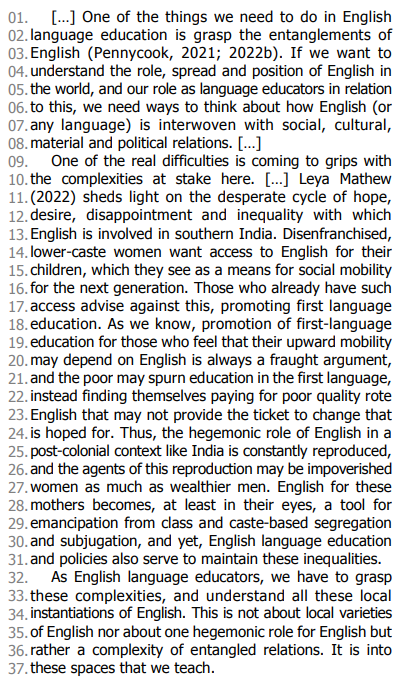
Instruction: Question refer to the
texts below.
(Adapted from: PENNYCOOK, A.; SILVESTRE, V. P. V.; PESSOA, R.
R. Reflections on Critical Applied Linguistics and Decoloniality:
a follow-up conversation with Alastair Pennycook. Calidoscópio, São
Leopoldo, v. 20, n. 2, p. 568–569, 2022. DOI:
10.4013/cld.2022.202.12.)
“These spaces” (l. 37) in “It is into these spaces that
we teach” (l. 36-37) refers to
Q4348455
Inglês
Texto associado
Instruction: Question refer to the
texts below.
(Adapted from: PENNYCOOK, A.; SILVESTRE, V. P. V.; PESSOA, R.
R. Reflections on Critical Applied Linguistics and Decoloniality:
a follow-up conversation with Alastair Pennycook. Calidoscópio, São
Leopoldo, v. 20, n. 2, p. 568–569, 2022. DOI:
10.4013/cld.2022.202.12.)
Pennycook’s description of the entanglements of English
is best explained by which of the following concepts?
Q4348454
Inglês
Texto associado
Instruction: Question refer to the
texts below.
(Adapted from: PENNYCOOK, A.; SILVESTRE, V. P. V.; PESSOA, R.
R. Reflections on Critical Applied Linguistics and Decoloniality:
a follow-up conversation with Alastair Pennycook. Calidoscópio, São
Leopoldo, v. 20, n. 2, p. 568–569, 2022. DOI:
10.4013/cld.2022.202.12.)
In the southern Indian context mentioned by Pennycook,
English is
Q4348453
Inglês
Texto associado
Instruction: Question refer to the
texts below.
(Adapted from: PENNYCOOK, A.; SILVESTRE, V. P. V.; PESSOA, R.
R. Reflections on Critical Applied Linguistics and Decoloniality:
a follow-up conversation with Alastair Pennycook. Calidoscópio, São
Leopoldo, v. 20, n. 2, p. 568–569, 2022. DOI:
10.4013/cld.2022.202.12.)
Pennycook’s main argument is that
Q4348451
Inglês
Read the following statements about Michael Byram’s
(1997) Intercultural Communicative Competence (ICC)
model.
I - Savoirs (knowledge) is primarily defined as deep declarative knowledge regarding the core cultural values and historical traditions specific to the target-language country, disregarding social groups and processes.
II - Savoir comprendre (skills of interpreting and relating) requires a learner to interpret a document or event from another culture, explain it, and relate it to documents or events from their own culture, without relying on real-time interaction with a target-culture interlocutor.
III - Savoir s’engager (critical cultural awareness) posits that language teachers should remain politically neutral and guide students to evaluate cultural practices using purely subjective, personal moral codes.
IV - The primary distinction between savoir comprendre and savoir apprendre/faire is that the former operates on existing knowledge and documents, whereas the latter involves acquiring new cultural knowledge and operating it in real-time constraints of social interaction.
V - According to Byram, a speaker who possesses high linguistic competence (fluency, native-like accent, advanced syntax) automatically fulfills the prerequisites for Intercultural Communicative Competence (ICC).
Which statements are correct?
Q4348449
Inglês
Texto associado
Question refer to the text below.
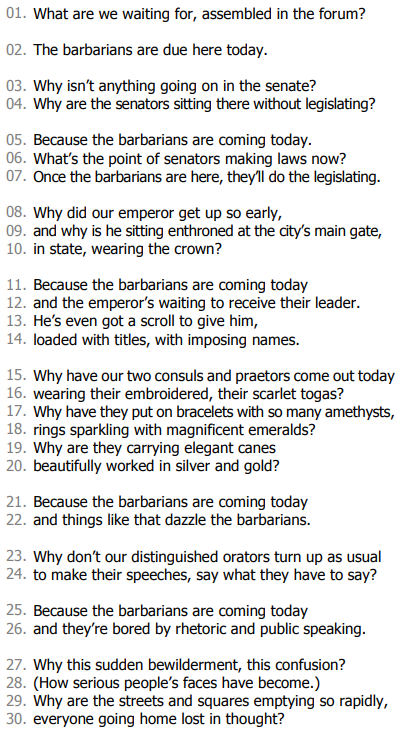
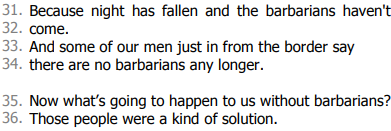
Instruction: Question refer to the texts below.
“Identities can be held together by narratives, in short, without essences: you don’t get to be called ‘English’ because there’s an essence this label follows; you’re English because our rules determine that you are entitled to the label—that you are connected in the right way with a place called England. […] The story of the golden nugget suggests that we can’t help caring about the traditions of ‘the West’ because they are ours: in fact, the opposite is true. They are ours only if we care about them. A culture of liberty, tolerance, and rational inquiry: that would be a good idea. But these values represent choices to make, not tracks laid down by a Western destiny.”
(Adapted from: APPIAH, Kwame Anthony. The lies that bind: rethinking identity. New York: Liveright Publishing Corporation, 2018. p. 151-159)
Which statement is NOT consistent with Appiah’s interpretation of Cavafy’s poem “Waiting for the Barbarians” mentioned above?
Q4348448
Inglês
Texto associado
Question refer to the text
below.
“Waiting for the Barbarians” by C.P. Cavafy
In English grammar, the words ending in “-ing” have
different uses. Match these functions to a corresponding
example in bold from the poem.
(1) Continuous verbs
(2) Gerunds acting as nouns
(3) Adjectives
( ) “Why are the senators sitting there without legislating?” (l. 4)
( ) “Once the barbarians are here, they’ll do the legislating” (l. 7)
( ) “Why have they put on bracelets with so many amethysts, rings sparkling with magnificent emeralds?” (l. 17-18)
( ) “Now what’s going to happen to us without barbarians?” (l. 35)
( ) “loaded with titles, with imposing names.” (l. 14)
( ) “and they’re bored by rhetoric and public speaking” (l. 26)
Select the alternative with the correct sequence from top to bottom.
Q4348447
Inglês
Texto associado
Question refer to the text
below.
“Waiting for the Barbarians” by C.P. Cavafy
What CANNOT be implied from the poem?
Q4348446
Inglês
Complete the following sentence: In Translation and
Language Teaching, Malmkjær (1998) discusses how
translation in education has undergone a paradigm
shift, according to which translation
Q4348445
Inglês
The following are reading strategies:
a. ___________ creates anticipation and gets students thinking about previous experiences they may have had about the topic before they read about it. b. It is important that readers be able to get the main idea of a text, and ___________ can help as the reader restates the meaning in his or her own words. c. The main idea of a paragraph is sometimes stated in the ___________ of a paragraph. d. ___________ are words and phrases that join parts of a text together just like the bands in a watch strap. e. ___________ is to look rapidly for specific information. f. ___________ — for gist or overview.
(Adapted from: FARRELL, T. S. C. Teaching reading to English language learners: a reflective guide. Thousand Oaks: Corwin Press, 2009)
Identify the correct sequence of the missing words in the text from top to bottom.

 Conheça nossos planos