Foram encontradas 316.049 questões

Resolva questões gratuitamente!

Junte-se a mais de 4 milhões de concurseiros!

Q4023345 Português
Sobre o texto, analise as assertivas abaixo:
I. Pode ser caracterizado como um texto de divulgação científica, pois explica conceitos da Botânica a um público não especializado.
II. A autora constrói seu texto utilizando linguagem denotativa e figurada para explicar os processos de respiração vegetal.
III. Utiliza fatos e opiniões para apresentar características consideradas interessantes sobre as cerejeiras e outras espécies de árvores.
Quais estão corretas?
Alternativas
Q4023343 Português
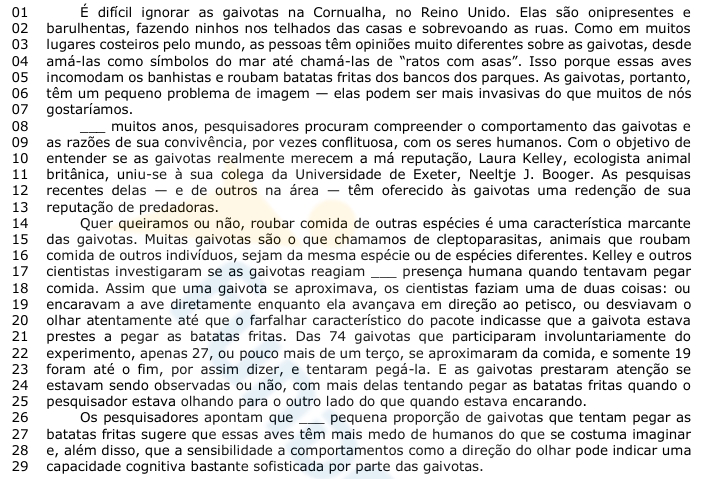
Com base na regência verbal e nas regras de uso do acento indicativo de crase, assinale a alternativa que preenche, correta e respectivamente, as lacunas tracejadas nas linhas 03, 16 e 25 do texto.
Alternativas
Q4023341 Redação Oficial
Considerando-se os atributos que regem as comunicações oficiais, analisar o trecho.

Assunto: apresentação das novas funcionalidades do sistema XYZ.
Senhor Chefe de Gabinete,
A Subchefia para Assuntos Jurídicos da Casa Civil ABC aprimorou o Sistema XYZ com a inserção de novas funcionalidades. Os novos recursos do sistema serão apresentados aos servidores em módulos organizados por essa Subchefia. Convido os servidores do Ministério EFGH para assistir à apresentação do primeiro módulo, a ser realizada em 05 de maio de 2026, às 9h30, no Auditório dessa Subchefia.

A redação dessa comunicação oficial foi feita de acordo com os atributos, principalmente, porque é:
Alternativas
Q4023312 Português
De acordo com os usos dos “porquês”, relacionar as colunas e assinalar a sequência correspondente.

(1) Porque
(2) Por que
(3) Porquê
(4) Por quê

( ) ________ queria viajar, você fez isso, não foi?
( ) Sabia que eu nunca dei ouvidos àquele _______?
( ) Juro que não sei _________ estudei tanto!
( ) Sem seu esclarecimento, nunca entenderei ________.
Alternativas
Q4023311 Português
Assinalar a alternativa em que todas as palavras foram acentuadas CORRETAMENTE.
Alternativas
Q4023310 Português
O asterisco (*) marca o emprego de uma vírgula. Nesse caso, assinalar a alternativa na qual há ERRO. 
Alternativas
Q4023309 Português
“A vida é curta demais para se preocupar com coisas insignificantes ou com pessoas que não te acrescentam.” (desconhecido). Sobre a estruturação fonético-fonológica desse pensamento, avaliar se as afirmativas são certas (C) ou erradas (E) e assinalar a sequência correspondente.

( ) Em “insignificantes”, temos a presença sonora de cinco fonemas /i/.
( ) As palavras “demais” e “coisas” são dissilábicas.
( ) Em “pessoas” e “preocupar”, temos o mesmo processo fonológico.
( ) Em “acrescentam” e “com”, o fonema /m/ representa um mesmo fone.
Alternativas
Q4023308 Português
Assinalar a alternativa em que a palavra sublinhada poderia ser trocada adequadamente, considerando-se o contexto, pelo vocábulo entre parênteses. 
Alternativas
Q4023307 Português
Observando-se o emprego adequado de certas palavras e expressões no contexto, assinalar a alternativa CORRETA.
Alternativas
Q4023306 Português
Considerando as regras de colocação pronominal, assinalar a alternativa em que o pronome oblíquo átono está CORRETAMENTE empregado em posição de ênclise.
Alternativas
Q4023305 Português
A proximidade da morte

    Se a morte é uma sombra constante para qualquer ser vivente desde o nascimento, sua presença torna-se mais marcante com o envelhecimento. São as pessoas mais idosas, portanto, que percebem com mais nitidez a proximidade da morte.
    Há pessoas que se mantêm ativas com a idade avançada e outras que precisam de cuidados especiais conforme envelhecem, em razão de doenças e problemas de mobilidade. A necessidade desses idosos entra em conflito com a situação real de grande parte das famílias. O ritmo acelerado imposto pelo sistema de produção e serviços desde as últimas décadas do século XX obriga trabalhadores a jornadas intensas fora de casa, o que dificulta o atendimento a idosos e doentes. Além disso, vale mencionar a elevação da expectativa de vida e o consequente aumento da parcela da população idosa com 60 anos ou mais. Segundo dados do Censo, esse grupo representava 15,6% da população brasileira em 2022.
    Deve-se comentar que, vítimas de um etarismo que os reduz à improdutividade, há idosos que vão viver em asilos ou em hospitais (quando apresentam doenças graves) onde possam usufruir dos avanços da medicina, cada vez mais especializada. Porém, mesmo aqueles que recorrem a técnicas avançadas e a ambientes assépticos que prolongam a vida não escapam à solidão e à impessoalidade do atendimento. Enfermeiros e médicos são eficazes, mas os pacientes idosos frequentemente se encontram afastados da mão amiga e da atenção íntima sem pressa. 
    No entanto, sabe-se que a maioria dos idosos faz parte da população de baixa renda e, por isso, não tem acesso a muitos desses recursos. Acrescente-se o fato de que nas últimas décadas o número de idosos com necessidades especiais cresceu sem o correspondente crescimento de atendimento público.
    Essa situação não seria uma expressão da morte em vida? Não seria uma espécie de morte simbólica antecedendo a morte fisiológica? Seria o aniquilamento da dignidade humana? O etarismo e a morte social, que colocam o indivíduo à margem e o tornam sem serventia, invisível para a sociedade, podem ser tão nocivos quanto uma doença letal. Além de causarem o desenvolvimento de um mal-estar físico e mental, podem levar à fragilidade e à morte do corpo.

Fonte: Moderna Plus Filosofia. Adaptado.
“Porém, mesmo aqueles que recorrem a técnicas avançadas e a ambientes assépticos que prolongam a vida não escapam à solidão e à impessoalidade do atendimento.” (3º parágrafo). Nesse segmento do texto, há: 
Alternativas
Q4023304 Português
A proximidade da morte

    Se a morte é uma sombra constante para qualquer ser vivente desde o nascimento, sua presença torna-se mais marcante com o envelhecimento. São as pessoas mais idosas, portanto, que percebem com mais nitidez a proximidade da morte.
    Há pessoas que se mantêm ativas com a idade avançada e outras que precisam de cuidados especiais conforme envelhecem, em razão de doenças e problemas de mobilidade. A necessidade desses idosos entra em conflito com a situação real de grande parte das famílias. O ritmo acelerado imposto pelo sistema de produção e serviços desde as últimas décadas do século XX obriga trabalhadores a jornadas intensas fora de casa, o que dificulta o atendimento a idosos e doentes. Além disso, vale mencionar a elevação da expectativa de vida e o consequente aumento da parcela da população idosa com 60 anos ou mais. Segundo dados do Censo, esse grupo representava 15,6% da população brasileira em 2022.
    Deve-se comentar que, vítimas de um etarismo que os reduz à improdutividade, há idosos que vão viver em asilos ou em hospitais (quando apresentam doenças graves) onde possam usufruir dos avanços da medicina, cada vez mais especializada. Porém, mesmo aqueles que recorrem a técnicas avançadas e a ambientes assépticos que prolongam a vida não escapam à solidão e à impessoalidade do atendimento. Enfermeiros e médicos são eficazes, mas os pacientes idosos frequentemente se encontram afastados da mão amiga e da atenção íntima sem pressa. 
    No entanto, sabe-se que a maioria dos idosos faz parte da população de baixa renda e, por isso, não tem acesso a muitos desses recursos. Acrescente-se o fato de que nas últimas décadas o número de idosos com necessidades especiais cresceu sem o correspondente crescimento de atendimento público.
    Essa situação não seria uma expressão da morte em vida? Não seria uma espécie de morte simbólica antecedendo a morte fisiológica? Seria o aniquilamento da dignidade humana? O etarismo e a morte social, que colocam o indivíduo à margem e o tornam sem serventia, invisível para a sociedade, podem ser tão nocivos quanto uma doença letal. Além de causarem o desenvolvimento de um mal-estar físico e mental, podem levar à fragilidade e à morte do corpo.

Fonte: Moderna Plus Filosofia. Adaptado.
A coesão textual pode ser obtida por meio da articulação harmônica entre as partes do texto, utilizando recursos gramaticais e lexicais que garantem a fluidez e a conexão lógica. Nesse sentido, assinalar a alternativa na qual o referente do termo sublinhado foi CORRETAMENTE indicado entre parênteses. 
Alternativas
Q4023303 Português
A proximidade da morte

    Se a morte é uma sombra constante para qualquer ser vivente desde o nascimento, sua presença torna-se mais marcante com o envelhecimento. São as pessoas mais idosas, portanto, que percebem com mais nitidez a proximidade da morte.
    Há pessoas que se mantêm ativas com a idade avançada e outras que precisam de cuidados especiais conforme envelhecem, em razão de doenças e problemas de mobilidade. A necessidade desses idosos entra em conflito com a situação real de grande parte das famílias. O ritmo acelerado imposto pelo sistema de produção e serviços desde as últimas décadas do século XX obriga trabalhadores a jornadas intensas fora de casa, o que dificulta o atendimento a idosos e doentes. Além disso, vale mencionar a elevação da expectativa de vida e o consequente aumento da parcela da população idosa com 60 anos ou mais. Segundo dados do Censo, esse grupo representava 15,6% da população brasileira em 2022.
    Deve-se comentar que, vítimas de um etarismo que os reduz à improdutividade, há idosos que vão viver em asilos ou em hospitais (quando apresentam doenças graves) onde possam usufruir dos avanços da medicina, cada vez mais especializada. Porém, mesmo aqueles que recorrem a técnicas avançadas e a ambientes assépticos que prolongam a vida não escapam à solidão e à impessoalidade do atendimento. Enfermeiros e médicos são eficazes, mas os pacientes idosos frequentemente se encontram afastados da mão amiga e da atenção íntima sem pressa. 
    No entanto, sabe-se que a maioria dos idosos faz parte da população de baixa renda e, por isso, não tem acesso a muitos desses recursos. Acrescente-se o fato de que nas últimas décadas o número de idosos com necessidades especiais cresceu sem o correspondente crescimento de atendimento público.
    Essa situação não seria uma expressão da morte em vida? Não seria uma espécie de morte simbólica antecedendo a morte fisiológica? Seria o aniquilamento da dignidade humana? O etarismo e a morte social, que colocam o indivíduo à margem e o tornam sem serventia, invisível para a sociedade, podem ser tão nocivos quanto uma doença letal. Além de causarem o desenvolvimento de um mal-estar físico e mental, podem levar à fragilidade e à morte do corpo.

Fonte: Moderna Plus Filosofia. Adaptado.
O texto apresenta exemplos de práticas etaristas, principalmente, quando os idosos:  
Alternativas
Q4023160 Inglês
    The security risks faced by Parliaments, legislatures, elected representatives, and the officials who support them, differ greatly according to their evolving national and local circumstances, among other things. For some, the biggest security risks may stem from disruptive protesters and cyber criminals, but terrorism may pose the most concerning risks for others. In fact, threat actors differ enormously in their intentions and capabilities, which also change over time.
    Given that risk is a product of threat, vulnerability, and impact, it follows that ultimately there are only three ways to reduce security risk — namely, by reducing the threat, reducing the vulnerability, or reducing the impact (or some combination thereof). Reducing the threat element of security risk is difficult, especially in the case of determined and capable threat actors. Responsibility for reducing threats tends to lie mainly with national law enforcement, security, and intelligence agencies. That said, parliaments and other organisations can contribute to threat reduction through deterrence — in other words, by influencing the intentions of threat actors. Carefully crafted security-minded communications can convey a discouraging message to potential attackers, to the effect that they should expect to confront professional security measures and face a substantial risk of being caught. For instance, a parliamentary website might advertise that visitors will undergo ‘airport-style screening’, without explaining precisely what that entails. The public should be reassured by such message, whereas some threat actors might be deterred.

Paul Martin. Parliamentary security: an introductory guide.
Internet: <www.cpahq.org> (adapted).


Considering the preceding text, judge the following item. 
As mentioned at the end of the text, the message about the airport-style screening advertised in a parliamentary website could have a dual effect on people, even if they are not told its exact implications.
Alternativas
Q4023159 Inglês
    The security risks faced by Parliaments, legislatures, elected representatives, and the officials who support them, differ greatly according to their evolving national and local circumstances, among other things. For some, the biggest security risks may stem from disruptive protesters and cyber criminals, but terrorism may pose the most concerning risks for others. In fact, threat actors differ enormously in their intentions and capabilities, which also change over time.
    Given that risk is a product of threat, vulnerability, and impact, it follows that ultimately there are only three ways to reduce security risk — namely, by reducing the threat, reducing the vulnerability, or reducing the impact (or some combination thereof). Reducing the threat element of security risk is difficult, especially in the case of determined and capable threat actors. Responsibility for reducing threats tends to lie mainly with national law enforcement, security, and intelligence agencies. That said, parliaments and other organisations can contribute to threat reduction through deterrence — in other words, by influencing the intentions of threat actors. Carefully crafted security-minded communications can convey a discouraging message to potential attackers, to the effect that they should expect to confront professional security measures and face a substantial risk of being caught. For instance, a parliamentary website might advertise that visitors will undergo ‘airport-style screening’, without explaining precisely what that entails. The public should be reassured by such message, whereas some threat actors might be deterred.

Paul Martin. Parliamentary security: an introductory guide.
Internet: <www.cpahq.org> (adapted).


Considering the preceding text, judge the following item. 
According to the text, with “Carefully crafted securityminded communications”, potential attackers are discouraged and caught before being able to cause any harm.
Alternativas
Q4023158 Inglês
    The security risks faced by Parliaments, legislatures, elected representatives, and the officials who support them, differ greatly according to their evolving national and local circumstances, among other things. For some, the biggest security risks may stem from disruptive protesters and cyber criminals, but terrorism may pose the most concerning risks for others. In fact, threat actors differ enormously in their intentions and capabilities, which also change over time.
    Given that risk is a product of threat, vulnerability, and impact, it follows that ultimately there are only three ways to reduce security risk — namely, by reducing the threat, reducing the vulnerability, or reducing the impact (or some combination thereof). Reducing the threat element of security risk is difficult, especially in the case of determined and capable threat actors. Responsibility for reducing threats tends to lie mainly with national law enforcement, security, and intelligence agencies. That said, parliaments and other organisations can contribute to threat reduction through deterrence — in other words, by influencing the intentions of threat actors. Carefully crafted security-minded communications can convey a discouraging message to potential attackers, to the effect that they should expect to confront professional security measures and face a substantial risk of being caught. For instance, a parliamentary website might advertise that visitors will undergo ‘airport-style screening’, without explaining precisely what that entails. The public should be reassured by such message, whereas some threat actors might be deterred.

Paul Martin. Parliamentary security: an introductory guide.
Internet: <www.cpahq.org> (adapted).


Considering the preceding text, judge the following item. 
n the second paragraph, both “Given that”, in “Given that risk is a product of threat”, and “to the effect that”, in “can convey a discouraging message to potential attackers, to the effect that they should expect to confront professional security measures” can be respectively replaced with Because and because without this changing the original meaning of the text.
Alternativas
Q4023157 Inglês
    The security risks faced by Parliaments, legislatures, elected representatives, and the officials who support them, differ greatly according to their evolving national and local circumstances, among other things. For some, the biggest security risks may stem from disruptive protesters and cyber criminals, but terrorism may pose the most concerning risks for others. In fact, threat actors differ enormously in their intentions and capabilities, which also change over time.
    Given that risk is a product of threat, vulnerability, and impact, it follows that ultimately there are only three ways to reduce security risk — namely, by reducing the threat, reducing the vulnerability, or reducing the impact (or some combination thereof). Reducing the threat element of security risk is difficult, especially in the case of determined and capable threat actors. Responsibility for reducing threats tends to lie mainly with national law enforcement, security, and intelligence agencies. That said, parliaments and other organisations can contribute to threat reduction through deterrence — in other words, by influencing the intentions of threat actors. Carefully crafted security-minded communications can convey a discouraging message to potential attackers, to the effect that they should expect to confront professional security measures and face a substantial risk of being caught. For instance, a parliamentary website might advertise that visitors will undergo ‘airport-style screening’, without explaining precisely what that entails. The public should be reassured by such message, whereas some threat actors might be deterred.

Paul Martin. Parliamentary security: an introductory guide.
Internet: <www.cpahq.org> (adapted).


Considering the preceding text, judge the following item. 
Based on the text, it is correct to conclude that the possibility of threat reduction being successful varies according to the level of determination and to the ability of those posing threats. 
Alternativas
Q4023156 Inglês
    The security risks faced by Parliaments, legislatures, elected representatives, and the officials who support them, differ greatly according to their evolving national and local circumstances, among other things. For some, the biggest security risks may stem from disruptive protesters and cyber criminals, but terrorism may pose the most concerning risks for others. In fact, threat actors differ enormously in their intentions and capabilities, which also change over time.
    Given that risk is a product of threat, vulnerability, and impact, it follows that ultimately there are only three ways to reduce security risk — namely, by reducing the threat, reducing the vulnerability, or reducing the impact (or some combination thereof). Reducing the threat element of security risk is difficult, especially in the case of determined and capable threat actors. Responsibility for reducing threats tends to lie mainly with national law enforcement, security, and intelligence agencies. That said, parliaments and other organisations can contribute to threat reduction through deterrence — in other words, by influencing the intentions of threat actors. Carefully crafted security-minded communications can convey a discouraging message to potential attackers, to the effect that they should expect to confront professional security measures and face a substantial risk of being caught. For instance, a parliamentary website might advertise that visitors will undergo ‘airport-style screening’, without explaining precisely what that entails. The public should be reassured by such message, whereas some threat actors might be deterred.

Paul Martin. Parliamentary security: an introductory guide.
Internet: <www.cpahq.org> (adapted).


Considering the preceding text, judge the following item. 
The passage “some combination thereof”, in “reducing the threat, reducing the vulnerability, or reducing the impact (or some combination thereof)” (second paragraph), necessarily indicates a combination of the two last factors mentioned: vulnerability reduction and impact reduction.
Alternativas
Q4023155 Inglês
    The security risks faced by Parliaments, legislatures, elected representatives, and the officials who support them, differ greatly according to their evolving national and local circumstances, among other things. For some, the biggest security risks may stem from disruptive protesters and cyber criminals, but terrorism may pose the most concerning risks for others. In fact, threat actors differ enormously in their intentions and capabilities, which also change over time.
    Given that risk is a product of threat, vulnerability, and impact, it follows that ultimately there are only three ways to reduce security risk — namely, by reducing the threat, reducing the vulnerability, or reducing the impact (or some combination thereof). Reducing the threat element of security risk is difficult, especially in the case of determined and capable threat actors. Responsibility for reducing threats tends to lie mainly with national law enforcement, security, and intelligence agencies. That said, parliaments and other organisations can contribute to threat reduction through deterrence — in other words, by influencing the intentions of threat actors. Carefully crafted security-minded communications can convey a discouraging message to potential attackers, to the effect that they should expect to confront professional security measures and face a substantial risk of being caught. For instance, a parliamentary website might advertise that visitors will undergo ‘airport-style screening’, without explaining precisely what that entails. The public should be reassured by such message, whereas some threat actors might be deterred.

Paul Martin. Parliamentary security: an introductory guide.
Internet: <www.cpahq.org> (adapted).


Considering the preceding text, judge the following item. 
In the excerpt “threat actors differ enormously in their intentions and capabilities, which also change over time” (first paragraph), “which” refers to “threat actors”. 
Alternativas
Q4023154 Inglês
    The role of the police in a healthy democracy is radically different from their role in authoritarian societies. In autocratic regimes, the police serve mainly to protect not the people, but the regime. The police are therefore typically politicized, with appointments being part of the patronage system that rewards regime loyalists. Police officers spend a great deal of time spying on the populace to unmask political opposition; crime against citizens is less of a concern. Abuse and corruption are usually rife, because police are not held accountable for their actions. Rather, political leaders tolerate abuses by the police in return for police loyalty to the regime.
    By contrast, in democratic societies the primary mission of the police is to protect citizens against crime and disorder, including illegal or corrupt behavior by officials. In democracies, police have carefully circumscribed roles that require close and positive relations with ordinary citizens. The use of arms and pursuit of criminals are rare and take up only a tiny fraction of police time. Instead, police officers spend the vast bulk of their time building relationships with the community through patrols, community-enhancing activities, and listening to citizens. The goal of democratic policing is to build a web of relationships between the community and the police that helps to control crime by making police aware of the persons and activities in the communities that they are assigned to protect and by inclining citizens to trust and cooperate with police. This also achieves the primary goal of making citizens feel secure in their daily activities, thereby fostering a climate that encourages increased legitimate business activity, investment, and planning for the future.

Michael D. Wiatrowski and Jack A. Goldstone. The ballot and the badge: democratic policing. In: Journal
of Democracy, Volume 21, Number 2. Internet: <muse.jhu.edu>  (adapted).


Concerning the previous text, judge the following items.
In the fragment “police have carefully circumscribed roles that require close and positive relations with ordinary citizens” (second paragraph), “ordinary citizens” are people who represent the average citizen in a democratic society.
Alternativas
Respostas
9281: E
9282: A
9283: B
9284: D
9285: B
9286: B
9287: C
9288: C
9289: A
9290: A
9291: D
9292: C
9293: B
9294: C
9295: E
9296: E
9297: C
9298: E
9299: E
9300: C